Build vs Buy: Adding Shariah-Compliant Investing Without Building Screening In-House
Every team offering halal investing hits the same fork: build the Shariah screening engine, or buy it. Here is what building actually requires, the costs that never make the first estimate, and why most fintechs buy an AAOIFI-based API.
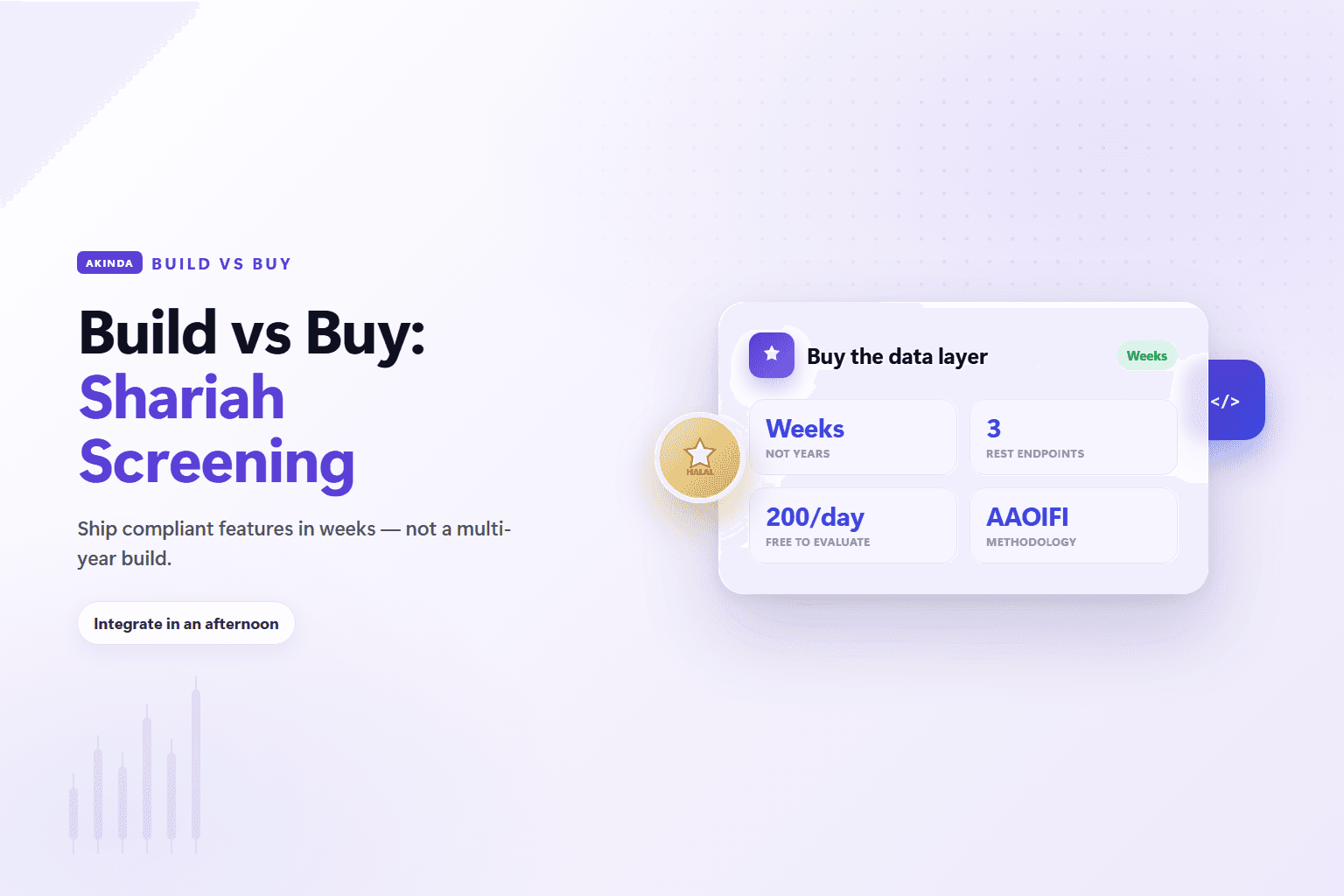
Quick answer: for almost all teams, buy
Every team that decides to offer halal investing hits the same fork: build the Shariah screening engine yourself, or buy it as a service. It looks like a classic engineering trade-off, but Shariah screening has a twist most build-vs-buy calls don't—it leans on scarce religious-scholarship expertise, not just code and data. This guide walks through what building actually requires, the costs that never make the first estimate, the narrow cases where building wins, and why most fintechs and banks land on buying an AAOIFI-based halal stock API.
By the numbers (2026)
- Market pull: Islamic finance assets are roughly $5.1 trillion in 2026, projected to reach about $8.46 trillion by 2031 (~10.7% CAGR, Mordor Intelligence), with Islamic fintech near $250 billion (Grand View Research) serving an estimated 2 billion Muslims.
- Scholar scarcity: the people who can govern a methodology—pairing Islamic jurisprudence with financial expertise—are genuinely hard to recruit and retain, which is exactly what makes screening different from an ordinary data build.
- Time to market: buying is measured in weeks; building the same capability runs months to years.
What building in-house actually requires
On a whiteboard, screening looks trivial: check the business, check a couple of financial ratios, done. As a reliable, production-grade capability it means assembling four things, each non-trivial:
- Licensed financial data. Current fundamentals—debt, cash, interest income, revenue segments—for every security across every market you cover, refreshed as companies report.
- A screening engine. Software that correctly encodes the business-activity screen and the AAOIFI financial ratios, with the right thresholds and denominator logic, applied consistently at scale.
- A purification model. Logic to compute the impermissible slice of income that holders must cleanse.
- Scholar governance. Qualified scholars to design the methodology, rule on edge cases (mergers, partial-period reporting, borderline sectors), and stand behind the verdicts.
That last requirement is what separates Shariah screening from a typical data build. You can hire engineers for the first three; the fourth needs people who combine Islamic jurisprudence with financial expertise, and they are genuinely scarce. Our companion piece, how to build a halal stock screener, walks the full build path if you want the detail.
The hidden costs of building
The initial build estimate almost always understates the true cost, because the hardest parts are ongoing and human, not one-off and technical.
- Scarce, expensive governance. The talent that can design and defend a methodology is hard to recruit and retain—and without it, your verdicts have nothing credible standing behind them.
- Perpetual maintenance. Compliance isn't static. A company's ratios shift every earnings season, so verdicts must be re-computed continuously. A build is a commitment to ongoing operations, not a project that ends.
- Coverage expansion. Every new market means new data sources and new edge cases. Coverage that looks complete at launch erodes as your product grows.
- Compliance liability. If your engine returns a wrong verdict, that's your reputation and your users' trust on the line, with no external, published methodology to point to.
- Opportunity cost. Every month your engineers spend rebuilding Islamic-finance plumbing is a month not spent on the product experience that actually differentiates you.
What buying an API gets you
Buying inverts every one of those costs. An AAOIFI-based API like the Akinda Halal API hands you the whole stack as a maintained service:
- The data and engine, maintained. Screening runs against current financials—you don't source data or write rules.
- Governance you inherit, not recruit. The methodology is built around AAOIFI Shari'ah Standard No. 21 and published, so your own compliance team and Shariah board can audit the rules rather than reverse-engineer a black box.
- Reports out of the box. The full-report endpoint returns the three AAOIFI ratios plus AI-extracted SEC figures with their dollar counterparts, alongside the verdict.
- Purification as a dedicated tool. Cleansing amounts come from the
akinda_calculate_purificationtool on the Akinda MCP server—not a REST field you have to model yourself. - Speed. You wire up a few endpoints and ship in weeks, on usage-based pricing that starts free.
Here is the whole integration surface. Authenticate with your key as an apikey query parameter or an X-API-Key header—there is no OAuth dance and no Authorization: Bearer token to manage:
cURL
# Free Basic tier: the compliance verdict
curl "https://b2b-api.akinda.io/api/v1/compliance/AAPL?apikey=YOUR_API_KEY"

# Same call, key in a header instead of the query string
curl -H "X-API-Key: YOUR_API_KEY" \
  https://b2b-api.akinda.io/api/v1/compliance/AAPL
The ticker is a path segment, not a ?symbol= query string, and the verdict comes back in the halal_status field:
JSON
{
  "company_name": "Apple Inc.",
  "halal_status": "HALAL",
  "ticker": "AAPL"
}
Current verdict: Halal
/full-report/{TICKER} the same ticker returns halal_rating 10, debt_ratio_perc 2.99, liquidity_ratio_perc 1.66, and non_compliant_revenue_perc 0—each with its AI-extracted dollar counterpart from the filings.halal_status is always one of HALAL, NOT HALAL, or DOUBTFUL (with ERROR_DATA or INCOMPLETE_DATA when a filing is missing)—so your UI can badge every state instead of guessing.
Endpoints map to tiers, so you buy only what your product needs:
- Basic (free):
/compliance/{TICKER}, 200 calls/day—the pass/fail verdict. - Personal Standard: adds
/basic-report/{TICKER}with the three AAOIFI ratios. - Personal Ultimate: adds
/full-report/{TICKER}with AI-extracted SEC figures and their dollar counterparts. - Business Standard / Ultimate / Enterprise: sit above the personal tiers with every endpoint at scale; the Akinda ranking pillars (
ranking_score,profitability_score, and the rest) are Business Ultimate and Enterprise only.
Coverage spans US tickers broadly, with UK (.L) and Canada (.TO) listings on the higher tiers—so you inherit market expansion instead of building it one exchange at a time.
When building might make sense
Buying isn't automatically right in every case. Building in-house can be justified in a few narrow situations:
- Screening is your core product. If you're building a Shariah-screening platform itself—not an investing app that needs compliance—the engine is your differentiator and owning it makes sense.
- You already have the scholarship. If you employ qualified Shariah scholars with financial expertise and an established governance process, the scarcest ingredient is already in-house.
- You have a genuinely proprietary methodology. If your value rests on a distinct, defensible screening approach that no provider offers, building lets you protect it.
A common middle path is hybrid: buy an API for the bulk of your screening and build only the narrow, proprietary logic that genuinely differentiates you. Outside these cases, though, the operational argument for buying is hard to beat—most teams don't need to own Islamic-finance infrastructure to ship a great halal product. Platforms and institutions weighing this at scale can see the full picture in our guide to Shariah screening for robo-advisors and brokerages.
Build vs buy, side by side
The trade-off across the dimensions that usually decide it:
| Dimension | Build in-house | Buy an API |
|---|---|---|
| Time to launch | Months to years | Weeks |
| Upfront cost | High (data, engineering, scholars) | Low (free Basic tier to start) |
| Scholar governance | Must recruit scarce talent | Included and published |
| Maintenance | Ongoing, every quarter | Handled by the provider |
| Coverage | Build market by market | US broadly; UK & Canada on higher tiers |
| Compliance risk | You own it alone | Shared, transparent methodology |
| Best when | Screening is your core product | Compliance supports your product |
How to buy: the Akinda API
If buying is the right call, getting started takes minutes, not a procurement cycle. The Akinda Halal API is designed for self-serve evaluation:
- Generate an API key from the dashboard and start on the free Basic tier.
- Call
/compliance/{TICKER}with a real ticker and confirm the verdicts fit your product. - Review the AAOIFI Shari'ah Standard No. 21 methodology with your Shariah board so everyone is comfortable with the rules.
- Wire
/basic-report/{TICKER}and/full-report/{TICKER}into your app on a paid plan, add badges and gates, and schedule quarterly re-screening. - Add purification via the
akinda_calculate_purificationMCP tool if your users need cleansing amounts. - Check the pricing page and move to a business plan when you go to production.
Frequently asked questions
Should I build or buy Shariah screening?
For almost all teams, buy. Building means licensing data, engineering a screening engine, computing purification, and recruiting scarce scholars to govern the methodology, then maintaining it every quarter. Buying an API delivers the same capability through a few endpoints, with governance included, at a fraction of the time and cost. Build only if screening itself is your core product and you already have the scholarship in-house.
Why is the scholar requirement such a big deal?
Because it's the ingredient you can't simply hire engineers to replace. Credible Shariah screening needs people who combine Islamic jurisprudence with financial expertise, and that talent is scarce. Buying an API lets you inherit governance built around AAOIFI Shari'ah Standard No. 21 rather than compete for it.
Is building ever the right choice?
Yes, in narrow cases: when Shariah screening is your core product, when you already employ qualified scholars with an established governance process, or when you have a genuinely proprietary methodology worth protecting. Many teams also go hybrid—buying the bulk of screening and building only the narrow logic that differentiates them.
What are the hidden costs of building in-house?
Mainly the ongoing, human ones: recruiting and retaining scarce scholars, re-computing verdicts as financials change every quarter, expanding coverage market by market, carrying compliance liability alone, and the opportunity cost of engineers not working on your actual product. These usually dwarf the initial build estimate.
How fast can I go live if I buy?
Weeks. Because the data, engine, and scholar governance already exist, you integrate the endpoints, design the UX around halal_status, and set up re-screening. You can start evaluating the same day by generating a key and calling /compliance/{TICKER} on the free Basic tier (200 calls/day).
Sources: AAOIFI Shari'ah Standard No. 21 (Financial Paper — Shares and Bonds), the standard Akinda's screening is built around; the published Akinda screening methodology; and Mordor Intelligence, Global Islamic Finance Market (2026). This article is about a software product and is for general information only—not financial or religious advice. Automated screening produces data-driven signals, not a fatwa; pair it with your own Shariah governance.
Verify it yourself via the Akinda API
Fire a live /full-report/<ticker> call from the playground using your own API key — see the compliance ratios, AAOIFI screen verdict, and source-breakdown fields the methodology produces.
Related reading