How to add Shariah compliance to your investing app (2026)
Halal investing is one of the fastest-growing segments in finance. Here's where Shariah compliance fits in an investing app, and how to add it with the Akinda API instead of building the screening engine yourself.
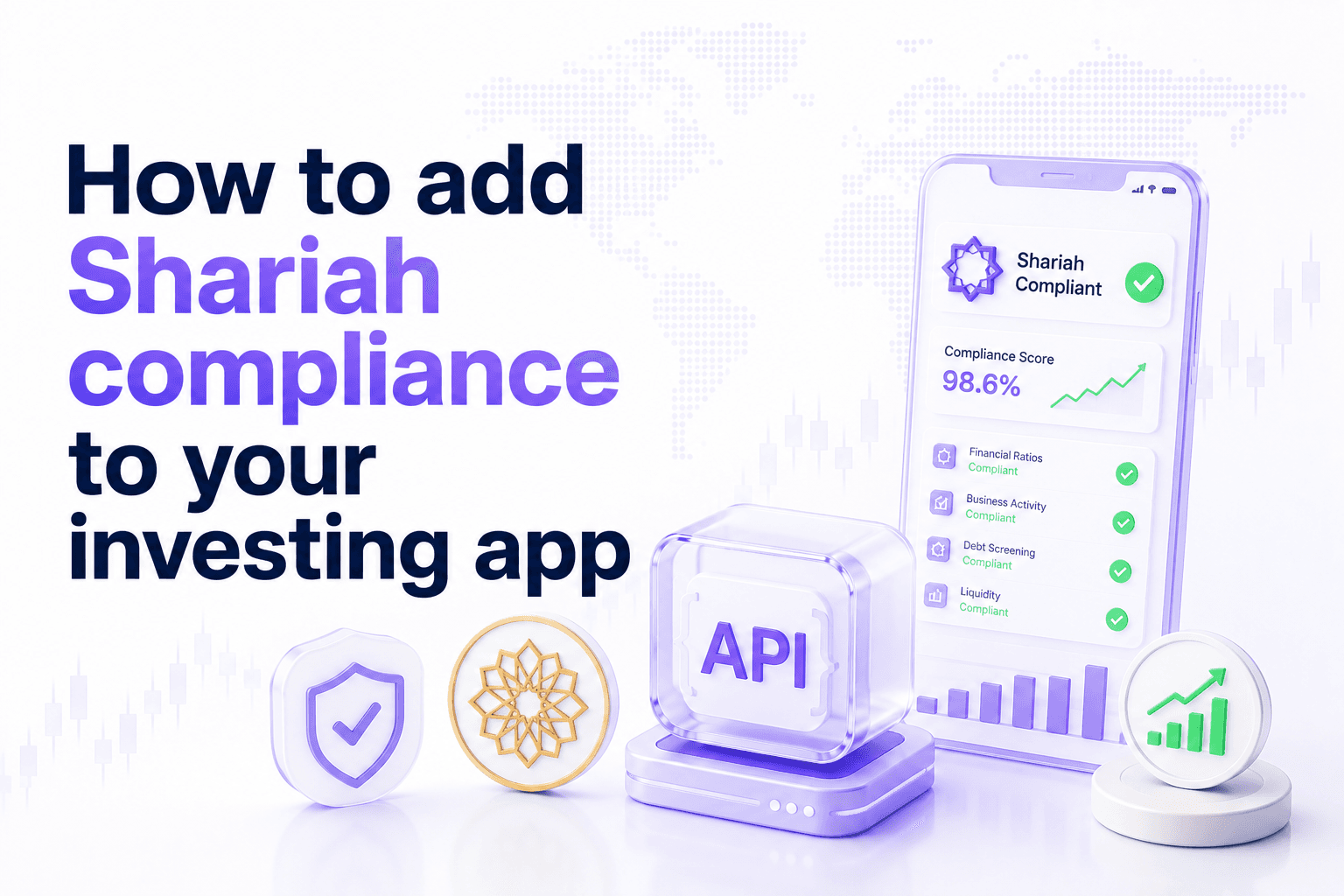
The market for halal investing is growing fast, and any investing app that serves Muslim users — or wants to — eventually hits the same question: how do you tell users whether a stock is Shariah-compliant, reliably and at scale? You can build the screening engine, the financial-data pipeline, and the scholar workflow yourself, or you can add a compliance layer through an API in an afternoon. This guide covers the size of the opportunity, where Shariah compliance fits in an investing app, and how to add it with the Akinda API without reinventing Islamic finance.
Quick answer
halal_status field as HALAL, NOT HALAL, or DOUBTFUL.How big is the opportunity?
Shariah compliance isn't a niche checkbox — it's access to one of the fastest-growing segments in finance. The numbers below are the widely-cited industry projections that frame the market:
- Global Islamic finance assets: roughly $5.1 trillion in 2026, projected to reach about $8.46 trillion by 2031 (a compound annual growth rate near 10.7%), according to Mordor Intelligence.
- Islamic fintech: around $250 billion in 2026, heading toward $619 billion by 2033 at roughly 13.8% a year, per Grand View Research.
- Addressable population: about 2 billion Muslims today, projected to reach 2.8 billion by 2050.
- Not just a Muslim market: a Morningstar survey found 61% of sustainable-fund investors in Europe and North America view Islamic funds as ESG-aligned.
For much of this audience, Shariah compliance isn't a premium feature — it's a baseline expectation before they will open an account. And the demand reaches beyond Muslim users: because Shariah screening overlaps heavily with ethical and ESG exclusions, values-driven investors are a meaningful part of the same audience. Adding a compliance layer can widen your reach on two fronts at once, faith-based and values-based.
Why add Shariah compliance?
For a large, underserved population of Muslim investors, Shariah compliance is the deciding factor in whether they can use your product at all. Adding it opens the fast-growing segment above, improves retention among values-driven users, and aligns naturally with the ethical and ESG screens many non-Muslim users already look for. There is also a cross-sell dividend: once users trust that a product respects their values, they tend to adopt adjacent offerings — savings, sukuk, takaful — at higher rates than conventional users convert across products. In markets across the Gulf, South and Southeast Asia, and the CIS region, compliance is simply table stakes for a financial product.
Build vs buy
Building Shariah screening in-house is deceptively hard. You would need licensed financial data, a screening engine encoding the business and financial rules, a purification model, and — critically — a qualified scholar to sign off on the methodology and edge cases. That last requirement is the real bottleneck: the Islamic International Rating Agency estimates there are fewer than 1,200 qualified Shariah board members worldwide serving over 2,000 institutions, and professionals with dual expertise in Islamic jurisprudence and financial engineering are rare and expensive to hire.
Maintaining all of that as company financials shift each quarter is an ongoing cost, not a one-off build. An API turns the whole stack into a few endpoints, and for most teams, buying a maintained, scholar-governed data layer is far cheaper and safer than owning it — it lets your engineers focus on the product rather than on Islamic-finance infrastructure. For a side-by-side of the options, see our halal stock screening API comparison.
Where compliance fits in your app
Screening is a building block you can surface in several places, depending on your product. The most common integrations, roughly in order of effort:
- A halal badge on every ticker and company page, so users see compliance status at a glance — one call to the
/complianceendpoint per symbol. This is the lowest-effort, highest-visibility integration. - A pre-trade compliance gate that checks a stock before an order executes and warns or blocks non-compliant buys. This is where screening becomes a real guardrail rather than just information.
- Portfolio monitoring that re-screens holdings each quarter and alerts users when a position drifts out of compliance after an earnings season changes a company's ratios.
- Purification tooling that tells users how much of their dividend income to cleanse — Akinda computes this via the
akinda_calculate_purificationtool on its MCP server, turning compliance into an actionable number. - Onboarding filters that let users opt into a halal-only universe from the start, so every screen they see is already compliant.
How to add it with the Akinda API
Integration follows the same path as any REST API. The base URL is https://b2b-api.akinda.io/api/v1, and the ticker is a path parameter. There are three endpoints:
GET /compliance/<ticker>— a fast Shariah verdict. Available on the free Basic tier.GET /basic-report/<ticker>— the verdict plus the three core AAOIFI ratios (debt_ratio_perc,liquidity_ratio_perc,non_compliant_revenue_perc). Personal Standard and up.GET /full-report/<ticker>— the full screen with AI-extracted figures and their dollar counterparts. Personal Ultimate and up; the Akinda ranking is a Business Ultimate / Enterprise add-on.
Authentication is an Akinda API key, sent either as a query parameter — ?apikey=YOUR_KEY — or as an X-API-Key: YOUR_KEY header. There is no bearer-token or OAuth flow for the REST API.
The verdict lives in a halal_status field, whose values are HALAL, NOT HALAL, or DOUBTFUL, plus a “no data” state (ERROR_DATA / INCOMPLETE_DATA) when a company hasn't reported enough to screen. A real call to GET /api/v1/compliance/AAPL returns Apple's company_name, ticker, and a halal_status of HALAL:
Current verdict: Halal
AAPL) returns halal_status: HALAL from the compliance endpoint. Want the ratios behind it? Our full write-up is in is Apple halal?The rest is a standard integration path:
- Generate an API key from the dashboard and start on the free Basic tier to prototype. The free tier calls the
/complianceendpoint only, at a low daily cap — enough to evaluate and wire up, not to run production traffic. The reports are paid: basic-report is Personal Standard and up, full-report is Personal Ultimate and up. - Call the endpoint with a ticker and parse the JSON verdict.
- Surface the result in your UI as a badge, a gate decision, or a full report view.
- Schedule quarterly re-screening so verdicts stay current, and cache results between runs to control request volume.
- Move to a paid plan before you ship. Coverage is US tickers on every tier; UK (London Stock Exchange) and Canadian (Toronto) listings are available on Business Enterprise. Review the pricing page to pick a tier.
Want the code? Our 10-minute build tutorial walks from sign-up to a rendered halal card in JavaScript and Python.
Screen inside an AI assistant (MCP)
Because the same data is exposed as an MCP (Model Context Protocol) server, you can also let an AI assistant screen tickers mid-conversation. Connect Akinda to Claude with Sign in with Google at the connector URL https://b2b-api.akinda.io/mcp — there is no API-key or header step for the MCP connection. Once connected, Claude gains five tools: akinda_check_compliance, akinda_basic_report, akinda_full_report, akinda_screen_portfolio, and akinda_calculate_purification. Each call is one metered request on your plan, gated by the same tiers as the REST API, and MCP requires a paid plan (the free Basic tier is blocked). Full walkthrough in Connect Akinda to Claude and the MCP Server docs.
Getting the governance right
Automated screening is powerful, but it isn't a fatwa — and your users deserve to know that. The lack of standardised Shariah interpretation across jurisdictions is a real industry challenge, which is exactly why transparency matters. Choose an API whose screening methodology is published in full, so your own compliance team and Shariah board can audit the rules, and whose verdicts are overseen by a qualified scholar.
The Akinda methodology is a documented three-phase screen — business activity, two financial ratios (debt and liquidity, each capped at 30% of average 12-quarter market capitalization), and a 5% non-compliant-revenue limit — reviewed by Dr. Muhammad Nazir Khan, who holds a PhD in Islamic Economics and Finance and an AAOIFI Shari'ah Auditing Certification. You can audit every rule on the methodology page. If you're still choosing a standard, our AAOIFI vs IFSB vs S&P Shariah comparison lays out the options.
In practice, good governance means three things: present verdicts as data-driven screening rather than religious rulings; keep a qualified scholar in the loop for edge cases like mergers or partial-period reporting; and make clear to users that final religious authority rests with scholars, not the algorithm. Done well, this builds exactly the trust that drives the retention and cross-sell economics described above.
Frequently asked questions
How big is the halal investing market?
Large and growing quickly. Global Islamic finance assets are around $5.1 trillion in 2026 and projected to reach roughly $8.46 trillion by 2031, while the Islamic fintech segment is expanding at nearly 14% a year toward $619 billion by 2033. With about 2 billion Muslims worldwide and rising demand from ethically-minded non-Muslim investors, the addressable market for compliant products is substantial.
Should I build or buy Shariah screening?
For almost all teams, buy. Building in-house means licensing financial data, encoding and maintaining the screening rules, modelling purification, and retaining a scholar to govern it — then keeping all of that current every quarter. With fewer than 1,200 qualified Shariah board members globally, the talent alone is a serious constraint. An API delivers the same capability through a few endpoints at a fraction of the cost and risk.
Do non-Muslims use Shariah-compliant products?
Increasingly, yes. Because Shariah screening overlaps heavily with ethical and ESG exclusions, values-driven non-Muslim investors are a meaningful part of the audience. Surveys show a majority of sustainable-fund investors in Europe and North America already view Islamic funds as ESG-aligned.
How do I keep compliance verdicts up to date?
Re-screen on a schedule — quarterly is sensible — since a company's debt, cash, and revenue mix can move it in or out of compliance after each earnings season. With an API, you re-call the endpoint for each holding and update your cached verdicts, then alert users whose positions have changed status.
Does adding screening make my app a religious authority?
No, and you shouldn't present it that way. Screening provides automated, data-driven signals, not religious rulings. Best practice is to show the verdict and the reasoning, pair it with a qualified scholar for edge cases, and tell users that final religious authority rests with scholars, not the algorithm.
Informational, not a fatwa
Related reading