What makes a stock Shariah-compliant?
The activity screen, the three financial ratios and the real AAOIFI thresholds behind them - plus why five published standards reach three different verdicts on one company.
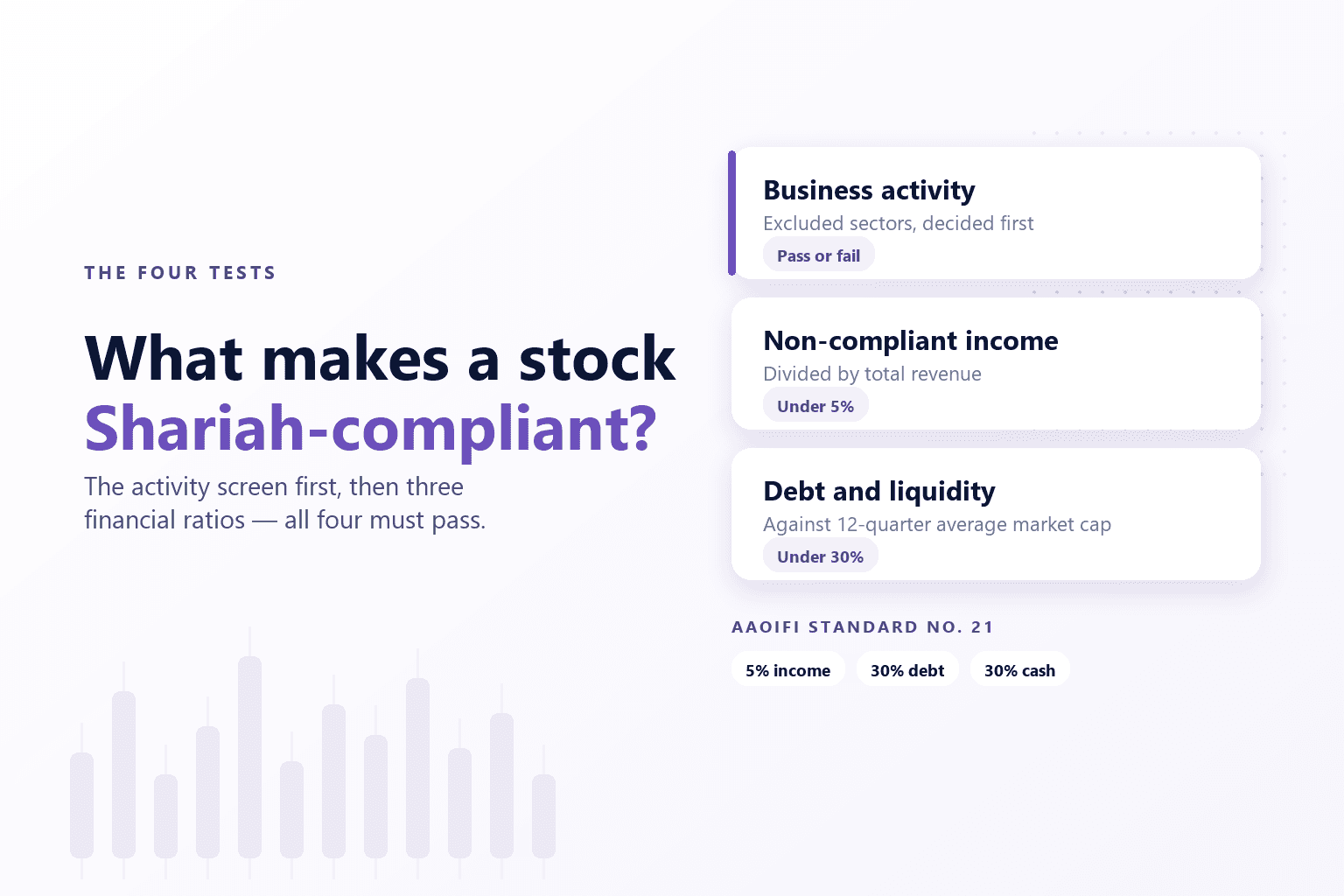
A stock is Shariah-compliant when the company's underlying business is permissible under Islamic law and its accounts clear a set of published financial ratios. Under AAOIFI Shari'ah Standard No. 21, the rulebook Akinda's own verdicts follow, income from prohibited activities must stay below 5% of total revenue, interest-bearing debt must stay below 30% of the company's 12-quarter average market capitalisation, and cash plus short-term investments must stay below that same 30% line. Fail any one of those four tests and the stock is not compliant, however comfortably it passes the other three.
The order matters. The activity screen runs first and is decisive on its own: a conventional bank with an immaculate balance sheet still fails it, because what the company does is the thing being screened. Only companies that clear the activity test ever reach the ratios.
What business activities disqualify a stock?
A company is excluded outright when its revenue comes from a sector the standard treats as impermissible. The base list is conventional banks and regional banks, mortgage lenders, asset managers, stock and securities exchanges, derivatives dealers and clearing houses, insurance and life insurance, healthcare plans, tobacco, alcohol (brewers, distillers, vintners), gambling and casinos, and pork / non-halal meat. Preferred shares and fixed-income instruments are excluded by instrument, whatever the company does.
Two details decide most real cases. The first is that preferred shares and fixed-income instruments are excluded by instrument, whatever the issuing company does — the screen is on what you are buying, not only on who issued it. The second is that a company with a small impermissible line of business is not excluded here at all. An airline that serves alcohol, a hotel group with bars, a retailer with a credit arm: all three clear the activity screen and are settled by the income ratio instead.
What are the AAOIFI financial thresholds?
There are three, and each is a fraction with a specific denominator. Non-compliant income is measured against total revenue and fails above 5%. Debt is measured against a 12-quarter average market capitalisation and fails at 30% or more. Cash plus short-term investments is measured against that same average market cap and fails at 30% or more.
The denominator is where most published disagreement lives, so it is worth stating rather than leaving implied. AAOIFI does not write an averaging window into the standard itself, so Akinda uses a 12-quarter average market cap and prints that beside every ratio. The Dow Jones Islamic rulebook divides by a 24-month average market cap. S&P uses a window the same length as AAOIFI's — twelve quarters is thirty-six months — but not the same base: it divides by average market value of equity. FTSE and MSCI use no market measure at all and divide by total assets. That is four denominators across five rulebooks, so one set of accounts produces four different ratios, and not one of them is an arithmetic error.
There is also a middle state, which is why some verdicts read neither pass nor fail. Prohibited income above 5% of total revenue returns not halal. Where the prohibited share stays inside the limit but total impure income crosses 5% once revenue from doubtful activities is counted at half weight, the result is doubtful instead. That category follows AAOIFI; the four index rulebooks have no doubtful state and return pass or fail.
The four AAOIFI tests, in full
| Test | Rule under AAOIFI Standard 21 | Field returned |
|---|---|---|
| Business activity | No revenue from the excluded sectors; preferred shares and fixed income excluded by instrument | halal_status |
| Non-compliant income | Prohibited income ÷ total revenue — fails above 5% | non_compliant_revenue_perc |
| Debt | (Short-term + long-term debt) ÷ 12-quarter average market cap — fails at 30% or more | debt_ratio_perc |
| Cash and short-term investments | (Cash + short-term investments) ÷ 12-quarter average market cap — fails at 30% or more | liquidity_ratio_perc |
The row most comparison tables get wrong
Why do five standards disagree about the same company?
Because they are five different rulebooks, not five readings of one. AAOIFI, Dow Jones Islamic Market, FTSE, MSCI and S&P each publish their own thresholds, their own denominators and their own averaging windows, so two providers can apply two of them faithfully and print opposite verdicts on the same company.
Lockheed Martin is the clearest case we publish, because the five do not merely differ on it — they split three ways. It comes out doubtful under AAOIFI, halal under the Dow Jones Islamic and S&P rulebooks, and not halal under FTSE and MSCI. Every one of those is a correct application of its own rules, on the same accounts, filed by the same company.
The consequence for anyone building a product is concrete: a single verdict with no standard named beside it cannot be defended against a competitor's different single verdict. The five can be combined — “permissible under at least one standard” is a legitimate view, and so is “permissible under AAOIFI” — but the rule has to be named, because those two questions have different answers. The longer version of this is in why two halal apps disagree about the same stock.
What is purification, and when does it apply?
Purification is what resolves the gap left by a tolerance rather than a zero. A company earning 2% of its revenue from interest still clears a 5% screen, but that 2% is not treated as permissible earnings, so the investor keeps the holding and gives away the share of what they received that traces back to it — income received, multiplied by that company's own non-compliant income proportion. It is a per-holding figure drawn from audited accounts, not a flat rate, and it moves when the accounts move. The mechanics, including the dividends-versus-capital-gains question, are in our guide to calculating purification.
Where the numbers come from
Every ratio above is only as good as the statement underneath it. Akinda extracts the inputs from primary filings rather than from a summary feed: SEC 10-K and 10-Q filings in the United States, Companies House annual accounts in the United Kingdom, and 40-F and investor-relations filings in Canada. Each ratio is returned with the numerator and the denominator that produced it, so a verdict can be checked rather than taken on trust.
All five rulebooks are evaluated for every security we rate under them, and a security we do not rate under one is marked not rated there rather than quietly given a pass. The screened universe is 12,500+ stocks across four markets: the United States, the United Kingdom, Canada and Uzbekistan. The thresholds, screens and denominators for each rulebook sit side by side on the screening methodology page, AAOIFI has a page of its own, the field names, response shapes and error codes are in the API documentation, and the same screen written as a developer reference — the endpoints, the payloads and which tier returns which field — is in our guide to the AAOIFI screening API.
Funds work one level down. An exchange-traded fund's verdict is a portfolio-weight test derived from AAOIFI, applied to the basket rather than to a single issuer, and the share of that basket we can actually see is published beside the verdict. Below 95% visible coverage a fund is never published halal or doubtful: a breach in the part we can see cannot be undone by the part we cannot, but a clean reading on a partly visible basket is not yet a verdict. How that works is set out on the fund screening page.
Who decides the cases the rules do not settle?
A scholar, not a data provider. This article describes what the published standards say and what the arithmetic produces; it is not a religious ruling, and the questions that genuinely need one — which rulebook to follow, whether purification extends to capital gains, how to treat a newly ambiguous line of business — belong with someone qualified to answer them. Akinda's Shariah advisor is named on this site with his credentials. Everything this article covers sits below that line and is arithmetic, which is the half that should always be visible: a verdict published without the ratio that produced it is an opinion wearing a number.
Verify it yourself via the Akinda API
Fire a live /full-report/<ticker> call from the playground using your own API key — see the compliance ratios, AAOIFI screen verdict, and source-breakdown fields the methodology produces.
Related reading