How to calculate purification for your users
A verdict tells a user whether to hold something. Purification tells them what to give away. Here is how the calculation works and where products get it wrong.
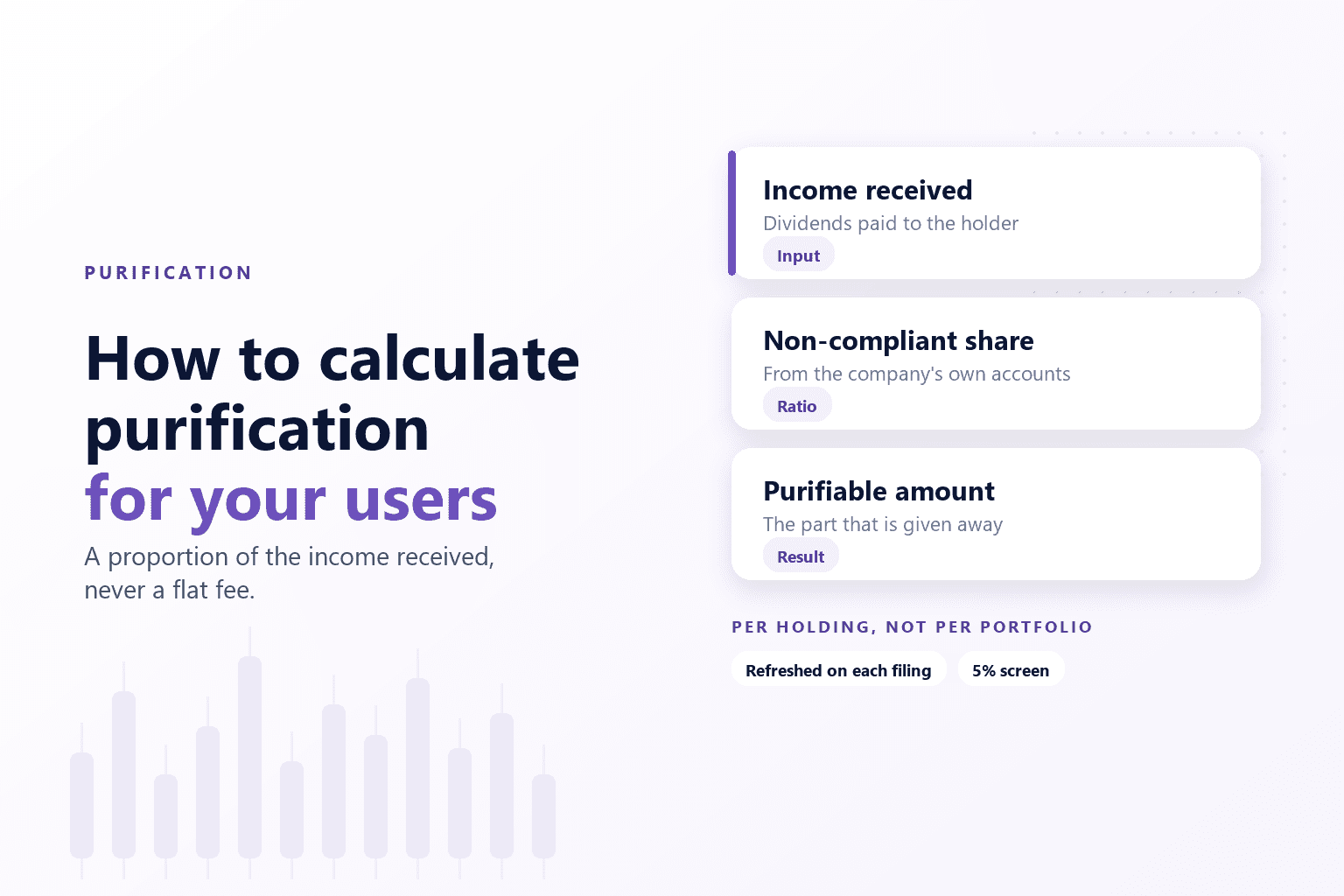
A screening verdict answers whether a user may hold something. Purification answers a harder question: given that they held it, how much of what they earned was not theirs to keep?
Almost every halal investing product eventually has to implement this, and almost nothing explains the mechanics. The result is that users are told to “purify” with no number attached, which is advice nobody can act on.
What purification actually is
A company that passes a Shariah screen is not necessarily free of impermissible income. The screens set a tolerance - commonly 5% of total revenue - rather than demanding zero. A company earning 2% of its revenue from interest is still investable under most standards, but that 2% is not considered permissible earnings.
Purification is the mechanism that resolves the gap: the investor keeps the holding, and gives away the share of what they received that traces back to the impermissible portion.
The calculation
In its common form it is a proportion, not a fee:
purification = income_received × (non_compliant_income ÷ total_revenue)
If a company drew 2.4% of its revenue from impermissible sources and a user received 100 units of dividend, the purifiable amount is 2.4 units. The ratio comes from the company's own audited accounts, so it changes when the company's accounts change - it is not a constant you can cache for a year.
The mistake that matters most
Does it apply to capital gains?
Standards and scholars differ here, and a data provider should say so rather than pick for you. The majority position applies purification to dividends, on the reasoning that a dividend is a distribution of the company's earnings, some of which were impermissible. A stricter position extends it to capital gains on the same reasoning.
Practically: implement the dividend case, and make the gains treatment a setting rather than an assumption. Which to apply is a question for a qualified scholar, not for an engineering decision made by default.
Funds work the same way, one level down
For an exchange-traded fund the same logic applies to the basket rather than to a single company: the purifiable proportion is the weight of the portfolio held in non-compliant positions. Which means a fund's purification figure depends on how much of its basket can actually be seen - and any product publishing one should publish that coverage beside it.
A short implementation checklist
- Store the non-compliant income proportion per holding, refreshed when the company files, never a single global rate.
- Apply it to income actually received by that user, not to the position's market value.
- Show the proportion alongside the amount, so the user can see where the figure came from.
- Keep a record of what was calculated and when. A user who gives money away will eventually want to show that they did.
Verify it yourself via the Akinda API
Fire a live /full-report/<ticker> call from the playground using your own API key — see the compliance ratios, AAOIFI screen verdict, and source-breakdown fields the methodology produces.
Related reading