Why two halal investing apps disagree about the same stock
One app says halal, the other says avoid, and your support queue fills up. Usually neither is wrong - they follow different standards. Here is what differs.
Sooner or later every halal investing product receives this message: your app says this stock is fine, but another one says it is not. Which of you is wrong?
The uncomfortable and correct answer is usually neither. Shariah screening is not one rulebook with one answer. There are several published standards, they use different denominators and different thresholds, and they were written by different bodies for different purposes. Two products can apply two of them faithfully and arrive at opposite verdicts on the same company.
The three places standards diverge
Almost every disagreement traces back to one of three choices, and none of them is a mistake by either side.
- The denominator. Debt and liquidity ratios are a fraction, and standards disagree about the bottom half. Some divide by a market-capitalisation average, others by total assets. A company with a volatile share price can sit on opposite sides of the same 30% line depending only on that choice.
- The averaging window. Where a standard uses market cap, it rarely specifies how long to average it over. A trailing twelve-quarter average and a trailing twelve-month average are different numbers, and in a year like the last one they are very different numbers.
- Whether a middle state exists. Some frameworks publish only pass or fail. Others keep a doubtful category for companies whose impure income is material but not decisive. A company that one product calls doubtful, another has to round into one of two buckets.
A worked example
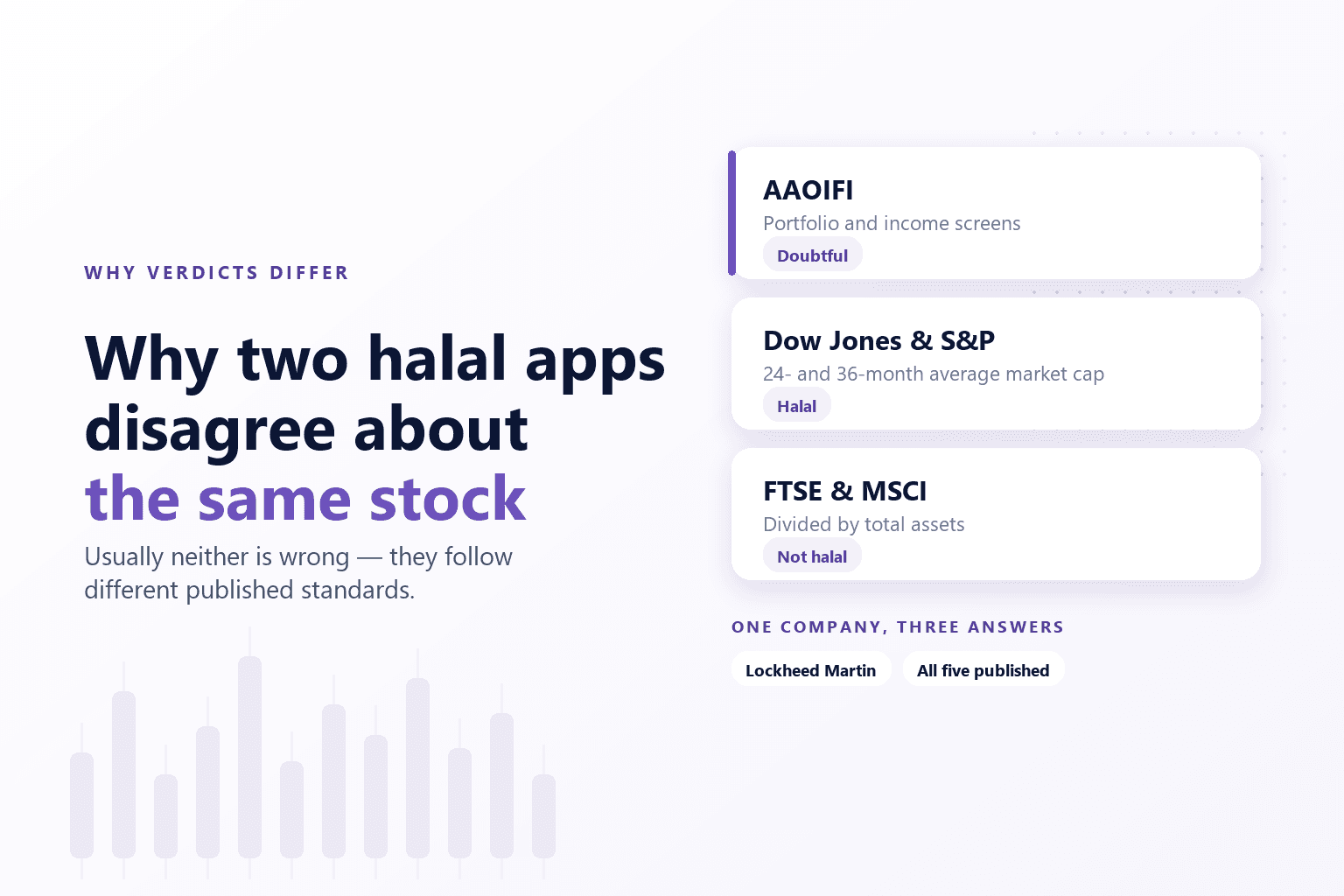
Lockheed Martin is the cleanest illustration we have, because the five standards we publish do not merely differ on it - they split three ways.
- Under AAOIFI, the standard our own verdict follows, it comes out doubtful.
- Under the Dow Jones and S&P Islamic rulebooks it comes out halal.
- Under FTSE and MSCI it comes out not halal.
Every one of those is a correct application of its own rules. An app showing only one of them is not lying to its users, but it is showing them one column of a five-column table without saying so.
The practical consequence
What to do in the product
- Name the standard beside the verdict. Not in a settings page - next to the word the user is reading. “Halal under AAOIFI” is a defensible sentence; “Halal” on its own is not.
- Show the ratio, not just the result. A user who can see that debt is 28.4% against a 30% limit understands why the answer might change next quarter, and why another app using a different denominator landed elsewhere.
- Let the standard be a user preference where it matters. Users who follow a particular board already know which rulebook they want. Offering it costs you nothing and removes the whole class of complaint.
- Say when the verdict last moved. Most disagreements between two apps are not methodological at all - one of them is simply working from older accounts.
One thing this article is not
This is a description of how published standards differ, not a religious ruling about which to follow. That judgement belongs with a qualified scholar, and ours is named and credentialed on this site. What a data provider can honestly do is apply each standard faithfully, publish all of them, and show the numbers underneath.
Verify it yourself via the Akinda API
Fire a live /full-report/<ticker> call from the playground using your own API key — see the compliance ratios, AAOIFI screen verdict, and source-breakdown fields the methodology produces.
Related reading