Shariah compliance data for robo-advisors and brokerages
A practical guide for platforms: what Shariah compliance data contains, how robo-advisors and brokerages each use it, and how to wire the Akinda AAOIFI API into your stack.
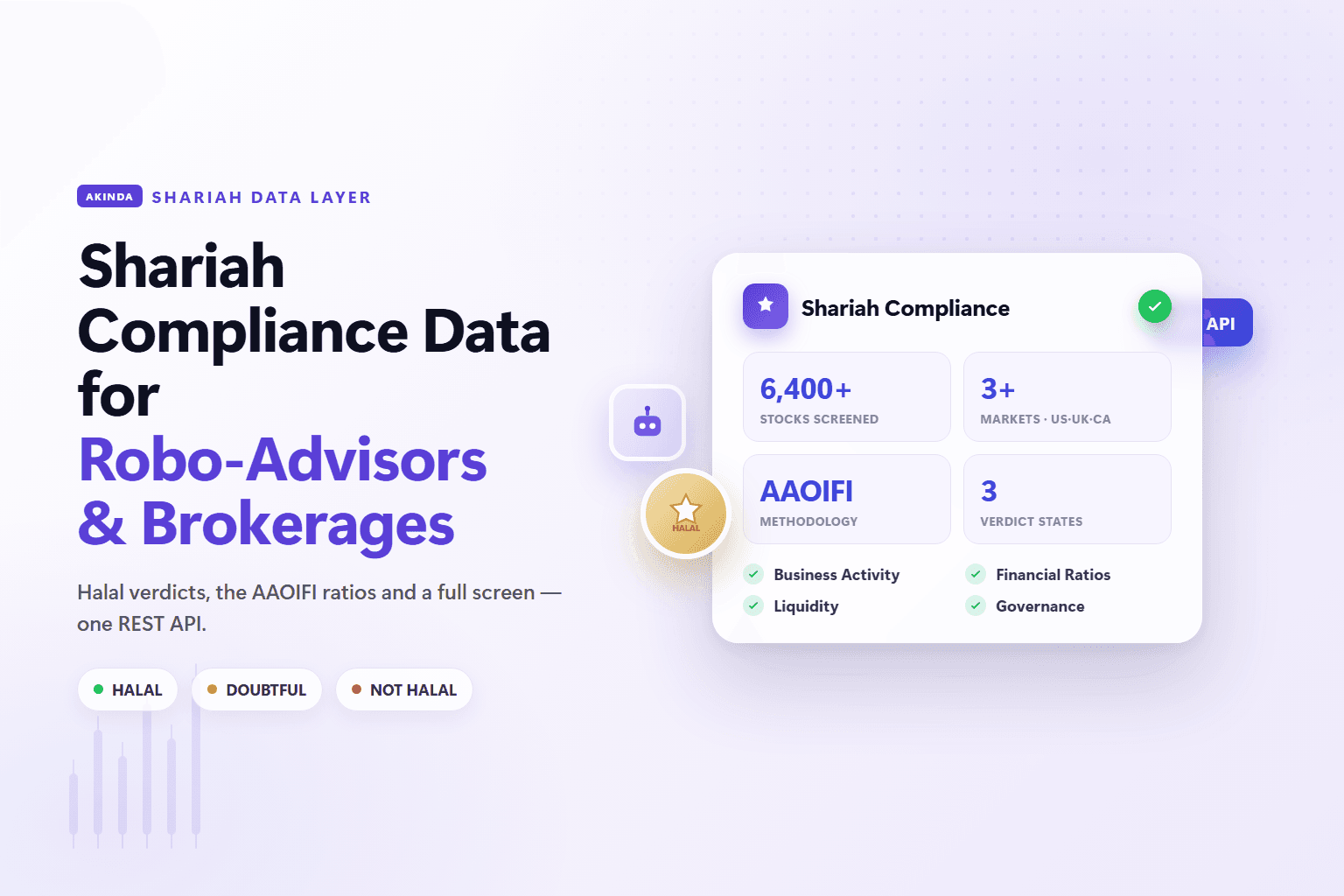
Robo-advisors and brokerages sit at the exact moment a Muslim investor decides whether to place a trade — and that is where Shariah compliance data earns its keep. Whether you allocate a client's portfolio automatically or show a compliance status at the point of trade, you need reliable, current, auditable data on which securities are halal and why. This guide covers what that data contains, how each platform uses it, and how to wire the Akinda API into your stack correctly.
Quick answer
halal_status (HALAL, NOT HALAL, or DOUBTFUL), the three AAOIFI financial ratios behind it, and a full AI-extracted screen — through AAOIFI-based REST endpoints with a published methodology. Robo-advisors use it to allocate and rebalance within a compliant universe; brokerages use it for halal badges and pre-trade gates.Why robo-advisors and brokerages need it
For a large and growing segment of investors, compliance is not a preference — it is a prerequisite. A Muslim client will not stay with a robo-advisor that allocates their money into interest-based banks or gambling stocks, and will not trust a brokerage that gives them no way to check a stock's status. Islamic finance assets run into the trillions of dollars and Islamic fintech is growing at a double-digit annual rate, so serving this audience well is a commercial opportunity, not a compliance chore.
There is also an ethical-investing overlap: Shariah screens exclude many of the same sectors that ESG-conscious investors avoid, so the same data can serve values-driven non-Muslim clients too. Either way, the data has to be accurate and defensible, because you are making — or gating — investment decisions on the basis of it.
What Shariah compliance data contains
Good Shariah compliance data is more than a green checkmark. Akinda exposes it across three REST endpoints, so you pull only the depth each screen needs:
- The verdict —
GET /api/v1/compliance/<ticker>returns a fasthalal_statusofHALAL,NOT HALAL, orDOUBTFUL(plus the no-data markersERROR_DATAandINCOMPLETE_DATA). - The three AAOIFI ratios —
GET /api/v1/basic-report/<ticker>adds the debt, liquidity, and impermissible-revenue ratios measured against the AAOIFI thresholds, so you can show why a stock passed or failed. - The full screen —
GET /api/v1/full-report/<ticker>returns the complete business-activity and financial screen and AI-extracted figures from the filings (the Akinda ranking is a Business Ultimate / Enterprise add-on).
The ticker is a path parameter, and every request is authenticated with your Akinda API key — sent either as the ?apikey=<key> query parameter or the X-API-Key header (there is no bearer-token flow). Here is the real full-report payload for Apple — the exact data your platform receives:
AAOIFI financial ratios
2.99%
Debt ratio
$98.66B
1.66%
Liquidity ratio
$54.70B
0%
Non-compliant revenue
$0
100%
Compliant revenue
$416.16B
Revenue by source (all compliant)
Ranking pillars · Business Ultimate & Enterprise
6.34
Ranking
9.94
Profitability
8.00
Financial strength
7.99
Momentum
5.49
Growth
5.15
Dividend
5.40
Liquidity
2.44
Value
Live GET /full-report/AAPL fields (snapshot). Interest-bearing debt $91.30B and operating lease $13.72B are returned too; run it yourself in the playground for the current numbers.
Current verdict: Halal
halal_status: HALAL today — the verdict a halal badge or pre-trade gate renders, backed by the AAOIFI ratios, the all-compliant revenue breakdown, and the ranking pillars shown above.Akinda also computes purification — the share of dividend income a holder should cleanse. It is exposed as a dedicated tool (calculate_purification) on the Akinda MCP server; check the developer docs for exactly where purification surfaces across the reports.
Robo-advisors: building compliant portfolios
For a robo-advisor, compliance data is an input to every allocation decision. The core pattern is to define a compliant universe — only securities that pass screening — and let allocation and rebalancing operate inside it:
- Universe construction — filter your investable set to
HALALsecurities before optimisation runs, so a non-compliant stock can never enter a portfolio. - Rebalancing checks — re-screen holdings before each rebalance, so a position that has drifted to
NOT HALALorDOUBTFULis flagged for replacement rather than topped up. - Ongoing monitoring — re-screen on a schedule and alert clients (or auto-adjust) when a holding changes status after an earnings season shifts its ratios.
- Purification reporting — use purification figures to tell clients how much dividend income to cleanse, turning compliance into a concrete, trust-building number.
The result is a portfolio that is compliant by construction, not by after-the-fact spot checks — which is what a Shariah-conscious client expects from an automated advisor. If you want a deeper look at the screening engine itself, see how to build a halal stock screener.
Brokerages: compliance at the point of trade
A brokerage's job is different: users choose their own trades, so compliance data has to meet them at the moment of decision. The highest-value integrations are:
- Halal badges on every ticker and company page, rendered straight from
halal_statusso a user sees status at a glance while browsing. - A pre-trade compliance gate that calls the compliance endpoint before an order executes and warns — or blocks — non-compliant buys.
- Compliance detail views that show the business result and the three ratios from
basic-reportorfull-report, so an informed user can see why a stock is or is not halal. - Halal-only filters in search and screeners, letting users browse a compliant universe directly.
Because the compliance endpoint is built for a fast verdict, it fits a latency-sensitive trade flow where a badge or gate decision has to render instantly.
Handle the no-data states explicitly
halal_status through verbatim, and never treat a missing verdict as a failure. ERROR_DATA and INCOMPLETE_DATA mean the screen could not be completed — not that the stock is non-compliant. A badge or gate should show “screen unavailable,” not a red “not halal,” when it sees those markers.Data quality, coverage, and freshness
7,200+
Stocks screened
4+
Markets · US · UK · CA · UZ
Coverage is expanding — new markets and tickers are added regularly, so these numbers keep growing.
Compliance data is only useful if it is accurate and current, and Shariah status is not static. A company can move in or out of compliance when its debt, cash, or revenue mix changes after an earnings report, so a verdict that was right last quarter can be wrong this quarter. Two things matter most:
- Coverage. Akinda covers US tickers broadly; UK (
.L) and Canada (.TO) listings are available on higher tiers. Confirm coverage for your target exchanges before you build. - Freshness and re-screening. Cache verdicts, re-screen on a schedule, and re-check holdings around earnings so a stale verdict never drives a live decision.
A transparent, published methodology matters here too: when a verdict changes, you and your users can see exactly why. If you are still choosing a provider, our halal stock API comparison and our guide to AAOIFI vs IFSB vs S&P screening standards cover what to look for.
Building on Claude and AI agents
If your platform is adding AI features — a research copilot, an agentic screener, a client-facing assistant — Akinda is also an MCP server. On a paid plan, connect it to Claude with “Sign in with Google” at https://b2b-api.akinda.io/mcp, and Claude gains five tools — including compliance checks, reports, whole-portfolio screening, and purification — without you writing any REST plumbing. See the MCP docs and our walkthrough on connecting Akinda to Claude.
Integrating the Akinda data layer
Integration is a standard REST flow, so a robo-advisor or brokerage can be up and running quickly:
- 1. Get a key. Generate an API key from the dashboard and prototype on the free Basic tier — the compliance endpoint only, with a low daily request cap (currently 200 requests a day). Basic is for evaluation and prototyping, not production.
- 2. Add depth as you need it. The three ratios live on
basic-report(Personal Standard and up); the full AAOIFI screen and AI-extracted figures live onfull-report(Personal Ultimate and up). - 3. Cache and re-screen. Store verdicts, re-screen on a schedule, and use each screen's freshness to flag data that has aged past your window.
- 4. Scale for production. Move to a Business plan for production volumes — Business tiers include every endpoint. Full request and response schemas are in the developer docs.
Frequently asked questions
What is Shariah compliance data?
It is structured data describing whether a security is Shariah-compliant and why — typically a verdict (Akinda's halal_status), the business-activity result, the financial ratios behind it, and purification figures. Robo-advisors and brokerages consume it through an API to build compliant portfolios, halal badges, and pre-trade gates without running their own screening engine.
How do robo-advisors use Shariah compliance data?
To define a compliant universe and keep portfolios inside it. Allocation runs only over securities that return HALAL, rebalancing re-checks holdings, and monitoring flags positions that drift to NOT HALAL or DOUBTFUL. Purification figures let the advisor tell clients how much dividend income to cleanse.
How do brokerages use it?
At the point of trade. Brokerages surface halal badges on tickers, run a pre-trade gate that checks a stock before an order executes, and offer halal-only filters in search. The fast compliance endpoint fits a latency-sensitive flow where the verdict has to render immediately.
How often does compliance data need updating?
Regularly, because status changes with a company's finances. Re-screen on a schedule — around earnings season is a sensible baseline — and flag verdicts that have aged past your window. A stock that was HALAL last quarter can turn NOT HALAL this quarter if its debt or interest income rises.
Does Shariah compliance data only serve Muslim clients?
No. Because Shariah screens exclude many of the same sectors that ethical and ESG investors avoid, the same data can serve values-driven non-Muslim clients and widen your addressable audience.
Informational, not a fatwa
Related reading