White-Label and Embedded Halal Investing (Shariah-as-a-Service)
Shariah-as-a-service turns a multi-year build into an API integration. Here is what white-label halal investing includes, who embeds it, and how to stand it up on the Akinda API under your own brand.
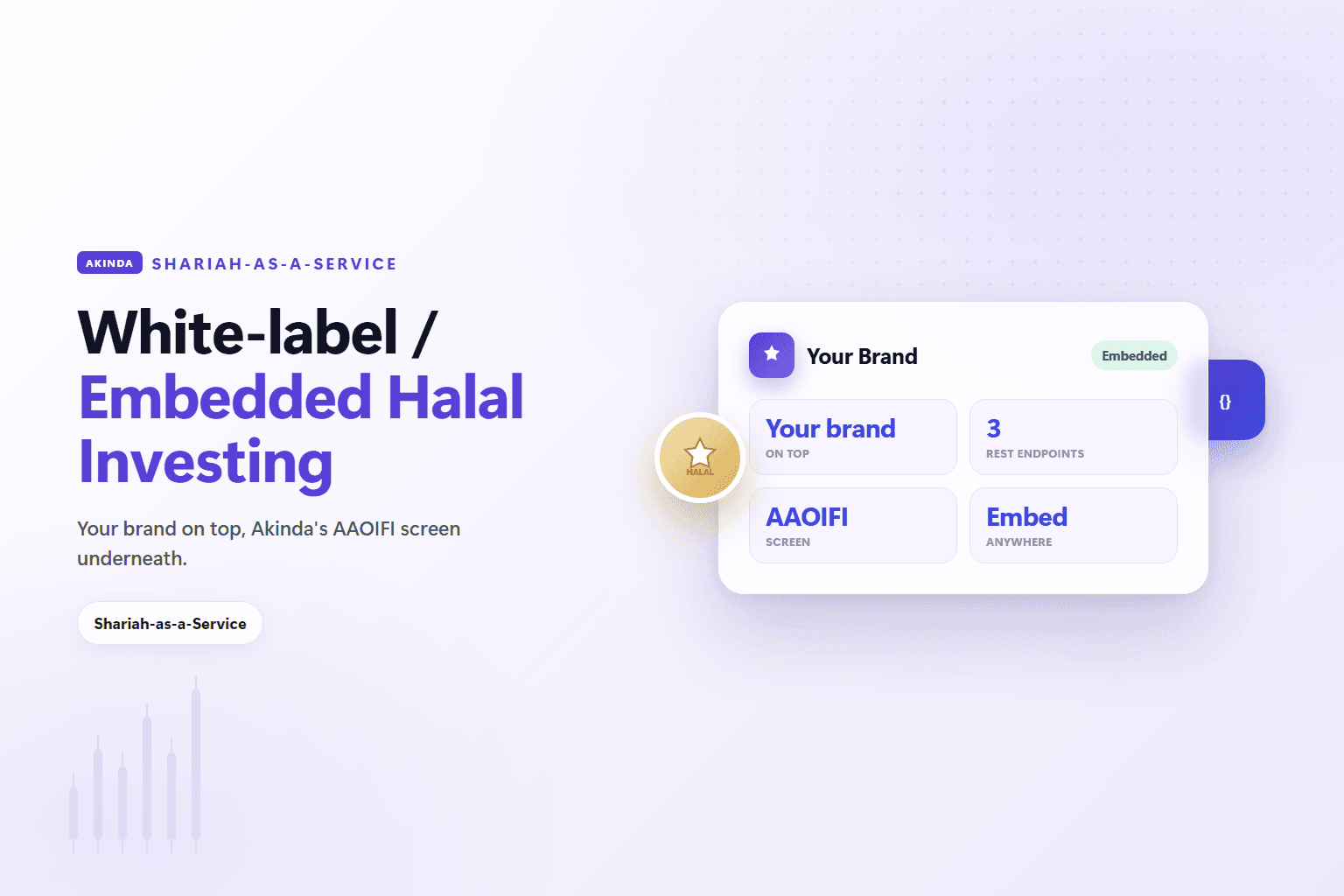
The fastest way to launch a halal investing product in 2026 isn't to build one from scratch — it's to embed compliance infrastructure that already exists. Just as embedded finance let any app add payments or lending through an API, Shariah-as-a-service lets fintechs, banks, and brokerages add halal screening, compliant filtering, and purification through a compliance layer they don't have to build. This guide explains what white-label and embedded halal investing is, why it's growing, and how to stand it up on top of an AAOIFI-based screening API.
Quick answer
halal_status field as HALAL, NOT HALAL, or DOUBTFUL. It turns a multi-year build into an integration you can ship in weeks.The market behind the pattern
Embedded halal investing is growing because the underlying demand is large and compounding. The widely-cited industry figures that frame it:
- Global Islamic finance assets: roughly $5.1 trillion in 2026, projected to reach about $8.46 trillion by 2031 — a compound annual growth rate near 10.7%, according to Mordor Intelligence.
- Islamic fintech: estimated at around $250 billion in 2026, per Grand View Research.
- Addressable population: roughly 2 billion Muslims worldwide — a large, fast-growing base — plus values-driven demand from non-Muslim investors whose ethical screens overlap with Shariah exclusions.
For a deeper look at the opportunity and where it concentrates, see our halal investing market opportunity breakdown.
What is Shariah-as-a-service?
Shariah-as-a-service is the delivery of Islamic-finance compliance as an on-demand, API-based product. Rather than each institution rebuilding the same screening engine and scholar workflow, a specialist provider maintains the methodology, the financial data, and the governance, and exposes it through endpoints any product can call. Your app sends a ticker and gets back a compliant verdict, the AAOIFI ratios behind it, and AI-extracted figures — all under your own brand. It's the same pattern as banking-as-a-service or payments-as-a-service, applied to halal investing.
The "white-label" part matters: the compliance layer runs invisibly behind your interface. Users experience your brand, your UX, and your product, while the halal verdicts they rely on come from a maintained, scholar-governed engine underneath. Embedding it means putting that capability inside your product instead of sending users elsewhere.
Why embed instead of build?
Building halal investing infrastructure in-house is a serious undertaking. You'd need licensed financial data across every market you cover, a screening engine that encodes the business and financial rules correctly, a purification model, and — hardest of all — qualified Shariah scholars to design and govern the methodology and rule on edge cases.
That last requirement is a genuine bottleneck. Scholars who pair deep Islamic jurisprudence with financial-engineering expertise are scarce and expensive, and the pool qualified to design and sit on a Shari'ah board is small relative to the demand for it. Embedding a Shariah-as-a-service layer lets you inherit that governance instead of recruiting it.
The economics follow the same logic. Building means a long, uncertain project plus ongoing maintenance as company financials shift every quarter; embedding means an integration you can ship in weeks and predictable, usage-based costs. For most fintechs and banks, the build-versus-buy math points clearly to buy, so engineering can focus on the product experience rather than on reconstructing Islamic-finance infrastructure. Our guide to adding Shariah compliance to your app walks through the same trade-off from a developer's seat.
What a Shariah-as-a-service layer includes
A complete embedded halal-investing layer is more than a single yes/no flag. The pieces you'll want to surface in your product:
- Compliance verdicts. A fast
halal_statusof HALAL, NOT HALAL, or DOUBTFUL for any ticker — the core of every halal feature — plus explicit no-data states (ERROR_DATA/INCOMPLETE_DATA) when a company hasn't reported enough to screen. - The reasoning behind them. The business-activity result and the three core AAOIFI ratios, so verdicts are transparent rather than a black box.
- A compliant filter. You call the compliance endpoint per ticker to keep only HALAL names, which is what powers halal portfolios and screeners. To screen a whole list at once inside an AI assistant, the Akinda MCP server exposes an
akinda_screen_portfoliotool. - Purification data. The figure users need to cleanse the impermissible portion of their dividends. Akinda computes this through the
akinda_calculate_purificationtool on its MCP server — it's a dedicated tool, not a field on the REST report. - A published methodology. Documented rules built around AAOIFI Shari'ah Standard No. 21 that your own compliance team and Shariah board can audit.
- Scholar governance. A named advisor and a review process behind the verdicts.
The Akinda Halal API packages the screening into three REST endpoints — a compliance verdict, a basic report, and a full report — documented in the developer docs, with the AI-assistant tools available over its MCP server.
Who embeds halal investing
Embedded halal investing suits any product whose users care about Shariah compliance, or could. The most common adopters:
- Brokerages and trading apps that add halal badges and pre-trade compliance gates so Muslim users can invest with confidence.
- Robo-advisors that build and rebalance portfolios drawn only from a compliant set of names — see Shariah screening for robo-advisors and brokerages.
- Neobanks and super-apps adding an investing tab that needs to be compliant from day one to fit their audience.
- Conventional banks launching an Islamic window that need a Shariah-native compliance layer rather than a bolt-on to their existing core.
- Wealth and advisory platforms serving Muslim clients who expect compliance screening as standard.
In each case, embedding lets the institution offer a credible halal product without becoming an Islamic-finance infrastructure company itself.
How to embed it with the Akinda API
The base URL is https://b2b-api.akinda.io/api/v1, the ticker is a path parameter, and authentication is an Akinda API key sent either as an X-API-Key header or an ?apikey= query parameter — there is no bearer-token or OAuth flow for the REST API. A single compliance call looks like this:
cURL
# Free Basic tier: one compliance verdict. Ticker is a PATH param.
curl "https://b2b-api.akinda.io/api/v1/compliance/AAPL" \
  -H "X-API-Key: YOUR_API_KEY"

# Or pass the key as a query parameter instead of a header:
curl "https://b2b-api.akinda.io/api/v1/compliance/AAPL?apikey=YOUR_API_KEY"
The response is compact JSON — the verdict a halal badge or pre-trade gate renders:
JSON
{
  "company_name": "Apple Inc.",
  "halal_status": "HALAL",
  "ticker": "AAPL"
}
Current verdict: Halal
AAPL) returns halal_status: HALAL from the compliance endpoint. The paid /basic-report/AAPL adds the three AAOIFI ratios behind it — debt_ratio_perc 2.99, liquidity_ratio_perc 1.66, and non_compliant_revenue_perc 0. Full write-up in is Apple halal?From there, standing up an embedded offering follows a straightforward path:
- Generate an API key from the dashboard and prototype on the free Basic tier. The free tier calls
/complianceonly, capped at 200 requests per day — enough to evaluate and wire up badges, not to run production traffic. - Add halal verdicts and badges across your product with one
/compliance/<ticker>call per symbol. - Filter to compliant names by screening your ticker list through the compliance endpoint to power screeners, halal-only filters, or robo portfolios.
- Pull report data where you need detail:
/basic-report(three AAOIFI ratios, Personal Standard and up) and/full-report(AI-extracted SEC figures and their dollar counterparts, Personal Ultimate and up). The Akinda ranking pillars, such asranking_score, are a Business Ultimate / Enterprise add-on. - Add purification where users cleanse dividends, via the
akinda_calculate_purificationMCP tool on a paid plan. - Schedule quarterly re-screening so verdicts stay current after each earnings season, and cache between runs to control request volume.
- Move up a tier for production — Personal Ultimate unlocks all three REST endpoints, while Business plans add higher rate limits, wider market coverage, and the ranking pillars. Review the pricing page to pick a tier.
Coverage
.L) and Canadian (Toronto, .TO) listings come in on higher tiers. Scope compliance features to the markets your tier covers.Because responses are structured JSON, the same layer also plugs into AI-agent and MCP workflows: connect the Akinda MCP server to Claude with Sign in with Google, and an assistant gains five read-only tools — compliance, basic report, full report, portfolio screening, and purification — available on paid plans only.
Branding, governance, and compliance
White-labelling means your brand is on the experience, so the credibility of the compliance layer behind it becomes your credibility. Choose a provider whose methodology is published in full and whose verdicts are overseen by a qualified scholar, so you can defend them to your users, your own Shariah board, and regulators. The Akinda methodology — a documented screen built around AAOIFI Shari'ah Standard No. 21 — is reviewed by Dr. Muhammad Nazir Khan, who holds a PhD in Islamic Economics and Finance and an AAOIFI Shari'ah Auditing Certification.
Three practices keep an embedded offering trustworthy: present verdicts as data-driven screening rather than fatwas, keep a qualified scholar in the loop for edge cases such as mergers and partial-period reporting, and be transparent with users about which methodology powers the compliance they see. Done well, that transparency is exactly what earns the trust that drives retention and cross-sell in halal financial products.
Frequently asked questions
What is Shariah-as-a-service?
It's the delivery of Islamic-finance compliance — screening, compliant filtering, purification, and governance — as an API-based product you embed in your own app. Instead of building the engine and hiring scholars, you integrate a maintained compliance layer and present halal investing under your own brand. It's the halal-investing equivalent of banking-as-a-service.
Is embedded halal investing white-label?
It can be. The compliance layer runs behind your interface, so users see your brand and UX while the verdicts come from a third-party, scholar-governed engine. You control the experience; the provider maintains the methodology, data, and governance underneath.
How long does it take to launch?
Because the hard parts — screening logic, financial data, and scholar governance — already exist, integration is measured in weeks rather than the months or years a from-scratch build would take. You generate an API key, wire up the endpoints, and design the UX around the halal_status verdict, then re-screen on a schedule to stay current.
Do I still need my own Shariah board?
You should keep qualified Shariah oversight in the loop, especially for edge cases and product-level decisions, but you don't need to build the entire screening methodology yourself. A good provider publishes its rules and has its own scholar governance, which your board can review and rely on rather than reconstruct.
Does this work for a conventional bank's Islamic window?
Yes. Rather than forking a conventional core, a bank can run a parallel, Shariah-native compliance layer through an API and expose a unified front end. Embedding the screening avoids retrofitting compliance into a system that wasn't designed for it, which is a common failure mode in Islamic-window projects.
Informational, not a fatwa
Verify it yourself via the Akinda API
Fire a live /full-report/<ticker> call from the playground using your own API key — see the compliance ratios, AAOIFI screen verdict, and source-breakdown fields the methodology produces.
Related reading