The halal investing market opportunity: why fintechs are adding Shariah products
The halal investing market is large, fast-growing, and structurally underserved. Here is why fintechs are adding Shariah-compliant products now, and how an AAOIFI-based API ships them in weeks.
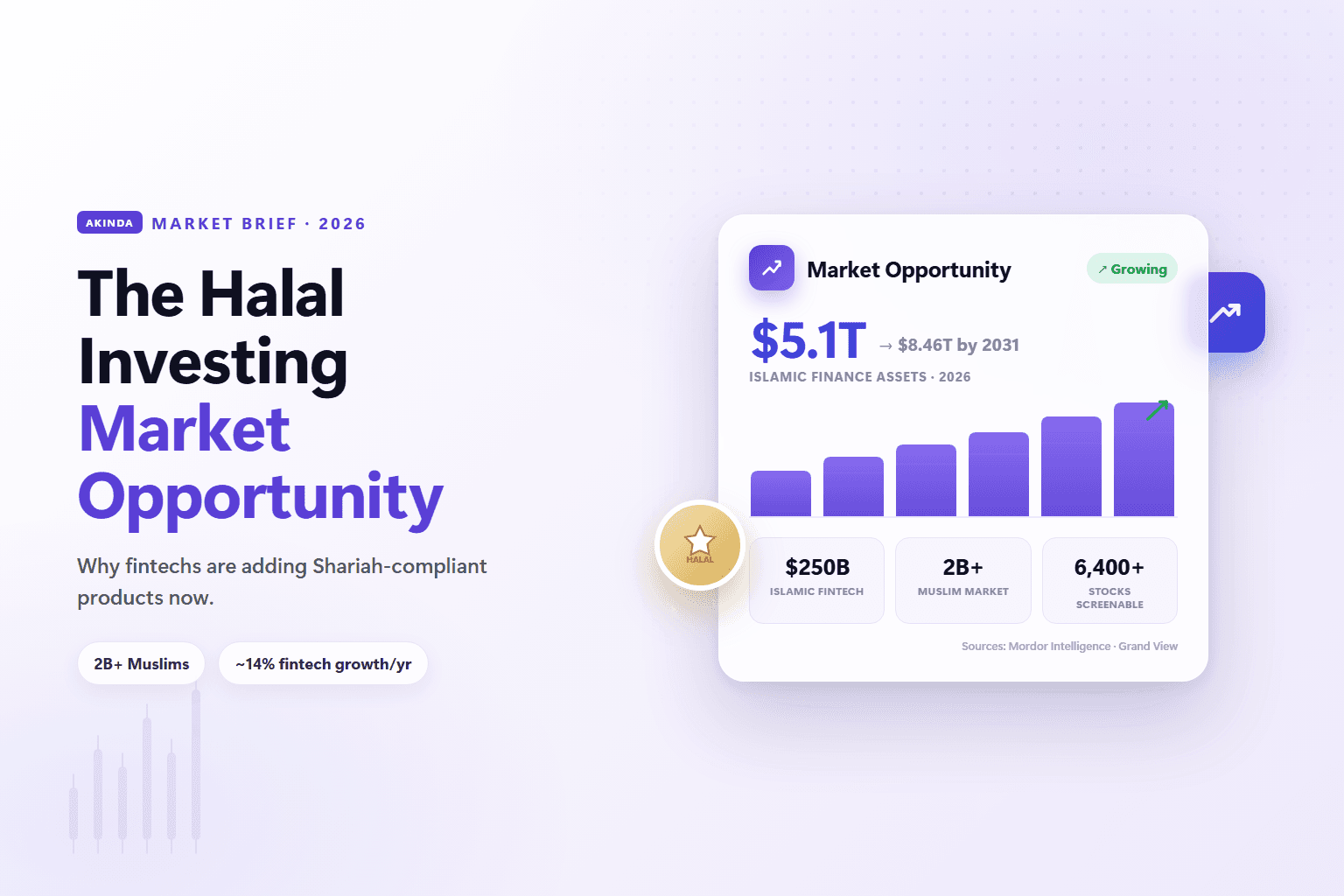
A growing number of fintechs and investing apps are adding Shariah-compliant products, and it is not out of charity. The halal investing market is large, fast-growing, structurally underserved, and — contrary to a stubborn myth — no drag on returns. For a product team looking for a defensible growth wedge, few segments combine this much demand with this little competition. This guide sizes the opportunity, explains why it is underserved, debunks the returns myth, and shows why adding Shariah-compliant products has become a strategic move rather than a niche play.
Quick answer
By the numbers (2026)
- Islamic finance assets: ~$5.1 trillion in 2026, projected to ~$8.46 trillion by 2031 (~10.7% CAGR, per Mordor Intelligence).
- Islamic fintech market: ~$250 billion in 2026, heading toward ~$619 billion by 2033 (~13.8% CAGR, per Grand View Research).
- Audience: ~2 billion Muslims in 2025, projected to ~2.8 billion by 2050, plus values-driven non-Muslim demand.
- Performance: over the 15 years to 2019, the S&P 500 Shariah index returned 10.2% annualized versus 9.1% for the S&P 500 (per S&P Global).
How big is the opportunity?
The headline numbers are substantial. Global Islamic finance assets stand at roughly $5.1 trillion in 2026 and are projected to reach about $8.46 trillion by 2031, a compound annual growth rate near 10.7% according to Mordor Intelligence, and other industry bodies project similar double-digit growth toward the end of the decade. The Islamic fintech slice is growing faster still: Grand View Research puts it around $250 billion in 2026, heading toward $619 billion by 2033 at roughly 13.8% a year.
Behind the assets is a large, young, digital-first audience. The global Muslim population is about 2 billion today and projected to reach 2.8 billion by 2050, concentrated in exactly the fast-growing, mobile-first markets where fintech adoption is highest. For much of this audience, Shariah compliance is not a premium feature — it is the threshold for using a financial product at all. That combination of a huge population, rising incomes, high digital adoption, and a hard requirement conventional apps do not meet is what makes the opportunity unusually attractive.
Why the market is underserved
Demand this large would normally attract intense competition, so why is halal investing still underserved? The answer is a supply-side bottleneck. Building compliant products is genuinely hard: it requires licensed financial data, a screening engine that encodes the rules correctly, a purification model, and — hardest of all — qualified scholars to design and govern the methodology.
That governance talent is scarce. The Islamic International Rating Agency estimates there are fewer than 1,200 qualified Shariah board members worldwide serving over 2,000 institutions, and an INCEIF study found that 42% of Islamic banks in Africa operate without a certified Shariah compliance officer. Because the expertise to build compliant products is rare, supply has lagged demand, leaving millions of investors using conventional apps that do not fit their values, or sitting on the sidelines entirely. For a fintech that can add credible compliance quickly, that gap is the opportunity. (The three standards teams usually weigh are covered in AAOIFI vs IFSB vs S&P Shariah.)
The myth that halal means lower returns
A persistent objection, from investors and product teams alike, is that screening out sectors must hurt performance. The data does not support it. Over the 15-year period ending July 2019, the S&P 500 Shariah index returned 10.2% annualized versus 9.1% for the standard S&P 500 per S&P Global, and over the long term Islamic indices have tended to track conventional benchmarks closely. Screening removes some sectors (notably conventional financials) but tilts toward others (technology, healthcare) in ways that have historically balanced out.
The upshot for a fintech: you can offer compliant products without asking users to sacrifice returns, which removes the biggest perceived objection to adopting them. Your users can also verify names for themselves — a single compliance call on a large-cap tech name typically comes back clean. See the worked screen in Is Apple halal? for a real example.
The ethical and ESG crossover
The halal opportunity is bigger than the Muslim population because Shariah screening overlaps heavily with ethical and ESG investing. Both exclude sectors like gambling, alcohol, and weapons, and both favour lower-leverage, transparent businesses. That overlap turns a faith-based product into a values-based one with broader appeal: a Morningstar survey found 61% of sustainable-fund investors in Europe and North America already view Islamic funds as ESG-aligned, and Islamic banking penetration has grown 18% in non-Muslim markets. For a fintech, this means the same investment in a compliance layer serves two growing audiences — observant Muslims and values-driven investors of any background — rather than one narrow niche.
Cross-sell and retention economics
Beyond acquisition, compliant products change the economics of the relationship. Users who trust that a product respects their values tend to consolidate more of their financial life into it, adopting adjacent offerings — savings, sukuk, and other compliant products — at higher rates than conventional users convert across products. Trust also drives retention: a Muslim investor who has finally found an app that genuinely fits their values has little reason to leave, and strong word-of-mouth within tight-knit communities lowers acquisition cost. In a category where compliant options are scarce, being the credible choice compounds: you win the customer, keep them longer, and earn referrals that conventional apps cannot.
What fintechs are adding, and how fast
Fintechs entering the space are adding a recognisable set of Shariah-compliant products:
- Halal stock screening and badges, so users can see a security's status before they buy.
- Compliant portfolios and robo-advice drawn only from a screened universe.
- Purification tools that quantify the income users should cleanse.
- Pre-trade compliance gates that keep non-compliant buys out of a halal-focused product.
- Embedded, white-label compliance inside neobanks and super-apps that want a halal investing tab.
All of it draws on the same data layer — the live coverage a fintech can build on today:
6,400+
Stocks screened
3+
Markets · US · UK · Canada
Coverage is expanding — new markets and tickers are added regularly, so these numbers keep growing.
The reason this is happening now is speed. Rather than a multi-year build, a fintech can integrate an AAOIFI-based API, generate a key on the dashboard, and call three REST endpoints (the ticker is a path param): GET /api/v1/compliance/<ticker> for a fast verdict, /api/v1/basic-report/<ticker> for the verdict plus the three AAOIFI ratios, and /api/v1/full-report/<ticker> for the full screen with AI-extracted figures and their dollar counterparts. Authenticate with your Akinda key as an ?apikey=<key> query parameter or an X-API-Key header — there is no OAuth dance on the REST path.
Current verdict: Halal
/api/v1/compliance/AAPL call returns halal_status: HALAL for Apple Inc. — the same audited verdict your users would see in-app. Verdicts come back as HALAL, NOT HALAL, or DOUBTFUL (with no-data states for tickers Akinda cannot yet screen), never a generic pass/fail.Coverage starts with US tickers broadly, with UK and Canadian listings available on higher tiers. Tooling follows the same tiers: the free Basic plan exposes the compliance verdict endpoint for evaluation and prototyping; the ratio-level basic-report is Personal Standard and up, and the full full-report screen is Personal Ultimate and up, with everything bundled on the Business plans. The methodology and scholar governance are already in place, so a team wires up the UX and re-screening rather than building Islamic-finance infrastructure from scratch. For a concrete build, see How to build a halal stock screener, and to weigh vendors, the halal stock screening API comparison. Teams that live in an AI assistant can even connect Akinda to Claude as an MCP server.
Frequently asked questions
How big is the halal investing market?
Large and growing quickly. Global Islamic finance assets are around $5.1 trillion in 2026 and projected to reach roughly $8.46 trillion by 2031, while the Islamic fintech segment is expanding at nearly 14% a year toward $619 billion by 2033. With about 2 billion Muslims worldwide, most poorly served by conventional apps, the addressable demand is substantial.
Why is the halal investing market underserved?
Because compliant products are hard to build. They require licensed data, a correct screening engine, purification logic, and qualified scholars to govern the methodology, and that scholarly talent is scarce, with fewer than 1,200 qualified Shariah board members globally. Supply has lagged demand, which is exactly why the opportunity exists for fintechs that can add compliance quickly.
Does halal investing mean lower returns?
Historically, no. Over the 15 years to 2019 the S&P 500 Shariah index returned 10.2% annualized versus 9.1% for the S&P 500 per S&P Global, and Islamic indices have generally tracked conventional benchmarks. Screening changes sector exposure rather than systematically reducing returns, which removes the main objection to offering compliant products.
Do only Muslims invest in halal products?
No. Because Shariah screening overlaps with ethical and ESG investing, values-driven non-Muslim investors are a meaningful part of the audience — a majority of sustainable-fund investors already view Islamic funds as ESG-aligned. A compliant offering can therefore serve both faith-based and values-based investors.
How quickly can a fintech add Shariah-compliant products?
With an API, in weeks. The screening logic, financial data, and scholar governance already exist, so a team integrates the endpoints, designs the UX, and sets up re-screening rather than building Islamic-finance infrastructure from scratch. Start on the free Basic tier to prototype the compliance verdict, then upgrade to Personal Standard for the ratio reports or Personal Ultimate for the full screen — pricing is published in full on the pricing page.
Sources and further reading
A note on scope
Related reading