
Most guides to ESG screening tools tell you to compare coverage counts and score histories, or to standardize on a single rating provider so every holding gets measured the same way. Both shortcuts fail the same test. A screen isn't a measurement, it's a decision rule, and a decision rule you can't inspect isn't auditable.
The ten platforms below don't answer the same question. MSCI's business involvement data flags what a company earns revenue from. Sustainalytics scores how much ESG risk a company carries. RepRisk tracks incidents reported about it. BlueOnion evaluates the funds that hold it. Ranking those on feature counts is like comparing a smoke alarm with a thermometer because both display a number.
So this comparison runs on two axes: the question each tool answers, and how much of its reasoning it puts on screen. Where pricing and methodology sit behind a sales call, I say so rather than guess. Start from your investment policy, not from a vendor's feature page.
Table of Contents
- 1. MSCI Business Involvement Screening Research (BISR)
- 2. Morningstar Sustainalytics Global Access
- 3. ISS STOXX DataDesk and Screening & Controversies
- 4. S&P Global Sustainable1 Screening Solutions
- 5. LSEG Workspace and ESG data
- 6. Clarity AI
- 7. RepRisk
- 8. Datia
- 9. ESG Book
- 10. BlueOnion
- How the ten ESG screening tools differ on screening focus, pricing access and data visibility
- Choosing the Right ESG Screening Tool for Your Workflow
1. MSCI Business Involvement Screening Research (BISR)
BISR answers one narrow question precisely. How much of this company's revenue comes from a named activity, and does that share breach the threshold your mandate sets? If your policy caps gambling revenue at 5%, this is the input you want, not a composite sustainability score.
The product is built for rules-based exclusion rather than a general verdict on how well a company manages its ESG exposure.
Data is company-level, and screens are configurable for client mandates and fund guidelines, including faith-based and values-aligned approaches. Eligible products include API access, which matters if you run exclusions nightly rather than quarterly.
Definitions decide the answer more than data volume does. The 2022 comparison by Berg, Kölbel and Rigobon in the Review of Finance measured six agencies (KLD, Sustainalytics, Moody's ESG/Vigeo-Eiris, S&P Global/RobecoSAM, Refinitiv/Asset4 and MSCI) and found pairwise correlations of only 0.38 to 0.71. Disagreement split into 56% measurement differences, 38% scope differences and 6% weighting. Revenue screens sit in the first two buckets. Two providers can both flag thermal coal involvement and still disagree, because one measures reserves and the other measures revenue.
If you're building exclusion lists for sin stocks, the same rule applies: a flag is only as good as the segment definition behind it.
Ask before signing: which segment mapping version produced this flag, and which filing date it rests on.
The trade-off is scope. BISR tells you what a company does, not how well it manages what it does, and access is sales-led with no public price list. Product detail sits in MSCI's business involvement documentation.
2. Morningstar Sustainalytics Global Access
Global Access puts three different outputs behind one login, and conflating them is the most common way teams misread it.
Risk score, controversy rating and involvement flag
- ESG risk score: how exposed a company is to material ESG issues and how well it manages that exposure, ranked against industry peers.
- Controversy screening: incidents scored by severity, which move faster than an annual risk score ever will.
- Product involvement: revenue links to named activities, a different question from the risk score and one that gets answered by a different field.
The platform supports custom investable universes, analyst commentary with peer comparisons, portfolio monitoring alerts, and API or data-feed delivery. Those exports are the part developers care about most, because a screen that only lives in a web interface doesn't help an application.
Treat any single score as one provider's opinion. Research published in the Review of Finance found correlations among major ESG ratings averaged 0.54, so a meaningful share of what one provider ranks highly, another doesn't. Keep the raw metrics and the methodology metadata, isolate disagreement at the environmental, social and governance pillar level, and record whether a change came from coverage, factor definition, normalization or weighting.
Pricing requires a sales inquiry and coverage varies by market, so test it against the names you hold. Product detail is on the Sustainalytics Global Access page.
3. ISS STOXX DataDesk and Screening & Controversies
Rating disagreement has a price attached to it. A study of Chinese listed companies covering 54,679 company-quarter observations across 4,377 firms from 2018 to 2022 found that divergence among three ESG rating agencies had a statistically significant negative relationship with stock returns (SSRN working paper on ESG rating divergence). Inconsistent classification changes what investors expect, and that shows up in prices.
DataDesk covers issuer- and portfolio-level analysis with daily alerts, so a screen doesn't go stale between quarterly reviews.
Screening research covers sector involvement, including energy and extractives, plus controversial-weapons research with published methodologies. You get raw ESG data alongside ratings and rankings, which is the combination that makes a verdict auditable rather than merely final.
What works and what doesn't
The sector screens hold up where underlying business definitions are stable, like controversial weapons. They get shakier wherever revenue segmentation is ambiguous, because a conglomerate's "involvement" depends entirely on how subsidiaries and joint ventures get mapped.
Access and pricing generally require contacting the provider, and coverage varies by dataset. Ask which universe a given screen covers before you rely on a clean result from it. Detail is on the ISS STOXX sustainability page.
4. S&P Global Sustainable1 Screening Solutions
Four screening types sit inside one service: sustainability event monitoring, controversy screening, business involvement screening and screening against UN Global Compact principles. Automated source detection flags candidate incidents, then analyst review decides what becomes a usable flag.
That pairing matters for a specific reason. Automated incident detection produces false positives at a rate no compliance team will accept uncut, so human review is what turns a keyword hit into something a portfolio manager can act on.
The four screens answer different questions. Event monitoring is continuous surveillance of sources. Controversy screening is incident-led. Business involvement asks whether revenue crosses a threshold in a flagged activity. The UN Global Compact screen is a norms test.
A norms test is not a performance test. A company can carry a decent ESG risk score and fail the norms screen in the same quarter.
When you evaluate the output, check whether it exposes the incident sources and revenue figures behind each verdict. That is what separates an auditable flag from a bare classification, and it is where bundled services vary most.
The multilingual source monitoring is the underrated part. Incidents surface first in local-language press, and a system that only reads English-language sources will arrive late to most controversies outside the anglosphere.
Where it fits. Institutions that need several screening approaches under one contract and one methodology document. Where it doesn't. A small application team that only needs business-involvement flags, since the broader institutional service is scoped and priced for enterprise use, and standard pricing isn't published.
Comparing these screens is a methodology exercise, the same way comparing Islamic index methodologies comes down to thresholds and definitions rather than labels. Read the methodology page before the marketing page, at S&P Global Sustainable1 screening solutions.
5. LSEG Workspace and ESG data
Workspace is where ESG data becomes convenient, and convenience is exactly the trade-off. Scores and sustainability analytics sit next to prices, fundamentals and estimates, so a portfolio manager can screen a universe and check exposure without leaving one terminal.
Screening runs through tools such as Screener and portfolio analytics, and data can be delivered through the platform or through other integration routes for teams that want it in their own systems.
What you're actually buying
An integration story more than a methodology. If your desk already pays for LSEG market data, adding ESG coverage to an existing entitlement is cheaper and faster than onboarding a specialist vendor, and the comparison work happens inside a workflow people already know how to use.
The cost is visibility. A score that arrives inside a terminal arrives with less of its reasoning exposed than a specialist product shows, and normalization choices stay hidden unless you pull the underlying fields. Ask which metrics feed the score, how missing values are treated, and whether historical scores get restated when the methodology changes.
Pricing isn't publicly listed and the value depends heavily on whether you use the rest of the suite. For a team that doesn't need market data, the bundle is dead weight. Product information is at LSEG Workspace.
6. Clarity AI
Clarity AI's exclusion screening is built around your policy rather than a headline score. You set the criteria, the platform applies them, and revenue-based exposure analysis separates direct involvement from indirect. That's the difference between a company that operates a casino and a company that owns a building a casino leases.
The platform extends past exclusions into company, fund and portfolio sustainability analysis, with risk and impact views, and it documents the underlying data rather than only the output. Integration runs through APIs and data feeds.
The test worth running. Data traceability is a claim every vendor makes, so pick three controversial names, ask each vendor for the evidence behind the flag, and compare the source documents and timestamps you get back. Do that before you compare dashboards, because the dashboard is the easy part to build.
Pricing isn't public, and this is a professional platform rather than a free stock screener, so budget for a sales cycle and a real contract rather than a card payment.
Where it earns its place is portfolio-scale analysis against policy-specific criteria. Where it needs scrutiny is any output you can't trace to a specific disclosure in a specific filing.
Clarity AI's platform overview covers the exclusion and portfolio products.
7. RepRisk
RepRisk screens conduct rather than credentials. Its research is built from reported incidents and public sources, then turned into risk scores covering business conduct, norms and sustainability topics. That answers a question ratings can't: what has this company been accused of, where, and how recently.
The platform screens and monitors portfolios, companies, projects, suppliers and clients, and ships a REST API and scheduled data feeds. That's what makes it usable inside a due-diligence pipeline rather than only in a browser tab.
Treat a reported allegation as a lead, not a verdict. Read the source, check the date, and check whether the company responded.
The trade-off is category. Incident and reputation data isn't an ESG performance assessment, and a company with no reported incidents isn't necessarily well managed. It may just be less covered, especially outside developed markets where media density is thinner.
If you're wiring compliance monitoring software into a review process, incident feeds are the part that generates work. Design the review queue and the escalation rule before the data arrives, or the alerts become noise nobody actions.
Pricing and access are sales-led. Product detail is at RepRisk solutions.
8. Datia
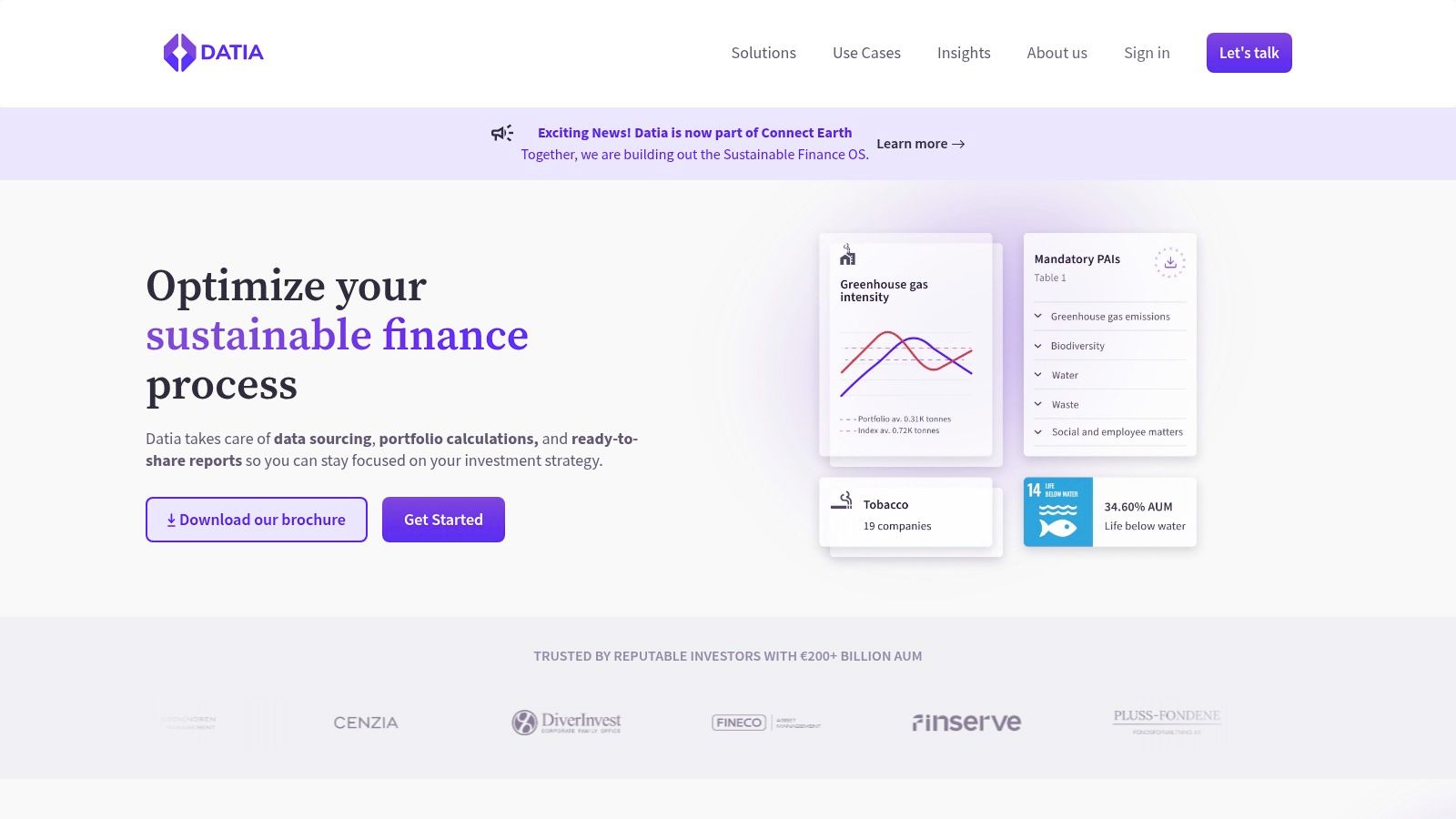
Datia is the one platform here that publishes example starting prices, which makes it the easiest to budget against. The published examples are €7,500 per year for ESG Assessment, €10,000 for SFDR and €17,000 for SFDR+, with the actual quote depending on modules and organization size.
That pricing transparency signals who it's built for. Regulatory reporting is now a purchasing driver in its own right: Verdantix reported that 61% of firms used commercial ESG and sustainability-reporting software in its 2025 global corporate survey, up from 29% in 2023 (Verdantix on ESG and sustainability reporting software). Integration with reporting and data-governance workflows has turned into an adoption requirement rather than a differentiator.
Screening plus reporting in one contract
You get company and fund analysis including ETFs, controversial business involvement, portfolio-level ESG measures, APIs that accept customer-provided sustainability data, and reporting workflows for SFDR, PAI statements and European ESG Templates.
The mismatch is just as obvious. If you only need stock exclusions, you're paying for a reporting engine you won't use, and coverage, API entitlements and contract terms all need checking before you commit.
Detail is at Datia.
9. ESG Book
ESG Book's selling point is the raw data behind the score. Portfolio screening runs on scores and underlying metrics, exclusions and best-in-class screens can both be built, and data services feed internal models through APIs and cloud delivery.
That raw-data route matters more than it sounds. The 2025 State of ESG survey found incomplete data across asset classes was the leading challenge for 47% of respondents, followed by data quality at 41% and vendor inconsistencies at 40% (Sustainalytics State of ESG Survey 2025). Those are three versions of the same coverage problem.
Unrated is not the same as non-compliant
Any screen you build should mark a company unrated when the field is missing, rather than pass or fail it by default. That's a product requirement, not a preference. Check whether the platform stores the distinction, or whether missing values get folded into a neutral score that then looks like a finding.
Bespoke dashboards and downloads help with audit trails. Pricing and feature availability depend on the product and access arrangement, some workflows require onboarding or sales contact, and coverage depth has to be verified against the markets you hold.
Product detail is at ESG Book.
10. BlueOnion
BlueOnion screens at the fund level: it takes a fund's holdings and aggregates them into ESG themes, climate and temperature measures, and involvement flags, so you compare what two funds contain rather than what their labels claim.
That unit of analysis matters because ESG products diverge sharply. Different providers can use up to 28 times more metrics to assess the same topic, according to the OECD's 2025 analysis of ESG ratings. Research on retail investors suggests allocations to sustainable funds fall when ratings of the same product disagree, so a tool that compares funds on the underlying measures rather than a single headline score carries real weight.
The platform supports watchlists, fund shortlisting and manager monitoring, which makes it a due-diligence workflow rather than a one-off pass-or-fail check. For teams comparing overlapping ETFs or maintaining an approved list, that is the practical use.
Where it's weaker for some teams. Fund-selection features matter less if you only screen individual stocks. Coverage and available fields should be verified against the markets you hold, and subscription pricing isn't publicly listed.
Details are at BlueOnion.
How the ten ESG screening tools differ on screening focus, pricing access and data visibility
| Item | Primary screening focus | Pricing access | Data transparency | Best fit |
|---|---|---|---|---|
| MSCI Business Involvement Screening Research (BISR) | Company involvement and rules-based exclusions | Sales-led; pricing not public | Methodology and product documentation available | Teams applying tailored or faith-based mandates |
| Morningstar Sustainalytics Global Access | ESG criteria, controversies, and product involvement | Subscription; pricing by inquiry | Company reports include analyst commentary and peer comparisons | Teams needing screening, research, and portfolio monitoring |
| ISS STOXX DataDesk and Screening & Controversies | Sector involvement, controversial activities, and issuer screening | Contact provider for access and pricing | Published methodologies; coverage varies by dataset and screen | Professional users combining screening with issuer and controversy research |
| S&P Global Sustainable1 Screening Solutions | Events, controversies, business involvement, and UN Global Compact alignment | Standard pricing not public | Documented methodologies; AI detection with analyst review | Institutions seeking several screening approaches in one service |
| LSEG Workspace and ESG data | ESG scores, company exposure, and portfolio screening | Subscription; typically requires sales discussion | ESG scores and company data; delivery options vary | Organizations already using LSEG market-data products |
| Clarity AI | Custom exclusions and revenue-based exposure analysis | Sales-led; pricing not public | Data traceability and documented underlying data | Professional teams needing customized, portfolio-scale analysis and integration |
| RepRisk | Public-source business-conduct and reputational incidents | Sales-led; pricing not public | Incident-based public-source research; allegations require context | Organizations prioritizing controversy detection and ongoing monitoring |
| Datia | Company and fund involvement screening, portfolio measures, and reporting | Example starts at €7,500/year for ESG Assessment, €10,000 for SFDR, and €17,000 for SFDR+; varies by needs | Supports customer-provided sustainability data; coverage and terms should be checked | Teams combining screening with portfolio calculations and regulatory reporting |
| ESG Book | Portfolio exclusions and best-in-class screening using scores and raw data | Enquiry-based; a 14-day trial has been advertised for some offerings | Raw data, scores, downloads, and API options | Teams wanting screening data for internal analysis and integration |
| BlueOnion | Fund, ETF, and company screening across ESG and climate themes | Subscription; pricing not public | Coverage and data fields should be verified | Teams evaluating and monitoring funds alongside sustainability factors |
Choosing the Right ESG Screening Tool for Your Workflow
Write the policy question in one sentence before you open a vendor site. "No revenue from controversial weapons" is a business-involvement screen. "No company in the bottom quartile of ESG risk in its sector" is a risk score with a peer group. "No issuer with an unresolved severe controversy" is an incident feed. Most procurement mistakes happen because a team buys the second when the policy asks for the first.
Then run the same 30 tickers through two or three tools and compare the outputs field by field. Not the scores, the inputs. Ask each vendor for the segment definition, the source document, the filing date and the methodology version behind a single flag, and watch how quickly the answer arrives.
Three questions that separate serious tools from dashboards
- Can it show why? A verdict that can't be traced to a disclosure, a date and a rule won't survive an investment committee or an audit.
- Does it distinguish unrated from non-compliant? Missing data treated as a pass is how a screen stops screening.
- Is the methodology versioned? If a provider changes weights or coverage, you need to know which historical verdicts were restated.
Run the sensitivity test while you're still in the trial. Screen the same universe under two providers, list the names where they disagree, and read the evidence behind five of them. That exercise tells you more about a platform than any feature comparison, and it reveals whether the disagreement sits in measurement, scope or weighting.
What to ignore
Feature counts, coverage totals without a market breakdown, and any ranking that treats a controversy feed and an ESG risk score as the same product category. They aren't the same, and a tool that blurs them will blur your mandate too.
On the commercial side, ask for the modules you need rather than the full platform demo. Sales-led vendors will scope down, and where a published starting price exists, treat it as a floor rather than a quote.
If your mandate is Shariah compliance rather than ESG risk, the question changes again, and a rules-based Shariah screening API such as Akinda is worth comparing on the same terms: does the output show the financial inputs, and can you reproduce the verdict from a filing? For a wider view of how these tools stack up, see the best picks ranked by Rankozo.
Akinda's Shariah compliance API screens more than 16,500 stocks and ETFs across the United States, United Kingdom, Canada and Uzbekistan under five methodologies, with AAOIFI as the primary one, returning HALAL, NOT HALAL or DOUBTFUL verdicts alongside the debt and liquidity ratios behind them. Fund screening is built from constituent holdings rather than fund names, so a label can't pass a portfolio that its holdings fail. If you're building a halal investment app, visit Akinda to check the free tier and the endpoints before you design your data model.