
If two investors agree that a company sells a harmful product, why might one exclude its shares while the other buys them, and why might neither decision tell you much about future returns?
Sin stocks sit at the intersection of values, business risk and investment performance. Those are different questions. Understanding the distinction helps you read screening verdicts, evaluate claims about higher returns and build a portfolio that follows a clear set of rules.
Table of Contents
- What Sin Stocks Are and Where the Term Comes From
- Industries Usually Classed as Sin Stocks
- How Ethical and Shariah Screens Decide Exclusion
- How to Run a Shariah Screen Step by Step
- Why Screening Verdicts Differ Between Providers
- What the Sin-Stock Return Evidence Shows
- Decide Which Screen Fits Your Portfolio
What Sin Stocks Are and Where the Term Comes From
Sin stocks are publicly traded companies that earn money from activities many investors or faith-based standards refuse to fund, most commonly alcohol, tobacco and gambling. The label describes an objection to the business activity, not a finding that its shares are expensive, its managers are dishonest or its finances are weak.
Think of a restaurant that appears on a list of places certain diners won't visit. The restaurant might serve excellent food and manage its costs carefully, but the exclusion still reduces its potential customer base. An investment restriction works similarly: some investors won't buy a company regardless of its profitability.
The analogy illustrates investor exclusion, not the harm associated with a product. Different investors can agree on the company's accounts while disagreeing about whether they should own it.
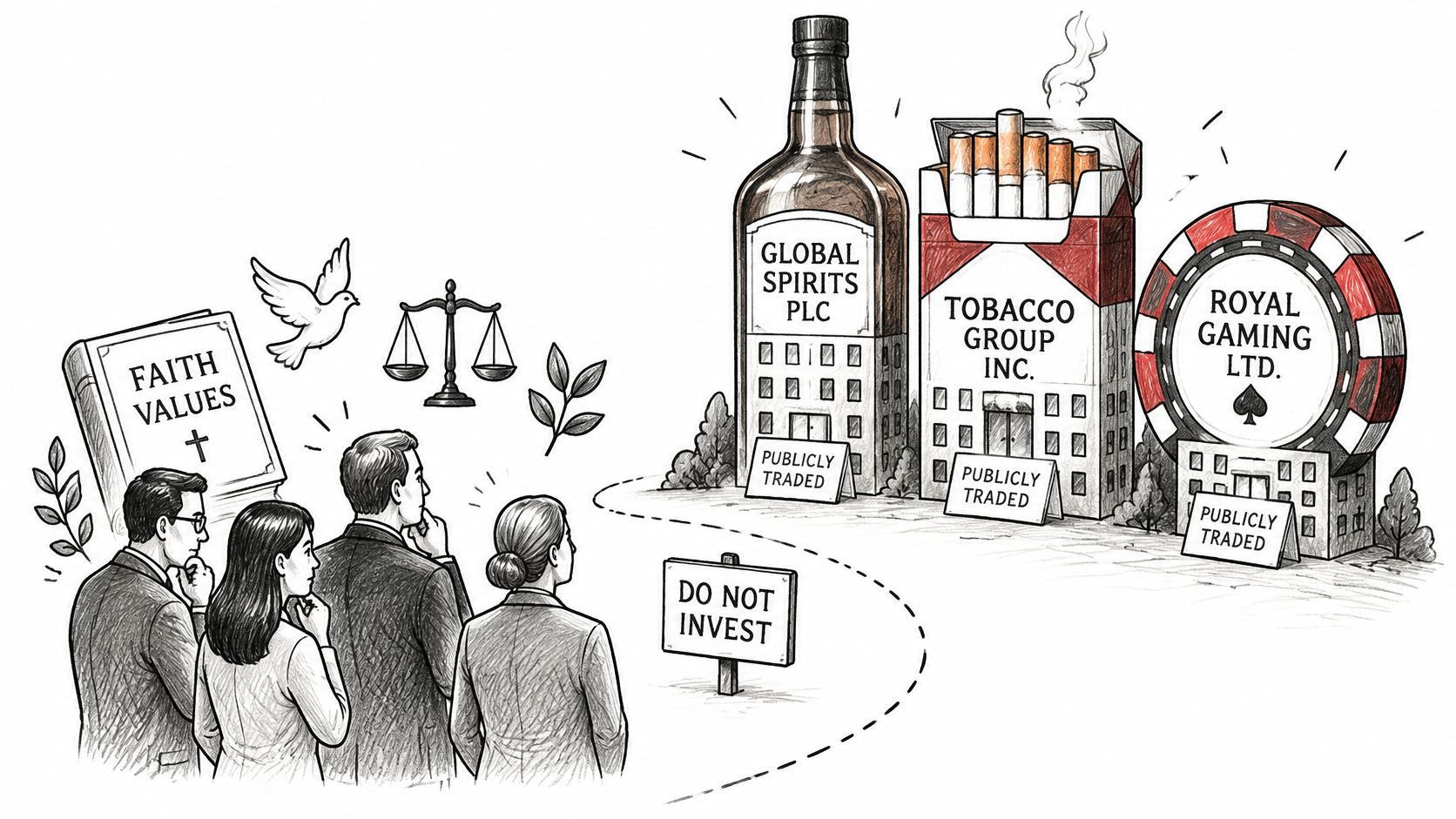
How the label became a research category
Economists Harrison Hong and Marcin Kacperczyk examined 193 distinct U.S. companies from 1926 through 2004, including 36 tobacco, 62 alcohol and 95 gaming firms, in their foundational study of the price of sin. They connected institutional avoidance with restricted ownership and found relatively high returns after controlling for conventional risk factors.
That made the category useful for studying how social norms affect financial decisions. If pension trustees or investment mandates prohibit certain holdings, their portfolio managers can't buy those shares because they appear attractive.
The resulting return hypothesis is commonly called the sin-stock premium. It's a hypothesis about investor restrictions and prices, not a promise that controversial businesses outperform.
Personal objections and religious obligations
An individual might exclude tobacco because of its health consequences, weapons because of their use or gambling because of its social effects. Another investor might choose different exclusions.
Religious screening adds a distinct rule system. Shariah screening considers both business activities and financial characteristics, so its exclusions extend beyond the conventional sin-stock category.
Practical rule: A company is called a sin stock because its activities fall within an exclusion category, not because of how well it's run.
Keep separate records for the ethical decision and the investment assessment. A company can fail your ownership rules while remaining profitable, or pass them while being a poor investment.
Industries Usually Classed as Sin Stocks
Industries commonly treated as sin stocks
| Industry | Typical activities | Usual screening status |
|---|---|---|
| Tobacco | Cigarettes, cigars, smokeless products | Common exclusion in ethical and Shariah screening |
| Alcohol | Brewers, distillers, vintners | Common exclusion in ethical and Shariah screening |
| Gambling | Casinos, online betting, lotteries | Common exclusion in ethical and Shariah screening |
| Weapons and defense | Arms, munitions, military components | Many ethical screens exclude weapons; Shariah treatment requires the applicable activity rules |
| Adult entertainment | Production and distribution of adult content | Common exclusion in restrictive ethical and religious screens |
| Cannabis | Recreational and medical cannabis growing and sales | Some ethical screens exclude it; check distinctions between recreational and medical activities |
| Nuclear power | Nuclear generation and fuel supply | Excluded by some ethical and environmental mandates, but not a universal exclusion |
| Conventional banking and insurance | Interest-based lending and conventional insurance | Excluded under Shariah business-activity screening |
The familiar list starts with alcohol, tobacco and gambling. Broader frameworks add activities according to the harm or obligation they're trying to address. That means there isn't a universal sin-stock universe.
Weapons illustrate why definitions matter. A mandate might prohibit all military sales, focus on particular weapons or distinguish dedicated manufacturers from suppliers with mixed civilian and military customers.
The economic exposure can be substantial: the Stockholm International Peace Research Institute's December newsletter reports that combined arms revenue among its Top 100 companies increased 26% in real terms between 2015 and 2024. That measures arms revenue, not stock-market returns or the size of every defense-related business.
Identify the activity, not just the industry name
A supermarket selling alcohol isn't operationally identical to a distiller. Likewise, a software supplier serving betting operators isn't necessarily classified like a casino owner.
For each holding, investigate:
- Direct involvement: Does the company produce or operate the prohibited activity?
- Distribution exposure: Does it sell someone else's products?
- Supporting services: Does it supply specialized equipment, technology or infrastructure?
- Revenue materiality: How much income comes from the activity the screen addresses?
These distinctions matter particularly for diversified companies. A broad industry code can miss a prohibited subsidiary or incorrectly treat a minor business line as the company's main activity.
Ethical frameworks may also add fossil fuels or controversial lending. Shariah frameworks address interest-based finance and other impermissible activities, so a conventional bank can fail even though mainstream investors wouldn't ordinarily call it a sin stock.
Use the table as an investigation list, not a final verdict. Find the relevant revenue segments, then apply your chosen standard's rules for involvement and materiality.
How Ethical and Shariah Screens Decide Exclusion
A screen turns an ownership policy into a repeatable decision. The important question isn't merely whether a company has an objectionable connection, but which connection counts and how the methodology measures it.
Screening approaches and how they decide
| Approach | How it decides | Typical example |
|---|---|---|
| Categorical exclusion | Any covered involvement removes the company | An ethical fund excludes every tobacco producer |
| Revenue threshold | Incidental prohibited income is tested against a permitted limit | A Shariah screen examines non-compliant income separately from core operations |
| Balance-sheet ratio | Defined financial items are compared with a prescribed denominator | Interest-bearing debt is tested using the methodology's valuation basis |
| Best-in-class or engagement | Select sector leaders or retain holdings to seek changes | A fund holds a company while pursuing governance or operational improvements |
These approaches aren't interchangeable. Categorical exclusion draws a firm boundary around ownership. A threshold-based approach allows a defined degree of incidental exposure, while engagement asks whether continued ownership can support a desired change.
Best-in-class selection and engagement are also distinct. Selecting the highest-rated company in an industry doesn't itself establish that an investor is actively influencing management.
Why business activity comes first
A conventional lender doesn't become Shariah-compliant by reducing its own borrowing. Its core revenue-generating activity must qualify before a balance-sheet test becomes relevant.
Incidental exposure requires a different assessment. Say a manufacturer earns interest on surplus cash. The reviewer needs to identify that income and apply the chosen methodology rather than treating the manufacturer as if it were a bank.
A strong financial position can't turn a prohibited core business into a permitted one.
For investors still defining their objectives, Everglow Prosperity's guide to explore values-based investing provides context for turning personal concerns into portfolio criteria. That exercise should precede choosing a rating or copying a fund's exclusions.
Religious compliance requires a named methodology rather than a general sustainability score. Record the standard and its version, along with the decision, because a label without calculation rules isn't reproducible.
The practical distinction is between a moral preference, a religious requirement and a financial judgment. You may apply all of them, but each needs its own evidence and decision process.
How to Run a Shariah Screen Step by Step
A defensible manual screen starts with the current methodology document and ends with a calculation record someone else can reproduce. Don't hard-code a threshold from an unsourced summary or assume every implementation defines debt, cash and income identically.
The workflow below provides a practical review sequence. Use the rules accepted by your Shariah adviser or mandate for the actual limits and accounting definitions.
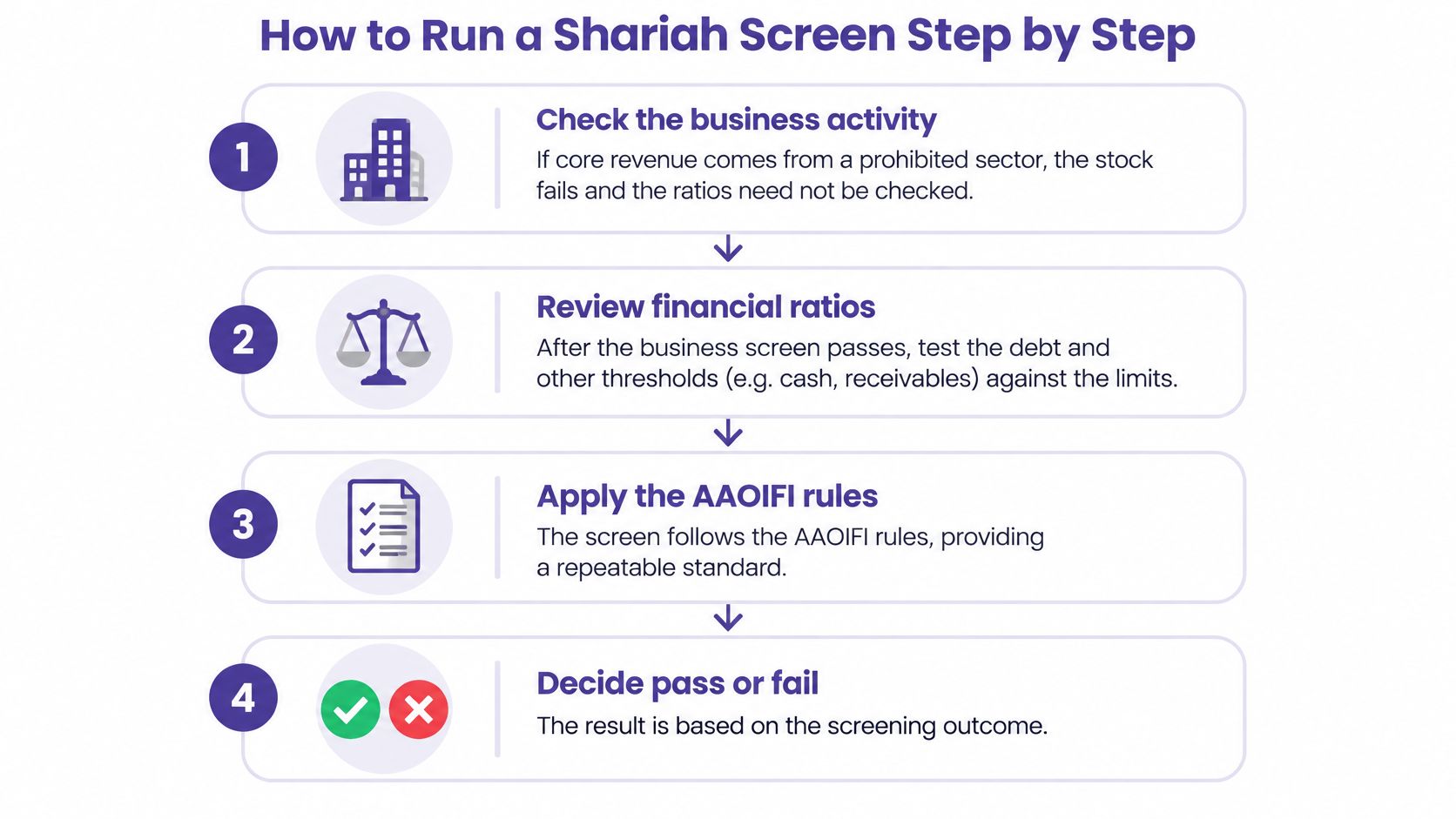
Build the calculation record
Check the business activity. Read the business description and segment disclosures to establish what the company sells. The common slip is trusting an industry label while overlooking a prohibited core operation or subsidiary.
Open the latest relevant filings and collect the supporting statements and notes. We source U.S. tickers from SEC EDGAR 10-K and 10-Q filings, UK tickers from Companies House annual accounts, and Canadian tickers from SEC 40-F filings plus company investor relations reports; the common slip is combining figures from different reporting periods without reconciliation.
Identify prohibited income. List each relevant income source, classify it under the selected standard and divide the required numerator by that standard's revenue denominator. Don't omit interest income merely because it appears outside operating revenue, or add it to the denominator without checking the rule.
Calculate the debt test using the methodology's definition of interest-bearing obligations and its prescribed denominator. A frequent mistake is substituting today's market capitalisation for a required historical average, which can change the result without any change in borrowing.
Calculate the applicable liquidity test. Inspect cash and investment notes rather than copying a combined balance-sheet heading, then include only the items required by the rule. The common slip is assuming that every short-term investment has the same treatment or that the debt denominator automatically applies unchanged.
Save the inputs, units, currency, reporting period, filing reference and calculation date. Don't round intermediate results so aggressively that a borderline company appears comfortably inside a limit.
Run a second methodology independently. Rebuild the calculations using its definitions, denominators and limits instead of applying a different label to the original answer. The common slip is interpreting disagreement as an arithmetic error before comparing the rules.
Review the result before relying on it
Our guide to checking whether a company is Shariah-compliant provides a companion workflow for organizing the review. Keep the original disclosures beside your spreadsheet so another reviewer can trace each input.
A clean result means the activity assessment passes, every required financial test meets the applicable rule and no material input remains unresolved. Missing information isn't evidence of compliance.
For a borderline result, preserve the unrounded calculation and identify what would change the classification. That could be a new filing, a revised revenue breakdown or a change in the valuation denominator. A screening result is a dated assessment, not a permanent characteristic of the stock.
Why Screening Verdicts Differ Between Providers
One app marks a stock acceptable; another says avoid it. Before deciding which app is wrong, compare what each one tested.
The same company can receive different verdicts under internally consistent rules. A useful comparison starts with the calculation, not the color of the badge.
Trace the disagreement to its source
| Possible cause | What to inspect |
|---|---|
| Denominator | Market capitalisation, total assets or another defined base |
| Averaging window | Historical valuation window and observation frequency |
| Intermediate status | Treatment of uncertainty, missing inputs and doubtful exposure |
| Sector taxonomy | Included activities, supplier rules and materiality definitions |
| Effective date | Filing period and market information used |
A market-value denominator changes with the share price; an asset-based denominator follows the accounts. After a sharp repricing, those approaches can produce different answers even when both providers extracted identical debt figures.
Averaging choices matter too. A longer window retains older valuations for longer, while a shorter window responds more quickly to a recent market move.
Some systems preserve an uncertain middle category. Others publish a binary result or withhold a verdict. Those outputs shouldn't be compared as if they express the same level of confidence.
A sector label isn't a valuation model
A matched-firm analysis summarized by the Harvard Law School Forum on Corporate Governance found no abnormal monthly return after extensive controls and no material difference in the cost of new equity. Its findings also caution against inferring valuation differences from a controversial-sector label alone.
For analysts, that means separating direct operating involvement from diversified exposure, and retaining financial characteristics rather than storing only a sector flag.
Our explanation of why halal apps disagree about the same stock helps structure that comparison. For boards overseeing an investment policy, ESG Consulting's sustainability training for board members is relevant to the governance task of defining objectives and understanding how assessments are used.
Before challenging a verdict: Collect the standard name, denominator, averaging window, effective date and revenue evidence.
A disagreement can come from methodology, timing, extraction or judgment. Diagnose those possibilities before calling it a data error, and don't assume that matching verdicts prove matching calculations.
What the Sin-Stock Return Evidence Shows
Reported sin-stock return evidence
| Study or comparison | Period | Reported finding |
|---|---|---|
| Hong and Kacperczyk, U.S. sin firms | Historical U.S. securities sample | Relatively high returns after conventional risk controls |
| Long sin stocks, short comparable firms | Historical factor-adjusted comparison | Positive relative performance in the reported sample |
| U.S. tobacco versus overall market | Long-run industry history | Substantial annualized outperformance |
| UK tobacco versus overall market | Long-run industry history | Annualized outperformance over its comparison period |
| Vice Fund versus Vanguard FTSE Social Index | Comparison period not specified in the available summary | Vice-oriented fund outperformed |
| Excluding sin stocks, U.S. equities | Historical sustainable-pricing sample | A measurable exclusion-related effect, not a forecast |
| Matched-firm analysis | Sample period not specified in the available summary | No abnormal monthly return after controls |
The London Business School discussion of vice investing reports that U.S. tobacco outperformed the overall equity market by approximately 4.5 percentage points annually over 1900–2014, while UK tobacco exceeded its broad market by about 2.6 percentage points annually over 1920–2014.
Those are striking historical outcomes. They don't establish that every excluded industry shares the same return pattern, or that an investor buying today can expect the historical difference.
Distinguish a return from an explanation
A raw return tells you how an investment performed. A relative return compares it with a benchmark. A factor-adjusted return attempts to separate performance from exposures such as market risk, company size, valuation and profitability.
The interpretation changes with the comparison. If excluded firms tend to be profitable, mature businesses, apparent outperformance might reflect those characteristics rather than exclusion itself.
A sustainable-capital-asset-pricing study in the Review of Finance estimated an average annual exclusion-related effect of 2.79% for U.S. equities over 1999–2019. Treat that as a sample- and methodology-dependent estimate, not a forward-looking alpha forecast.
A peer-reviewed study in the Journal of Sustainable Finance & Investment found no strong evidence of a distinct sin premium or discount after accounting for relevant factor exposures and unreliable classification data. That challenges the simple claim that ethical avoidance necessarily creates a dependable bargain.
Ownership preferences and corporate financing aren't the same
Avoiding a share also doesn't automatically deprive the issuer of operating cash. Buying or selling an existing share usually transfers ownership between investors rather than providing new financing directly to the company.
The Columbia Business School study of negative screening found that institutional ownership and valuation differences disappeared after controlling for fundamentals, with no difference in new-equity financing costs or public-market exit likelihood. It nevertheless found a higher cost of new debt for sin firms.
That distinction matters. An exclusion can express an investor's values without having the precise financing effect the investor assumes.
Before acting on any performance headline, ask:
- Return definition: Is it raw, benchmark-relative or factor-adjusted?
- Sample design: Which industries, markets and dates are included, and how are failed firms handled?
- Portfolio construction: What weighting, rebalancing, fees and transaction costs apply?
The defensible conclusion is narrower than a universal sin premium: some controversial industries have delivered exceptional historical returns, but the explanation and persistence remain contested.
Decide Which Screen Fits Your Portfolio
Choose the screen by the decision you need to make, not by whichever label looks most reassuring.
The choice begins with your ownership objective.
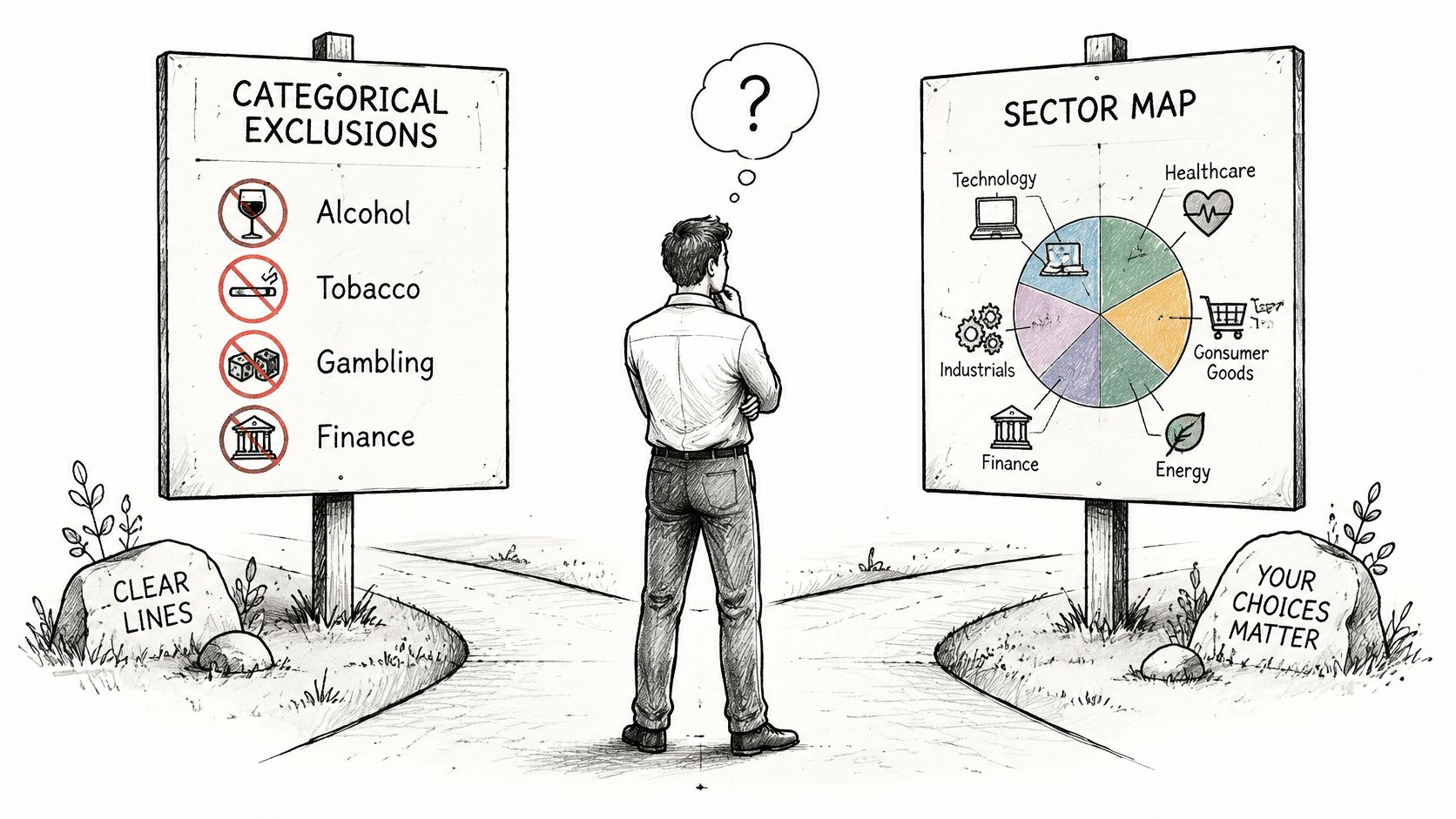
Match the evidence to your objective
For personal values, write an exclusion policy that names activities and acceptable involvement. Wealth Collective's guide to building a values-aligned investment portfolio provides additional context for translating preferences into investment choices.
For Shariah compliance, use the methodology your mandate or religious adviser accepts and preserve the supporting calculations. Fund investors should examine constituent holdings rather than infer compliance from branding; our guide to halal ETFs addresses that additional layer.
For return-focused investing, evaluate the business and price independently of the moral label. Compare sector exposures, financial risks and factor-adjusted performance before making a portfolio tilt.
For an additional educational resource, the video is embedded below.
Make every verdict auditable
For research or product development, retain the methodology, threshold definitions, denominator, observation date and benchmark alongside the classification. Design your application to distinguish an actual failure from an uncomputed or uncertain result.
Our API has five stock endpoints and six ETF endpoints, all REST over HTTPS and returning JSON; /compliance supplies a one-line halal verdict for a stock. Treat that concise output as a decision aid, while using supporting reports when your workflow requires an explanation.
This week, pick a stock you own, complete the manual screening sequence and compare it with another accepted methodology. Save the calculations and write a short explanation of any disagreement before making a trading decision.
Akinda offers Shariah screening for stocks and ETFs, with AAOIFI as its primary methodology and parallel assessments under other standards. Visit Akinda to explore screening outputs and supporting financial reports for an auditable investment workflow.