Halal Screening API Pricing vs Institutional Data Feeds (2026)
A single Bloomberg seat runs roughly $32,000 a year and still ships zero Shari'ah verdicts. Here's how usage-based halal screening API pricing compares — and what actually drives the cost.
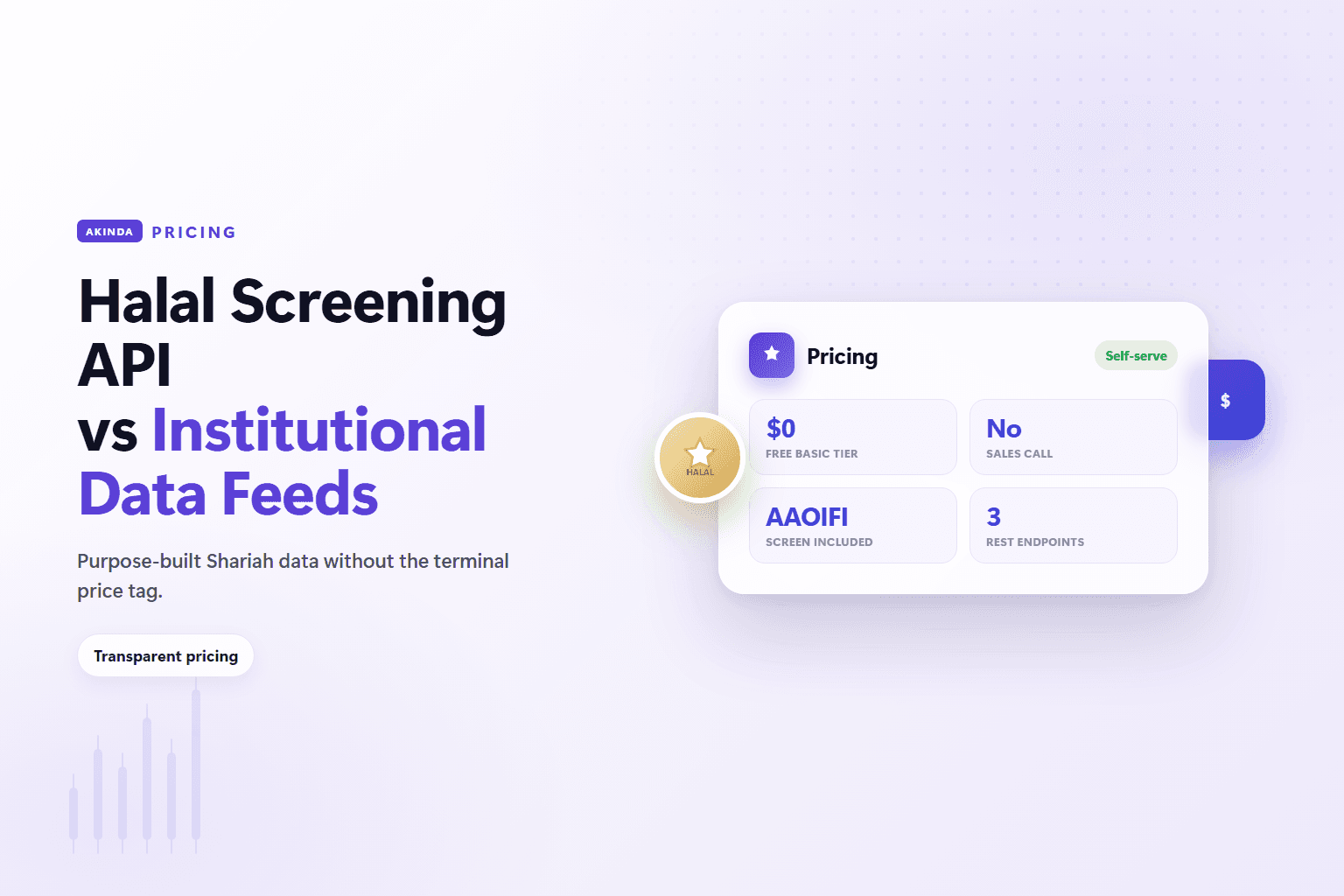
If you're pricing out a halal investing product, the first sticker shock usually comes from traditional market-data feeds. A single Bloomberg Terminal seat is widely estimated at around $32,000 a year, its enterprise data API can reach six figures, and none of it includes a Shari'ah compliance layer. A purpose-built halal screening API is a fundamentally different model — self-serve, usage-based, and starting from a free tier. This guide compares the two, explains what actually drives the cost of Shari'ah screening, and helps you reason about total cost of ownership.
Quick answer
What institutional data feeds cost
Traditional market-data terminals are priced for large institutions — per seat, on annual or multi-year contracts, at opaque, negotiated rates. List prices are rarely published, but widely cited industry estimates put the majors roughly here:
- Bloomberg Terminal — ~$32,000 / seat / year, typically on a ~2-year contract
- FactSet — ~$12,000–$50,000 / seat, with modular add-ons
- LSEG Workspace (Refinitiv) — ~$14,000–$24,000 / seat
- S&P Capital IQ Pro — ~$12,000–$30,000 / seat
- Bloomberg B-PIPE (data API) — ~$50,000–$200,000+, enterprise and volume-based
Those are per-seat numbers. A five-person desk on Bloomberg is comfortably into six figures a year before add-ons, and the enterprise data-API products that let you pull data programmatically are priced higher still. Contracts typically lock you in for one to two years with limited room to scale down.
Why traditional feeds fit halal screening poorly
Beyond the price, institutional feeds are a poor structural fit when what you actually need is Shari'ah compliance data:
- They don't include Shari'ah screening. A Bloomberg or FactSet seat gives you raw financial data, not halal verdicts. You'd still have to build the screening engine and encode the methodology on top — paying twice, in effect.
- They're priced per seat, not per call. Terminal licensing is designed for human analysts at desks, not for an app making programmatic screening calls for thousands of users.
- They require enterprise procurement. Opaque pricing, sales negotiations, and multi-year commitments are the opposite of the self-serve, ship-this-week workflow most fintech teams want.
- They're built for breadth you may not need. You're paying for real-time trading, messaging, and cross-asset analytics when your product needs one thing: is this stock halal?
For a halal investing product, paying institutional-terminal prices for general data and then building the compliance layer yourself is the most expensive path available. (For a like-for-like look at the purpose-built options, see the halal stock API comparison.)
How halal screening API pricing works
A purpose-built halal screening API uses a modern, developer-first pricing model rather than per-seat licensing. The typical shape:
- A free tier to evaluate and prototype without a credit card or a sales call, so you can confirm the data fits before you commit.
- Usage- or tier-based pricing that scales with how much you actually call the API, rather than how many people sit at a desk.
- Self-serve onboarding where you generate a key and start building the same day.
- The Shari'ah layer included — the verdict comes with the free tier, and the AAOIFI ratios come with the paid tiers, not as a separate build.
Here is what the free tier actually returns. A single call to the compliance endpoint gives you a verdict — no credit card, no sales call:
cURL
curl -H "X-API-Key: YOUR_API_KEY" "https://b2b-api.akinda.io/api/v1/compliance/AAPL"
JSON
{
  "company_name": "Apple Inc.",
  "halal_status": "HALAL",
  "ticker": "AAPL"
}
Current verdict: Halal
HALAL on the free tier — and Microsoft (MSFT) does too. Paid plans layer the AAOIFI ratios and full SEC-extracted figures on top of that same verdict.That verdict is the free Basic tier: the GET /compliance/{TICKER} endpoint, 200 calls a day, ticker as a path parameter, authenticated with an apikey query parameter or an X-API-Key header. This is the Akinda model in miniature — start free from the dashboard, then move to a personal or business plan as your volume and depth needs grow. Because pricing scales with usage, a small product pays a small amount, and the entry cost is a tiny fraction of one institutional-terminal seat.
What drives the cost of a halal screening API
Not all halal screening APIs are priced the same, and the differences usually reflect what you're actually getting:
- Coverage. How many markets and securities are screened. Akinda covers US tickers broadly, with UK (
.L) and Canada (.TO) listings on higher tiers — broader coverage costs more to maintain. - Methodology depth. Whether you get a bare verdict (
/compliance), the three core AAOIFI ratios (/basic-report), or full AI-extracted SEC figures with their dollar counterparts (/full-report). The Akinda ranking pillars —ranking_score,profitability_score, and the rest — sit on the top Business Ultimate and Enterprise tiers. - Governance. A published, auditable methodology (AAOIFI Shari'ah Standard No. 21) adds real value — and cost — versus an unaccountable, black-box flag.
- Freshness. How often companies are re-screened as their financials change.
- Support and reliability. Commercial support and higher rate limits on business plans, versus self-serve on the free tier.
The Akinda API's methodology follows AAOIFI Shari'ah Standard No. 21 and is published in full, so what you pay for is transparent, auditable compliance data — not a black box. Purification is handled separately: the akinda_calculate_purification tool on the Akinda MCP server computes how much income to purify, and is available on paid plans.
Total cost of ownership: build vs buy vs feed
The honest comparison isn't just the sticker price of an API — it's the total cost of each path to getting halal verdicts into your product.
- Build in-house. License financial data, build and maintain a screening engine, model purification, and encode a defensible methodology — then re-screen everything each quarter as financials change. It's specialized, ongoing work, and the Shari'ah expertise it needs is a small talent pool.
- Buy an institutional feed and build on top. Pay per-seat terminal or enterprise-API prices for raw data, then still build the compliance layer yourself. The most expensive option, because you carry both costs.
- Buy a halal screening API. Integrate a maintained, AAOIFI-based compliance layer through a few endpoints, on usage-based pricing that starts free. The lowest total cost for most teams, and the fastest to ship.
For the large majority of fintechs and platforms, the third path wins on both cost and time-to-market — which is why API-first compliance has become the default for new halal products. If you're a brokerage or robo-advisor weighing this decision, the robo-advisor and brokerage integration guide walks through it in detail.
How Akinda prices
The Akinda Halal API is priced to let you start for free and scale on usage, with the AAOIFI-based Shari'ah layer included rather than bolted on. Because exact limits and prices change over time, the authoritative source is always the pricing page — which shows the free Basic tier plus personal and business plans — and the dashboard, where you generate a key. The headline point stands regardless of the exact numbers: a halal screening API's entry cost is a small fraction of one institutional-terminal seat, it scales with usage rather than headcount, and it includes the compliance layer a raw data feed makes you build yourself.
Frequently asked questions
How much does a halal screening API cost?
Far less to start than an institutional data feed. Halal screening APIs typically offer a free tier and then usage- or tier-based pricing, so a small product pays a small amount and scales as it grows. For the Akinda API's exact plans and limits, check the pricing page, since these change over time.
Why is a halal screening API cheaper than Bloomberg or FactSet?
Because the models are different. Bloomberg (~$32,000/seat/year) and FactSet (~$12,000–$50,000/seat) charge per seat for broad, real-time market data on multi-year contracts, and neither includes Shari'ah screening. A halal screening API charges based on usage, starts free, and includes the compliance layer — so it solves the specific question, "is this stock halal?", without the terminal overhead.
Do institutional data feeds include Shari'ah screening?
No. Terminals like Bloomberg, FactSet, and LSEG Workspace provide financial data, not halal verdicts. If you use them, you still have to build the screening engine and encode a methodology yourself — which is why pairing a raw feed with an in-house build is the most expensive route to a halal product.
What should I compare besides price?
Coverage, methodology depth, governance, freshness, and support. A cheap API that returns an unaccountable flag is worth less than one with a published, auditable AAOIFI methodology and the ratios behind each verdict (with purification available through the MCP server). Weigh total cost of ownership — including what you'd otherwise build — not just the headline number.
Is there a free halal screening API?
Yes. The Akinda Basic tier is free: the /compliance/{TICKER} endpoint at 200 calls a day, so you can evaluate and prototype before paying. Generate a key from the dashboard and test it, or read more in the free halal stock screening API guide — something institutional feeds, with their sales-led procurement, rarely offer.
Not financial or religious advice
Verify it yourself via the Akinda API
Fire a live /full-report/<ticker> call from the playground using your own API key — see the compliance ratios, AAOIFI screen verdict, and source-breakdown fields the methodology produces.
Related reading