
Buy the platform with the longest feature list and you'll usually buy the wrong kind of monitoring. That's the popular advice behind most shortlists, and it fails because compliance monitoring software covers failures that have almost nothing in common. An employee trading ahead of a client order, a rule change nobody mapped to a control, and a halal label you can't defend to an auditor require different data, alerts, and evidence.
The market's size explains the confusion. Grand View Research's compliance software market report places the worldwide compliance software market at approximately USD 35.8 billion in 2025, with projected growth to USD 78.8 billion by 2033. Vendors from GRC, trade surveillance, financial crime, and investment screening all compete for that budget, so category labels tell you little about fit.
Adoption also isn't maturity. In a 2025 survey of 200 U.S. financial-services professionals, the Finextra compliance report found 72% reported using data analytics and 66% using artificial intelligence, yet only 3% said their existing technology stack fully satisfied compliance needs. Judge each tool below by what it monitors, how it alerts, what its reports prove, and what it connects to. If privacy is your adjacent problem, compare those trade-offs separately in this guide to privacy platform pricing and feature trade-offs.
Table of Contents
- 1. Akinda
- 2. Hadrius
- 3. ACA ComplianceAlpha
- 4. MyComplianceOffice (MCO)
- 5. StarCompliance
- 6. Skematic
- 7. Comply
- 8. MetricStream Regulatory Compliance Management
- 9. Archer Evolv Compliance (formerly Compliance.ai)
- 10. Oracle Financial Crime and Compliance Management (FCCM)
- How the ten tools differ in monitoring scope, alerts and reporting, and pricing visibility
- Matching the Tool to the Failure You Need to Catch
1. Akinda
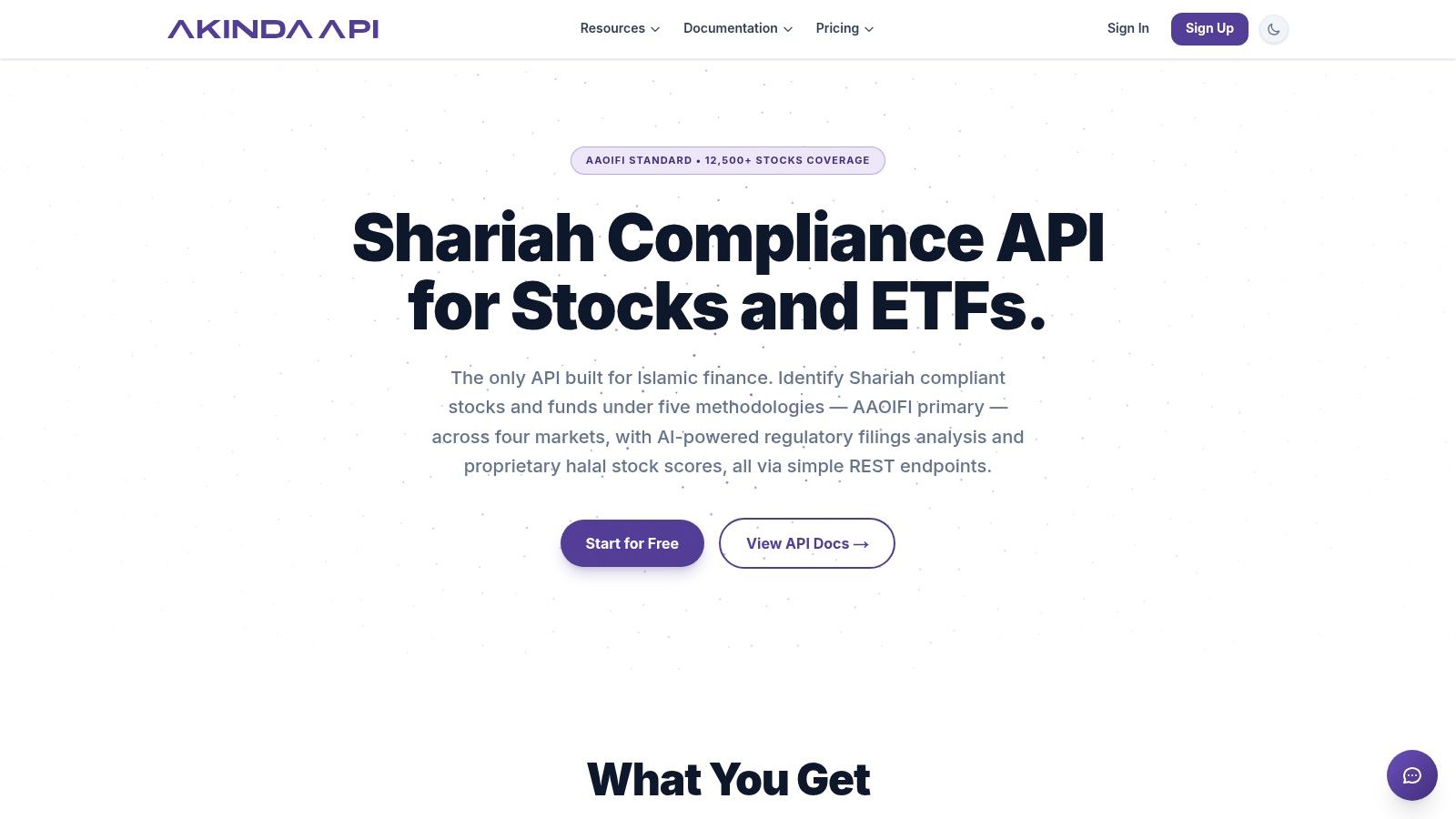
Most tools in this list monitor your firm's own people and controls. Akinda monitors the securities your product puts in front of investors. It's a developer focused REST API for Shariah stock and ETF screening in investment apps, robo-advisors, and research tools, built so you don't have to construct a filings analysis pipeline yourself. The primary framework is AAOIFI Shari'ah Standard No. 21, with parallel outputs for Dow Jones Islamic Market, FTSE Shariah, MSCI Islamic, and S&P Shariah, because those rulebooks can classify the same issuer differently.
Coverage spans the United States, United Kingdom, Canada, and Uzbekistan, across more than 16,500 stocks and ETFs. Responses return verdicts of HALAL, NOT HALAL, or DOUBTFUL, plus debt and liquidity ratios, non-compliant income, source level financial detail, and proprietary scores. That evidence chain matters. The EY survey of AI governance found in a 2025 survey of 57 companies that 70% lacked well-defined AI governance models and only 10% were fully prepared for AI-system audits. A bare pass or fail label won't survive that scrutiny.
What the reports actually show
- Full report endpoint: Returns the verdict, halal rating, every underlying ratio, and the AI extracted financial breakdown in one JSON response.
- Holdings based ETF screening: Evaluates constituents and portfolio weights with coverage information, refreshed nightly, rather than trusting a fund name.
- Developer integration: Endpoints include /api/v1/compliance, /api/v1/full-report, /api/v1/methodology, and /api/v1/verdict-changes, alongside documentation, an interactive viewer, code examples, and an MCP server.
- Change monitoring: Eligible business plans add verdict change feeds and webhooks.
The limits are real. Ratios update from filings quarterly, not in real time, and there's no live price feed. ETF endpoints, multiple methodology data, and change feeds sit on higher tiers, so confirm plan access before you design around them. A limited free tier lets you test first. For selection criteria, see this guidance on how to choose a Shariah compliance API, then visit the Akinda B2B site. I recommend it when the failure you're preventing is an indefensible investment verdict, not an internal policy breach.
2. Hadrius
If your examiners ask who tested a control and where the record lives, start here. Hadrius is built for RIAs, broker-dealers, private funds, and compliance consultants that need ongoing testing and program oversight in one system. It consolidates employee monitoring, account surveillance, communications review, and marketing review instead of forcing you to stitch point tools together.
Monitoring scope
- Compliance testing: Tracks risks, annual reviews, and audit ready reports.
- Trading surveillance: Monitors employee and firm trading against rules, restricted lists, and blackout periods.
- Attestations: Handles certifications and personal trading oversight.
- Communications and marketing: Routes reviews through exception handling and evidence workflows.
The strength is consolidation with documented, exam ready records, which suits firms running several supervision workflows at once. The trade-off is breadth you'll pay to implement even if you only need one workflow. Pricing isn't publicly listed, so budget for a sales led evaluation and press for implementation scope in writing. It's also not a Shariah stock or ETF screening data service, and it won't supply security level verdicts for an investing product. Choose it for firm supervision, not portfolio screening.
3. ACA ComplianceAlpha
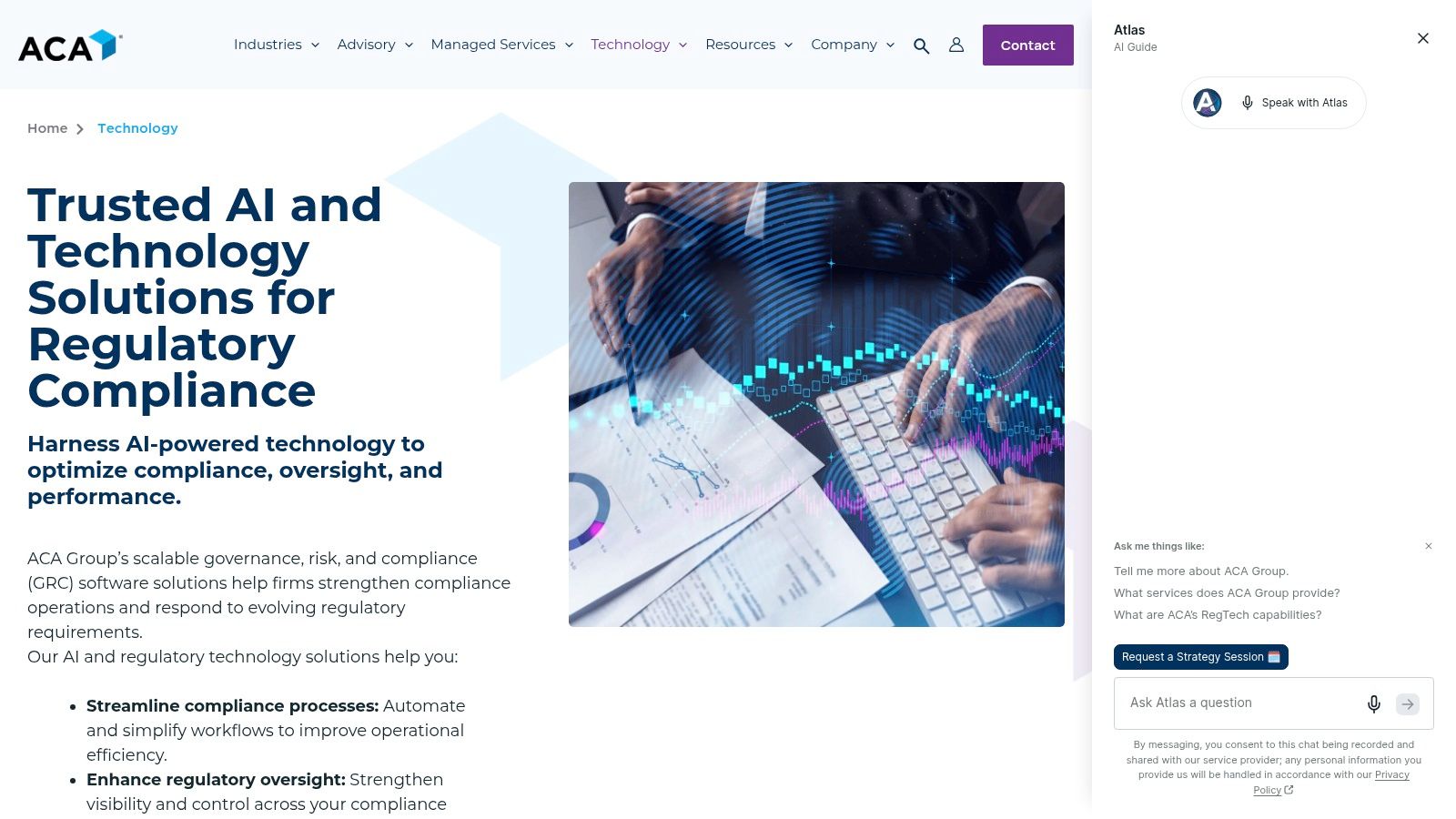
Some firms don't want software alone. They want specialists who'll help run it. ACA ComplianceAlpha pairs a modular platform with advisory and managed services, covering compliance management, employee conduct, trading and communications surveillance, marketing review, AML and KYC, training, and regulatory workflows.
That model works when your team is thin and the failure you're preventing is an unowned task rather than a missing dashboard. You can add modules over time instead of replacing the system as obligations grow. The workflows are also shaped for investment firms, which makes them more targeted than general GRC software that treats a trade alert like any other ticket.
Software plus services only helps if accountability is explicit. Get in writing which tasks ACA owns, which your team owns, and who signs off.
The downsides follow from the scope. A wide module and service catalogue needs careful scoping, or you'll license capability nobody uses. Pricing is customized and not publicly listed. I wouldn't buy it for a single narrow monitoring job, since the services relationship is the point. Buy it when you'd otherwise hire compliance headcount to operate a cheaper tool.
4. MyComplianceOffice (MCO)
Trade surveillance fails in a specific way. The alert fires, nobody investigates it properly, and the file is empty when an examiner asks. MyComplianceOffice targets that gap for investment advisers, broker-dealers, hedge funds, and investment managers by linking detection to case work.
Its tools cover employee personal trading pre-clearance and post-trade review, with configurable surveillance rules for unusual patterns and restricted list issues across firm, client, and employee activity. Alerts move into case workflows to investigate, document, and resolve them, and broader employee compliance functions sit alongside.
- Best fit: Firms monitoring trading activity for conflicts and policy breaches.
- Strong point: Configurable rules mapped to your own policies, not only vendor defaults.
- Evidence: Investigations tied to documented audit records.
Configurability cuts both ways. Scope and implementation effort vary by firm, and badly tuned rules produce noise your team will start ignoring. Pricing isn't published on the reviewed pages. Before signing, confirm exactly which feeds, asset classes, and surveillance scenarios are included, and test with your messiest real accounts rather than a clean demo set.
5. StarCompliance
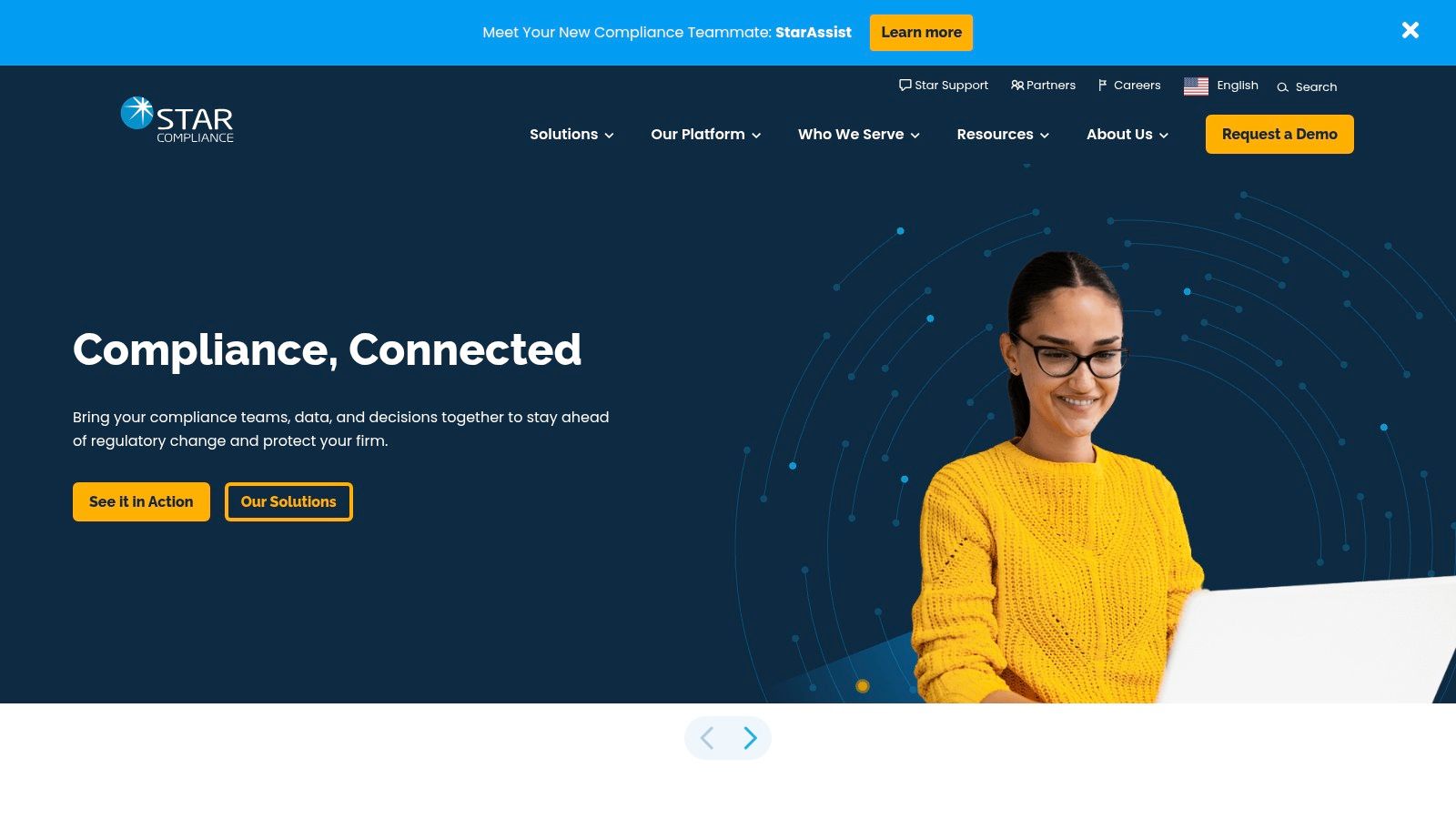
Employee conflicts are this platform's entire focus. StarCompliance covers personal account dealing, gifts and hospitality, outside business activities, political contributions, and insider trading controls for financial organizations. If pre-clearance volume is burying your compliance team, that specialization is the argument.
Employees submit trade requests that are assessed against firm defined rules, supported by trade and holdings data spanning securities such as ETFs and digital assets. Gifts, outside activity, and certification workflows run in the same system, with case management and audit records for potential breaches. Mobile and web submission matters more than vendors admit, since employees who find pre-clearance painful find ways around it.
Where it stops
It's primarily an employee and firm compliance platform, not a general regulatory obligations tracker, and public pricing isn't listed. Validate broker feed availability and asset class coverage against your actual employee accounts before committing. The build or outsource question behind tools like this mirrors the one in screening, explored in this build versus buy analysis for Shariah screening. Either way, you're deciding who maintains rules and data feeds over time.
6. Skematic
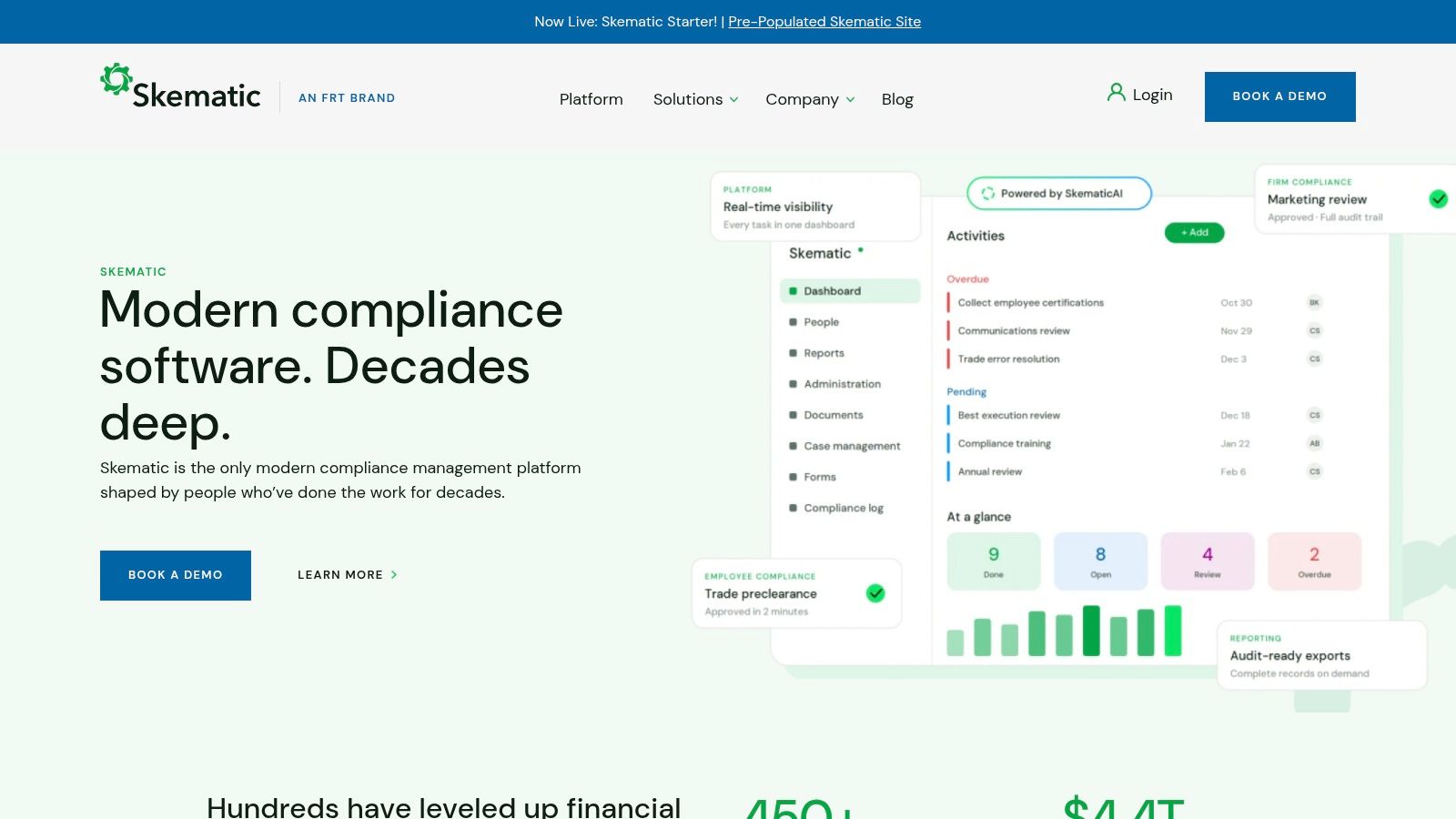
Skematic connects written policies and procedures to operational tasks, surveillance, investigations, and reporting for financial services firms. Its focus is the handoff from policy to execution: teams can track compliance work as it moves from stated requirements to assigned tasks and oversight.
The platform covers task management, certifications, pre-clearance, and personal trade alerts. Case management supports investigations and issue resolution, while reporting and analytics help document oversight for audits. For firms whose main problem is scattered spreadsheets and missed follow-ups, this joined-up workflow may matter more than another alert engine.
- Program management: Link policies to daily activities.
- Monitoring support: Manage certifications, pre-clearance, and trade alerts in one workflow.
- Reporting: Use analytics to document oversight for audits.
Pricing is not published. Request a quote and ask for reference customers to assess day-to-day fit. Confirm which monitoring data sources and integrations are included rather than assuming feeds are native. Teams embedding investment screening should also assess the integration requirements described in this guide to Shariah screening for robo-advisors and brokerages.
7. Comply
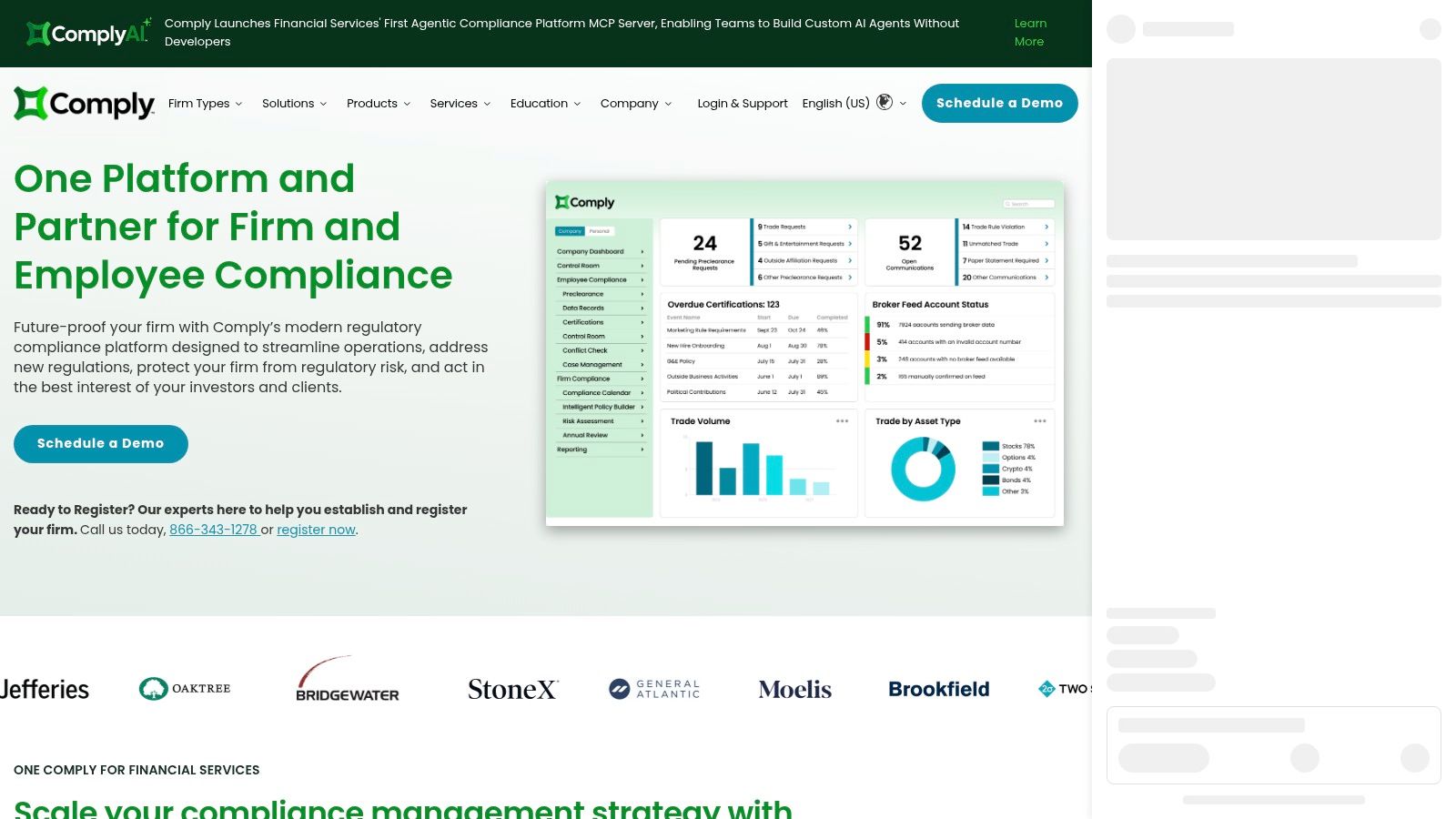
Comply sells software and services together for private funds, investment banks, RIAs, broker-dealers, and hedge funds. Its employee trade monitoring covers account activity through broker feeds, pre-clearance, alerts, and investigation records. Optional services add regulatory filings and compliance reviews.
The alert set is practical rather than exotic. It flags potential conflicts, insider trading, front-running, and excessive trading, with pre-clearance checked against firm rules and restricted lists. Digital asset employee trade monitoring is a genuine differentiator if your staff hold crypto and your current process is an annual attestation and hope.
Test this first: Feed in your hardest broker connection during evaluation. Trade monitoring is only as complete as the accounts it can actually see.
Scope varies by customer type and selected offering, and pricing is quote based, so pin down what's software, what's a paid service, and what renews automatically. It's focused on firm and employee compliance, not public company screening for investment products. I recommend it when you want monitoring plus filing and review support from one vendor and you're willing to manage that bundle actively.
8. MetricStream Regulatory Compliance Management
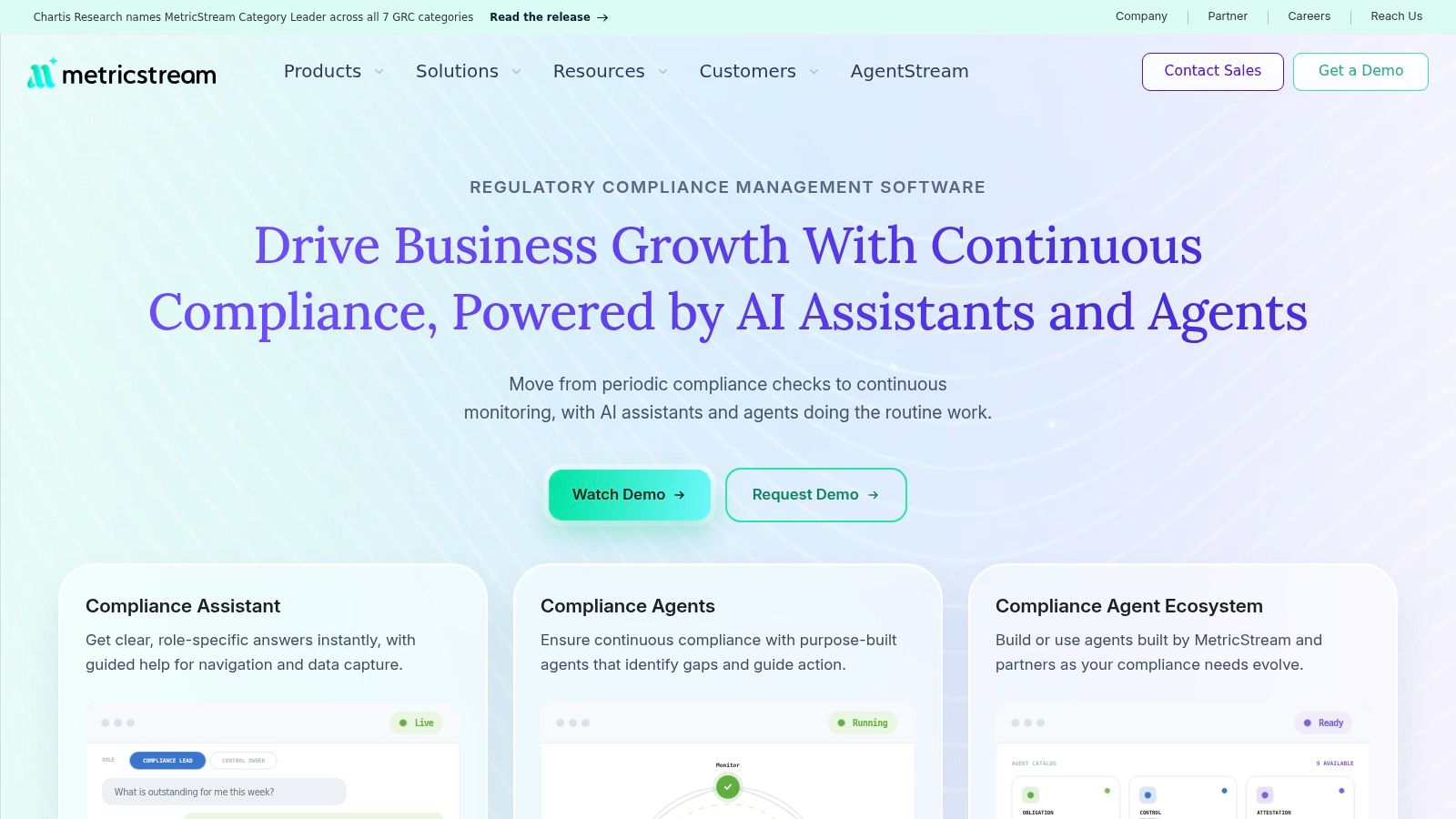
At enterprise scale, the failure changes. It isn't one missed trade. It's a regulation that changed in one jurisdiction while three business units kept running the old control. MetricStream is an enterprise GRC platform built for that problem, connecting regulatory updates to policies, controls, risks, and remediation workflows.
What it manages
- Regulatory intelligence: Alerts linked to controls, policies, and risks.
- Control testing: Assessments, self assessments, and testing plans.
- Remediation: Issue workflows and management dashboards.
- Engagement records: Case, incident, and regulatory engagement management.
That regulation to control traceability is what large, multi framework organizations need from compliance monitoring software, and dashboards give management a defensible oversight view. The cost is implementation and governance effort that smaller firms don't need. Public pricing isn't listed. It's also a general system, so it won't provide specialized trading surveillance data or holdings screening verdicts. Buy it to coordinate obligations across departments, then feed it with specialist tools rather than expecting it to replace them.
9. Archer Evolv Compliance (formerly Compliance.ai)
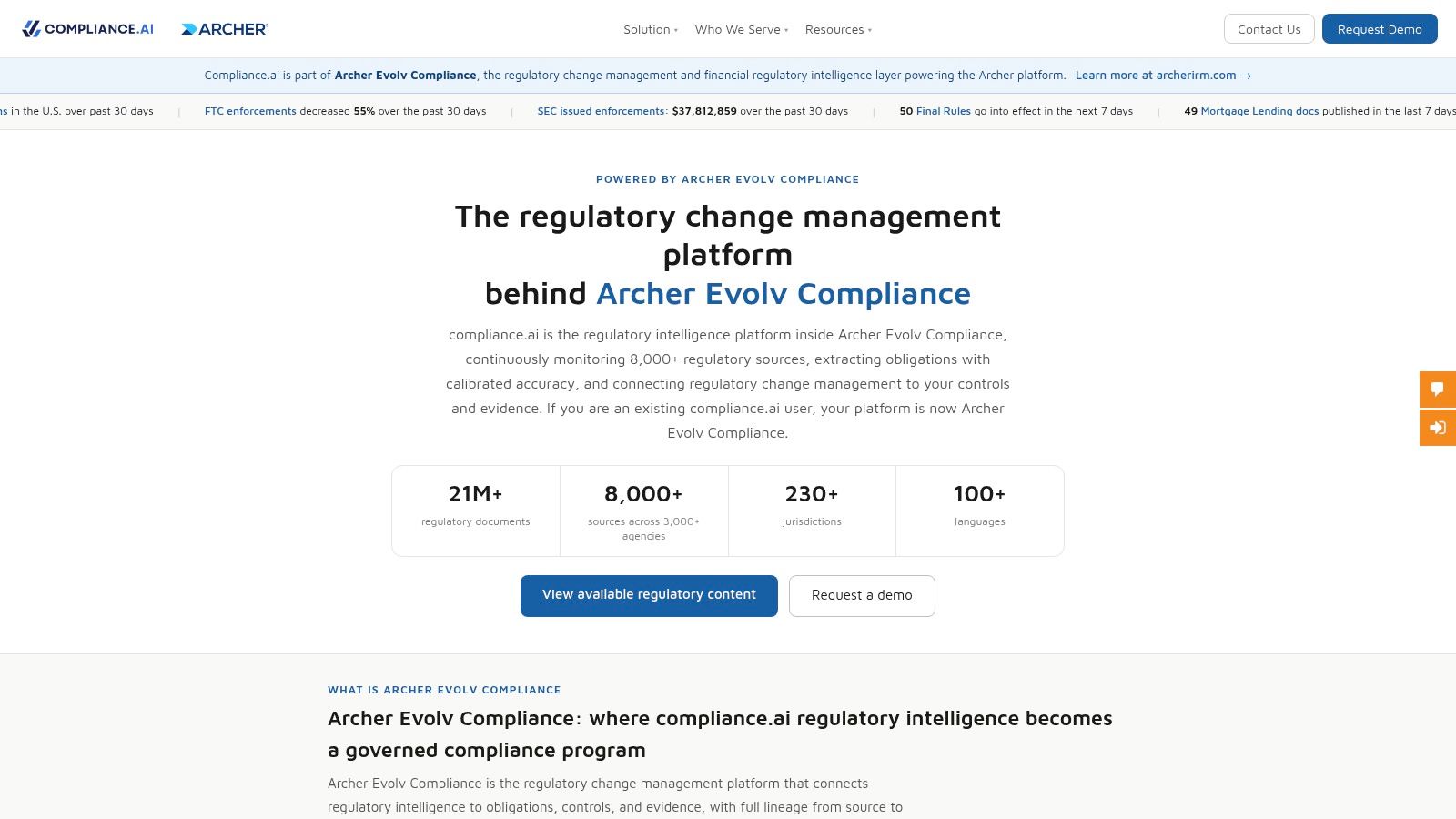
Reading every regulatory publication yourself doesn't scale, and skimming them is how obligations get missed. Archer Evolv Compliance monitors regulatory sources, identifies relevant changes, and helps teams map obligations to controls and evidence. Its job is tracking changing requirements and documenting your response.
The workflow covers source monitoring and change notifications, obligation extraction and mapping to controls, policies, and processes, plus impact assessment with assigned follow-up. Audit trails record how each change was handled, which is the part manual horizon scanning almost never produces. Reducing manual review of updates is the clearest efficiency gain here.
Adoption context supports the category without overselling it. Regology's 2025 State of Regulatory Compliance Survey reported that in 2025, 42.9% of organizations reported adopting technology to enhance compliance processes, which still leaves many organizations doing this work partly by hand.
It isn't designed for employee trade surveillance or Shariah investment screening, and pricing requires sales engagement. Suitability depends entirely on whether its source coverage matches your jurisdictions, so test it against your own regulatory perimeter, including the obscure sources.
10. Oracle Financial Crime and Compliance Management (FCCM)
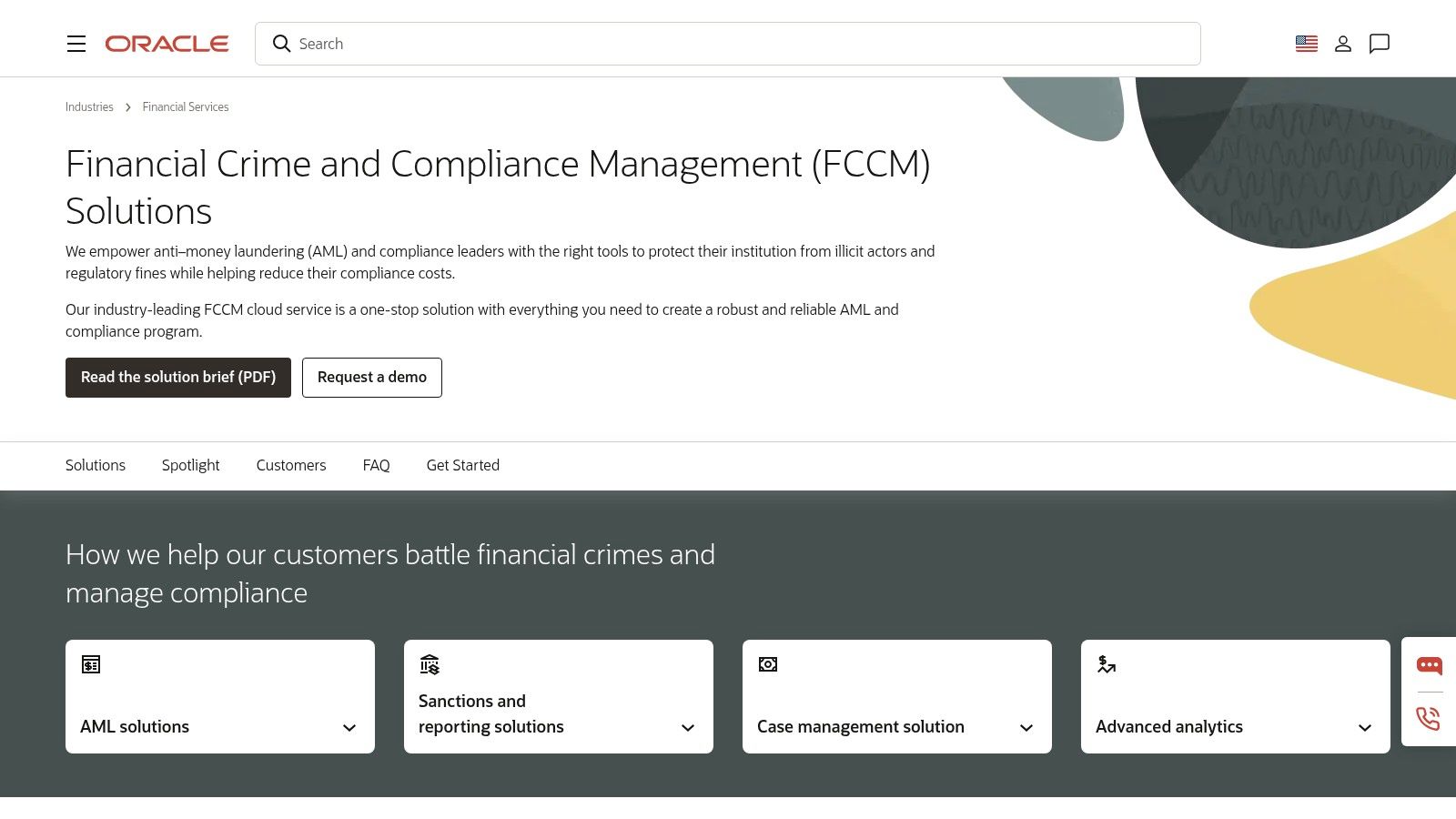
Financial crime is a different monitoring discipline, and Oracle FCCM is built for banks and financial institutions that need it at scale. The suite spans risk based transaction monitoring, KYC and customer due diligence, customer screening, sanctions and transaction filtering, investigations, and regulatory reporting.
Consolidating those workflows matters because AML failures often sit between systems, where a screening hit never reaches the team monitoring transactions. Case management and analytics sit across the suite, cloud delivery and configurable applications are available, and the design assumes operations across multiple jurisdictions.
- Choose it for: A broad financial crime program in a regulated institution.
- Skip it for: Investment policy or Shariah screening, which it doesn't do.
- Watch for: Scope far beyond what a fintech seeking a lightweight tool can absorb.
Pricing, scope, and implementation details aren't presented as simple public plans, so confirm deployment requirements directly with Oracle and cost the internal team needed to run it. This is infrastructure, not a plug in. Evaluate it against your transaction volumes, sanctions exposure, and reporting obligations, not against employee conduct tools.
How the ten tools differ in monitoring scope, alerts and reporting, and pricing visibility
Monitoring scope shows which failure a tool can catch. Alerts and reports show how a team follows up and what evidence it can review. Pricing visibility indicates whether evaluation can start with published plan limits or requires a sales process.
| Tool | Primary focus | Monitoring scope | Alerts and reporting | Pricing visibility |
|---|---|---|---|---|
| Akinda | Shariah stock and ETF screening API | Stocks and ETF holdings, with five Shariah methodologies | JSON verdicts and reports expose screening inputs; fund non-compliant weight supports purification calculations | Limited free tier; paid plans, with endpoint access varying by tier |
| Hadrius | Financial-services compliance and supervision | Firm and employee trading, communications, marketing, and compliance testing | Monitoring and supervision workflows; confirm alert and reporting details during evaluation | Not public; sales-led evaluation |
| ACA ComplianceAlpha | Compliance software with advisory services | Employee conduct, trading, communications, marketing, AML/KYC, and regulatory workflows | Compliance workflows and testing; confirm alert and report configuration with the provider | Customized; not public |
| MyComplianceOffice (MCO) | Trade surveillance and compliance operations | Employee trading, restricted-list issues, alerts, and investigations | Alerts and investigation workflows | Not public |
| StarCompliance | Employee conduct and conflicts management | Personal trading, pre-clearance, gifts, outside activities, and insider-trading controls | Pre-clearance and monitoring alerts; assess reporting against the team's review process | Not public |
| Skematic | Compliance program and workflow management | Personal-trade alerts, pre-clearance, investigations, and reporting | Alerts, investigations, and reporting workflows | Not public |
| Comply | Employee trade monitoring and compliance services | Broker-feed activity, pre-clearance, alerts, and investigations | Broker-feed monitoring, alerts, and investigation workflows | Quote-based |
| MetricStream Regulatory Compliance Management | Enterprise regulatory compliance management | Regulatory changes, controls, risks, assessments, and remediation | Change and control workflows support assessments and remediation tracking | Not public |
| Archer Evolv Compliance (formerly Compliance.ai) | Regulatory intelligence and change management | Regulatory-source updates, obligation mapping, and follow-up workflows | Regulatory updates and obligation follow-up workflows | Not public; sales engagement required |
| Oracle Financial Crime and Compliance Management (FCCM) | AML and financial-crime compliance | Transactions, KYC, customer screening, sanctions, and investigations | Screening, transaction monitoring, investigations, and regulatory reporting | Not presented as public plans |
Compare tools by the failure they are meant to catch, then check whether their alerts and reports give the responsible team enough detail to act. For investment screening, a verdict alone may be insufficient: teams reviewing a decision need the underlying ratios, methodology, or holdings contribution. For employee conduct and regulatory change, the practical test is whether alerts connect to an investigation, assigned action, or documented follow-up. Price visibility helps set the evaluation process, but does not establish how much configuration or operational work the system requires.
Matching the Tool to the Failure You Need to Catch
Choose by the failure your team needs to prevent. Personal trading conflicts call for surveillance tools such as StarCompliance, MCO, or Comply. Regulatory change calls for platforms such as MetricStream and Archer Evolv, which connect obligations with controls and assigned actions. Financial crime requires a different category: Oracle FCCM is not a substitute for employee conduct monitoring. For investment-screening decisions, look for tools that expose the methodology, inputs, and coverage behind each verdict.
Data gaps can make an otherwise functional system unreliable. The White & Case 2025 global compliance benchmarking survey found that 64% of global compliance professionals identified data protection as their leading concern when using AI in compliance, while 57% cited inaccuracy, including hallucinations and flawed analysis. Check whether the system distinguishes compliant, non-compliant, doubtful, and unrated outcomes, and whether it reports insufficient coverage rather than forcing a verdict.
How to run a serious evaluation
- Sample your own data: Test actual tickers, holdings, or employee accounts, including edge cases.
- Confirm feeds and jurisdictions: List the broker feeds, markets, and regulatory sources you need. Ask vendors to identify gaps.
- Trace an alert end to end: Follow a trigger through review, decision, remediation, and stored evidence.
- Check refresh and versioning: Confirm update frequency, how rule changes are versioned, and how users are notified.
- Measure coverage: Record coverage by obligation and jurisdiction, and check whether the system preserves the inputs behind each decision.
Adoption rates do not establish fit. Compliance Week's survey of approximately 227 compliance professionals reported that 56% of compliance teams used artificial intelligence in 2024, up from 41% in 2023. Evaluate the requirements your stack covers separately from the technology it uses. Score vendors on alert latency, false positives, field-level completeness, and the share of decisions supported by source evidence.
Choose the tool with the smallest monitoring gaps for your specific risk, not the longest feature list.
Market forecasts can provide budget context, but they do not establish a business case. Grand View Research's enterprise compliance management report valued the global enterprise compliance-management market at approximately USD 5.3 billion in 2025, projected to reach USD 16.5 billion by 2033, with software accounting for 68.5% of the market in 2025. Build your case around the controls you need to cover, using an obligation-by-obligation approach like mapping security controls to compliance frameworks. Pilot the finalist on real data before signing a long-term contract.
For investment products where reviewers need evidence behind screening verdicts, Akinda provides a REST API for Shariah screening of stocks and ETFs, with AAOIFI as its primary methodology. Its reports expose ratios and extracted financial figures, while fund screening uses underlying holdings. Start with the free tier's /compliance endpoint for one-line stock verdicts. If reviewers need the underlying ratios and financial breakdown, move to a paid plan with full-report access and assess whether that evidence supports your review process.