
The Dow Jones Islamic Market index is a benchmark of Shariah-screened equities that first excludes prohibited business activities, then applies 33% tests on debt, cash and receivables against trailing 24-month average market capitalization. Those headline rules are a starting point, not a permanent verdict on every stock.
If two applications give the same company different compliance labels, has someone made a mistake, or are they using different rulebooks?
The useful way to understand the Islamic Dow Jones index is as a family of dated rulebooks rather than one fixed list. For investors, that means checking which benchmark a portfolio follows. For developers, it means attaching the methodology version, financial inputs and review date to each result.
Table of Contents
- The Five Screening Tests at a Glance
- Where the Index Came From
- How the Two-Stage Screen Works
- Rebalancing, Weighting and Transition Rules
- What Changed in the 2026 Methodology Update
- Denominator Errors and a Verdict Checklist
The Five Screening Tests at a Glance
| Test | What Is Measured | Limit | Applied To |
|---|---|---|---|
| Business activity | Principal business in prohibited sectors | Excluded outright | Conventional finance, alcohol, pork-related products, gambling, tobacco, certain entertainment, weapons |
| Interest-bearing debt | Debt divided by trailing average market capitalization | Must remain below the applicable ratio ceiling | Companies that pass the activity screen |
| Cash and interest-bearing securities | Cash plus interest-bearing securities divided by the same denominator | Must remain below the applicable ratio ceiling | Companies that pass the activity screen |
| Accounts receivable | Receivables divided by the same denominator | Must remain below the applicable ratio ceiling | Companies that pass the activity screen |
| Non-compliant income | Share of total revenue from prohibited activities | Incidental prohibited income must remain within the applicable allowance | Companies whose main business is permissible |
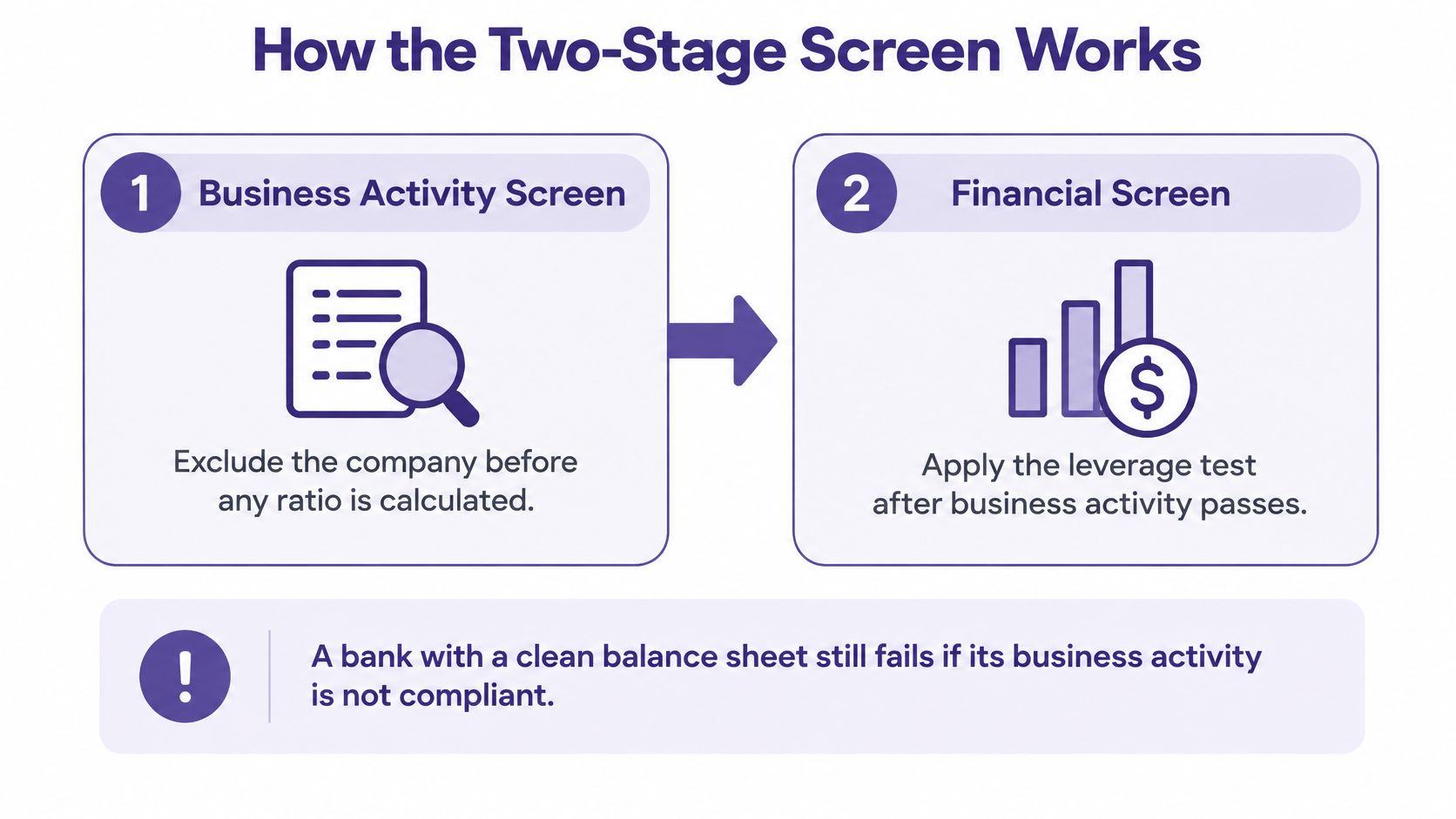
The Dow Jones Islamic Market framework, commonly shortened to DJIM, screens companies in two stages: business activity first, financial tests second. Read the table as a sequence of gates, not a scoring system in which strong results can cancel weak ones.
The activity gate asks what the company does. A conventional lender doesn't become eligible because it carries little debt of its own. Its principal business is the issue, so calculating its financial ratios won't resolve the exclusion.
What the financial rows mean
The debt row examines interest-bearing borrowing relative to the company's averaged market value. The cash row examines cash and interest-bearing securities, while the receivables row examines amounts customers owe the business. These are separate tests, even though the denominator is shared.
The income row addresses a different situation: a company may operate a permissible main business while receiving incidental prohibited income. That requires a revenue-based check rather than another balance-sheet ratio.
- Activity eligibility: Identify the company's principal operations before calculating ratios.
- Financial eligibility: Test each required numerator separately rather than combining the results.
- Income eligibility: Examine incidental prohibited revenue even when the main business passes.
Practical rule: Passing one screen doesn't compensate for failing another.
This distinction matters when someone describes a stock as having little debt and therefore being halal. A low debt level answers only part of the eligibility question. It doesn't establish that the business activity, asset composition or revenue sources satisfy the rulebook.
The table deliberately separates what is measured from the applicable limit. Thresholds, transition provisions and definitions belong to a particular methodology version. Treating a familiar percentage as the entire methodology can produce a plausible calculation and the wrong classification.
Where the Index Came From
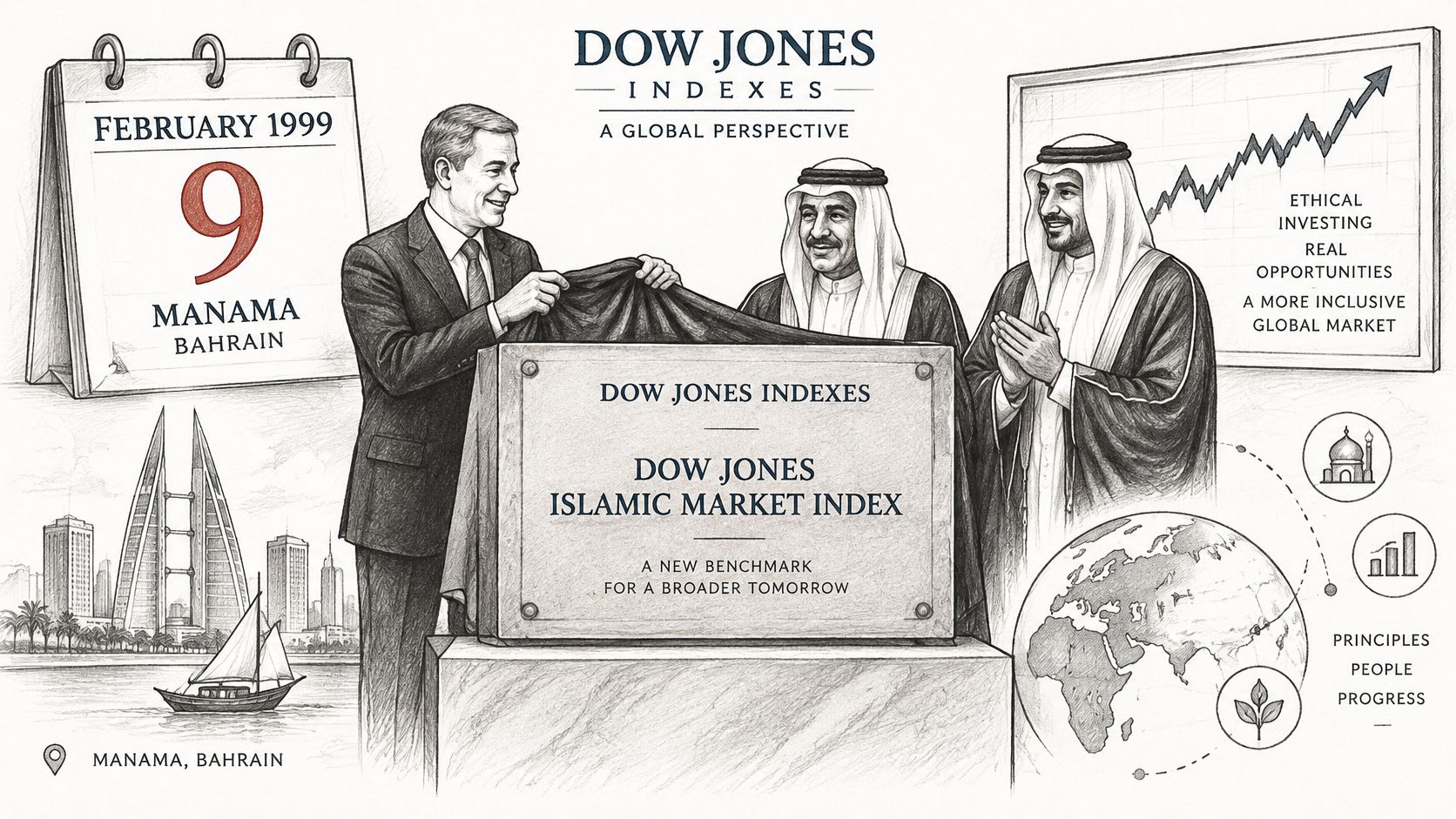
Dow Jones Indexes launched the Dow Jones Islamic Market Index on February 9, 1999, in Manama, Bahrain, establishing what is widely described as the first global benchmark specifically designed to measure Shariah-screened equities, according to the Chicago Journal of International Law account.
This commemorative illustration represents that institutional milestone.
Before a widely recognized global benchmark existed, an investor evaluating international shares lacked a common reference for comparing permissible companies. One investor might classify companies using sector descriptions, while another might investigate financing arrangements and incidental income.
Think of each investor building a private scale to weigh companies. DJIM supplied a shared scale, making the readings more comparable, without removing the need for religious oversight.
A shared methodology, not individual guesswork
An independent Shariah supervisory board reviews the methodology and guides eligibility decisions. Its role is distinct from the analyst's task of collecting financial statements and applying calculations: the board guides the rulebook, while the screening process implements it.
That separation also matters when a fintech team translates the methodology into software. If you're assembling an implementation team, HireDevelopers.com's resource to hire developers from latam can support the staffing search, but the technical specification still needs to distinguish scholarly criteria from data-processing decisions.
The embedded video provides an additional viewing resource.
The modern family extends beyond a single global equity list into broad-market, blue-chip, fixed-income, strategy and thematic benchmarks. A regional member and a global member can apply related screening principles while selecting from different starting universes.
An index family name identifies an approach. The full variant name identifies the benchmark you're actually discussing.
For a portfolio mandate, research spreadsheet or API response, DJIM World is more useful than Islamic Dow Jones alone. Record the complete benchmark name before comparing holdings, returns or constituent status.
How the Two-Stage Screen Works
Stage One checks the business
Start with the company's principal activities. A conventional bank with an otherwise clean balance sheet still fails an activity-based exclusion. The financial stage isn't a route around a prohibited principal business.
For a diversified company, read segment descriptions and revenue disclosures rather than relying solely on its name. A broad industry label may not explain what the business sells or how it earns income.
The screening sequence is illustrated below.
Stage Two checks the financial structure
The historical framework described in the International Journal of Islamic Finance and Sustainable Development excludes companies at or above 33% for interest-bearing debt, cash plus interest-bearing securities, and accounts receivable, each measured against trailing 24-month average market capitalization, and commonly reports a 5% of total revenue limit for non-compliant income.
Translate those definitions into explicit calculations:
- Debt test: Divide interest-bearing debt by the prescribed averaged market capitalization.
- Cash test: Add cash and interest-bearing securities, then divide by that same denominator.
- Receivables test: Divide accounts receivable by the same averaged market value.
- Income test: Compare prohibited incidental income with total revenue, not market capitalization.
The distinction between numerator and denominator is important. The numerator is the financial amount being tested. The denominator is the reference amount against which you measure it.
Consider a clearly hypothetical company with an averaged market value of ten billion and interest-bearing debt of three billion. Its debt ratio is three tenths. If the averaged market value falls to eight billion while debt remains unchanged, the ratio becomes three eighths and fails the ordinary ceiling.
Nothing in that scenario requires new borrowing. The reference value changed, so the measured relationship changed.
Why summaries can disagree
Published descriptions don't always represent the same methodology version or liquidity treatment. Don't combine a debt rule from one summary, a receivables rule from another and an income rule from a third.
The same caution applies when comparing AAOIFI, FTSE Shariah, MSCI Islamic and S&P Shariah. Providers may differ in their denominators, averaging periods, thresholds and treatment of particular financial items.
For an initial calculation, collect the debt, cash and securities, and receivables inputs separately. Then confirm the denominator and income calculation against the specific dated methodology you're implementing.
Rebalancing, Weighting and Transition Rules
Eligibility determines whether a company can enter the benchmark. Weighting determines how much influence it has once included.
The S&P Dow Jones Indices methodology describes generally float-adjusted market-capitalization weighting and quarterly rebalancing in March, June, September and December. Larger eligible companies therefore carry more influence than smaller eligible companies, rather than every constituent receiving an equal allocation.
What a portfolio holder experiences
Float adjustment focuses the weighting calculation on shares available for public investment. The resulting portfolio reflects the eligible market, not an attempt to give every company, sector or country equal representation.
A portfolio can therefore satisfy its screening methodology and still have substantial concentration. Compliance answers an eligibility question; it doesn't establish diversification or suitability for a particular investor.
For a fund investor, the distinction also requires separating the benchmark's rules from the vehicle's implementation. A Shariah-compliant fund needs to be understood through its holdings and screening approach, not just the benchmark name printed in its description.
A breach isn't always an immediate deletion
Scheduled reviews and interim corporate developments are different events. A company can publish new accounts, change its financing or undergo a corporate action before the next formal review.
The cited methodology includes transition provisions under which a previously compliant constituent may remain eligible after a modest breach, while persistent breaches can lead to removal. An ordinary entry threshold alone therefore isn't enough to reproduce every existing constituent's status.
A benchmarking system should retain:
- Effective dates: When a decision becomes operative.
- Historical constituent status: Whether the security was already included.
- Float-adjusted weights: Its actual benchmark representation.
- Methodology version: The rules used for that review.
An analyst calculating fresh eligibility and an index administrator applying constituent transition provisions may reach different immediate outputs without using different underlying financial statements. A binary label without dates is a snapshot, not a rule.
What Changed in the 2026 Methodology Update
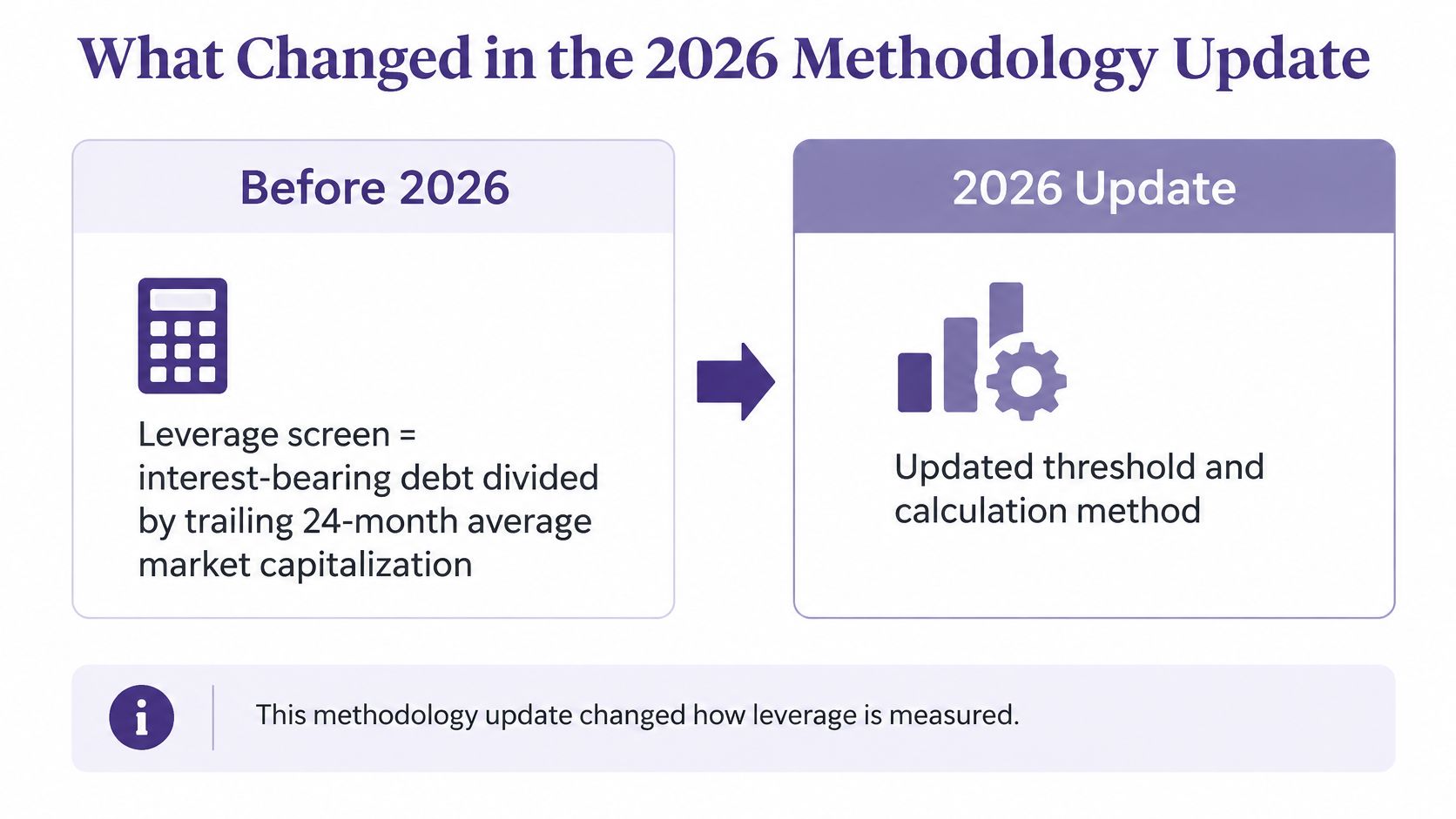
The 2026 update described in the S&P DJI methodology document reports the following comparison across 13,614 screened securities.
| Measure | Before update | After update |
|---|---|---|
| Leverage screen | 30% framework | Interest-bearing debt divided by trailing 24-month average market cap, 33% limit |
| Compliant stocks | 7,323 | 6,360 |
| Compliance rate | 53.8% | 46.7% |
These are dated methodology-impact figures, not a live constituent count for every member of the DJIM family. They describe the screened universe in that comparison, not the holdings of an individual fund.
The infographic highlights the change in how borrowing is measured.
Why a higher headline limit can still exclude more companies
Reading only the threshold might suggest that the revised screen must be more permissive. That conclusion ignores the rest of the calculation.
A ratio is a package: numerator definition, denominator, observation period, cutoff and any transition treatment. Change the package and the eligible universe can shrink even when the headline percentage increases.
The update also describes temporary tolerance for marginal breaches. That makes it especially important to distinguish the normal screen from the treatment of a previously eligible constituent.
Separate a rule change from a business change
A classification can move for several reasons:
- Methodology revisions: The provider changes what the screen measures or how it is applied.
- Market-value movements: The reference value changes even when operations remain similar.
- New financial statements: Updated borrowing, asset or revenue disclosures alter the inputs.
- Review timing: The formal index decision takes effect according to its review process.
A company's removal doesn't necessarily mean its principal business suddenly became prohibited. It means the company no longer satisfies the applicable eligibility process at that point.
For teams comparing standards, the distinction between AAOIFI, IFSB and S&P Shariah also helps prevent unlike frameworks from being treated as interchangeable labels.
The useful question is not only whether a stock is in the Islamic Dow Jones index. Ask which methodology version, rebalance date and index variant produced the verdict, and retain the dated comparison rather than presenting it as a timeless result.
Denominator Errors and a Verdict Checklist
A screening engine can perform every division correctly and still produce a result that isn't comparable with DJIM. The error often sits in the definition of the inputs rather than the arithmetic.
The official DJIM methodology uses trailing 24-month average market capitalization for the relevant financial screens, rather than current market value, and specifies sub-33% limits in the cited version. Averaging spreads the effect of a short-term price movement across the observation period instead of treating the latest price as the entire reference value.
Three implementation mistakes to prevent
Using spot market capitalization. In a falling market, a current market value can be much lower than the prescribed historical average. Substituting that smaller denominator makes the ratio larger and can turn a passing result into a failing one.
The appropriate fix isn't to smooth the finished ratio after calculating it. Reconstruct the required denominator first, then perform the calculation.
Substituting total liabilities for interest-bearing debt. Total liabilities can contain obligations that aren't interest-bearing borrowing. Using the broader total changes the meaning of the debt test, even when the financial statement value itself is accurate.
Mapping the wrong statement line. Debt, cash, securities and receivables need documented mappings from the company's disclosures. A broad financial-data field may not match the methodology's intended category.
For qualitative context, Artul.ai's discussion of connecting executive language with financial results offers a useful complementary reading approach. Management commentary can help an analyst understand a financing change, but it shouldn't replace the statement figures used in a screening calculation.
Record the evidence behind every verdict
Keep a reproducible record with each assessment:
- Index variant: Identify DJIM World or the relevant regional, blue-chip or thematic benchmark.
- Methodology version and effective date: Preserve the document version, not just its current download location.
- Rebalance date: Record the review associated with the constituent decision.
- Financial statement date: Identify the disclosures behind debt, cash, securities, receivables and revenue.
- Average-market-value confirmation: Verify that the prescribed historical series was used rather than a spot value.
- Calculation specification: Store the denominator, threshold, averaging period and any transition provision applied.
Also distinguish calculated screening eligibility from official index membership. Reproducing ratios doesn't by itself establish that a security belongs to a particular published constituent list.
Dow Jones Islamic Market, FTSE Shariah, MSCI Islamic and S&P Shariah each have their own denominators, thresholds and business exclusions. Those differences help explain why halal apps disagree about the same stock, but disagreement should prompt inspection rather than an assumption that every output is equally well implemented.
In our /full-report, the index verdict fields halal_status_djim, halal_status_ftse, halal_status_msci and halal_status_sp are available to every plan that already includes the full report. halal_status remains the verdict we serve, so integrations should preserve the distinction between that headline result and the parallel index-methodology results.
A halal label without its calculation inputs and applicable rulebook cannot be meaningfully audited.
Our data is not investment advice, a recommendation, a fatwa or a religious ruling. It doesn't replace a qualified scholar or licensed adviser.
Akinda provides API-based Shariah screening with supporting financial inputs and parallel methodology verdicts, helping developers distinguish a headline classification from a DJIM-specific result. Visit Akinda to review the integration resources and inspect a full report before mapping those verdicts into your application.