
Under AAOIFI Shari'ah Standard No. 21, a stock is halal only when it clears a business activity screen, keeps income from prohibited activities below 5% of revenue, and holds interest-bearing debt and interest-bearing cash each under 30% of a twelve-quarter average market capitalisation. Fail any one of those four tests and the answer is no, however familiar or well-regarded the company behind the ticker happens to be.
The advice you'll hear most often is simpler than that: skip the banks, skip the alcohol producers, buy whatever's left. That advice gets you through half of one test. It ignores the three ratios that eliminate most of the companies people assume are fine, and it gives you no way to answer the question when two screening apps disagree about the same stock.
There's a second problem the popular advice never mentions. A verdict isn't permanent and it isn't universal. One company can be halal under one rulebook and not halal under another on the same day, using the same financial statements. A share price fall can flip a pass into a fail without the company borrowing a single extra dollar.
So the useful skill isn't memorising a list of approved sectors. It's learning to read a screening verdict the way you'd read a set of accounts: knowing which rule produced it, which numbers went in, and what date they were pulled.
Table of Contents
- The Four Tests a Stock Must Pass
- Why Two Apps Disagree About the Same Stock
- Scholars Differ, So the Standard Is Your Choice
- How to Check a Stock Yourself, Step by Step
- Market Swings Can Flip a Verdict
- Purifying Dividends You Already Received
- Decide, Record and Recheck Each Verdict
The Four Tests a Stock Must Pass
Screening runs in a fixed order, and the order isn't cosmetic. A company's business activities get checked before any ratio is calculated, because a business built on interest, alcohol or gambling can't be rescued by a tidy balance sheet. Only companies that clear that first gate reach the arithmetic.
Test 1, business activity. The company's core business must sit outside the prohibited sectors: conventional banking and insurance, alcohol, pork-related products, gambling, tobacco and conventional lending. This is the test that produces the easy answers, which is exactly why people stop here. Companies that fail it outright are what the market loosely calls sin stocks, and no debt ratio makes them permissible.
Test 2, prohibited income. Revenue from non-permissible activities has to stay under 5% of total revenue. A supermarket that sells wine lives here. The question isn't whether wine appears on the shelves, it's what slice of revenue the wine represents, and that number comes from segment reporting, not from the shop floor.
Test 3, interest-bearing debt. Debt must stay under 30% of the company's twelve-quarter average market capitalisation. Test 4, cash and interest-bearing short-term investments. The same 30% ceiling against the same twelve-quarter average.
| Order | Test | AAOIFI limit | Fails when |
|---|---|---|---|
| 1 | Business activity | No core activity in a prohibited sector | Any core activity in a prohibited sector |
| 2 | Prohibited income | Under 5% of total revenue | Above 5% of total revenue |
| 3 | Interest-bearing debt | Under 30% of 12-quarter average market cap | Above 30% |
| 4 | Cash and interest-bearing investments | Under 30% of 12-quarter average market cap | Above 30% |
Why the two-stage design survived
The structure isn't a modern invention bolted onto old rules. A Chicago Journal of International Law analysis of Islamic equity screening records that the Dow Jones Islamic Market Index launched on February 9, 1999, in Manama, Bahrain, and worked in exactly these two stages: sector exclusions first, then financial ratios on debt and interest income.
The same analysis estimates the screened universe came to roughly 30% of the broader global universe of public companies covered by the Dow Jones World Index. That figure is the clearest argument for not stopping at the sector check. Most of the elimination happens in the ratios, among businesses nobody would call haram by name.
The order applies outside obvious problem industries too. Consider a gold miner: the metal itself raises no issue, but the company can still fail on borrowings or on interest income parked in a treasury account, and a collection of gold mining stock articles is a sensible place to understand how those businesses are financed before you run the numbers on one.
The reusable rule: check the activity screen first, then the three ratios, and write down which standard you applied before you look at the result.
Why Two Apps Disagree About the Same Stock
Two apps can show opposite verdicts for the same ticker on the same afternoon. Nothing is broken. They're measuring different things and calling both measurements by the same word.
The clearest published example sits in a US regulatory filing. The SEC filing for a FTSE USA Shariah index sets out a 33.333% debt-to-total-assets test, a 33.333% cash-and-interest-bearing-items test, a 50% receivables-and-cash test and a 5% prohibited-income ceiling. Compare that with the market-capitalisation approach, which divides debt by a twelve-quarter average market value and applies a 30% line.
Three places the rulebooks part ways
- The denominator. Some divide debt by total assets, others by market capitalisation. A company with modest assets and a large market value scores very differently depending on which one you use.
- The averaging window. A twelve-quarter average, today's market cap, and a 24-month or 36-month smoothed average can each produce a different ratio from identical accounts.
- The threshold. Thirty percent and 33.333% look close until a company lands between them.
Dow Jones Islamic Market, FTSE Shariah, MSCI Islamic and S&P Shariah each publish their own denominators, thresholds and business exclusions, which is the mechanical reason they disagree.
A worked example that passes one test and fails another
Say a company carries $1 billion of interest-bearing debt, holds $3 billion in total assets and trades at a $2.5 billion market capitalisation.
Debt over assets is 33.3%, which sits under the 33.333% line and passes. Debt over market cap is 40%, which clears the 30% line and fails. Same company, same filing, same day.
| Rulebook | Denominator | Debt limit | Result for this company |
|---|---|---|---|
| FTSE USA Shariah (2026 filing) | Total assets | 33.333% | 33.3%, passes |
| AAOIFI No. 21 | 12-quarter average market cap | 30% | 40%, fails |
The disagreement isn't an error to be arbitrated by a third app. It's a difference in measurement, and the size of the money affected is the reason it draws so much argument: Islamic funds were valued at $223 billion in 2025, according to LSEG's Islamic Investment Review 2025.
Practical rule: when two verdicts conflict, ask which rulebook produced each one before you ask which is right. Comparing a total-assets verdict with a market-cap verdict tells you nothing except that the two screens are different.
Scholars Differ, So the Standard Is Your Choice
Once you accept that rulebooks diverge, the next question is the one readers ask: whose rulebook do I follow?
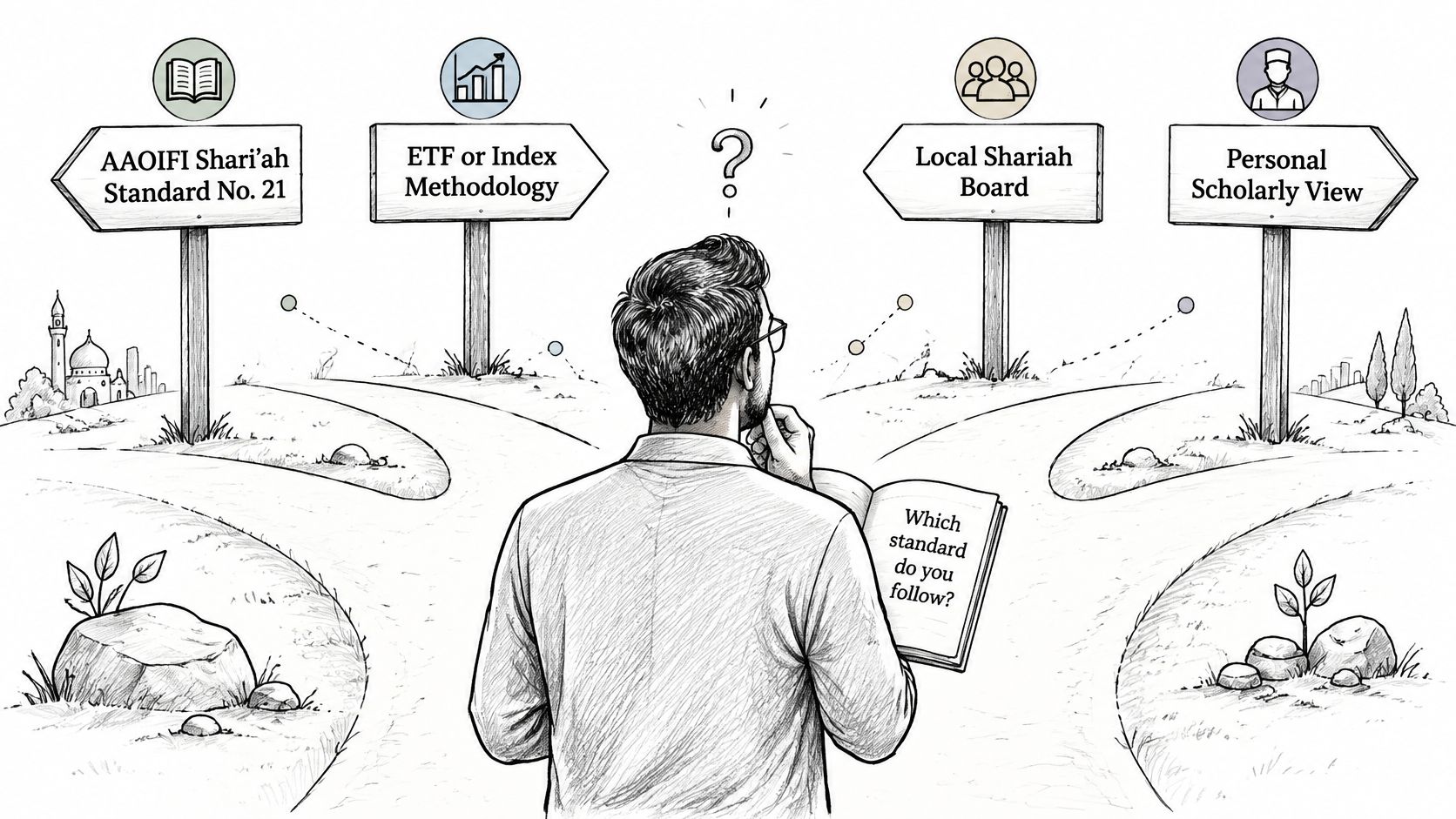
There are four honest answers, and each has a cost.
AAOIFI Shari'ah Standard No. 21, titled "Financial Paper (Shares and Bonds)." It's the reference most published screens cite, and its appeal is consistency: one set of tests applied the same way to every holding. The AAOIFI standards are catalogued by the Accounting and Auditing Organization for Islamic Financial Institutions, and you can read how they're structured in this overview of AAOIFI Shariah standards.
The methodology of the fund or index you hold. If your money sits in an ETF, the fund's own screen already made the decision for you, and second-guessing it with a different rulebook produces a portfolio that matches neither standard.
A local Shariah board's ruling. Scholars weigh doubtful income and borderline ratios differently, and a board that knows your circumstances can answer questions a ratio can't.
The most conservative result across the standards. This is the safest option and the most expensive one, because it removes the largest number of borderline companies from your universe.
Here's the awkward part nobody puts on a comparison chart: there's no meta-rule that tells you which of those four to pick. The scale of the industry is why the choice needs to be deliberate rather than accidental. The Islamic Financial Services Board reported that global Islamic financial services industry assets reached approximately USD 3.38 trillion in 2023, up from USD 3.25 trillion in 2022, growth of about 4%, in its IFSB Stability Report 2024. Money at that scale moves on repeatable rules, and a rule you can't name isn't repeatable.
Pick a standard and stick to it. A loose reading admits companies other scholars reject. A strict reading shrinks your universe and your diversification. Both are defensible; drifting between them is not, because you end up holding a portfolio that satisfies no rulebook completely.
Three steps that make the choice auditable
- Name the standard and the date. "AAOIFI No. 21, checked against the 2025 annual report" is a verdict someone can review. "Halal according to an app" isn't.
- Apply it to every holding, funds included. A fund isn't compliant because of its name; it's compliant because of what it holds and how much of each.
- Flag anything near a threshold for a fresh check and a scholar's opinion, since small data changes move borderline names first.
How to Check a Stock Yourself, Step by Step
You don't need an app to run this the first time. You need the latest annual report or 10-K, a calculator and about twenty minutes.
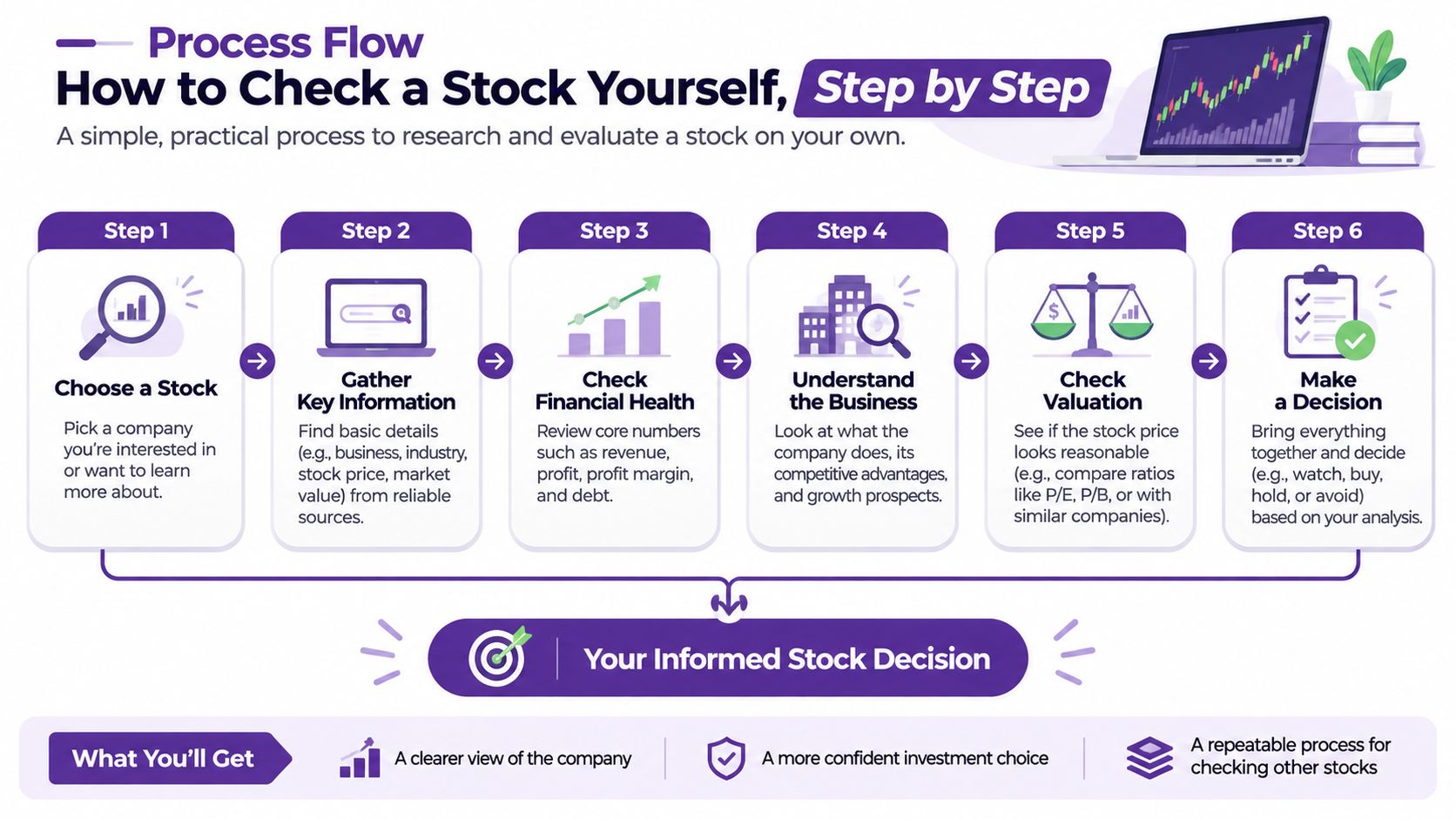
1. Choose your standard and write it down. AAOIFI No. 21 is the reference most published screens cite, which makes it the easiest choice to defend later. Record the name and the version date before you open the filing.
2. Pull the revenue breakdown. Annual reports and 10-Ks break revenue out by segment. List every segment that touches a prohibited sector and add up its share of total revenue. If the company doesn't break it out, that's a data problem, not a pass.
3. Compare that share with the 5% ceiling. A segment at 2% is a purification question later. A segment at 18% ends the analysis.
4. Find interest-bearing debt on the balance sheet. Short-term borrowings, the current portion of long-term debt, long-term debt and any interest-bearing lease obligations. Note the period-end date on the statement, because a ratio without a date is a rumour.
5. Calculate average market capitalisation over the last twelve quarters. Add the quarter-end market values and divide by twelve. This is the step people skip, and it's the one that changes answers.
6. Divide debt by that average and check it against 30%. Then 7. repeat with cash and short-term interest-bearing investments.
The same company, two answers
Say a company carries $500 million of interest-bearing debt against a twelve-quarter average market capitalisation of $2 billion. That's 25%, and it passes.
Now hold the debt constant and let the average market value fall to $1.5 billion, which happens when a share price drifts down over three years. The same $500 million becomes 33%, and it fails. Nothing about the business changed. The denominator did.
Record the result properly
Write four fields for every stock you screen: the standard, the calculation date, the inputs you used (debt figure, market-cap window, non-compliant revenue share) and the verdict. That record is what lets you defend a decision months later, and it's what stops you re-litigating the same stock every time you open your portfolio.
A habit worth building: screenshot the balance sheet page you took the debt figure from. When a provider's number disagrees with yours, you'll want to know whether the difference is the debt figure or the denominator.
Market Swings Can Flip a Verdict
A verdict has a shelf life, and the shelf life is shorter than most investors assume. When debt is measured against market capitalisation, the share price becomes part of the test.
Take a company with $400 million of interest-bearing debt and a twelve-quarter average market cap of $1.6 billion. That's 25%, a comfortable pass. Let the average slide to $1.2 billion through a long bear market and the identical debt reads 33%, a fail. No new borrowing, no change in the business, no change in the revenue mix.
The reverse happens too, and it's more dangerous because it feels like good news. A price surge lifts the market value, the debt ratio looks safer, and a company that was borderline slips inside the limit without improving anything.
The comparison of Shariah screening standards at Purindex makes the timing problem explicit: under market-capitalisation methodologies a falling share price can push a company above the screening limit without any new borrowing, and some providers rely on current market capitalisation while others smooth volatility with 24- or 36-month averages. Two providers using the same threshold can therefore disagree purely because of the window they chose.
Operational compliance versus price-driven movement
Separate two events that look identical on a dashboard.
Operational compliance changed when the company borrowed, sold a division, or shifted its revenue mix. Something in the filing is different.
Price-driven movement changed when the denominator moved. The filing is identical to last quarter's.
When a breach appears, check whether the debt figure, the revenue mix or the reporting period changed. If only the market cap moved, mark the stock as under review and rescreen at the next annual report or after the next large price move. If the breach survives a fresh calculation on the latest filing, treat the holding as non-compliant and talk through exit timing with a qualified scholar rather than selling by reflex.
Don't let a single breach trigger an automatic sale. A ratio that crossed 30% because of a bad quarter in the share price is a prompt to look, not a verdict on the business.
Purifying Dividends You Already Received
Screening looks forward. Purification deals with what already arrived in your account, which is why a clean verdict doesn't clean past income. The logic is straightforward: if a company earned 2% of its revenue from a prohibited activity, roughly 2% of the dividend you received carries that same character, and you give that portion away.
Three steps, in order.
1. Get the non-compliant revenue share from your screen or from your own segment calculation. Use the most recent filing, not last year's.
2. Multiply it by each dividend you received, gross, before withholding tax.
3. Give that amount to charity without intending it as a reward or as sadaqah with expectation of return. It's the removal of something that wasn't yours to keep.
| Dividend received | Non-compliant share | Amount to give away |
|---|---|---|
| $1,000 | 2% | $20 |
| $500 | 0% | $0 |
| $2,000 | 5% | $100 |
The 5% row is worth staring at, because it's the ceiling rather than a typical figure. Most companies that pass the income test sit far below it, which is why real purification amounts tend to be small. A stock with 0% non-compliant revenue owes nothing, and that's a perfectly normal result.
Keep the tax question separate
Purification is not a tax. The dividend has already been taxed or withheld according to the rules where you live, and the charity amount is calculated on the dividend you received. If you hold international stocks and the withholding treatment confuses you, understand your franked dividend income before you try to net the two against each other. Getting the tax position right and getting the purification position right are two separate exercises.
Scholars differ on the method here, including how capital gains are treated and whether the share should be recalculated at each payment. Our walkthrough of how to calculate purification covers the arithmetic in more depth, and any method you settle on should be confirmed with a qualified scholar for your situation.
The division of labour: purification addresses income you've already received. The screening verdict addresses what you buy next. Neither one substitutes for the other.
Decide, Record and Recheck Each Verdict
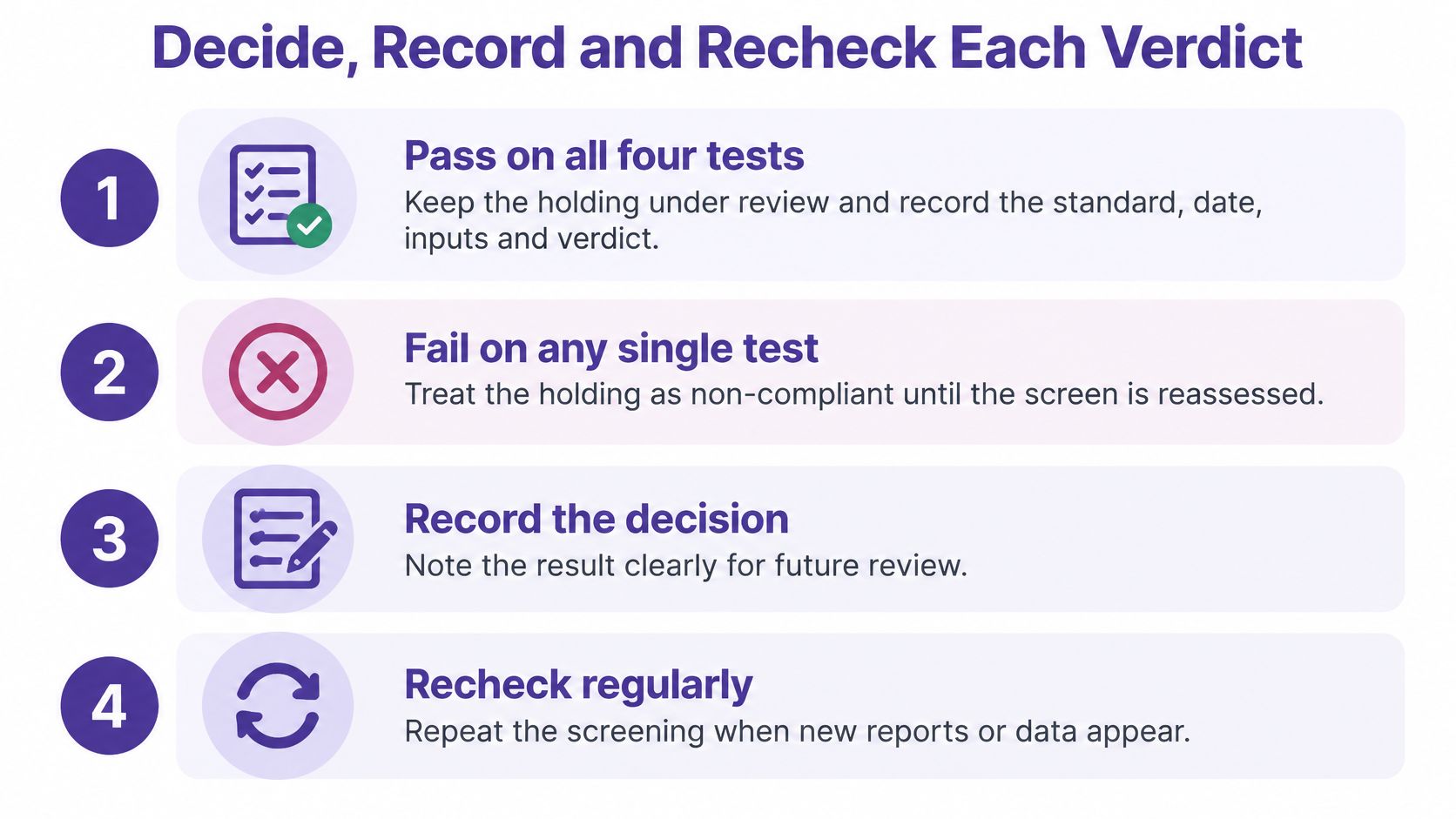
A screen produces a result. A decision needs a rule for what to do with it. Four outcomes cover nearly every case you'll meet.
Pass on all four tests. Keep the holding, note the standard, date, inputs and verdict, and put a review date in your calendar for after the next annual report.
Fail on any single test. Treat the stock as non-compliant for new purchases and work out with a qualified scholar how to handle shares you already own. The two decisions are separate, and the exit question deserves a real conversation rather than a panic sale.
Land within a few percentage points of a threshold. Rerun the calculation on the latest filing using the standard's own averaging window, then record both results side by side. Borderline names are the ones that flip, so they deserve the more careful record.
Hit missing or unclear data. Mark the verdict doubtful and don't buy until the inputs are confirmed. A company with no usable segment breakdown can't be screened, and a guess isn't a screen.
That fourth outcome is where a documented verdict earns its keep. Our API returns HALAL, NOT HALAL or DOUBTFUL rather than forcing every company into a yes or a no, and each verdict maps back to a documented Shariah rule and the exact numbers that decided it, including the debt and liquidity ratios and the non-compliant revenue share behind the answer. Asking whether a stock is halal, say "Is AAPL halal?", should get you the rule and the figures, not just a label. A bare label can't be checked, and a verdict you can't check isn't worth much when the next annual report lands.
Set the review habit now: after each annual report, and after any large price move on a holding near a limit. Then run the thresholds from the first table against the next stock on your watchlist, write down the four fields, and let the record carry the argument.
If you're building an app, a robo-advisor or an internal research desk that needs to answer "are stocks halal" for thousands of tickers without hand-checking every filing, Akinda's Shariah compliance API returns verdicts across AAOIFI, Dow Jones Islamic Market, FTSE Shariah, MSCI Islamic and S&P Shariah, with the ratios and extracted financials behind each one. You can pull a single company's status, compare how the five rulebooks treat it, and see exactly which line of the filing moved the answer. Start with the Akinda documentation and run your first ticker through it.