
A user screens a stock in your app and gets a halal badge. They screenshot it, post it in a group chat, and someone replies with a different app that marks the same ticker as not halal. Now you're the one explaining why, and "both are right" isn't an answer that keeps users.
That situation is common, and it usually isn't a bug. It comes from what sits underneath the verdict: which rulebook was applied, which number went in the denominator, which dates were averaged, and where the company is listed. AAOIFI Shariah standards are a widely used rulebook in Islamic finance, and Standard No. 21 is the one that deals with shares and bonds. Knowing it properly means knowing its arithmetic, its scope and its limits.
The denominator point matters more than it first appears. A debt ratio measured against market capitalisation moves with the share price, so the same balance sheet can pass one month and fail the next. Change the averaging window and the verdict can flip again. This is why a defensible screen keeps every raw input behind the badge: the thresholds applied, the figures that fed them, and the dates they came from. When a user challenges the verdict, you can show the working instead of asking them to trust it.
Table of Contents
- Standard No. 21 Thresholds at a Glance
- What AAOIFI Shariah Standards Are and Who Uses Them
- Which Markets Make AAOIFI Standards Binding
- How to Run the Screen in the Right Order
- Why Two Credible Screens Reach Opposite Verdicts
- Applying Standard No. 21 in a Real Screen
Standard No. 21 Thresholds at a Glance
| Test | Threshold | Measured Against |
|---|---|---|
| Business activity | Must not deal in prohibited products or services | Stated corporate purpose and sources of revenue |
| Interest-bearing debt | Below 30% | Market capitalisation |
| Interest-taking deposits | Below 30% | Market capitalisation |
| Impermissible income | Below 5% | Total income |
Read that table from the top. Many jump straight to the ratios because ratios feel like the technical part, and that's where a first build usually goes wrong. The business activity test isn't a filter that adjusts the numbers. It decides the outcome on its own.
If a company's stated corporate purpose or its revenue comes from prohibited products or services, it fails, and no balance sheet rescues it. A conventional bank with almost no debt still fails. So does an insurer sitting on a large cash pile. The ratios only get checked once that gate is clear.
Then come the three quantitative tests, in the order the table lists them. Interest-bearing debt has to stay below 30% of market capitalisation. Interest-taking deposits have to stay below 30% of market capitalisation. Impermissible income, meaning interest and any other non-permissible revenue, has to stay below 5% of total income. A company fails if any single test fails. There's no scoring, no weighting and no averaging across the four rows.
The activity screen removes the obvious names first: conventional banks and mortgage lenders, conventional insurers, tobacco, alcohol, gambling and pork. That list isn't the whole test, though. What counts is what the company earns, so a conglomerate with a small alcohol division is a revenue question, not a name question.
How to read the table: find the sector first, then check each ratio against its own denominator. Debt and deposits both divide by market capitalisation. Impermissible income divides by total income. Confusing those three is the most common arithmetic error in a home-built screen.
One more thing about the shape of the tests. Two of them share a denominator and one doesn't, and that single detail is why the same company can look risky on one line and fine on another in the same quarter. Hold that thought, because it drives almost every disagreement later on.
What AAOIFI Shariah Standards Are and Who Uses Them
Think of a building code. Different architects, different materials, different cities, and the code makes sure each structure meets the same safety requirements without every designer inventing their own load calculations. AAOIFI Shariah standards do that job for Islamic finance. They turn broad Shariah principles into rules you can hold a company's activities, accounts and governance against.
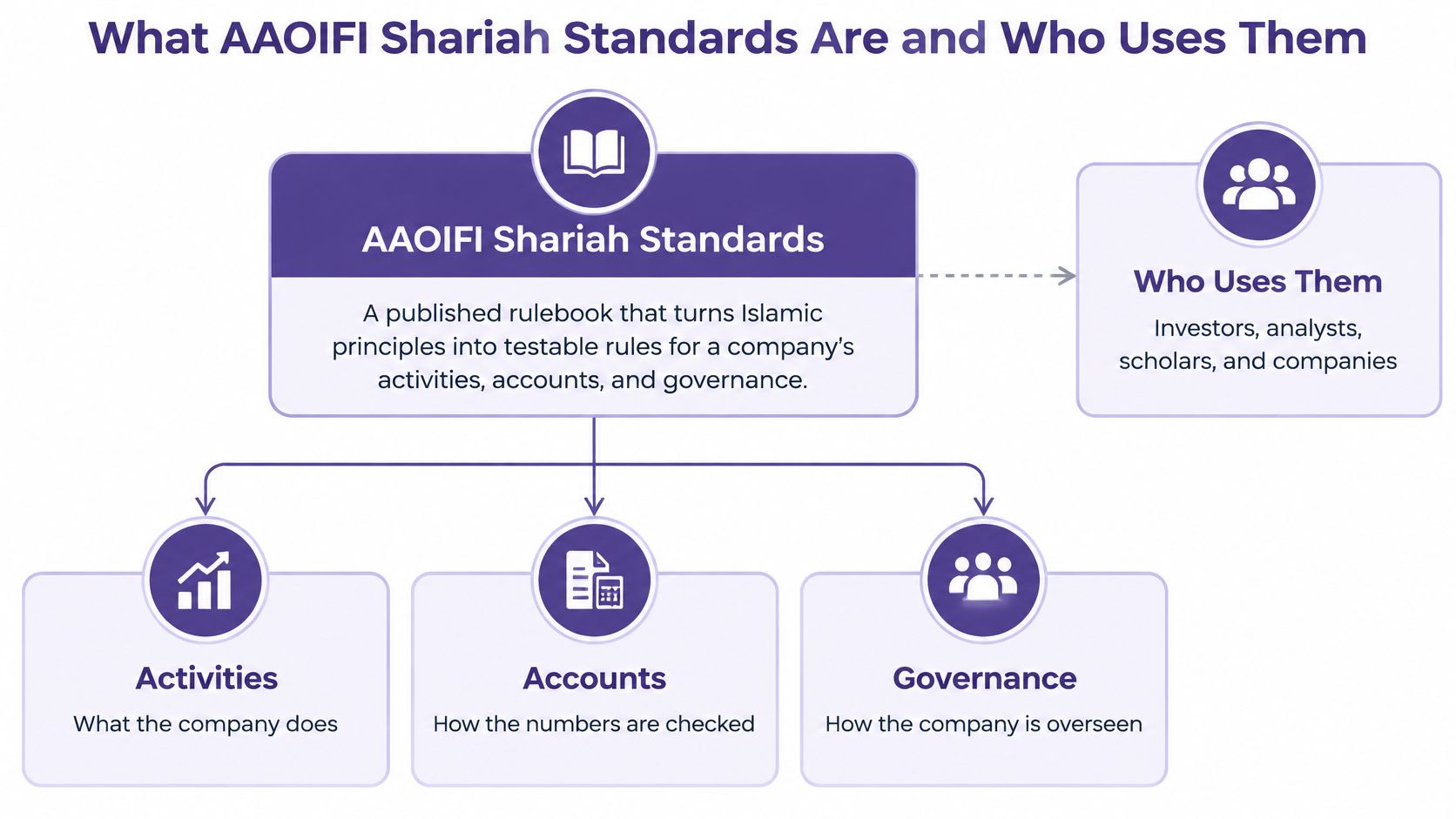
AAOIFI is based in Bahrain and was established in 1991, according to its own account of the organisation's history, and its mandate runs past Shariah rules into accounting, auditing, ethics and governance. That matters for equity screening because the same body sets the rules for how figures get reported and how they get judged.
The standards sit in a wider series covering banking, Islamic insurance, investment banking, capital markets and financing products. AAOIFI describes its Shariah standards as references used by legislative bodies, regulatory authorities, financial institutions, law and consultancy firms, universities, research centres and fatwa-issuing bodies, as set out on its Shariah standards page. For shares and bonds, the governing document is Standard No. 21, formally titled "Financial Paper (Shares and Bonds)".
The portfolio is bigger than many assume. AAOIFI counts 54 Shari'ah standards within a total of 94 standards spanning Shariah, accounting, auditing, governance and ethics, per its accounting standards catalogue. Several dozen regulatory and supervisory authorities adopt or recognise those standards fully, partially, as guidelines, or as the basis for local rules, which is the honest description of how the system works. A standard is a reference, not a licence.
That distinction separates two roles people blur together. The standard sets the rules. The screen applies them to a company's actual numbers, and the quality of the screen depends on how carefully that application is done. Akinda follows AAOIFI standards for Shariah compliance screening, with Standard No. 21 as the basis for its primary verdict, and the verdict is only as useful as the inputs behind it.
Which Markets Make AAOIFI Standards Binding
A developer in London can show the same ratio as a developer in Bahrain and mean two different things by “compliant.” In one market the verdict works like a building code. In the other it works like a respected house style: persuasive, often expected, still not the law by itself.
| Market | Status of AAOIFI Shariah Standards |
|---|---|
| Bahrain | Mandatory |
| Oman | Mandatory |
| Pakistan | Mandatory |
| Sudan | Mandatory |
| Syria | Mandatory |
| United Kingdom | Voluntary or internal guidance |
| North America | Voluntary or internal guidance |
| Malaysia | Voluntary or internal guidance |
| Saudi Arabia | Voluntary or internal guidance |
| South Africa | Voluntary or internal guidance |
AAOIFI's feature on adoption describes that split and also records several 2025 circulars from Pakistan's State Bank concerning adoption of AAOIFI Shariah standards: the standards are mandatory in Bahrain, Oman, Pakistan, Sudan and Syria, while in markets including the United Kingdom, North America, Malaysia, Saudi Arabia and South Africa they are generally used voluntarily or as internal guidance. The pattern is stable enough to design around, but the details still move.
Malaysia sits in the voluntary column. A Shariah-compliant product built there can follow AAOIFI logic without treating every AAOIFI clause as a local statute. A Shariah-compliant agile banking case study can be useful for delivery lessons, while the legal status above still rests on AAOIFI's adoption description.
Three things people call compliance
A regulatory status. In a mandatory market, an AAOIFI-based verdict is closer to a rule. In a voluntary market, it is closer to a house methodology.
A provider's screening policy. A fund manager or index provider may adopt AAOIFI thresholds, adapt them, or use a different rulebook entirely. If you want the comparison laid out plainly, this breakdown of AAOIFI versus IFSB versus S&P Shariah methodologies covers where the rulebooks part ways.
An investor's own choice. A user may follow a particular scholar, fund or app. That is a third basis, and it does not have to match either of the first two.
The jurisdiction changes the weight of the verdict. It does not change the arithmetic inside it. A debt ratio still depends on the denominator, the averaging window and the filing inputs, so two authorities can both recognise AAOIFI while reaching different outcomes on the same company if their versions or data differ. Keep AAOIFI standards distinct from national rulebooks, index-provider methods and a company's own Shariah board opinion, because all four can appear in the same conversation.
For a robo-advisor or broker serving users across borders, map each user's market to its status and record which basis the screen used for that user's holdings. A verdict without that context is a number with no provenance.
The rule for anything customer-facing: name the rulebook, the version and the market behind every verdict you show.
How to Run the Screen in the Right Order
Order matters more than expected because the prerequisites change the meaning of the numbers. Running the arithmetic before settling them will produce a result that appears defensible but is not.
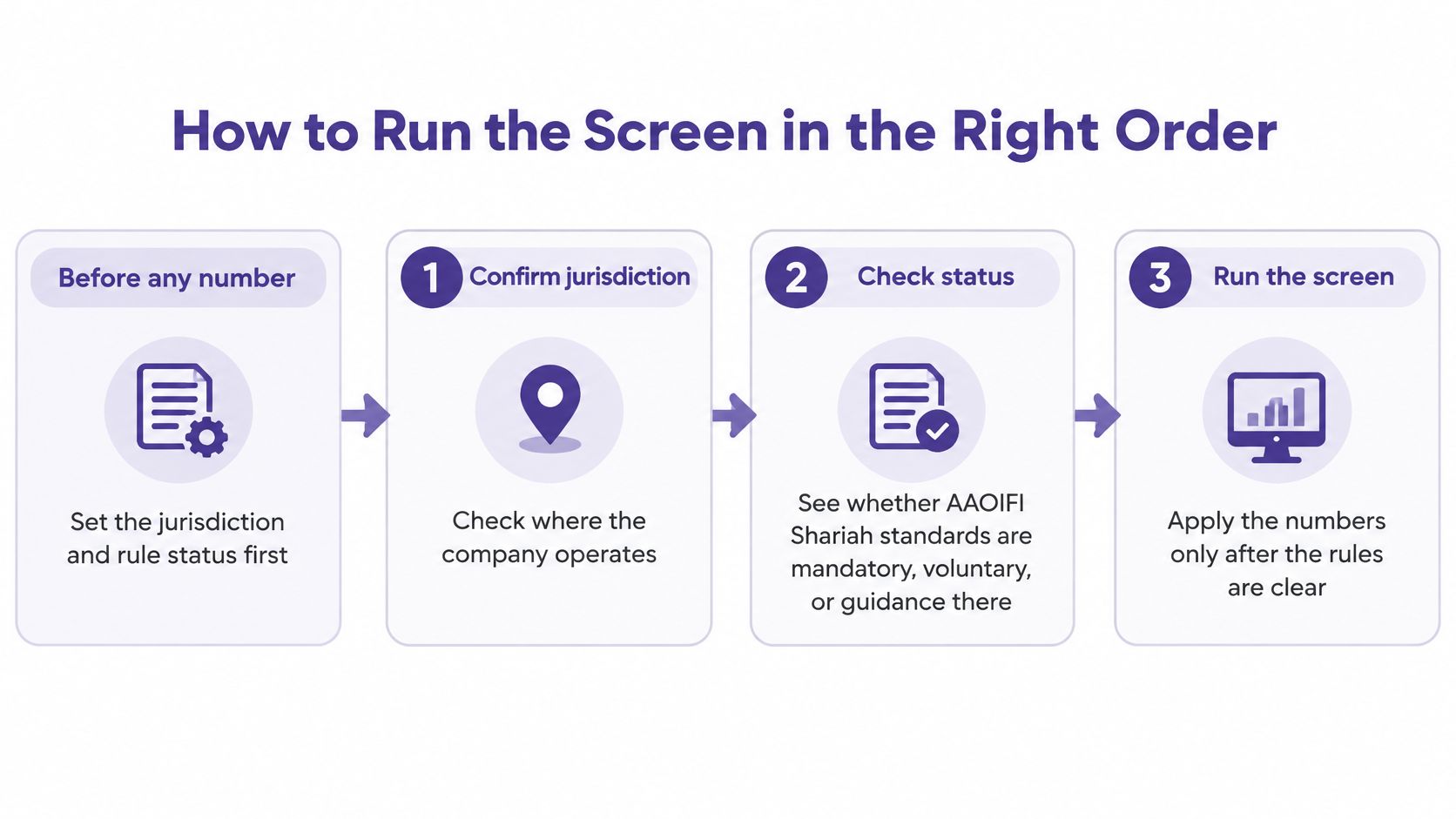
Settle two things before you touch a number
First, the jurisdiction. Confirm whether AAOIFI Shariah standards are mandatory, voluntary or guidance in the market where the company is listed and where your user sits, because that answer decides whether your verdict is a rule or a convention. Second, the rulebook and version. A screen built on a superseded methodology version is a screen you can't reconcile with anyone else's output.
Those two facts belong in the record alongside the ratios. Without them, a disagreement with another provider is unresolvable, because you can't tell whether you differ on rules or on data.
The six steps
- Confirm the stated purpose. Read the corporate purpose and the revenue segments before any ratio. Interest dealing or prohibited products and services fail the company here, and this test is decisive on its own, so stop the moment it fails rather than spending an afternoon computing ratios for a stock that was never eligible. If you want the wider checklist beyond this one standard, this guide to checking whether a company is Shariah compliant walks the same inputs through a broader lens.
- Put prohibited income over total income. Interest and other non-permissible revenue must sit below 5% of total income. Pull both figures from the same reporting period and note which line items you treated as impermissible, so the number can be rebuilt by someone else.
- Divide interest-bearing debt by market capitalisation. The line is 30%. Decide once whether operating leases count as interest-bearing and apply the same answer across every company you screen, or your verdicts stop being comparable with each other.
- Run the deposits test on the same denominator. Interest-taking deposits go over market capitalisation against the same 30% line. This is the test builders forget, and it's the one that catches cash-rich companies parking funds in interest-bearing accounts.
- Store the raw inputs. Keep the numerator, the denominator, the valuation date and the calculation timestamp, not just the word halal. A stored verdict without its inputs can't be audited, reproduced or explained.
- Re-run when an input moves. A new quarterly filing changes the debt figure. A share price move changes the denominator. Trigger a refresh on either event rather than on a fixed calendar, or your data will drift behind reality.
Step five is the one that separates a tool from a guess. Every halal verdict we return on the Akinda API maps back to a documented Shariah rule and the exact numbers that decided it, which is the standard to hold any provider to, including us.
Why the denominator does most of the work
A peer-reviewed industry study of AAOIFI's stock-screening criteria summarises the 30% debt threshold and the 5% non-compliant-income threshold and makes the operational point sharply: because the debt test uses market capitalisation, a firm can pass or fail without any corresponding change in its debt. The income test behaves differently, measuring prohibited revenue against the scale of the operating business.
That means a single screen uses two denominators with two different behaviours. One is a market measure that moves every trading day. The other is an accounting measure that moves once a quarter. Treating them as interchangeable is how home-built screens produce verdict flips nobody can explain.
Write this down before you ship: a ratio without its denominator isn't a result, it's an opinion.
A company that clears every test is compliant under the standard, and the stored inputs are what let you, a customer or a regulator check that conclusion a year from now. That's the whole point of keeping them.
Why Two Credible Screens Reach Opposite Verdicts
One app marks a stock halal. Another tells the same investor to avoid it. Both can be applying a published standard faithfully and still land on opposite sides, because the choices that decide the outcome sit outside the headline thresholds.
Where methods part company
| Source of Difference | Effect on the Verdict | What to Record |
|---|---|---|
| Denominator | Market capitalisation and total assets produce different ratios | Denominator used and its value |
| Averaging window | Twelve-quarter and twelve-month averages can diverge widely in volatile years | Averaging period and dates |
| Middle state | Some frameworks allow an in-between outcome, others force a binary result | Whether the framework permits an intermediate verdict |
| Debt threshold | A 33% approach sits against the 30% line commonly linked to Standard No. 21 | Threshold value applied |
| Financial-statement timing | Lease treatment and reporting dates can move the ratio | Reporting period and data date |
A 2025 review of Shariah screening methods describes screening as a combination of qualitative sector exclusions with quantitative tests for debt, interest income and liquidity, and it highlights real variation in tolerance limits for impermissible income, interest-bearing debt and prohibited investments. The same review reports a debt threshold of 33% of market capitalisation for one prominent approach, which is enough to change the verdict for a company sitting between the two lines.
Tolerance limits deserve their own note. Some frameworks permit an intermediate classification rather than a clean yes or no, and the difference between three states and two states changes what your interface has to display. A binary badge can't represent a screen that offers a middle answer, and users notice when it tries.
The question to ask when a verdict changes
Does the change reflect a real shift in the company's business, or a difference in methodology and data date? A rising share price can lift a company back under a market-cap-based threshold without anything about the company improving. We covered the practical version of this in why halal apps disagree about the same stock.
So demand specifics from any screen you rely on or build: the exact ratio, the denominator behind it, the reporting period, how non-compliant income was treated, how fresh the data is, and whether the gap with another provider comes from the rules or from an incomplete filing. Harmonisation proposals exist, including a weighted-average compliance model, but those reflect an active debate rather than a settled answer, and shipping one as though it were universal would be a mistake.
Applying Standard No. 21 in a Real Screen
Take a company with 3.2 billion in interest-bearing debt and a market capitalisation of 10 billion. Divide one by the other and the debt ratio is 32%, so the company fails the 30% test and the screen returns not halal.
Now change only the market capitalisation, to 11 billion, and keep the debt where it was. The ratio falls to about 29%, and the same company passes. Nothing about its business moved. No new loan was taken, no division was sold. The denominator shifted because investors repriced the equity, and the verdict followed.
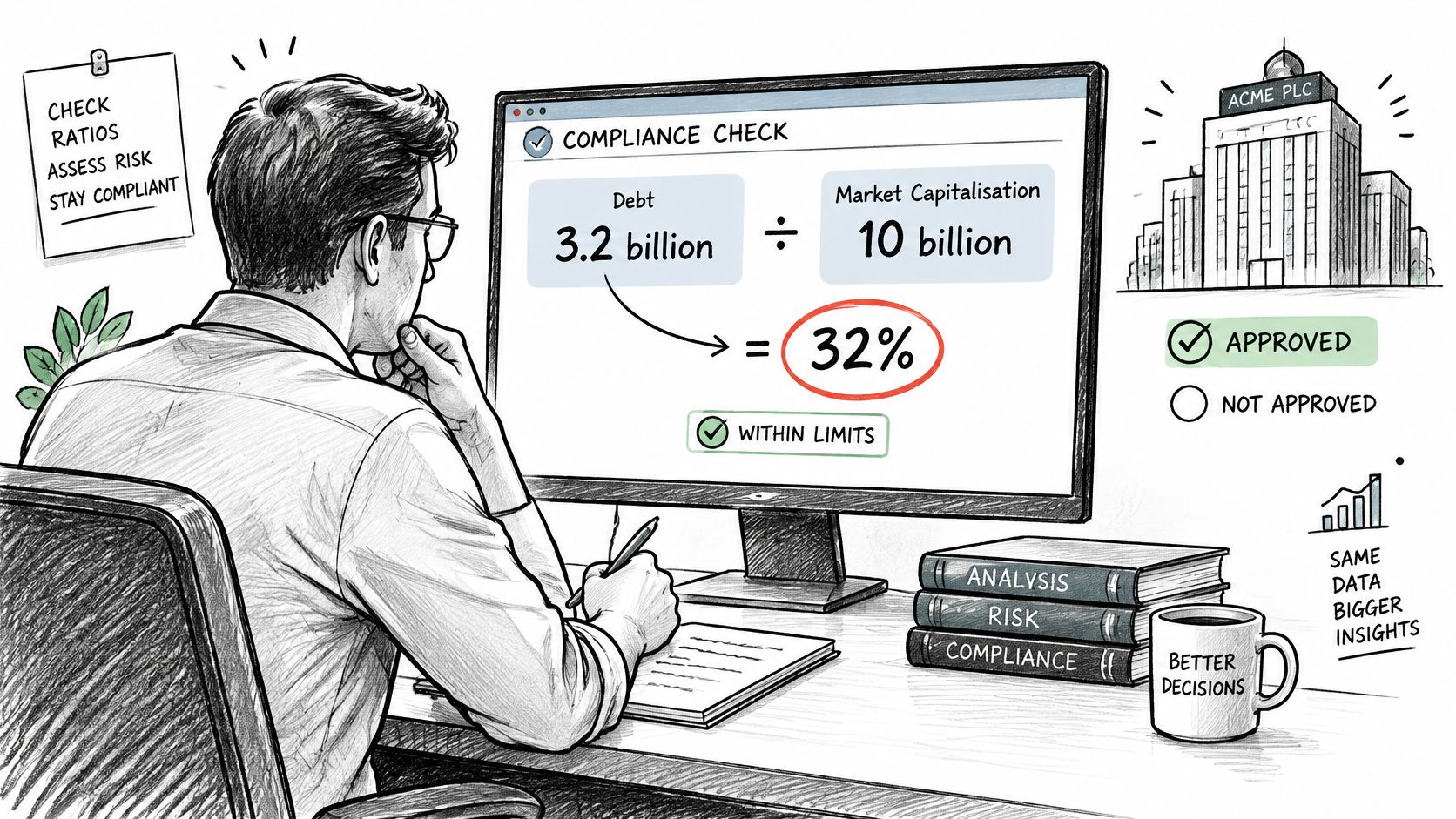
That example is the argument for keeping records rather than badges. A useful screening record holds the ticker, the company name, the listing country, the reporting currency, the date it was last scanned, the date it was last updated, the valuation date used for the denominator, and the status itself. When a user asks why a stock flipped, those fields answer the question in one look.
Two habits that prevent most disputes
Store unknown values as null, never as zero. A missing debt figure recorded as zero looks like a clean pass. A null makes your own interface show the gap, which is honest and catches bad data before a customer does. Our own reports represent uncomputed values as null rather than estimated zeros for exactly this reason.
Keep the extraction trail. If the interest-bearing debt figure came from a filing, note where. The same applies to prohibited revenue segments and operating leases, which are the three inputs that most often differ between two providers screening the same company.
Questions worth putting to any provider
Which rulebook and which version does the methodology apply, and has that methodology had Shariah advisor review? Can you trace any single verdict back to the numbers that produced it? What happens when a figure is missing, and does the output show the gap or paper over it? Akinda's methodology is reviewed by Shariah advisor Dr. Muhammad Nazir Khan, and the Full Compliance Report returns the verdict, every underlying ratio and the extracted financial breakdown together, which is the level of traceability to ask for.
A verdict you can't trace back to its inputs is one you can't defend to a customer, an auditor or a scholar. Keep the denominator, the window and the jurisdiction, and the verdict becomes an argument you can have.
Akinda returns Shariah verdicts for stocks and ETFs under AAOIFI Shari'ah Standard No. 21, with the ratios, denominators and extracted financial figures kept alongside every verdict, so a user who asks why a stock passed or failed gets an answer instead of a badge. If you're building a halal investing product, you can test a handful of tickers through the Akinda API and check the numbers against the four tests above before you ship anything.