
Two screening apps, one stock, two verdicts. Which one got it wrong?
Usually, neither. The company hasn't changed. The rulebook behind the verdict has: which ratio gets measured, what that ratio is divided by, and which filing the numbers came from. Most introductions to shariah compliant investments stop at the short list of prohibited businesses and hand you a screen. The list is real, but it hides the machinery, and the machinery is where the disagreements, the edge cases and the actual portfolio decisions live.
So start with a better model. Compliance isn't a property a company carries around like a brand colour. It's a conclusion drawn from a rule and a number, and it flips when either one moves. Once you can see the two layers beneath a verdict, the confusion that surrounds this subject mostly evaporates.
Table of Contents
- What Shariah-Compliant Investing Means
- Screening Thresholds at a Glance
- How a Stock Passes or Fails the Screen
- Investment Types and What Each One Checks
- Why Standards Disagree on the Same Stock
- Purification and Cleaning Dividend Income
- Verify Compliance Before You Invest
What Shariah-Compliant Investing Means
Picture a sieve with two meshes stacked one above the other. You pour a whole stock market in at the top. What reaches the tray underneath is the investable universe, and anything caught on the first mesh never gets tested against the second.
The top mesh is the business itself. A company has to earn its money from something Islam permits, so conventional banking, insurance underwriting, alcohol, tobacco, gambling, pork and adult entertainment belong on the exclusion list. A well-run conventional bank fails at this mesh, and it fails permanently. Financial strength doesn't buy it a pass, because the objection is to how the profit is made rather than to how much of it there is.
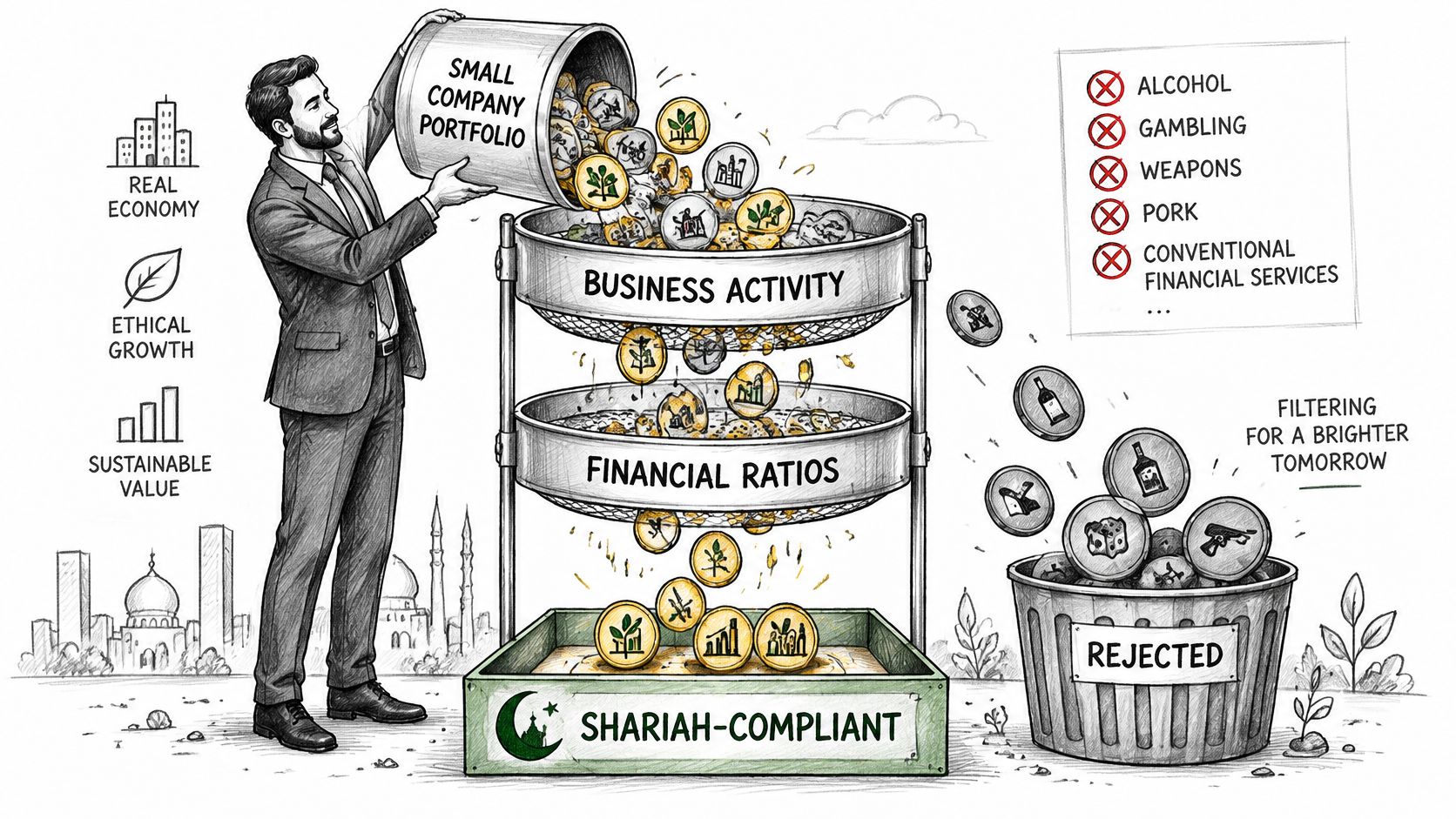
The lower mesh is the balance sheet. A permissible business can still carry interest-bearing debt or park money in interest-bearing deposits, and both involve riba. So the second layer measures those figures against the size of the company: set the borrowings and the interest-bearing cash next to market value, and a percentage falls out for each.
Scale explains why this machinery matters well beyond a religious audience. The global Islamic financial services industry, spanning Islamic banking, sukuk, takaful and Islamic funds, reached USD 3.88 trillion in total assets in 2024, a 14.9% increase on the USD 3.38 trillion recorded a year earlier, according to the Islamic Financial Services Board's 2025 stability report. Growth was broad rather than concentrated in one segment: sukuk assets rose 25.6%, Islamic insurance 16.9%, and Islamic banking around 17.0%.
That breadth is the clearest signal. Sukuk and insurance expanding faster than banking means the universe is diversifying away from a single asset class, and it means screening has moved into ordinary portfolio work rather than sitting at the edge of it.
The screens also overlap with filters investors already know from elsewhere. Tobacco, gambling and weapons exclusions appear in mainstream ethical and ESG products too, and the sharpest differences sit in the interest prohibition and the financial ratios, which is where ethical investing frameworks stop and Shariah screening keeps going.
The model to keep: a company doesn't wear a halal label. It carries a verdict, produced by a rule and a set of numbers on a specific date.
Screening Thresholds at a Glance
Screeners love to quote a single percentage as if it settled the matter. It doesn't. Each number is meaningless without the rulebook that set it, so here's where the main standards land.
| Standard | Debt limit | Cash and deposit limit |
|---|---|---|
| AAOIFI Shari'ah Standard No. 21 | Below 30% of market capitalization | Below 30% of market capitalization |
| MSCI Islamic Indexes | 33.33% principal ratio (30% for new inclusions) | Covered within the principal ratio |
| Dow Jones Islamic Market | Set by the provider's own rulebook | Own cash test on the provider's own denominator |
| FTSE Shariah | Set by the provider's own rulebook | Own cash and receivables test |
| S&P Shariah | Set by the provider's own rulebook | Own cash test |
What Each Column Actually Tests
The debt column is a borrowing test. A high figure means the company funds itself with borrowings that carry interest, and past the line that borrowing is judged too large a share of the business to tolerate. The cash column is an idle-interest test: holding cash isn't the objection, but parking it in interest-bearing instruments turns a permissible business into a collector of riba.
The number at the top of a column is only half of a rule. The other half is the base it's divided by, which is why the AAOIFI row names market capitalization explicitly rather than leaving it implied. Debt ratios on that base move with the share price, so a screen run on stale price data is effectively testing a different company from the one in front of you.
A fourth number sits outside the table because it isn't a balance-sheet test at all: the share of income coming from prohibited activity, measured against the company's total income. Because the base is income rather than market value, that ratio doesn't drift when the share price does, which makes it the most stable of the tests and the hardest to source properly.
One row deserves a note. The 30% figure beside MSCI's 33.33% ceiling isn't a second threshold you have to satisfy. It's the level applied to new index additions, set below the ceiling so that funds tracking the index don't churn every time a borderline name crosses the line.
Some providers publish their thresholds openly and others keep the calculation inside the methodology document sold alongside the index. Where a number isn't published, the honest entry is the rule that governs it, not a figure borrowed from a competitor's table and presented as universal.
Practical rule: write the standard next to every verdict you keep. A bare "halal" isn't a result you can defend to a client, an auditor or your own notes six months later.
How a Stock Passes or Fails the Screen
A screen isn't one question. It's a sequence, and the order matters because the first step can end the review before any ratio gets computed.
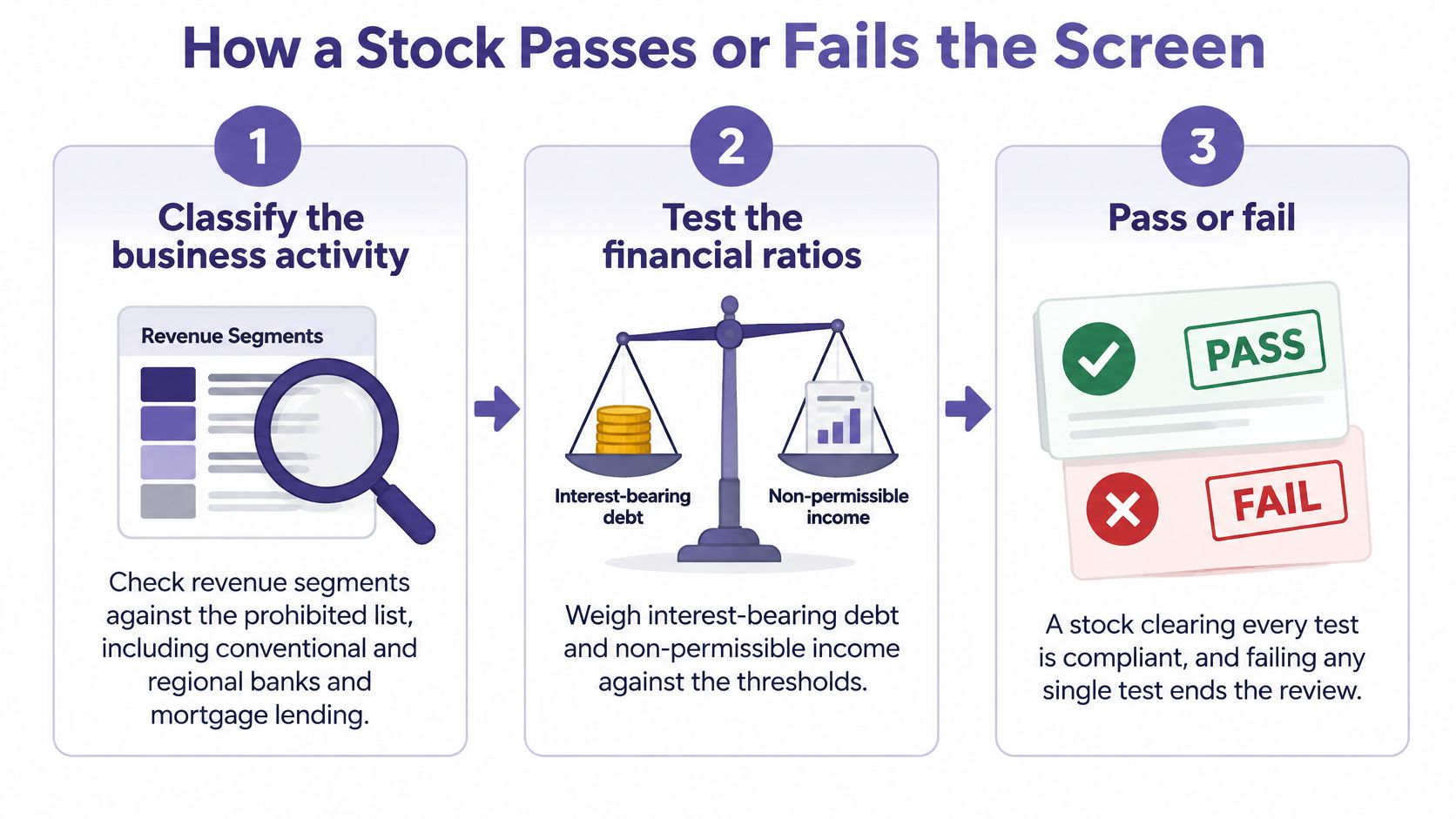
AAOIFI Shari'ah Standard No. 21 sets the lines the sequence works toward: interest-bearing debt and interest-bearing deposits must each stay below 30% of market capitalization, while income from prohibited activities must stay below 5% of total income, as laid out in this analysis of AAOIFI Standard No. 21. With those two numbers in hand, the steps run like this.
- Classify the business activity. Read the revenue segments, not the industry label on the listing. A holding company can look like a technology name while a lending arm supplies a chunk of its profit, so the segments decide. Conventional and regional banks, mortgage lenders, conventional insurers, exchanges, alcohol, tobacco, gambling and pork processing all fail at this step, and fail immediately.
- Set aside instruments that aren't equity. Preferred shares and fixed-income holdings are excluded by type, whatever the issuer does. The reason is structural: a preferred share pays a fixed return, which puts it closer to a loan than to a share of a business.
- Measure interest-bearing debt against market capitalization. Total the borrowings that carry interest, divide by market value, and compare with the 30% line. The base is equity value, so this ratio moves whenever the share price moves, even if the loan book never changes.
- Measure cash and interest-bearing deposits the same way. Same denominator, same 30% line. This step catches companies that keep an unusually large share of their wealth in interest-bearing accounts rather than in the operating business.
- Measure prohibited income against total income. A different base entirely: the company's total income rather than its market value. The line is 5%, and the test needs segment-level revenue detail showing where each dollar came from.
- Fail on any single breach. The tests stack rather than average. A company whose prohibited income sits comfortably under the 5% line but whose debt runs past the 30% line is non-compliant, full stop, and no strong result on the other tests offsets it.
Start with a logistics company whose interest-bearing debt sits at 24% of its market capitalization, comfortably inside the line, so the stock passes. Then the share price falls and market capitalization shrinks. Nothing about the loans changed, but the same borrowings now measure past the 30% line, and the company fails the test it passed last quarter.
Why step one decides everything: a conventional bank with almost no debt and immaculate margins still fails, because the screen isn't scoring quality. It's asking what the business does.
Each failure needs its own record: which test broke, which input was used, which date the data came from. A bare "not halal" tells a portfolio manager nothing useful. Is the breach caused by debt that a deleveraging plan might fix, by a share price collapse that could reverse, or by the nature of the business, which no amount of waiting will change? Without the inputs, you can't tell those three apart.
Investment Types and What Each One Checks
The check changes with the vehicle. A ratio that settles a single stock tells you very little about a fund, and nothing at all about a sukuk certificate.
| Investment type | How compliance is judged | What to verify | Main limitation |
|---|---|---|---|
| Individual stocks | Activity screen, then debt, cash and income ratios | Standard used and ratio inputs | Verdict can change with share price |
| Equity funds and ETFs | Weight of non-compliant holdings | Holdings coverage and rulebook | Fund name or label does not prove compliance |
| Sukuk | Structure and underlying assets reviewed under Islamic finance rules | Asset backing and structure documents | Needs a contract-level review, not a company ratio |
| Real estate investment trusts | Rental income and leverage against market value | Income sources and debt ratio inputs | Property financing often breaches the debt line first |
| Index-based products | Provider rulebook | Which rulebook the index follows | Rulebooks use different denominators and thresholds |
Stocks are judged one company at a time, and the verdict travels with the market capitalization. A name that cleared the line at one share price can fall out of compliance at a lower one with no filing changing in between, so the ratio, not the ticker, is the thing to track.
Funds and ETFs inherit the weighted verdicts of what they hold. The judgement rests on the share of the portfolio that fails and on how much of the portfolio the screener can see; a fund whose disclosed holdings cover only part of the portfolio can't be cleared on the strength of that part. Coverage matters as much as the number itself, which is why shariah compliant fund screening starts from constituent weights and a stated coverage figure. Fund names describe marketing, not arithmetic, and a "Islamic" wrapper over a conventional index is still a conventional index.
Sukuk aren't debt in the ordinary sense. Each certificate represents ownership of an underlying asset or a contractual claim on revenue, which is what makes the return permissible. The review is structural: what backs the certificate, who carries the risk, and whether the return is tied to the asset's performance rather than to money lent at interest. You won't answer those questions by computing a company ratio, which is why sukuk review looks at documentation and asset backing rather than at filings.
Real estate investment trusts ask two questions. Does any tenant earn from prohibited activity at a level that matters, and how much of the property is financed with interest-bearing debt? Property companies generally carry more debt than a 30% line allows, so the financing test tends to decide the outcome before the tenant mix gets a hearing.
Index-based products hand the whole decision to whoever wrote the rulebook. The Dow Jones Islamic Market World Index, launched on May 24, 1999, established the template: a rules-based series of screened global equities that funds and structured products could track. That launch date doubles as a warning, since any performance shown before it is a hypothetical back-test of the methodology rather than money anyone earned.
Match the vehicle to the check before you trust the verdict. A stock needs its ratio inputs, a fund needs its coverage, a sukuk needs its structure, and an index product needs the rulebook it follows.
Why Standards Disagree on the Same Stock
The question arrives almost every week: why does one tool call a stock halal and another call it non-compliant? Three causes explain nearly every case.
- The denominator. Debt equal to 30% of a company's market value comes to 23% when the same borrowings are measured against total assets instead. Move the share price and the first figure moves with it; the second barely budges.
- The ratio set. One methodology tests debt alone. Another tests debt, cash plus interest-bearing securities, and receivables plus cash together, which means a company can fail on a measure the first methodology never checked.
- The data treatment. Operating leases, ordinary operating cash versus interest-bearing securities, and how non-permissible income gets classified all change the inputs. Restated financials arrive and a verdict flips without anyone touching a rule.
A stock sitting at 29% on a market-value basis and 31% on an asset basis is not a contradiction. It's two arithmetic exercises producing two honest answers to slightly different questions. A 2025 comparative study of Shariah stock-screening practices found no harmonization among the major methodologies, with debt limits around 30% versus 33.33% and market-capitalization versus asset-based calculations in live use.
So make the choice deliberately rather than by whichever app you installed first. Adopt the standard your governance requires, whether that's AAOIFI, a national board or an index provider, record it against every verdict, and treat disagreement between tools as information about the inputs rather than as an error to resolve.
Before you compare two verdicts: check the denominator, the data date, and how cash and leases were treated. Those three account for most of the gap.
Purification and Cleaning Dividend Income
A screen answers two different questions. The first is eligibility: may you hold this stock at all? The second is purification: how much of the income it pays out must be given away? A stock can pass the screen and still require a small donation from each dividend.
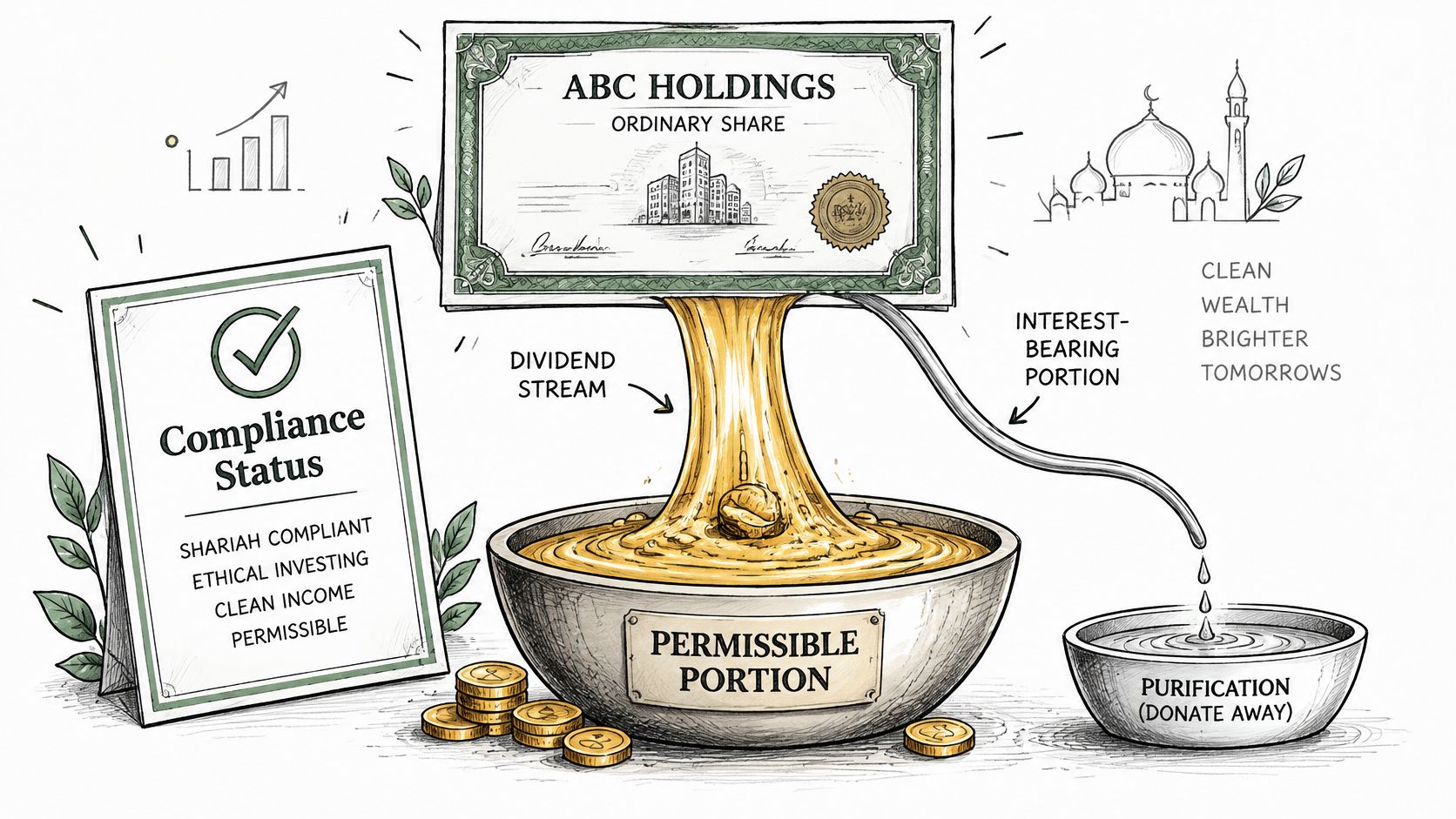
The reason is arithmetic rather than theology. A company that clears the 5% revenue test may still earn a small slice from interest or another non-permissible line. That sliver does not disqualify the business, but you are not entitled to keep it either. Treat the dividend like a mixed basket: most of it may be permissible, while one small portion belongs elsewhere.
The calculation itself is three steps:
- Find the non-permissible income proportion disclosed for the company, usually expressed as a percentage of total income or revenue.
- Multiply that proportion by the dividend you received, not by an estimated annual figure.
- Donate the result to charity and record the amount, the proportion used and the payment date.
A worked number makes it concrete. Say you receive USD 1,000 in dividends from a company whose non-permissible income proportion is 2%. The purification is USD 20. On one holding that reads like a rounding error, but across a portfolio it becomes a figure you need to report. It also shifts as the company's income mix shifts, so last quarter's proportion may not fit this quarter's payment.
Purification is built into index methodologies rather than bolted on afterwards. MSCI's Islamic index methodology deducts the non-permissible proportion from shareholder dividends and donates it, and it treats compliance status and purification amount as separate outputs. The same rulebook shows why one debt test cannot carry the whole job: its principal ratios cover total debt, cash plus interest-bearing securities, and receivables plus cash, capped at 33.33%. Two companies with identical debt-to-assets ratios can land differently if one holds far more interest-bearing cash.
Ratio intensity can affect outcomes because purification depends on the proportion itself. A smaller non-permissible share produces a smaller donation, while a larger share reduces the portion of the dividend you keep. That is why the ratio belongs in both the compliance record and the return calculation.
If you'd rather not rebuild the arithmetic every quarter, this walkthrough of how to calculate purification covers the same steps with portfolio-level totals. Track the proportion and the dividend date for every payment. A donation you can't document is indistinguishable from one you didn't make.
Verify Compliance Before You Invest
A verdict with no source behind it isn't evidence. It's an opinion wearing a data format. Run this checklist and you'll know which one you're holding.
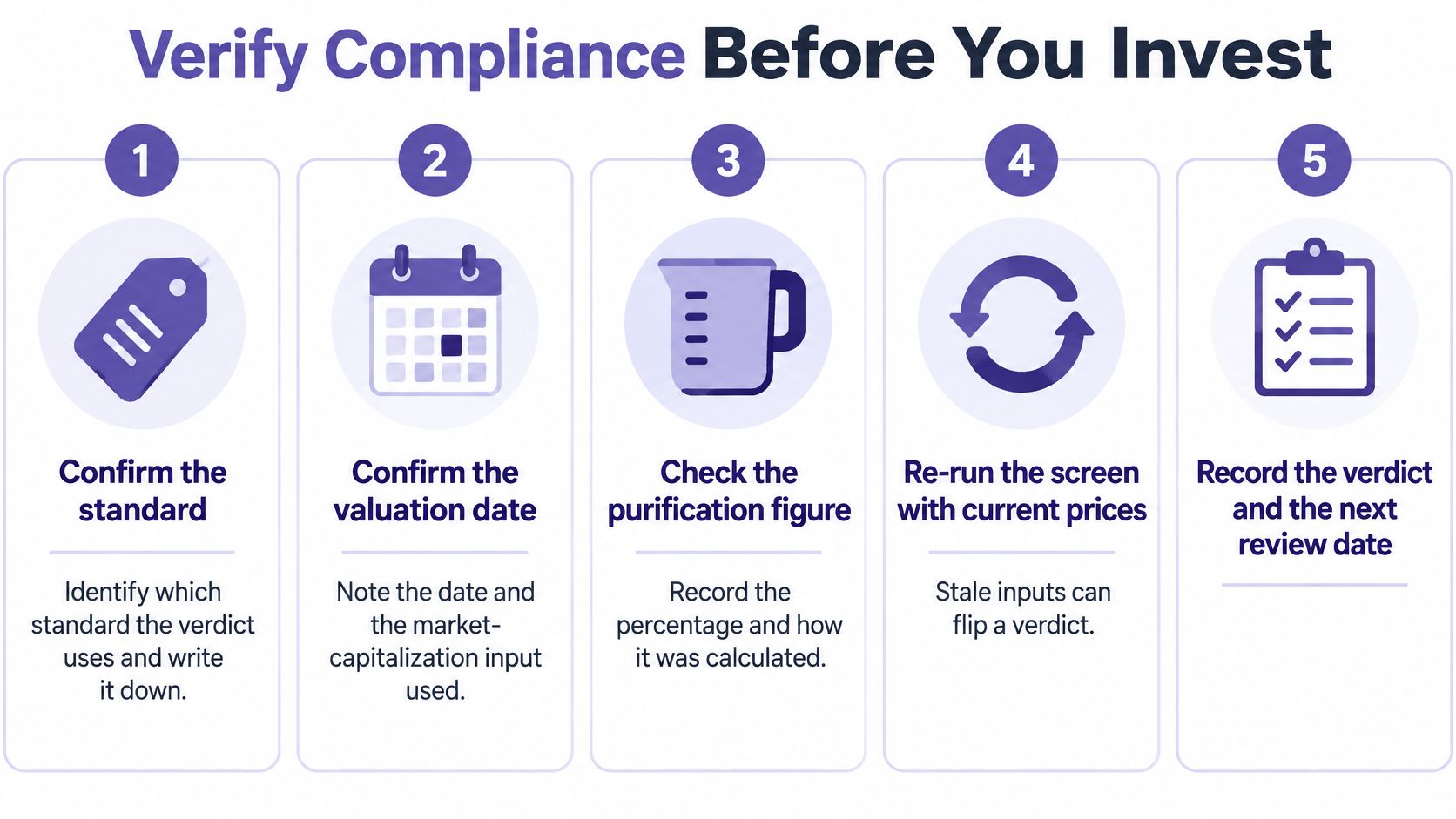
- Confirm the standard and write it down. AAOIFI, a national board, or an index provider's rulebook all produce defensible answers to different questions. What matters is knowing which one you're relying on.
- Confirm the valuation date and the market-capitalization input behind the debt test. A ratio computed on a price from three weeks ago isn't describing the company you'd buy today.
- Check the business classification against revenue segments, not the industry label. The prohibited income is usually embedded somewhere the sector tag doesn't show.
- For funds, check holdings coverage and the weight of non-compliant names. A label with no coverage figure tells you how the product is marketed, not what's inside it.
- Recheck on a schedule. A holding close to the 30% line can flip on price movement alone, without a single new filing.
When a company has no Shariah audit or certification trail, treat its status as unverified rather than compliant. That's how our own screening handles it: a company that has never been through a Shariah audit returns UNQUALIFIED as its halal status, with a Halal Rating of 0 and no audit date, because we make no claim about it in either direction. Every halal verdict on the Akinda API maps back to a documented Shariah rule and the exact numbers that decided it, so the checklist above lives inside the JSON rather than in a footnote.
Budget for purification even on holdings that pass every test. Eligibility and the donation are separate calculations, and only one of them appears in the verdict.
One action for this week: take five holdings from your current portfolio and run them through the list above. Note where the standard differs from the tool you've been relying on, and note which input drove the difference.
Akinda screens stocks and ETFs under five Shariah methodologies, with AAOIFI Shari'ah Standard No. 21 as the primary one, and returns the verdict alongside every underlying ratio and revenue breakdown in a single JSON response. The same holding can be compared under AAOIFI, Dow Jones Islamic Market, FTSE Shariah, MSCI Islamic and S&P Shariah rules side by side, which is the fastest way to see exactly which input is driving a disagreement. That comparison is the whole point: a verdict you can trace is worth more than a label you have to trust. Start for free at Akinda and run your first five names through it this week.