
The most repeated advice in this market is still the weakest one. Buy the fund with a green word in the title, or sort the list by an ESG score, and treat the top result as an ethical choice. A name is marketing. A score is someone else's weighting of environmental, social and governance inputs. Neither one is a screen you can audit.
Ethical investing only starts when a value becomes a constraint the portfolio has to obey. That constraint has a written rule, a denominator, a filing period and a date. What you can check is the methodology, the holdings weights and the buffer around the threshold. Everything else is a story about the portfolio, not a verdict on it.
Table of Contents
- What Ethical Investing Actually Constrains
- Where Ethical Investing Meets ESG and Faith
- How a Written Rule Passes or Fails
- How to Test a Fund Name Against Its Holdings
- What a Good or Bad Year Does Not Prove
- Choose the Constraint Before You Buy
What Ethical Investing Actually Constrains
A mood is not a portfolio rule, and neither is a promise of better returns. The decision is narrower. You turn a value into something the book must pass or fail, then you live with the companies that rule keeps out and the ones it lets in.
Six families cover almost every product a retail or institutional buyer already holds. They answer different questions, and each one fails a claim people often attach to it.
| Approach | Question it answers | Typical rule | Does not prove |
|---|---|---|---|
| Negative or exclusion | Which activities must I refuse | Drop tobacco, controversial weapons, thermal coal, or faith-barred lines such as alcohol and gambling | That the rest of the portfolio creates a positive outcome |
| Positive or best-in-class | Who leads inside a sector I still own | Keep a sector and prefer the stronger operators on stated criteria | That harmful activities are absent from the portfolio |
| ESG integration | Which factors change risk or price | Weigh emissions, labour, supply chain and governance in the analysis | That the fund follows a values ban list |
| Norms-based | Who breached a cited standard | Flag severe controversies against standards such as the UN Global Compact | A full ethical portfolio by itself |
| Impact or thematic | What outcome am I funding | Target renewables, health, housing or a similar stated theme | That every holding is free of controversy |
| Faith-based, including Shariah | Is the business and the balance sheet permissible | Activity test first, then debt and prohibited-revenue ratio tests under a named standard | Environmental or social impact |
Negative screens refuse an activity. They say nothing about whether the remaining names do any good. Best-in-class screens stay inside a sector, so a "leader" in a harmful industry can still sit in the fund. ESG integration prices a risk. It does not ban a business. Norms-based flags catch a breach of a cited standard. They are not a complete ethics policy. Impact and thematic funds fund a stated outcome, and a controversial name can still ride along if it touches the theme. Faith screens, including Shariah, test the business and then the accounts. They do not measure emissions or labour outcomes.
Scale makes the mix-up worse. The Global Sustainable Investment Alliance reported about US$30.3 trillion in sustainable investment assets in 2022. Under the prior, broader definitions, the 2020 review had put the total at US$35.3 trillion. The gap is about 14%, and it comes from tighter classification, not from a US$5 trillion withdrawal. The same revised method also cut the narrower market set from US$17 trillion to US$8.4 trillion. A large total is not proof that every dollar passed one ethical screen. It is proof that a lot of money sits under some sustainability consideration, defined differently from one edition to the next.
If you cannot name the row your fund claims, you do not yet know what it constrains. Exclusion lists aimed at tobacco, weapons or gambling sit in the first row, and the argument over whether those sin stocks belong in a portfolio is a separate question from whether the screen was applied to the weights.
Practical rule: Read the policy until you can point to one row. If the document only says "we consider ESG," you are in integration, not in a ban list.
Where Ethical Investing Meets ESG and Faith
ESG and faith screens both put constraints on a portfolio. They answer different questions, and a disagreement between them is usually correct application of both systems. A high social score can sit beside a business that fails a permissibility test. A permissible business can sit beside a weak environmental record.
What institutions signed up to
On 27 April 2006, United Nations Secretary-General Kofi Annan launched the Principles for Responsible Investment at the New York Stock Exchange, as the PRI's own account records. The network began with roughly 100 founding signatories representing more than US$6 trillion. By 2024 it had passed 5,000 signatories representing about US$128.4 trillion. Signatories commit to putting environmental, social and governance factors into analysis, ownership and disclosure, and to reporting progress. That is a consideration pledge. It does not certify that every holding cleared an ethical screen.
A high ESG score can still fail a faith screen. A Shariah-compliant industrial firm can carry a weak environmental record, because an activity ban and a debt test do not measure emissions or working conditions. Social outcomes can matter to an ESG analysis through labour practices, product impact or access. They still do not become a faith ratio unless a written rule says how they affect permissibility. The point of accessibility tech and social value can inform that broader social assessment, while the faith verdict stays tied to its own rulebook.
Why two families disagree on purpose
| Family | Primary question | Binding constraint | Why it can disagree with the other |
|---|---|---|---|
| ESG, as large institutions use it | Which facts change analysis, ownership and disclosure | Material environmental, social and governance inputs, plus stewardship of names still owned | A permissible business can score poorly on emissions or labour |
| Faith-based, Shariah as the concrete case | Is this business allowed, and do the accounts clear published ratios | Activity test, then financial ratios | A strong ESG name can fail on interest, alcohol, gambling or conventional finance |
Stewardship sits beside both, and it is a different action. Engagement tries to change a company you still own. Exclusion refuses to own it. You cannot maximise both on the same holding. One binds, the other is a preference.
Pick the question you need answered before you compare products. If the question is risk and price, an ESG input belongs in the model, and the tool that feeds it should show factors rather than a single halo. A comparison of ESG screening tools is useful once you know you are buying analysis, not a ban. If the question is permissibility, a score will not settle it.
How a Written Rule Passes or Fails
Shariah equity screening is the cleanest worked case of a value turned into a number. A secular exclusion list behaves the same way once someone writes it down. The belief comes first. The arithmetic comes second. A binary "compliant" label, stored alone, is not enough to defend the verdict.
The activity test, then the ratios
Under a commonly applied AAOIFI framework, the activity test runs first. A conventional bank never reaches the ratios, because the business itself is out. For names that pass the activity test, the AAOIFI treatment explained by Tabadulat limits interest-bearing debt to 30% of market capitalization and non-permissible revenue to 5% of total revenue. Debt compliance can flip when the share price moves even if borrowings do not. Revenue compliance depends on classifying segments and isolating prohibited income. Competing standards also differ on cash, securities, averaging windows and which market-cap convention they use, so the same issuer can pass one book and fail another without either book being sloppy.
A screen worth trusting keeps four things beside the label: the source figures, the filing period, the denominator definition and the calculation timestamp. Names sitting in a small buffer of the 30% debt line, or with prohibited revenue near 5%, belong in a review queue. Rounding, a stale price, an amended filing or a bad segment tag will otherwise look like certainty.
Three splits that move the verdict
1. The denominator. Say two standards both print a 30% debt line. One divides interest-bearing debt by a multi-quarter average market capitalisation. The other divides by total assets. Borrowings are unchanged. In a rising market the first ratio falls and the name passes. The second ratio does not move with the share price, and the name fails. The rule name is the same. The denominator is not.
2. The averaging window. A trailing twelve-quarter market-cap average and a trailing twelve-month average can land on opposite sides of that line in a sharp year. The longer window remembers an older, lower price. The shorter window tracks the latest print. If you do not record which window and which filing produced the ratio, you cannot explain next quarter's flip.
3. The fund. A sustainable or values label can still hold a conventional bank, a fossil producer or a high-debt name. The manager may be integrating scores, engaging, or allowing a loose revenue tolerance rather than excluding. Exposure is the sum of constituent weights. A fund's status cannot be read off its name when the holdings set the economic exposure. A 5% revenue tolerance is the secular version of the same fight. One desk calls that slice "involvement" and drops the name. Another calls it a trace and keeps it. Write down which one you mean.
A rule that cannot be tested against holdings, with the denominator and the filing in view, is not yet a rule.
For each of the three cases, the documents that settle an argument are the standard's name, the ratio, the denominator, the filing period and the date of the last check. Store those. Do not store only pass or fail.
How to Test a Fund Name Against Its Holdings
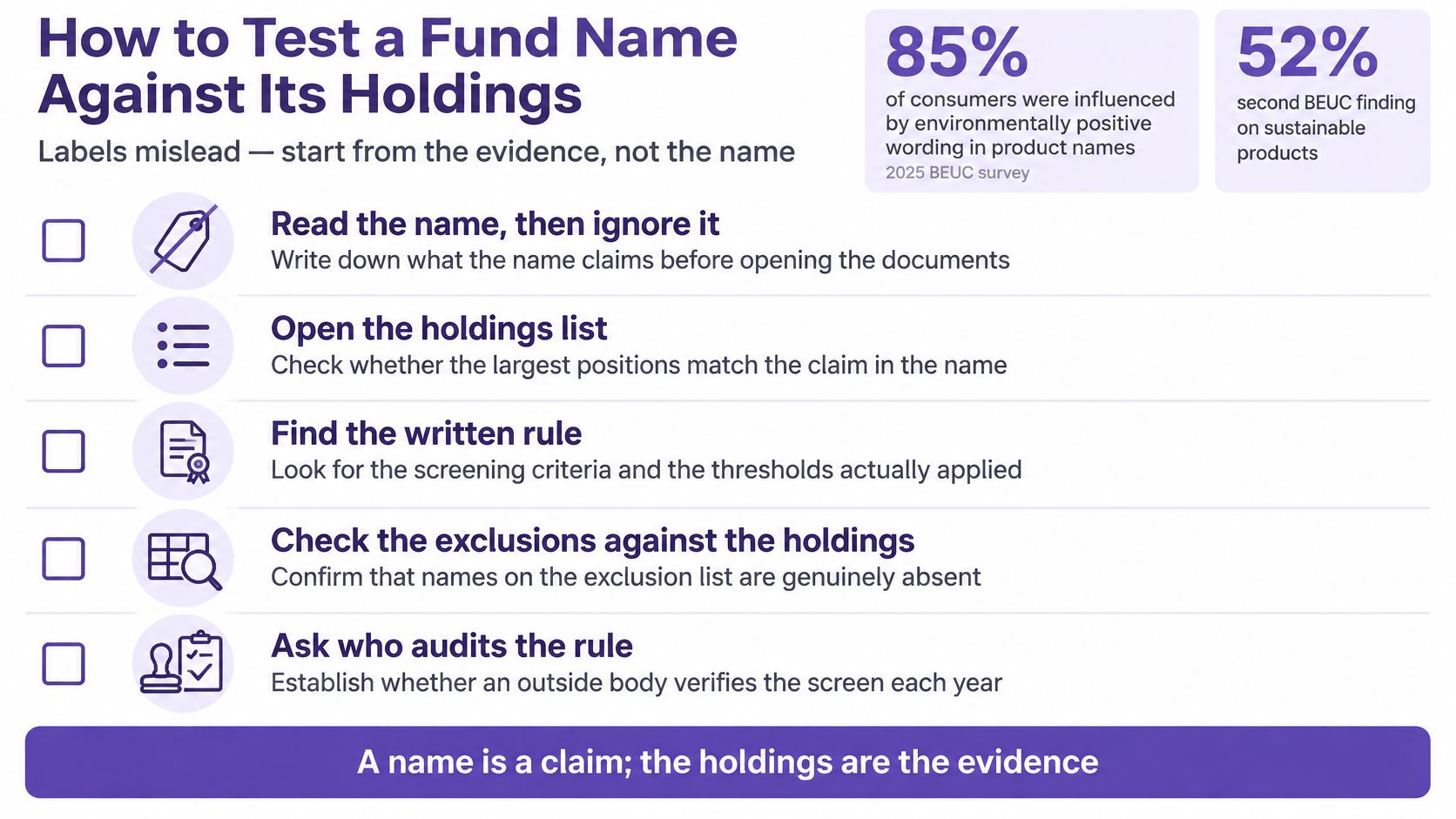
Labels move money before documents do. A 2025 BEUC survey found that 85% of consumers were influenced by environmentally positive wording in product names, while 52% of sustainable investors incorrectly believed such products were subject to a strict legal definition of sustainability. In the same research, 76% wanted stronger rules, 71% wanted scientific evidence, and 52% said the line between conventional and sustainable investments was unclear.
| Finding | Figure | Source |
|---|---|---|
| Environmentally positive wording in product names influenced consumers | 85% | 2025 BEUC survey |
| Sustainable investors who believed a strict legal definition applied | 52% | 2025 BEUC survey |
| Wanted stronger rules | 76% | 2025 BEUC survey |
| Wanted scientific evidence | 71% | 2025 BEUC survey |
| Said the line between conventional and sustainable investments was unclear | 52% | 2025 BEUC survey |
| Wanted to know which companies they held | 66% | New Zealand evidence |
| More likely to choose an independently certified fund | 54% | New Zealand evidence |
| Concerned about misleading claims | 50% | New Zealand evidence |
The New Zealand evidence in that same BEUC paper points the same way. 66% of respondents wanted to know which companies were held, 54% were more likely to choose an independently certified fund, and half were concerned about misleading claims. The useful question is not "is this ethical?" It is what was screened, under which rules, with what data, and how recently.
Six checks, in order
- Ignore the name. Read the policy for the activity list, any revenue tolerance, and whether ESG is an exclusion or only an input to analysis. Write the claim down before you open the holdings, so the name cannot talk you out of a miss.
- Open the full holdings, not the top ten. Match controversial names to that list. A clean top ten with a conventional bank at position 40 is still a holding.
- Ask which rulebook produced any faith or ethical verdict. You want the denominator and the thresholds, not a logo. A Shariah-compliant fund is a holdings result under a named standard, not a title.
- Note the as-of date. A business line or a ratio can change before the next report. Ask what the manager does in that gap, and whether you will see the change or only the next factsheet.
- Treat missing coverage as unknown, not as a pass. If a large share of fund weight was never screened, the label is unfinished.
- Prefer a stated certification or a holdings-weighted calculation over a slogan. Certification raises the odds that someone outside the marketing team re-runs the rule. It still does not replace the weights.
A short walk-through of how a holdings file is read against a policy makes the order easier to repeat on the next fund.
Different methodologies can disagree on the same issuer. That is a reason to keep the rulebook visible, not a reason to trust the friendlier label.
What a Good or Bad Year Does Not Prove
A strong year says markets moved in your favour while your rule was in force. It does not show that the rule caused the return.
A review presented to the U.S. House Judiciary Committee reported that investor-level meta-analyses covering 107 studies generally found ESG-investing returns indistinguishable from conventional returns. Corporate-level evidence across 1,272 studies more often found positive or neutral links between ESG practices and company financial performance. A better-run company is not the same thing as a portfolio that beats a benchmark after valuation, tracking error, turnover, fees, exclusions and factor tilts.
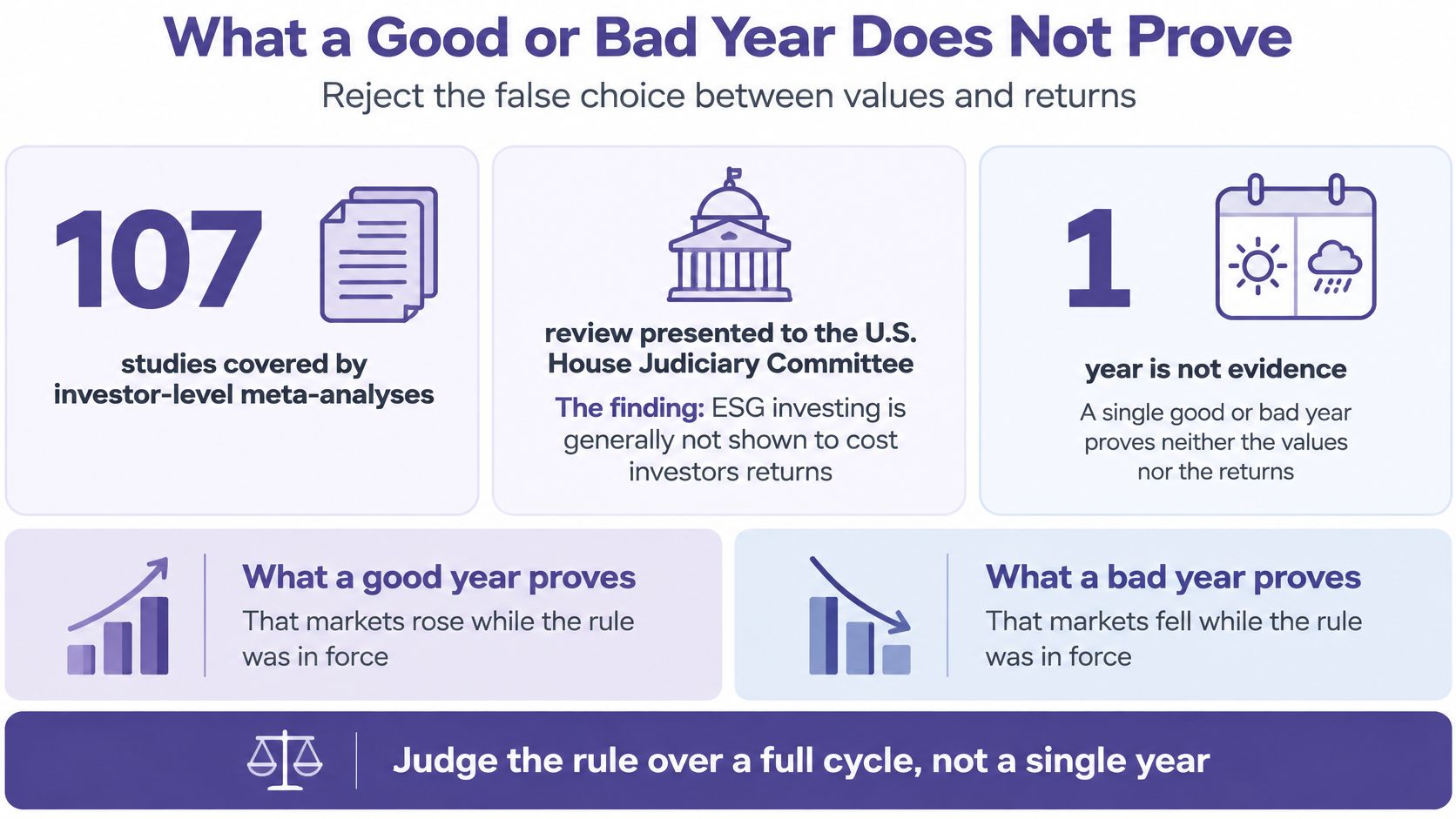
Screening changes exposure to sectors, profitability, debt, size, geography and growth. One strong half-year can be sector leadership. It is not proof that ethics pays, and a weak half-year is not proof that the constraint was a mistake.
What a fair comparison actually needs
A fair test uses a stated benchmark, the same rebalancing dates, survivorship-bias controls, transaction costs, and risk-adjusted measures such as tracking error and information ratio. Exclusion, ESG integration and impact make different causal promises, so they should not share one performance slogan. A faith screen answers investability. It does not answer environmental impact, and a return gap should be attributed to the constraint you wrote down, not to "ethical investing" as a mood.
Recent results are mixed, which is the point. Morgan Stanley reported a median return of 12.5% for sustainable funds in the first half of 2025, versus 9.2% for traditional funds, while first-quarter net flows were negative before second-quarter inflows reversed the trend. A half-year lead can come from sector mix, size tilt or a rebound in previously out-of-favour names. Demand for a label also says little about whether the calculation behind it held.
Judge the rule over a full cycle. A good year proves markets rose while the rule was in force. A bad year proves they fell.
For each decision, record the rule, the eligible securities, the weights and the data date. Then keep the return record beside the constraint, so performance can be read against the thing you screened. Private-market readers hit the same attribution problem when they try to separate value creation from a label, which is why careful net IRR and NAV reporting matters once the constraint and the cash flows have to be told apart.
Choose the Constraint Before You Buy
Write one sentence before you compare products. Name the activity you will not own, the ESG risks you want in the analysis, the faith standard you must meet, or the outcome you want to fund. When two sentences conflict, one must bind. The same holdings cannot maximise exclusion, engagement, faith ratios and measurable impact.
Match the product to that sentence with the holdings test. You need the written policy, the full constituent list, the named thresholds, the data date and the share of weight screened. If the binding rule is a Shariah screen rather than a general sustainability label, require a holdings-weighted calculation under a named standard, not a fund title. Weight nobody has screened is unknown, not a pass.
For a personal account, open one fund's holdings this week and mark every name the written policy should have caught. For a product team, store the standard, the ratio and the filing beside every verdict, so a user can see why two results disagree. Where Shariah is the binding constraint, we screen each ETF constituent with the same stock test, weight it by its share of the fund and recompute overnight, and we decline an ETF verdict when we can see less than 95% of the weight without an already visible breach, or when the fund uses borrowing, inverse strategies or long-short strategies. That is one way to apply a stated screen. It is not proof that a portfolio is ethical.
If the constraint you wrote down is a Shariah screen, Akinda gives you stock and ETF verdicts under named methodologies, with the ratios and the coverage sitting next to the result rather than a fund title doing the work. You can apply that check to holdings you already own and see where a name would have passed a label and failed the weights. Visit Akinda when you are ready to run the screen against the book, not the marketing line.