
The wrong question to ask about robo advisor software is which platform is best. Most comparisons rank products as though a portfolio API, a branded investing app and an advisor's trading desktop solve the same problem. They don't. Buying the wrong delivery model leaves your team building the missing pieces after the contract is signed.
A fintech with engineers needs investment infrastructure it can control through APIs. A bank launching digital advice may prefer a white-label experience. An RIA usually needs an advisor-desktop suite for portfolio operations, while a larger institution may need a wealth platform that includes operational services.
Understanding how automated investment platforms work helps separate the recommendation engine from the interface, execution services and custody arrangements.
Evaluate each candidate against the same practical questions:
- Portfolio control: Can you configure allocations, rebalance rules and security restrictions?
- Integration depth: Which capabilities are accessible through APIs, rather than only through a dashboard?
- Compliance boundaries: Who owns suitability, investment eligibility and exception review?
- Operating scale: Can your team reconcile orders, investigate failures and support clients as volume grows?
For halal investment products, add another distinction: portfolio automation isn't Shariah screening. A platform can execute a model correctly while lacking the evidence needed to establish whether its holdings belong in that model.
Table of Contents
- 1. InvestSuite Robo Advisor
- 2. WealthKernel
- 3. Hydrogen Wealth
- 4. Bambu
- 5. additiv addWealth
- 6. Envestnet Tamarac
- 7. Orion Eclipse
- 8. Vestmark
- 9. AdvisorEngine
- 10. SEI Wealth Platform
- Robo advisor software platforms at a glance
- How to Choose, Test and Launch a Practical Decision Path
1. InvestSuite Robo Advisor
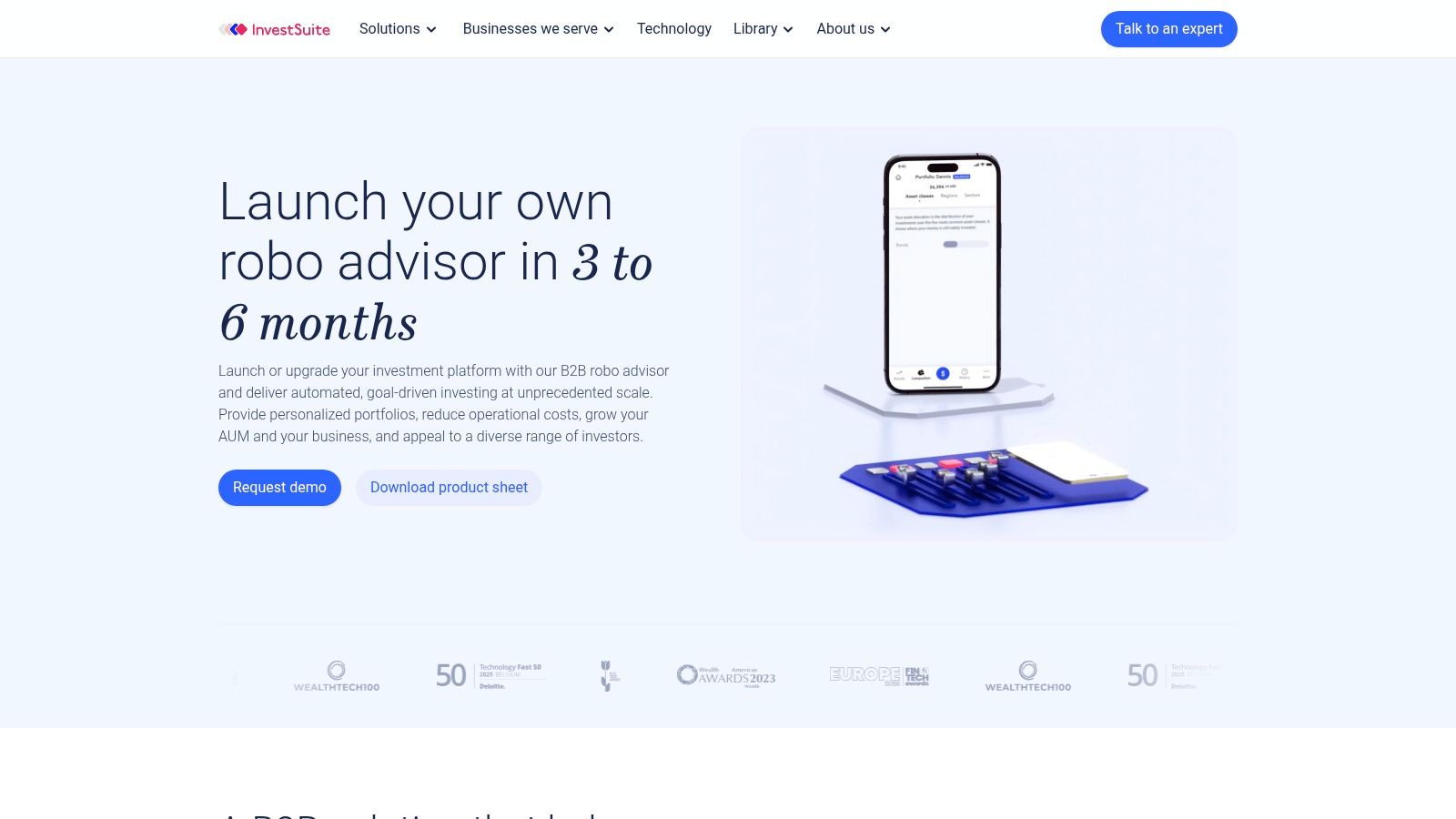
Best fit: financial institutions buying a configurable digital investing experience. InvestSuite Robo Advisor combines goal-setting, investor-preference capture, risk profiling and portfolio proposals with monitoring and rebalancing.
Its appeal is the choice between a branded experience and integration into an existing product. That makes it relevant to a bank that wants a customer journey and to an engineering team evaluating its API route. Configurable portfolios and hybrid-advice support also leave room for different investment policies.
What to Establish Before Buying
- Interface versus infrastructure: Identify which onboarding, brokerage, custody and reporting responsibilities remain with your organization or partners.
- Portfolio restrictions: Ask whether exclusions affect optimization, replacement selection and subsequent rebalancing.
- Commercial scope: Pricing requires a sales discussion. Request separate implementation, integration, support and recurring charges.
I'd shortlist InvestSuite when owning every screen isn't the main objective. The trade-off is that a configurable product still needs operational integration, investment governance and a clearly assigned compliance owner.
For an Islamic robo-advisor, don't treat investor-preference questions as evidence of built-in Shariah screening. Ask the vendor to demonstrate how an external eligibility verdict enters portfolio construction and what happens when an existing holding becomes restricted. A polished onboarding flow doesn't answer those questions.
2. WealthKernel
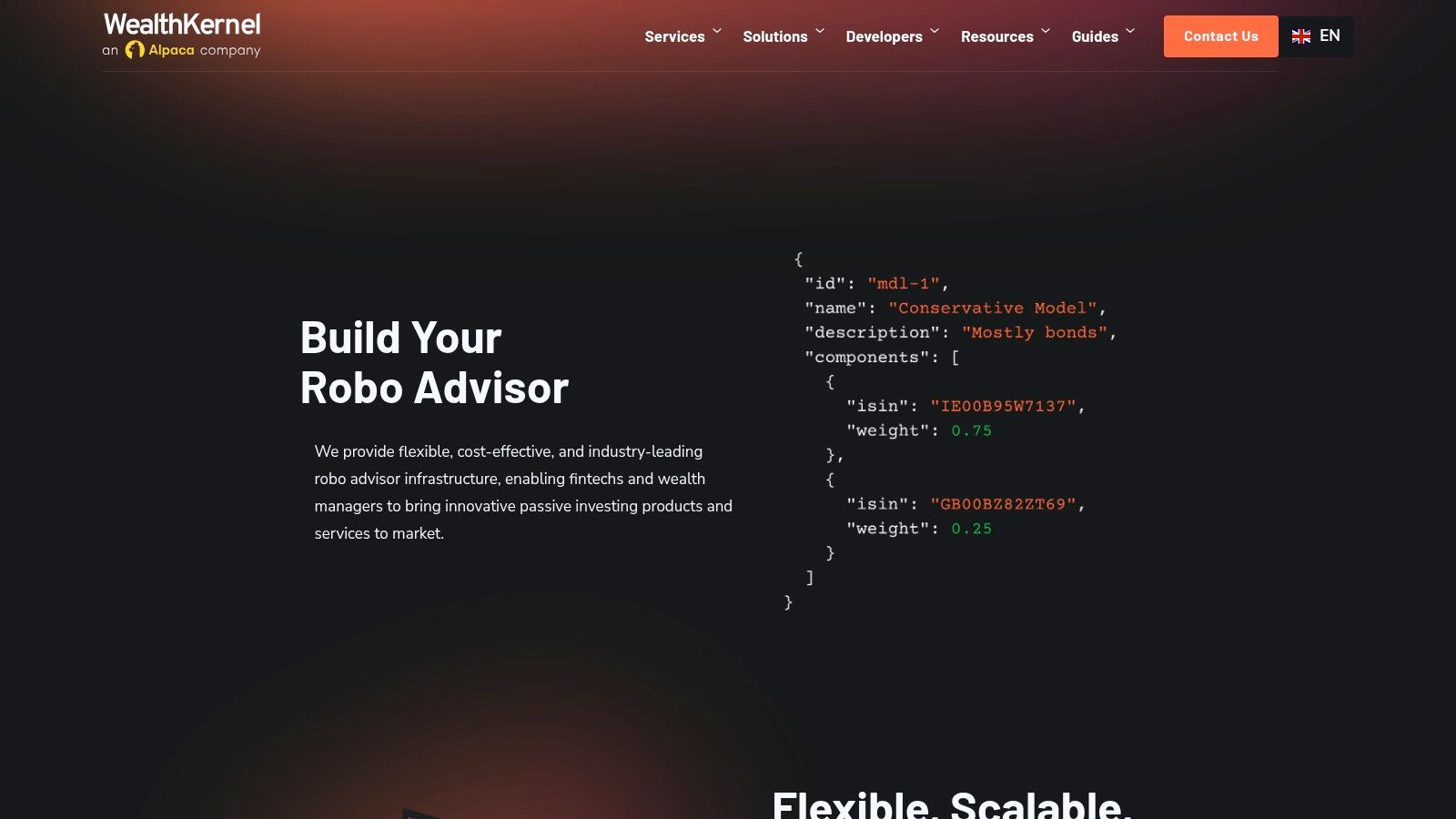
Start with WealthKernel if your team wants to build the product experience around investment APIs, rather than license an advisor desktop. Its offering covers onboarding, accounts, funding, transfers, trading, custody and portfolio-management components.
Model portfolios, automated rebalancing, order handling and fractional trading make it more than a financial-calculation service. Its UK account-wrapper coverage includes ISAs, GIAs, JISAs and SIPPs, so geography should be an early qualification question, especially for a US-only launch.
Practical rule: Choose investment infrastructure against your intended jurisdiction, account types and operating responsibilities before comparing developer convenience.
The main trade-off is front-end ownership. WealthKernel provides investment rails; a complete customer application may require your engineers or a white-label implementation partner. That flexibility suits teams with distinctive onboarding or portfolio-explanation requirements, but it doesn't eliminate product-development work.
Use the technical evaluation to inspect account-state transitions, funding failures, rejected orders and reconciliation outputs. Ask whether security restrictions can be applied before order creation and how a rebalance behaves when a target instrument becomes unavailable.
Pricing is quote-based, with scope affected by modules and partners. Obtain a combined commercial proposal covering infrastructure and any implementation partner, rather than comparing the API quote with another vendor's finished application. Otherwise, the apparent cost comparison excludes the work your team still has to fund.
3. Hydrogen Wealth
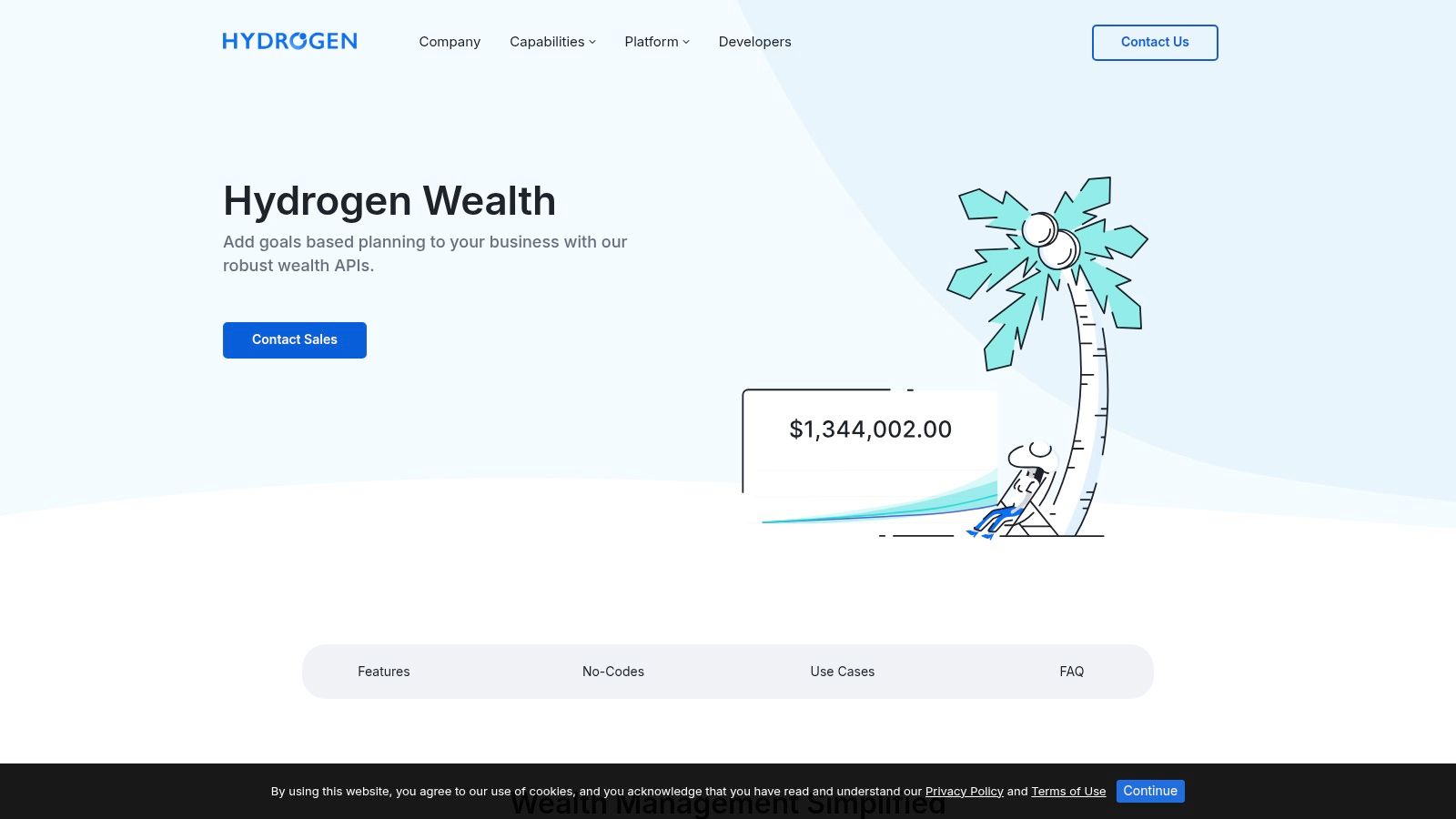
Say your application already has accounts, authentication and a customer dashboard, but lacks goals-based planning. Replacing the whole product would be unnecessary. Hydrogen Wealth is relevant to that buying decision because it offers wealth APIs, embeddable components and configurable applications.
Its capabilities span financial calculations, savings and retirement components, advice use cases and portfolio-management applications. Prebuilt and no-code implementation options can reduce interface development, while professional services can support data integration.
Separate Planning From Investment Delivery
The important distinction is between producing a recommendation and operating an investment account. Planning tools and portfolio APIs don't necessarily include brokerage, custody or an ongoing managed-portfolio service.
Before shortlisting Hydrogen, establish:
- Calculation ownership: Can your investment team inspect assumptions, inputs and model versions?
- Execution boundaries: Which provider turns a proposed allocation into funded positions?
- Embedding limits: Can components use your authentication, design system and accessibility requirements?
I'd consider Hydrogen when advice features need to fit inside an existing application. It's less obviously suited to a small team seeking a complete investing business in a single subscription.
Public pricing isn't available, and the offering is enterprise-focused. Ask which components are currently supported, which require professional services and how changes to calculations or upstream data affect your implementation. A configurable planning experience is useful only if your team can maintain the assumptions behind it.
4. Bambu
Buy the deployment arrangement, not just the branded interface. Bambu offers digital wealth technology for financial institutions, including white-label robo-advisory and planning capabilities. Its positioning covers customizable platforms, while Bambu GO has been presented as a packaged robo-advisor offering.
That distinction matters because a packaged product and a custom institutional implementation create different responsibilities. Before evaluating either, establish which organization supplies the interface, the investment infrastructure and the operational support. A demo that only shows the front end hides exactly the questions that decide the contract.
- Customer journey: Goal-oriented planning and risk profiling can reduce the front-end work required.
- Integration options: APIs and web interfaces may support embedding within an existing financial product.
- Partner dependencies: Availability and service responsibilities need confirmation for the intended market and product.
A useful demo should include a failed funding attempt, an incomplete risk questionnaire and a portfolio that can't satisfy its restrictions. Ask the presenters to show the resulting customer message and the staff workflow, not merely the successful investment journey. What happens on a bad day tells you more than the polished path ever will.
Pricing isn't publicly listed. Request a responsibility map alongside the commercial proposal, naming the owner of customer support, trade exceptions, releases and infrastructure incidents.
Bambu belongs on a white-label shortlist, particularly when reducing interface development matters. Before committing, verify current product availability, deployment status and support commitments. Don't assume every capability shown across its product materials belongs to the same purchasable package.
5. additiv addWealth
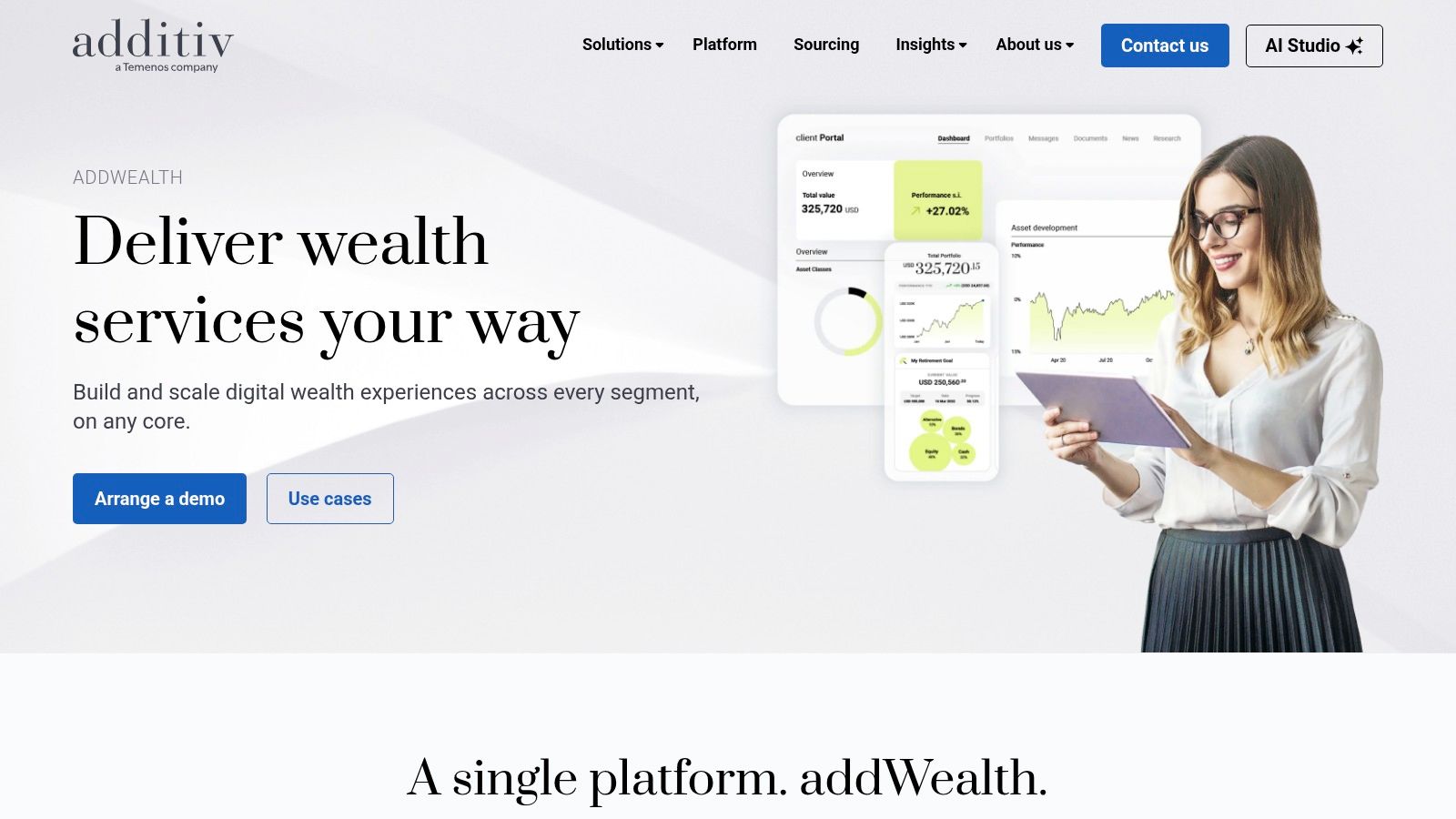
additiv addWealth makes more sense when the plan extends beyond a standalone robo-advisor. Its scope includes self-service, hybrid and advisor-led wealth journeys, with onboarding, suitability workflows, portfolio management, rebalancing and reporting.
The practical advantage is continuity between digital and human service. A customer can need automated allocation for routine investing but human review for a complex objective. In the Escalent affluent-investor survey reported by WealthManagement.com, 65% of robo-advisor users considered access to a human adviser very important.
Test the Handoff, Not Just the Questionnaire
For addWealth, the evaluation should follow a customer from onboarding into an advisor-assisted exception. Check whether the advisor sees the same goals, restrictions and recommendation history, and whether an override preserves the original rationale.
Its API-first integration approach and modular scope can suit institutions connecting existing systems and external providers. However, that breadth also introduces implementation decisions: customer records, suitability ownership, portfolio data and reporting must agree across systems.
Pricing requires a sales discussion, and a broader wealth implementation may exceed what a startup needs for portfolio APIs alone. Ask for a scoped initial deployment rather than an undifferentiated platform proposal.
For a halal proposition, confirm that suitability workflows can consume external screening evidence. Suitability assesses whether an investment fits the customer; Shariah eligibility asks a different question. Your implementation needs both decisions without presenting them as interchangeable.
6. Envestnet Tamarac
An RIA trying to reduce trading and reporting work should evaluate Envestnet Tamarac differently from a fintech building an investing app. Tamarac is an advisor-focused operating suite, with portfolio rebalancing, trading, reporting, billing and client-service capabilities.
Its strengths sit around accounts and households: implementing models, monitoring portfolios and connecting investment operations with the advisory practice. CRM and client-portal capabilities within the broader ecosystem make it relevant when several staff workflows need to share information.
A client portal is not the same purchase as a developer-controlled consumer investing application.
That distinction prevents an expensive category mistake. Tamarac may fit an advisory firm's automation needs without being the right foundation for a separately branded fintech product.
Use a realistic household in the demo: taxable and tax-advantaged accounts, a restricted holding, a withdrawal request and an advisor override. Require the team to show how those constraints affect proposed trades and reporting.
- Integration fit: Compare existing custody and practice-management connections with your actual stack.
- Dashboard scope: Assess financial dashboard software requirements separately from trading capability.
- Commercial fit: Public pricing isn't listed, so establish module, migration and implementation scope.
Tamarac's breadth can help firms consolidating operations, but smaller practices should resist paying for workflows they won't use. For screened portfolios, demonstrate security exclusions and exception review rather than assuming model management includes compliance classification.
7. Orion Eclipse
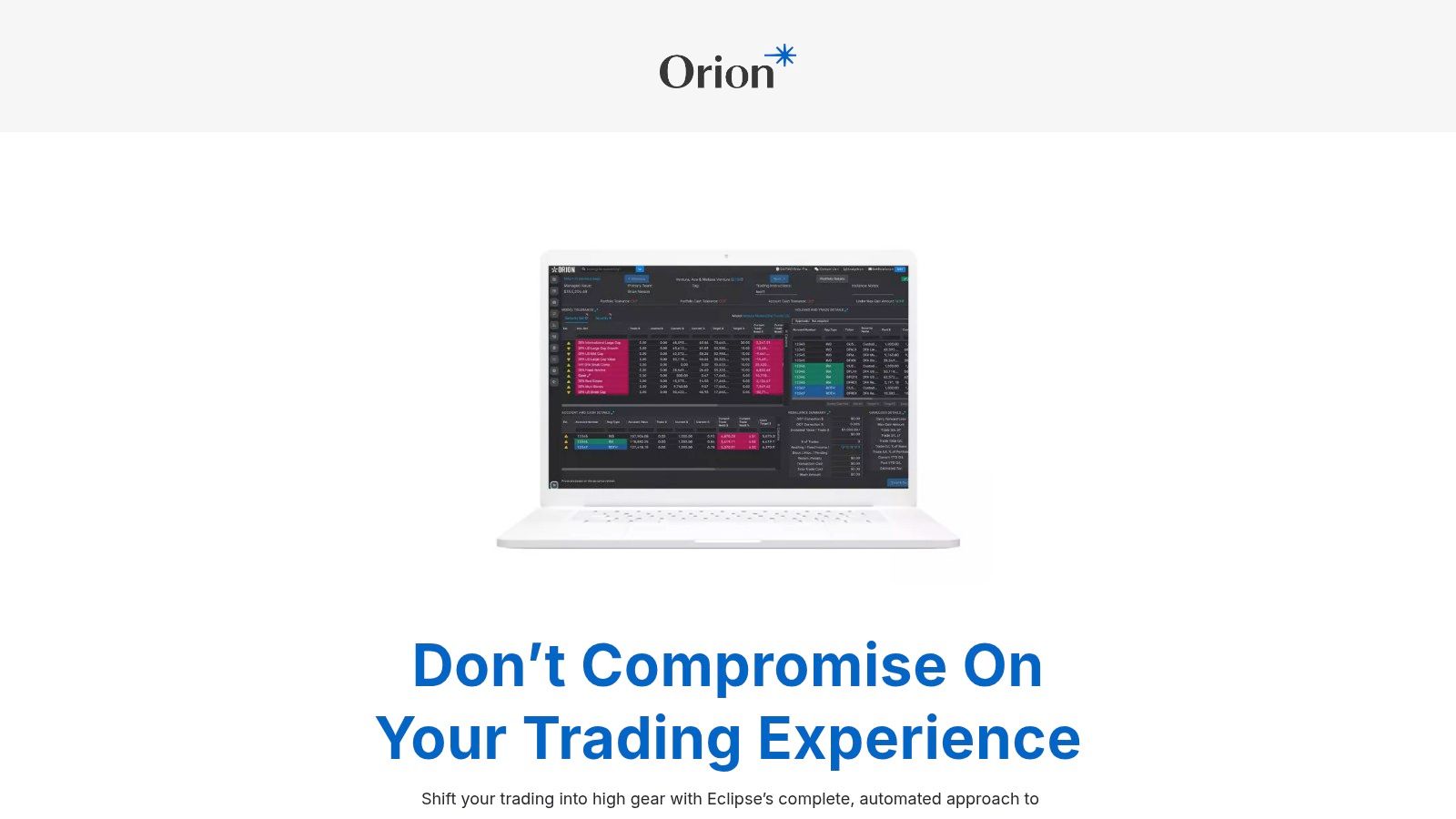
Orion Eclipse is primarily a portfolio-implementation decision. Eclipse emphasizes automated trading, model management, rebalancing, cash monitoring and tax-aware controls for financial advisors.
That makes it a candidate when advisors already have client relationships and investment models but need more controlled execution. Multi-level models, account-level management and custodian-directed workflows address a different problem from launching a complete consumer robo-advisor.
Where the Controls Matter
Evaluate tax-loss harvesting, wash-sale controls and cash requirements against your investment process. A tax-aware trade isn't automatically an eligible trade for a values-based portfolio, so test how restrictions interact with replacement-security selection.
A useful test case involves a holding that becomes prohibited while selling it would create an unwanted tax consequence. The software should expose the conflict for an authorized decision, rather than treating one objective as universally dominant without transparency.
Additional systems may be needed for onboarding, the customer interface and investment infrastructure. Pricing and implementation requirements also need direct confirmation.
For Shariah portfolios, distinguish the trade-control layer from compliance monitoring software. Eclipse can be evaluated for enforcing restrictions, while an external screening process supplies the evidence behind those restrictions.
I'd shortlist it for advisor-led investment operations, not because it carries the broad robo-advisor label. Ask who can override restrictions, how approvals are recorded and whether the final trade record retains the reason for an exception.
8. Vestmark
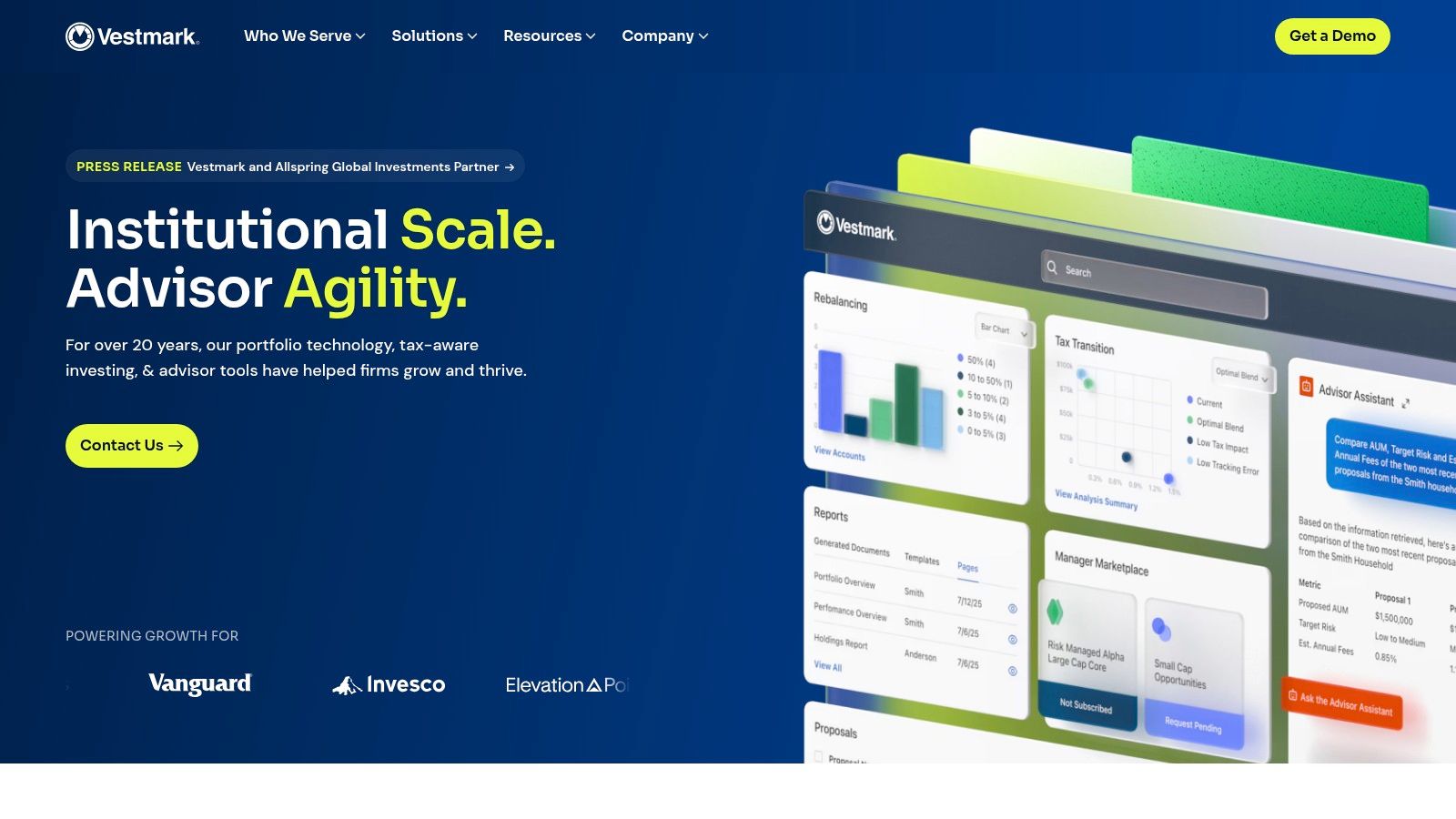
Customization becomes difficult when a client arrives with legacy holdings, embedded gains and account-specific restrictions. Vestmark is relevant to that problem through portfolio management, tax-aware investment capabilities and household workflows, alongside advisor tools and optional services.
Its platform scope includes proposals, reporting, trading, rebalancing and access to a model marketplace. Firms can also evaluate operational and trading services instead of treating the purchase as software alone.
The buying question is how much portfolio customization your team must support:
- Existing positions: Can the transition process retain selected holdings while moving toward the target model?
- Household constraints: Can staff distinguish account restrictions from household-level objectives?
- Service boundaries: Which tasks remain with your investment operations team when optional services are included?
More customization doesn't automatically produce better advice. A study in the Journal of Empirical Finance using 151,200 investor profiles found that goals and time horizons affected recommended equity allocations, while commercial robo-advisors largely ignored Merton-style hedging demands.
For buyers, the lesson is to test assumptions behind a personalized allocation, not just the number of configurable fields.
Pricing isn't publicly listed, and Vestmark's enterprise orientation may be excessive for an early-stage app. It's not positioned as a simple self-serve robo API. Shortlist it when customized implementation and advisor operations justify that broader scope.
9. AdvisorEngine
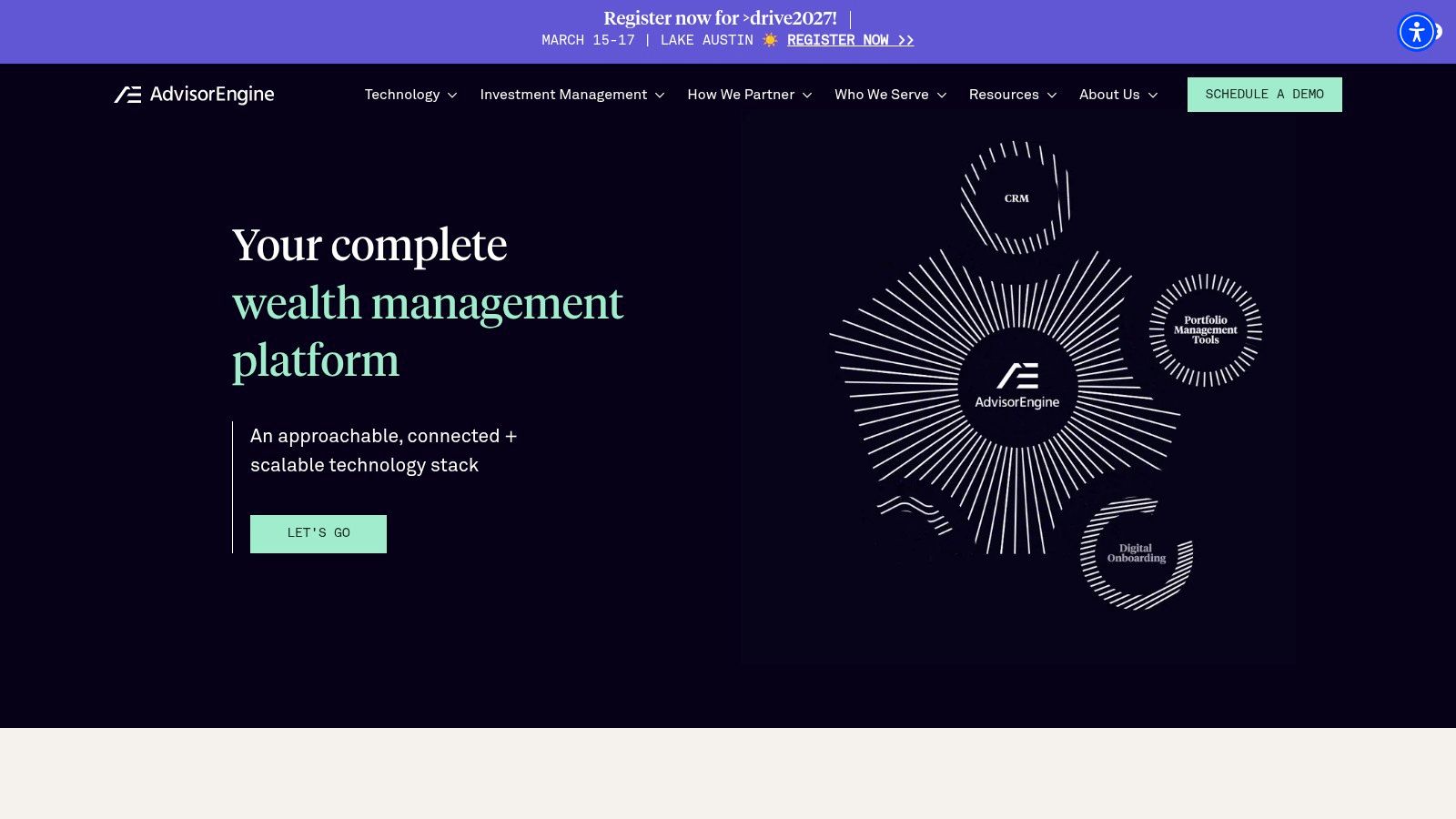
Choose AdvisorEngine for evaluation when the problem is running an advisory practice across disconnected tools. Its offering combines CRM, goals-based planning, onboarding, portfolio management, reporting, billing and automated rebalancing.
That combination can connect a client's objectives with portfolio implementation and ongoing service. It's a different proposition from buying infrastructure APIs for an independently developed consumer application.
Evaluate the Shared Client Record
The critical demo is a change, not an initial setup. Update a client's goal, liquidity requirement or investment restriction, then follow that change through planning, proposed trades, reporting and the client portal.
Ask which fields synchronize automatically and which require staff intervention. Also inspect data consolidation and migration requirements, especially if historical reporting and CRM records currently live in separate systems.
- Workflow fit: Determine whether your staff can complete routine service tasks without duplicate entry.
- Integration depth: Confirm the specific objects and actions available through each connection.
- Cost scope: Pricing varies by firm and feature set rather than a published standard rate.
The trade-off is consolidation versus migration effort. Replacing multiple systems can simplify future operations, but only after your team reconciles records, permissions and reporting expectations.
For Shariah-sensitive clients, make screening status a governed input rather than an informal CRM note. Ask how restrictions reach the portfolio engine and whether staff can distinguish a current verdict from stale or missing evidence.
10. SEI Wealth Platform
SEI Wealth Platform belongs in a broader procurement conversation. It combines wealth technology, operational capabilities, investment solutions and related services, rather than offering a lightweight robo-advisor subscription.
Its scope spans advisor, client and operations workflows, portfolio and account information, trade processing, exception handling and rebalancing. Institutions seeking a unified operating environment should assess that combination, not compare it directly with a narrowly scoped API.
Procurement test: If your main problem is fragmented operations, evaluate the service model alongside the software. If your main problem is embedding portfolio recommendations, start with a narrower shortlist.
SEI can suit wealth managers with complex operating requirements, but breadth creates a larger implementation decision. Define which activities you intend to retain, outsource or redesign before requesting a proposal.
The Condor Capital digital-advice industry review estimated that robo-advisors collectively managed approximately $1.2 trillion at the end of 2024. That market scale makes operational controls relevant, but it doesn't mean every new entrant needs an institutional platform.
Pricing and implementation details are sales-led. Ask for explicit boundaries around exception ownership, data access, service dependencies and exit arrangements.
SEI is most relevant when technology and operations are being selected together. A startup seeking only portfolio construction and a customer app should establish whether that broader commitment solves an actual requirement.
Robo advisor software platforms at a glance
| Best for | Delivery model | Pricing transparency |
|---|---|---|
| InvestSuite Robo Advisor: banks and financial institutions launching digital investing | White-label app or API integration; supports hybrid advice | Not publicly listed; contact sales |
| WealthKernel: fintechs and wealth managers seeking investment infrastructure, especially in the UK and Europe | Modular APIs and infrastructure; white-label partners can provide the customer interface | Quote-based; depends on modules and partner scope |
| Hydrogen Wealth: organizations adding wealth, advice, or planning tools to existing apps | APIs, embeddable components, configurable white-label apps, and implementation services | Not publicly available |
| Bambu: financial institutions and fintechs seeking white-label digital wealth capabilities | SaaS-style or custom implementation; infrastructure may involve partners | Not publicly listed |
| additiv addWealth: financial providers building digital, hybrid, or advisor-led wealth services | Modular digital wealth platform with API integrations | Not publicly listed; likely enterprise-specific |
| Envestnet Tamarac: RIAs managing portfolios and automating advisory operations | Advisor-focused wealth-management software suite | Not publicly listed |
| Orion Eclipse: financial advisors seeking automated trading and portfolio management | Advisor and investment-operations platform | Not publicly disclosed |
| Vestmark: wealth firms, RIAs, and asset managers needing portfolio-management workflows | Enterprise software, with optional operational and trading services | Not publicly listed |
| AdvisorEngine: advisory firms seeking an integrated practice-management platform | Integrated software for planning, onboarding, portfolio management, and client service | Varies by firm and features; standard rates not published |
| SEI Wealth Platform: wealth managers and institutions with complex operating needs | Integrated technology, investment solutions, operations, and related services | Sales-led; pricing details not public |
How to Choose, Test and Launch a Practical Decision Path
Choose the delivery model before choosing the vendor. Fintech engineers building a product should start with WealthKernel, Hydrogen and InvestSuite's API route. Banks seeking a branded experience should examine InvestSuite, Bambu and additiv.
RIAs and advisory firms should evaluate Tamarac, Eclipse, AdvisorEngine and Vestmark against their investment workflows. Include SEI when the requirement extends into a broader wealth operating environment, rather than treating it as another desktop application.
Prove the Workflow in a Sandbox
Request sandbox access and run anonymized, representative client scenarios through the portfolio engine. Include incomplete suitability answers, conflicting objectives, restricted securities, withdrawals and a fund with insufficient screening coverage.
- Trace the recommendation: Preserve inputs, model versions, eligible instruments, constraints and proposed orders.
- Exercise failure paths: Reject an order, interrupt a funding flow and change a holding's eligibility.
- Inspect human review: Establish who receives an exception, what evidence they see and how the resolution is recorded.
Don't accept a successful demo allocation as proof of an operable service. Test reconciliation, repeat requests, stale data and permission boundaries, then include browser compatibility checks for release teams for customer-facing journeys.
Get Compliance Answers in Writing
Ask each vendor which suitability checks it supports, which decisions remain your responsibility and how values-based restrictions reach the trading process. Built-in Shariah screening isn't established by the platform descriptions above, so treat it as a separate requirement until demonstrated.
For this layer, we provide Akinda's Shariah screening API for stocks and ETFs, serving robo-advisors and fintech teams building halal portfolios. Our outputs include verdicts and supporting financial inputs, while holdings-based fund assessments expose coverage rather than relying on fund labels.
Our Business plans include dedicated SLAs and commercial-use terms for robo-advisor deployments. Integration still needs explicit behavior for null values, unrated funds, methodology differences and verdict changes; a screening feed doesn't decide your portfolio policy.
Keep financial suitability, screening evidence and religious review distinct. Our data isn't investment advice or a fatwa, and it doesn't replace a licensed adviser or qualified scholar.
Choose by delivery model, verify through sandbox testing and don't sign until the compliance responsibilities are answered in writing. Ask shortlisted vendors to attach those answers to the implementation scope, not leave them in a sales presentation.
We offer a Shariah screening REST API with stock and ETF verdicts, supporting financial inputs and holdings-based fund assessments for investment applications. Visit Akinda to review the integration resources and discuss commercial access for your robo-advisor's screening workflow.