
Most halal investing round-ups review the wrong thing. They recommend choosing a familiar brand, comparing headline fees, and opening an account. But a screening subscription, a managed portfolio, and a fund purchase aren't interchangeable, even when every provider uses the word halal.
The meaningful comparison is what the platform screens, what it manages, and what you're paying someone else to do. An Islamic robo advisor should connect investment suitability with ongoing portfolio management and Shariah governance. A tool that identifies eligible stocks may help you build that system, but it doesn't necessarily operate it for you.
Run each candidate through these tests:
- Shariah screening method. Which rules apply, who oversees them, and can you inspect the inputs behind a verdict?
- What the fee buys. Does it cover allocation, monitoring, rebalancing, and purification support, or just access to information?
- Jurisdictional eligibility. Can your particular residency, tax status, and account type pass onboarding?
- What the service doesn't do. Who remains responsible for investment decisions, charitable payments, tax reporting, and responding to compliance changes?
For developers and investment teams, those distinctions also define the product architecture. Screening data, discretionary management, brokerage execution, and religious oversight are separate responsibilities.
The platforms below aren't all direct substitutes. That's deliberate: the useful shortlist separates genuine managed services from research tools, specialist endowment platforms, and investment products that still leave you managing the overall portfolio.
Table of Contents
- 1. Wahed Invest, United States
- 2. Wahed Invest, United Kingdom
- 3. Musaffa Managed Portfolios
- 4. Tamra Capital
- 5. Derayah Smart
- 6. Awqef Financial
- 7. Abyan Capital
- 8. Hejaz Investa
- 9. Musaffa Self-Directed Halal Investing Platform
- 10. Hejaz-Managed Funds
- Islamic robo advisor platforms compared
- How to Choose and How to Check the Screening Yourself
1. Wahed Invest, United States
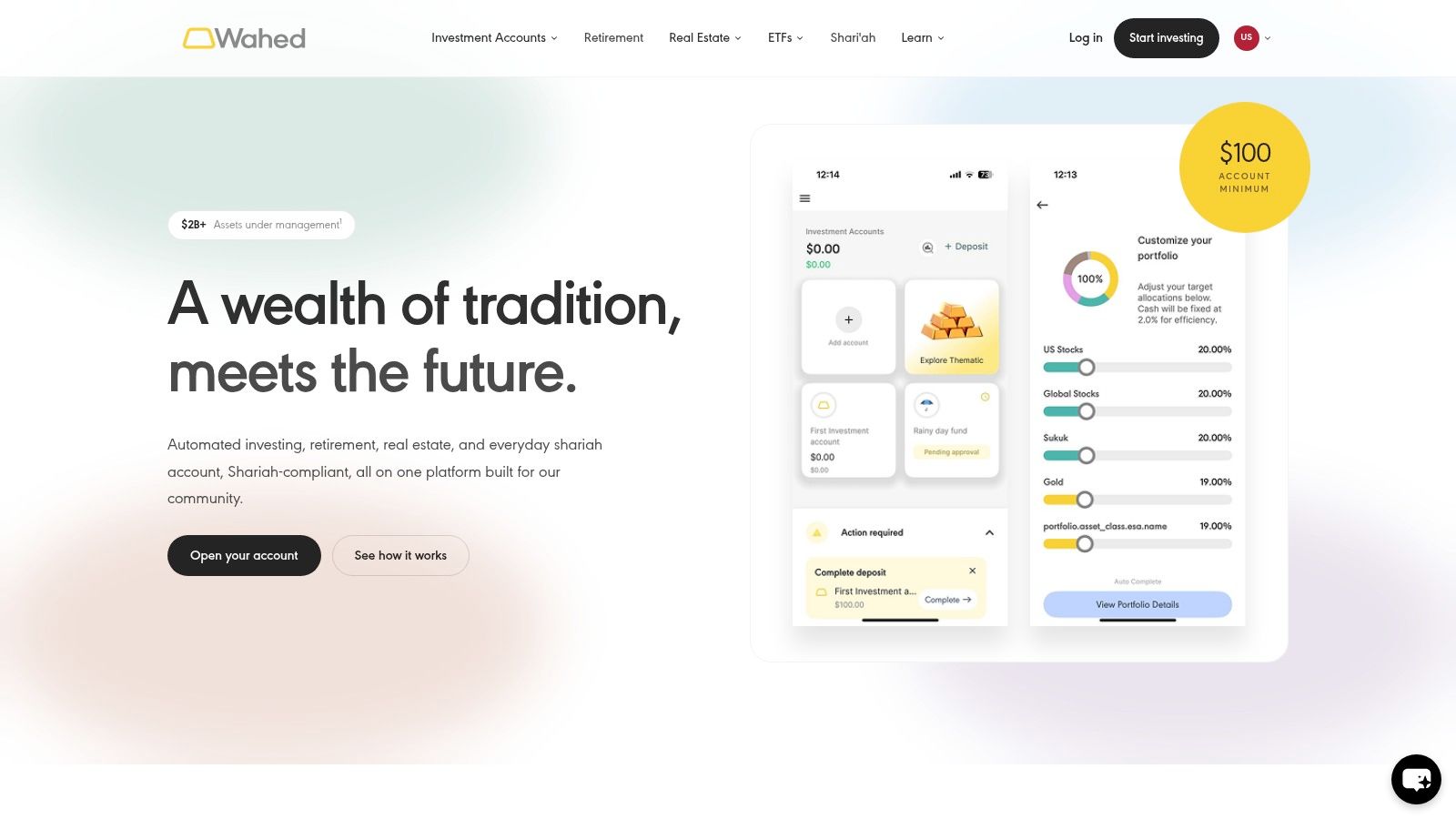
Wahed Invest belongs in the managed-service category. Its US offering builds a portfolio around an investor's risk profile and handles ongoing allocation and rebalancing, rather than presenting a list of eligible securities.
Screening and oversight are part of its proposition. Wahed describes Shariah supervisory review, with portfolios potentially combining screened equities, sukuk, and gold. However, approval of an underlying fund and oversight of the overall account are different things, so inspect the applicable portfolio documentation.
What you're delegating
The practical benefit is reduced portfolio maintenance. You aren't expected to select every holding or place each rebalance yourself, and retirement-account options may be relevant where available and appropriate.
The cost comparison needs more than the management charge:
- Management layer. Establish which portfolio-management activities the wrap fee covers.
- Fund layer. Include underlying expense ratios when comparing total costs.
- Affiliated products. Review the use of Wahed's own ETFs if independent fund selection matters to you.
Zakat calculators and purification information can support your obligations, but confirm whether the service calculates an amount, facilitates payment, or completes it.
For builders, Shariah screening for robo-advisors and brokerages helps separate the compliance layer from portfolio optimization. Neither automated management nor Shariah eligibility protects against market losses.
2. Wahed Invest, United Kingdom
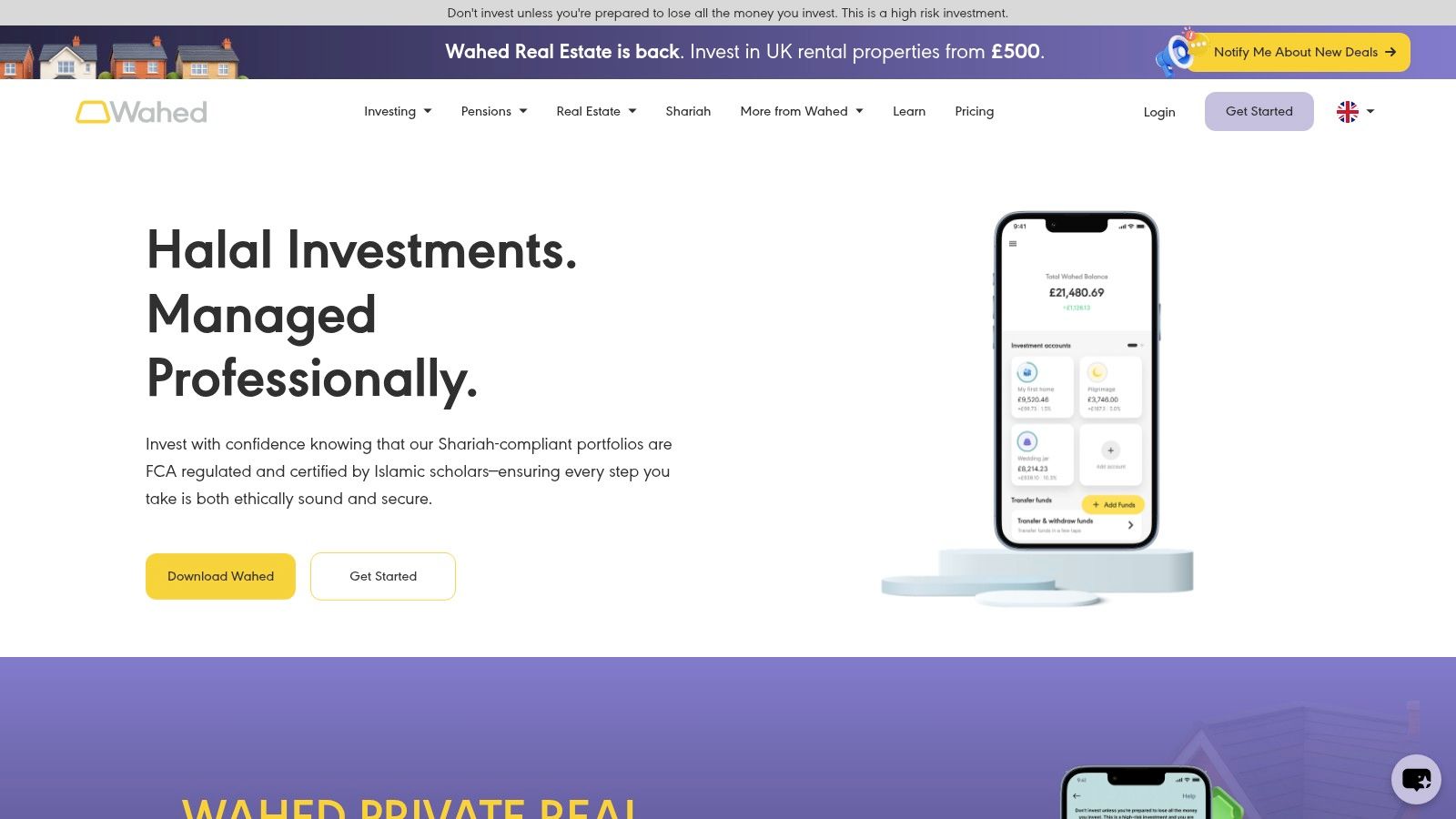
A UK investor's starting point shouldn't be whether Wahed's American service looks attractive. It should be whether Wahed's UK offering supports the account wrapper and investment arrangement they need.
The UK service offers risk-profiled managed investing, with Stocks & Shares ISA and SIPP options subject to eligibility. Those wrappers make this a distinct comparison from a standard taxable investment account, but their availability doesn't establish your personal eligibility or make transferring existing assets automatically worthwhile.
Compare the wrapper and the portfolio separately
Shariah review concerns the investment process and holdings. Account suitability concerns matters such as access, tax treatment, contribution eligibility, and retirement objectives. Don't let a satisfactory answer to either question substitute for the other.
Wahed describes portfolio rebalancing and app-based monitoring. The management fee therefore buys an ongoing service, not merely a research dashboard, but underlying fund costs and market spreads still need to enter your calculation.
Cost discipline: Compare the total cost at your intended account balance, including any minimum charge, rather than treating an advertised percentage as your complete bill.
App access and portfolio statements help you monitor the account; they aren't individualized financial planning. Customer support also shouldn't be mistaken for a licensed adviser evaluating your entire financial position.
For a UK shortlist, Wahed is most relevant when local account wrappers and delegated portfolio maintenance matter more than selecting each security yourself.
3. Musaffa Managed Portfolios
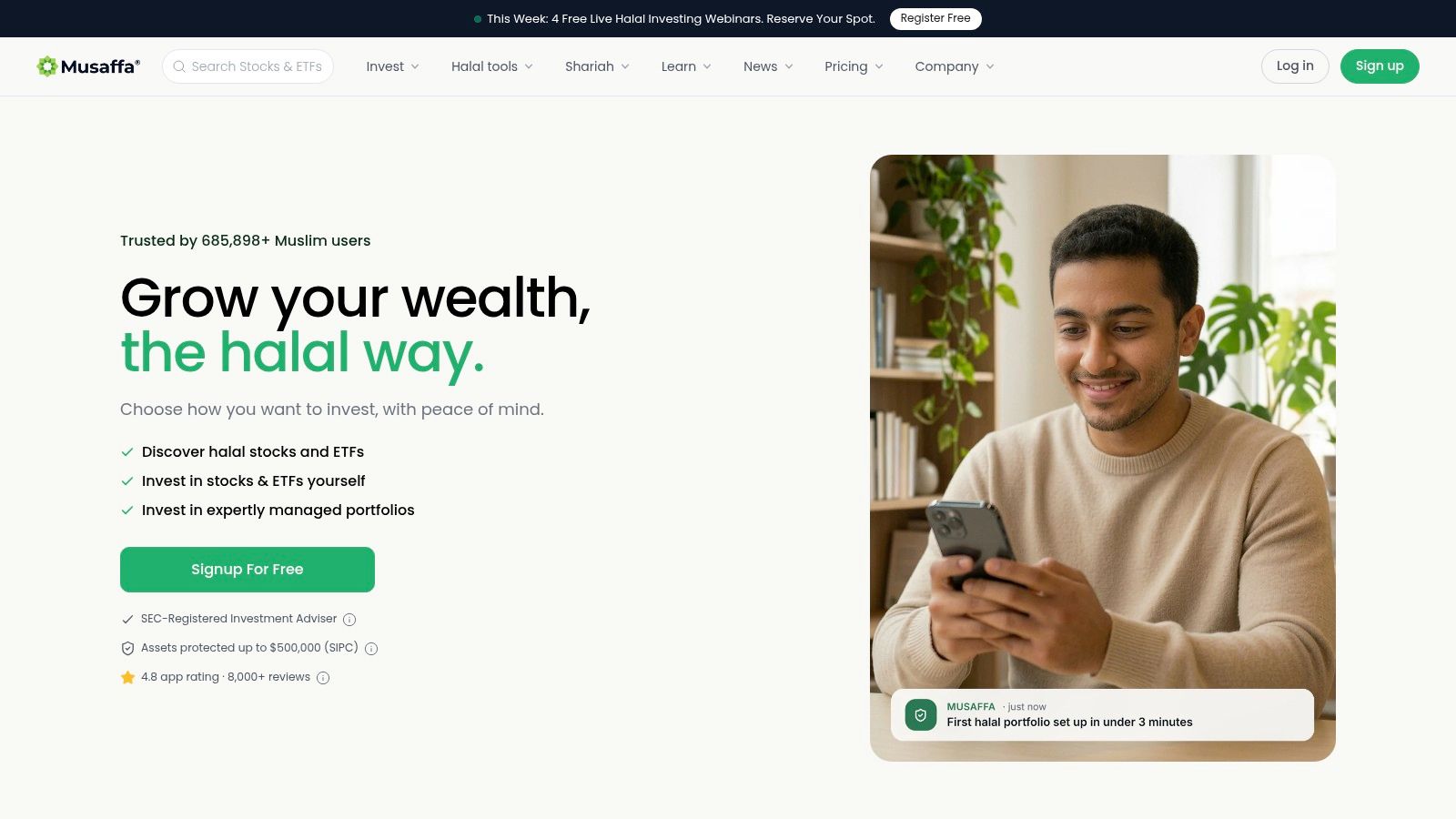
The important word in Musaffa Managed Portfolios is managed. Musaffa also offers research and self-directed tools, so a screening account shouldn't be confused with an agreement authorizing discretionary investment management.
Its managed-service description includes risk-profiled portfolio construction, monitoring, rebalancing, and purification support. That combination may suit an investor who wants to delegate allocation while retaining access to screening explanations.
Assess the offering through the actual advisory agreement:
- Screening method. Identify the governing methodology, oversight arrangements, and treatment of changes in eligibility.
- Fee scope. Separate advisory charges from fund expenses and any trading-related costs.
- Eligibility. Confirm that managed accounts, not merely research subscriptions, are available for your location.
- Service boundary. Establish what purification support means and which actions remain yours.
Research depth isn't the same as management scope
A detailed stock report can explain why a security qualifies without explaining why it belongs in your portfolio. Risk tolerance, time horizon, liquidity needs, and concentration limits require a separate allocation process.
Likewise, an ETF's label isn't enough. The underlying holdings and their assessment matter, particularly when a portfolio combines several funds with overlapping exposures. Understanding a Shariah-compliant fund helps distinguish fund eligibility from whole-portfolio suitability.
The trade-off is delegation versus control. Choose the managed service because you want responsibility for implementation assigned under an advisory mandate, not because you like the research interface.
4. Tamra Capital
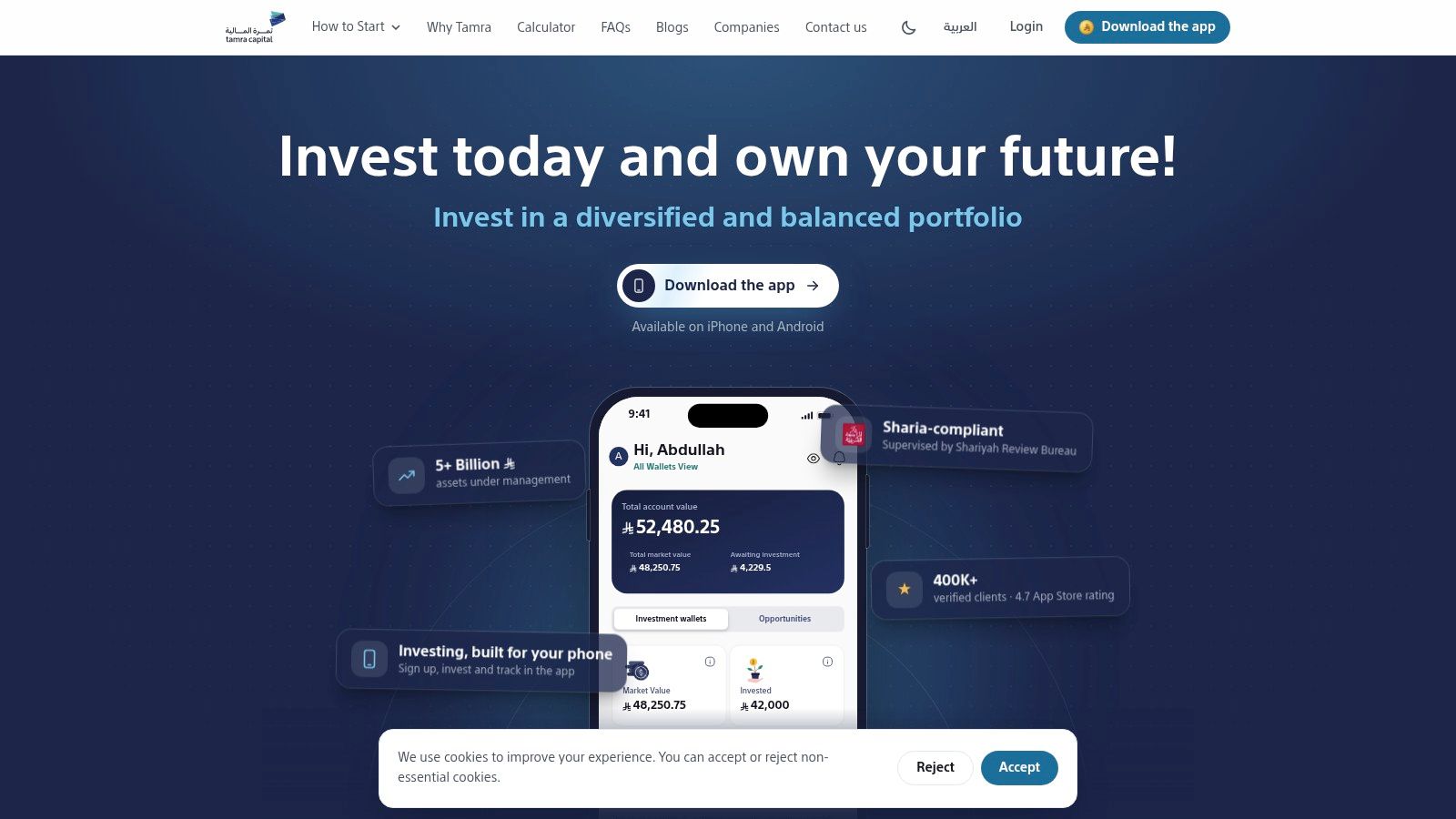
Tamra Capital is a more relevant starting point for an eligible Saudi investor than a foreign platform whose onboarding rules exclude them. Its app-based model uses a risk assessment to recommend and manage a diversified portfolio.
Tamra describes Shariah-compliant ETF investing, potentially spanning equities, sukuk, real estate, and gold. It identifies Shariyah Review Bureau as its Shariah adviser and states that it operates under Saudi Capital Market Authority supervision. Treat these as distinct disclosures: regulatory supervision and Shariah oversight answer different questions.
Look beyond the asset-class names
An allocation across several asset types can be useful, but the names alone don't establish diversification. Inspect geographic exposure, currency exposure, and overlapping equity holdings before concluding that a portfolio spreads risk effectively.
What the fee buys should be automated allocation, monitoring, and portfolio maintenance under the applicable mandate. Confirm current charges and minimums in the account documents rather than relying on comparison-site figures.
- Practical advantage. A Saudi-oriented onboarding and managed-investing service can reduce the friction of using an overseas provider.
- Practical limitation. Local availability doesn't mean every resident or account category qualifies.
- Residual risk. Shariah-compliant ETFs can still expose investors to market declines, currency movements, and concentrated sectors.
For fintech teams, Tamra illustrates why the eligibility process belongs alongside the portfolio engine. A technically suitable allocation is unusable if the customer can't legally open or maintain the account.
5. Derayah Smart
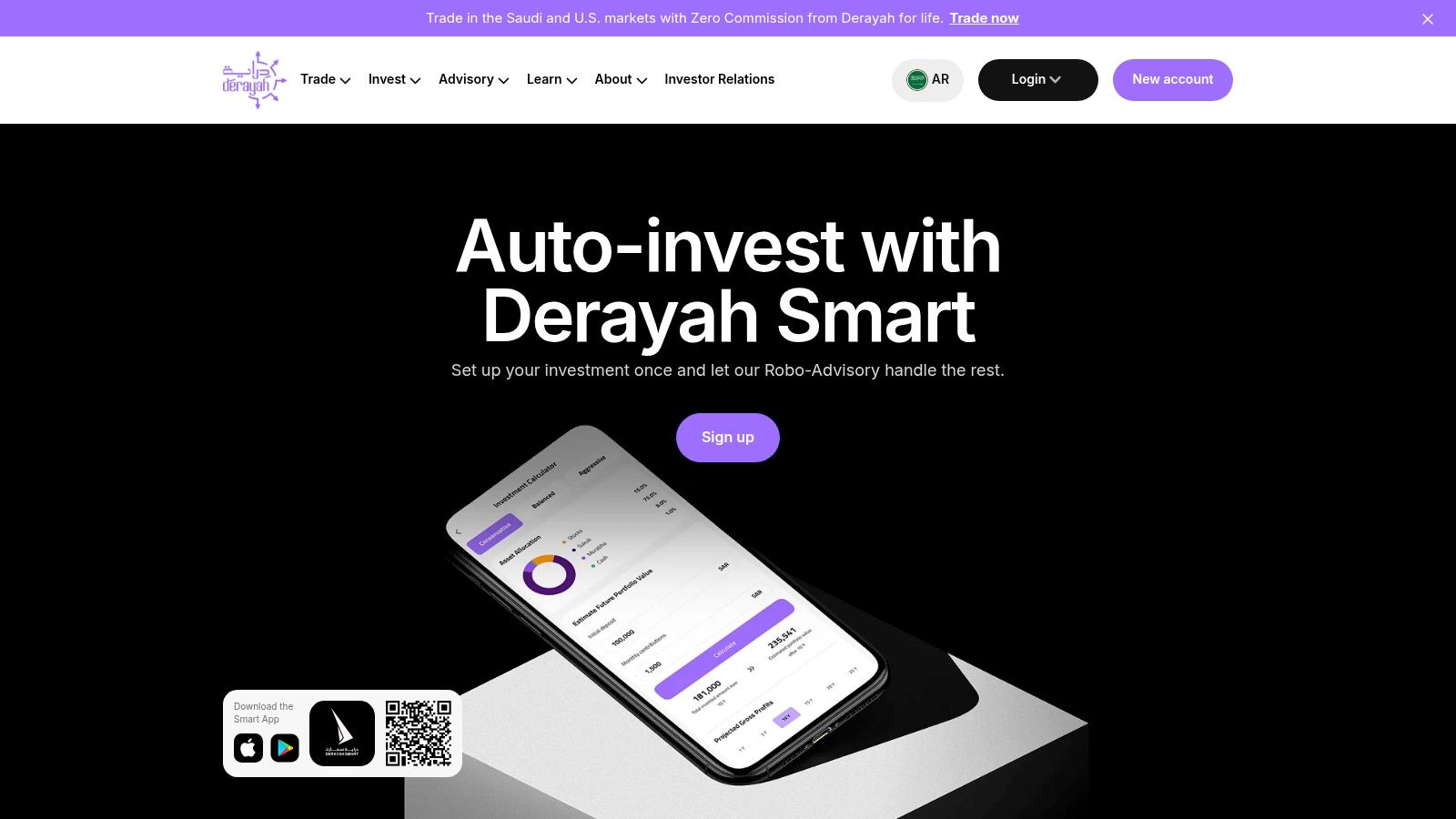
Don't assume that digital portfolio management means Islamic portfolio management. Derayah Smart deserves consideration as a Saudi digital investment service, but the available information doesn't establish that every strategy or portfolio is Shariah-compliant.
Its digital onboarding, identity verification, and guided portfolio setup may be convenient, especially for investors already familiar with Derayah's brokerage services. Convenience, however, doesn't settle which investments a particular mandate permits.
Make the specific portfolio pass the test
Start with the proposed holdings and the documents governing that strategy. A firm can offer several services with different investment universes, so company-level familiarity isn't enough.
A local platform can be convenient without being the right halal portfolio. Assess the mandate you're signing, not the brand above it.
The fee question also needs a defined service boundary. Establish whether you're paying for discretionary allocation and rebalancing, access to selected products, or another form of digitally guided investing.
Jurisdiction is a reason to investigate, not a reason to waive verification. Saudi-market orientation may simplify account administration for eligible customers, but residency, identification, and account restrictions still matter.
Derayah Smart remains a conditional candidate for a halal shortlist until the particular portfolio's Shariah documentation, holdings, and ongoing review process are clear. For builders, this is the same distinction your interface should preserve: provider identity isn't a security-level or portfolio-level compliance verdict.
6. Awqef Financial
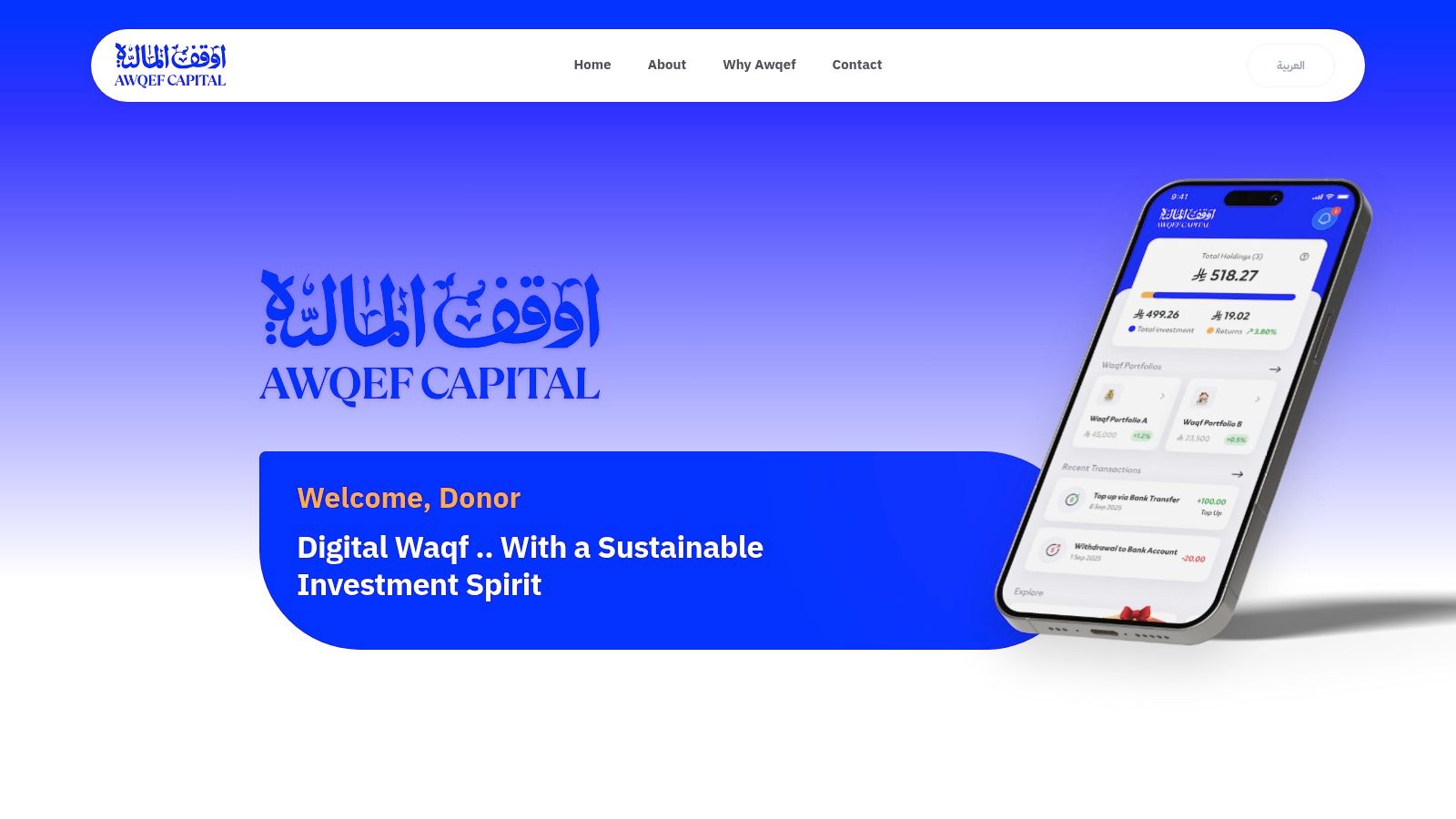
Awqef Financial addresses a different objective: establishing and growing a waqf, rather than managing unrestricted personal savings. Comparing it directly with a retirement robo-advisor would overlook the purpose and constraints of the arrangement.
The platform describes user profiling, suggested portfolios of Shariah-compliant funds, portfolio monitoring, periodic rebalancing, and financial and social-impact reporting. Those are managed-investing functions, but they're attached to an endowment structure.
Purpose comes before portfolio selection
Say your objective is to support an ongoing charitable activity while investing the endowment's capital. You need to understand how investment returns reach beneficiaries, who controls allocation decisions, and what happens when investment performance disappoints.
That differs from saving money you expect to withdraw for personal spending.
- Screening method. Review the funds' Shariah documentation and how their continuing eligibility is monitored.
- Fee scope. Distinguish investment-management costs from any administration associated with the waqf.
- Eligibility. Establish who can create the arrangement and which legal terms apply.
- Service limits. Understand restrictions on withdrawals, changes of purpose, and access to capital before contributing.
Social-impact reporting is useful only when you can distinguish invested assets, investment results, distributions, and the outcomes reported by beneficiaries. Don't treat a portfolio-value chart as evidence of charitable impact.
Awqef is a specialist option, not a general-purpose substitute. Its relevance depends first on whether you want an endowment, then on whether the investment and governance arrangements meet that objective.
7. Abyan Capital
Abyan Capital merits investigation as a Saudi digital wealth-management provider, but a regulatory experimentation history isn't enough to establish the terms of a current retail product. Nor does a reference to robo-advisory establish the Shariah status of every investment offered.
The practical task is to identify the current operating service. A historical announcement, a downloadable app, and an account available for your circumstances are different pieces of evidence.
Verify the live mandate
Before comparing Abyan with Tamra or another managed service, establish what it currently undertakes to manage. The key distinction is whether the provider chooses and maintains allocations under a discretionary agreement or gives customers tools to make those decisions themselves.
Use the same tests without filling gaps with assumptions:
- Shariah method. Locate product-specific oversight, screening rules, and current portfolio information.
- Fee scope. Identify the management charge and any separate fund or transaction costs.
- Jurisdiction. Confirm current account availability for your residency and customer category.
- Service limits. Determine who responds to a compliance breach and whether rebalancing is automatic.
Incomplete public detail isn't proof of a poor service. It does mean the comparison can't responsibly assign a confident halal classification or cost advantage.
For startup teams, this is a useful disclosure lesson. Publish the mandate, eligibility criteria, screening governance, and cost structure together so prospective users don't have to reconstruct the service from marketing language and historical announcements.
8. Hejaz Investa
For an Australian investor seeking delegated investing, Hejaz Investa is closer to a managed portfolio than buying individual Hejaz funds. Its described offering is a professionally managed, Shariah-compliant multi-asset Growth Portfolio, accessible through web and mobile channels.
That doesn't automatically make it a fully personalized robo-advisor. An online managed portfolio can provide professional implementation without offering a questionnaire-driven range of allocations suited to very different risk profiles.
Growth is a suitability decision
If you need conservative exposure or expect to withdraw capital soon, don't assume a Growth Portfolio becomes suitable because it carries a halal designation. Shariah eligibility and investment suitability are separate decisions.
Hejaz describes the portfolio as using its ETFs. Review both the portfolio-management terms and the underlying product disclosures, including how affiliated funds are selected and what costs apply at each layer.
Delegation test: Identify whether the provider manages your overall allocation or simply manages the assets inside the funds you buy.
The jurisdictional fit is Australian retail investing, subject to the relevant eligibility and product terms. It shouldn't be treated as an internationally available account merely because you can access the website.
The appeal is hands-off implementation through a local Islamic-finance provider. The limitation is that the described Growth Portfolio may offer less allocation choice than an investor expects from the term robo-advisor. Verify that distinction before comparing fees with services offering a broader suitability-driven portfolio range.
9. Musaffa Self-Directed Halal Investing Platform
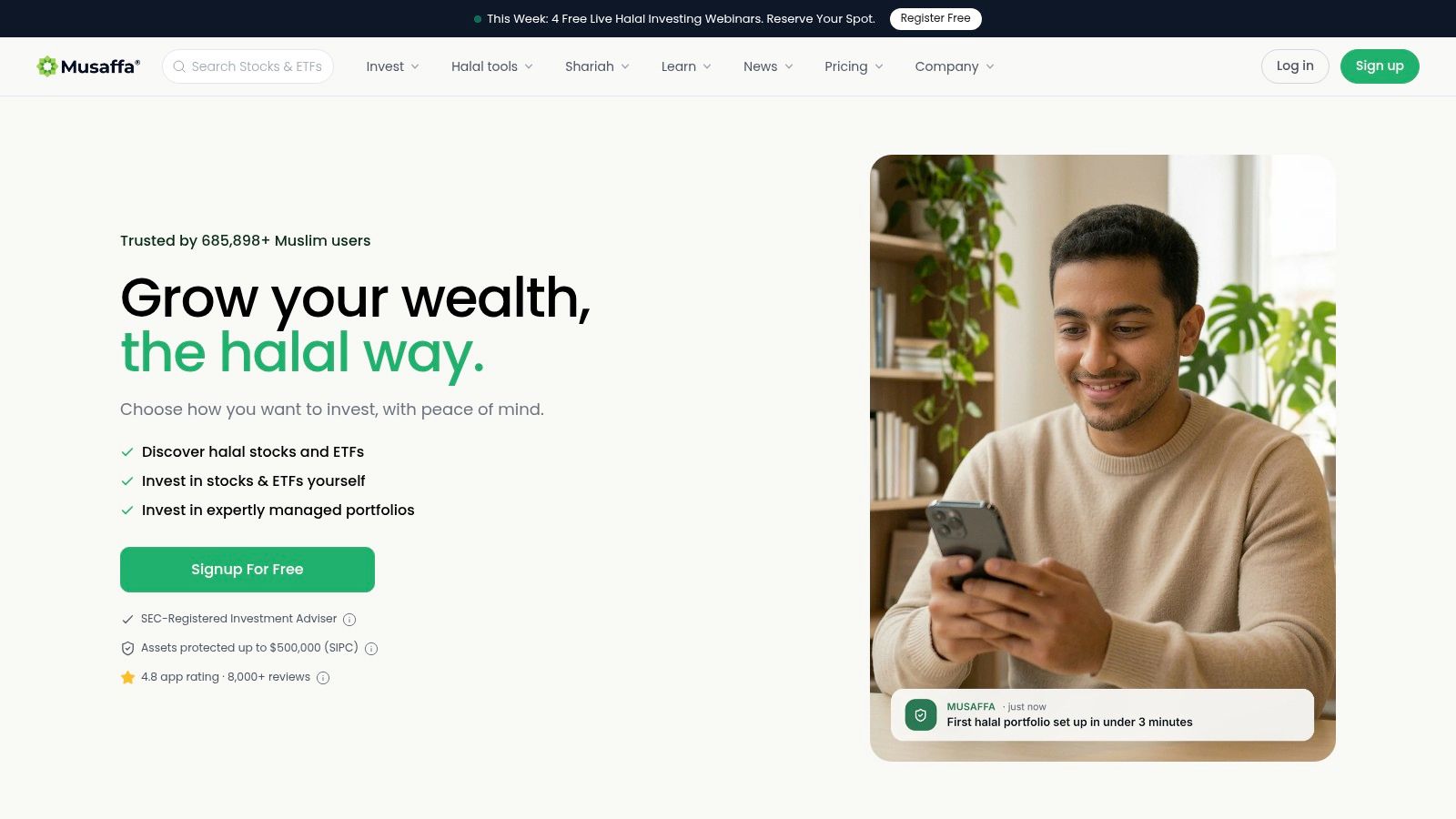
Musaffa's self-directed offering serves a different user from its managed portfolios. Here, screening reports, portfolio tracking, purification tools, and eligible brokerage-linked features support your decisions, rather than necessarily transferring portfolio responsibility to a manager.
That distinction matters when comparing costs. A research subscription and an advisory fee buy different work, even if the interfaces display similar holdings and compliance information.
You retain the allocation job
Say you identify several screened technology stocks and buy them through a connected brokerage. The software may help assess their eligibility, but you still need to decide position sizes, sector concentration, selling rules, and how much cash to retain.
A green compliance label doesn't answer those questions.
- Screening method. Read the methodology and inspect the financial inputs where available.
- Fee scope. Separate research access from brokerage charges and any optional services.
- Jurisdiction. Distinguish access to screening tools from permission to trade through an integrated broker.
- Service limits. Don't assume portfolio tracking includes discretionary rebalancing or automatic disposal after a status change.
Purification and zakat calculators can reduce administrative work, but their outputs still depend on inputs, assumptions, and the obligations applicable to you. Confirm whether the tool merely estimates amounts or supports subsequent action.
This is a self-directed alternative, not an equivalent managed account. It's a better fit for investors who want research detail and control, and who accept responsibility for implementation and ongoing portfolio maintenance.
10. Hejaz-Managed Funds
Hejaz's investment products include managed funds and Australian-listed ETFs. These can be components of a halal portfolio, but buying them doesn't necessarily appoint someone to manage your overall asset allocation.
The distinction from Hejaz Investa is straightforward: fund managers manage the fund; a portfolio service manages the combination you hold, subject to its mandate. You may delegate security selection inside a product while retaining responsibility for everything around it.
Product oversight has a boundary
Hejaz states that its products follow Islamic-finance principles under Shariah supervisory oversight. Review the relevant disclosure documents and certificates for the specific fund, rather than applying a general provider statement to every possible investment arrangement.
For ETF selection, the complete guide to halal ETFs explains why underlying holdings matter alongside labels.
The practical trade-offs are:
- Screening method. Product documentation should establish the investment universe and Shariah review arrangements.
- Fee scope. Fund expenses pay for fund-level operations and management, not necessarily personal portfolio advice.
- Jurisdiction. Australian product availability doesn't establish eligibility in another country.
- Service limits. Choosing allocations, coordinating several funds, and rebalancing between them may remain your responsibility.
This route suits investors who want defined investment products and are comfortable constructing their own portfolio. It can also suit developers building allocation tools around eligible funds, but product access and screening data don't themselves confer investment-management authority.
Don't compare a fund expense ratio directly with a full portfolio-management fee without accounting for the work left to you.
Islamic robo advisor platforms compared
| Item | Jurisdiction | Managed or self-directed | Shariah oversight | Key account types |
|---|---|---|---|---|
| Wahed Invest, United States | United States | Managed, automated portfolios | Shariah supervisory advisers review the approach | Individual accounts; IRA options may be available |
| Wahed Invest, United Kingdom | United Kingdom | Managed, automated portfolios | Shariah adviser and supervisory-board review | Stocks & Shares ISA; SIPP |
| Musaffa Managed Portfolios | Varies by availability | Managed portfolios | Shariah screening and purification support; specific oversight details should be checked | Managed investment accounts; availability varies |
| Tamra Capital | Saudi Arabia | Managed, risk-assessed portfolios | Shariyah Review Bureau is its Shariah adviser | Saudi investment accounts; specific account types should be confirmed |
| Derayah Smart | Saudi Arabia | Digitally guided portfolio service | Shariah compliance is not established for every offering | Saudi investment accounts; specific account types should be confirmed |
| Awqef Financial | Saudi Arabia | Managed waqf portfolios | Portfolios are described as using Shariah-compliant funds | Waqf endowment accounts |
| Abyan Capital | Saudi Arabia | Robo-advisory model; current offering should be confirmed | Shariah compliance should be verified for each product | Current account types and retail availability require confirmation |
| Hejaz Investa | Australia | Professionally managed Growth Portfolio | Described as Shariah-compliant | Australian retail investment accounts |
| Musaffa Self-Directed Halal Investing Platform | Varies by country | Self-directed, with screening and research tools | Screening methodology should be checked against the preferred Shariah authority | Brokerage-linked accounts in eligible locations |
| Hejaz-Managed Funds | Primarily Australia | Fund investment; investors may manage allocations themselves | Shariah supervisory board oversees products | Funds and ASX-listed ETFs |
How to Choose and How to Check the Screening Yourself
Start with jurisdiction and account needs, then decide how much responsibility you want to delegate. A suitable managed service must accept your circumstances, support the required account type, and manage a portfolio consistent with your risk and liquidity needs.
Next, examine the screening evidence. Establish which standard governs the assessment, which financial periods supply the inputs, how unavailable values are handled, and whether fund assessments examine underlying holdings. A verdict without its calculation date and coverage information is difficult to evaluate independently.
Inspect the process after a verdict changes
The awkward case isn't a stock that clearly fails before purchase. It's a holding that changes status after you own it, when the platform must decide who reviews the change, what action follows, and how the investor is informed.
The Journal of Shariah article on Islamic robo-advisory identifies governance, transparency, and regulatory preparedness as unresolved adoption barriers. For a production application, respond with versioned rules, decision logs, explicit missing-data handling, and a documented human escalation process.
Don't confuse numerical compliance with a thorough ethical assessment. The Iqtishodia discussion of AI-based Shariah screening highlights the limits of quantitative screening when broader social and environmental concerns matter. An investor may want both formal eligibility and additional ethical exclusions, but the interface should distinguish them.
Keep screening separate from advice
For independent verification and product development, our Akinda Shariah Compliance API screens stocks and ETFs using AAOIFI Shari'ah Standard No. 21 as its primary methodology alongside other rulebooks, with a free tier to start. Reports expose underlying financial inputs, and holdings-based fund assessments include coverage information.
The same screening JSON shape works for a single founder's halal portfolio app and a bank's Shariah trading product. That consistency supports integration, but it doesn't eliminate the need for suitability controls, licensed activities where applicable, or qualified Shariah governance.
The broader discussion of how AI is reshaping fintech is relevant here: automate extraction and repeatable calculations, while keeping responsibility for decisions explicit. Screening data is not investment advice, a recommendation, or a religious ruling, and it doesn't replace a qualified scholar or licensed adviser.
Choose the service whose contractual responsibilities match the work you want delegated. Then verify the evidence behind its compliance claims before funding the account or integrating its outputs into your application.
Akinda provides stock and ETF screening data with supporting financial inputs and methodology comparisons for halal investment applications. Visit Akinda to start with the free API tier and test how transparent screening can support your Islamic robo-advisor workflow.