
Your client's balanced portfolio has grown after a strong equity market, but the latest statement raises awkward questions. Stocks now dominate the allocation, an ETF's holdings file is incomplete, and a company that previously passed screening needs another review. You need to decide what to sell, what to retain and what you can confidently report.
That's the daily work of a portfolio asset manager. Investment selection matters, but so does knowing when the evidence is incomplete, when a rule overrides a return forecast and when trading would cost more than the risk it removes.
Table of Contents
- What a Portfolio Asset Manager Actually Does
- Mandates, Benchmarks and Client Reporting
- The Analysis Behind Every Portfolio Decision
- How to Decide When and What to Rebalance
- Compliance Monitoring and Debt Ratio Screens
- Verdicts When ETF Holdings Are Incomplete
- Choosing a Screening Standard and Governing It
- Set Up Your Oversight Checklist Before Your Next Review
What a Portfolio Asset Manager Actually Does
A portfolio asset manager is accountable for managing one or more portfolios against a stated objective, risk limit and set of investment rules. The job isn't only to find attractive securities. It's to make sure the combination of holdings remains suitable for the client.
Think of a ship's navigator. Choosing the destination is only the beginning. The navigator keeps checking the course, conditions and restrictions, then recommends adjustments when the original route no longer fits.
In the drifting balanced portfolio, selling the strongest-performing stock might seem obvious. But the manager first needs to establish whether the equity allocation has breached its permitted range, whether upcoming withdrawals can reduce the imbalance and whether any holding has become ineligible.
Three duties that work together
Three core duties of a portfolio asset manager
| Duty | Core question | Typical tasks | Output |
|---|---|---|---|
| Portfolio oversight | Are holdings still on target? | Track weights, drift, cash and trade needs | Rebalancing list and weight report |
| Analysis | Where does risk come from? | Measure volatility, correlation and factor exposure | Risk budget and allocation recommendations |
| Compliance monitoring | Does each holding still pass its rules? | Check screens, coverage and status changes | Breach alerts and audit records |
The distinction between portfolio growth and managerial decisions matters. Boston Consulting Group reported that worldwide assets under management reached approximately $128 trillion in 2024, up 12%, with the increase driven primarily by asset-price appreciation rather than new investor capital.
A larger portfolio therefore doesn't automatically mean the manager attracted new money or improved the allocation. Rising prices can increase both the account value and its concentration.
For bank-linked investment operations, resources from Visbanking on how to unify bank data and mitigate risk are relevant to the underlying challenge: managers need consistent inputs before they can make defensible decisions.
Practical rule: Resolve eligibility and data-quality problems before optimizing a trade list.
These duties aren't separate queues. Analysis tells the manager whether drift matters, compliance determines which responses are permitted, and oversight turns the decision into an executable plan. In the opening scenario, an unresolved eligibility alert deserves attention before routine allocation adjustments.
Mandates, Benchmarks and Client Reporting
Before placing a trade, the manager needs a written answer to a basic question: What has the client authorized us to do?
The investment policy statement records the return objective, acceptable risk, investment horizon, liquidity requirements and exclusions. A balanced mandate might permit equities only within a stated range, require accessible cash for withdrawals and prohibit particular business activities.
Those constraints have operational consequences. An attractive private investment may be unsuitable if the client needs ready access to the money. A stock with a persuasive investment case remains ineligible if it violates an exclusion.
Turn the mandate into an operating reference
A strategic benchmark gives the manager a neutral comparison aligned with the mandate. It shouldn't be chosen because it's easy to outperform. The difference between a portfolio weight and its benchmark weight is an active position, whether the manager intended it or not.
Before trading, the team should:
- Reconcile positions: Match internal records against custodian holdings and investigate discrepancies.
- Record cash movements: Separate contributions, withdrawals, income and expenses from investment performance.
- Check permissions: Confirm that proposed holdings and trades remain within the mandate.
Say a client withdraws cash while equities rise. The manager must distinguish the effect of that withdrawal from the effect of investment returns before explaining why the allocation changed.
Report the decision, not just the result
A useful reporting policy can specify monthly statements, quarterly risk reviews and prompt notification of material breaches. The agreed cycle should reflect the mandate rather than an assumed universal requirement.
Present performance net of fees against the appropriate benchmark, and use attribution to explain allocation, security selection and currency effects. Include unresolved exceptions, not just completed trades.
Each review should answer: Is the mandate still suitable? Is the benchmark still appropriate? Did the portfolio behave as intended?
The written answers matter. They let the client understand what happened and allow compliance staff or auditors to reconstruct what the manager knew when making a decision.
The Analysis Behind Every Portfolio Decision
Why can adding another volatile asset reduce total portfolio risk? Because the holdings don't necessarily rise and fall together.
The allocation sketch below highlights the connected decisions a manager needs to consider.

Harry Markowitz's 1952 publication, Portfolio Selection, formalized the importance of evaluating assets together rather than individually, as explained in UBS's profile of Markowitz and his work. Correlation, the relationship between asset returns, helps explain why combining risky holdings can produce a less risky portfolio.
Diversification is about shared behavior
Volatility describes how much an asset's returns fluctuate. Correlation describes how those fluctuations relate to another asset's returns. Owning different securities doesn't guarantee diversification if they respond to the same economic forces.
Consider a portfolio holding a technology stock, a growth-oriented fund and a broad equity ETF. The account has different line items, but the manager may discover substantial overlap in companies, sectors and sensitivity to interest rates.
A rowing crew offers a useful analogy: the boat's behavior depends on how the rowers work together, not just each rower's strength.
For a visual companion to the allocation discussion, the following video provides another format.
Use optimization without mistaking it for certainty
Mean-variance optimization searches for allocations offering the highest expected return for a chosen risk level, or the lowest risk for a chosen expected return. The resulting combinations form the efficient frontier.
The limitation is in the inputs. Expected returns are estimates, historical relationships can change, and an unconstrained optimizer can recommend impractical concentrations.
Before adding a holding, check:
- Underlying overlap: Does it repeat companies or exposures already owned?
- Risk drivers: Does it add a different source of return, or amplify an existing bet?
- Implementation limits: Can the portfolio hold and trade it within the mandate?
The useful question isn't whether an asset looks attractive alone. It's what changes when you add it to everything the client already owns.
How to Decide When and What to Rebalance
Rebalance on evidence, not because a date has arrived. A scheduled review is useful, but it shouldn't automatically generate orders.
CFA Institute's asset-allocation guidance connects risk budgeting to each asset's marginal contribution to total portfolio risk and discusses how disciplined rebalancing can reduce risk while potentially adding incremental return. That supports a process that weighs the benefit of a trade against its implementation cost.
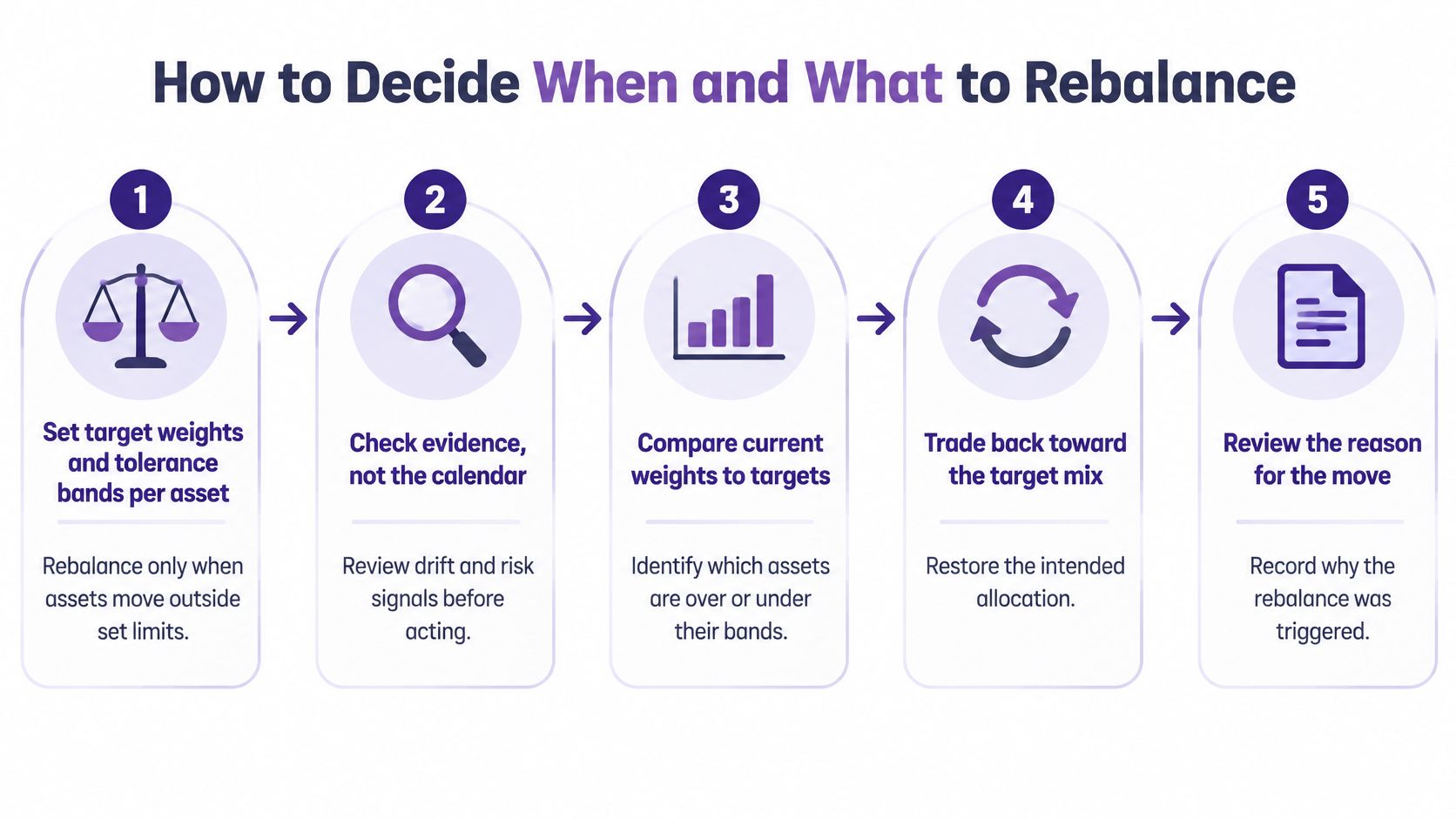
The infographic summarizes the review cycle; the execution checks below add the controls needed before releasing orders.
Build a cost-aware trade queue
Set target weights and tolerance bands. Record the intended allocation and acceptable movement around it. The band defines when drift warrants attention; a review date merely prompts you to check.
Measure current drift. Compare reconciled position values with the targets, including cash and pending transactions. Stale prices or unsettled trades can otherwise create misleading signals.
Check compliance status first. A hard eligibility breach can override the normal allocation process. Follow the mandate's disposal, escalation and approval requirements rather than assuming the holding can wait.
Estimate marginal risk contribution. Ask how much each position contributes to total portfolio risk and how a proposed trade changes that contribution. The largest weight deviation isn't necessarily the most consequential exposure.
Estimate execution costs. Include the bid-ask spread, expected market impact and relevant transaction charges. For taxable accounts, consider the consequences of realizing gains before approving discretionary adjustments.
Rank discretionary trades by risk reduction relative to cost. Favor trades that remove meaningful unwanted exposure efficiently. Keep mandatory compliance actions identifiable so they aren't delayed by an economic ranking.
Apply liquidity limits and release approved orders. Check available cash, settlement timing and executable size. Retain the decision record, then compare actual execution with the assumptions used.
Set bands deliberately
Consider wider tolerance bands for highly correlated assets and expensive-to-trade positions. Small reallocations between similar exposures may do little to improve the portfolio, while repeated trading incurs costs.
A rebalancing rule should prevent unwanted risk, not manufacture activity.
As a hypothetical contrast, a noticeable drift between similar bond funds may justify monitoring rather than immediate trading. A smaller deviation in a stock that has become ineligible requires action under the breach policy, even if its allocation remains close to target.
Record why the manager traded, deferred or escalated. Choosing not to trade should be an explainable decision, not an undocumented omission.
Compliance Monitoring and Debt Ratio Screens
For a Shariah-screened portfolio, begin with business activity, then apply the financial tests required by the selected methodology. A company whose core business is excluded doesn't become eligible merely because it carries little debt.
Financial screening requires more care than copying a ratio from a dashboard. The numerator, denominator and observation period all affect the result. A plain-language explanation of Shariah-compliant investment screening can help investment and engineering teams agree on the terms before implementing them.
AAOIFI-oriented screening material published through the OIC Exchanges Forum documents an interest-bearing-debt limit below 30% of market capitalization and compares methodologies that use different thresholds or market-capitalization averaging periods. Don't turn that into a universal rule covering every standard or financial screen.
Why the denominator changes the verdict
Suppose a company's debt remains unchanged while its share price falls. Under a market-capitalization-based test, the denominator can shrink and the debt ratio can rise without any additional borrowing.
An averaging window moderates how market observations enter the calculation, but it doesn't eliminate the need to understand them. The manager should distinguish a market-driven ratio change from a fundamental change such as new financing.
That distinction helps explain the alert to the client. It doesn't excuse a breach of the selected rule.
Compliance screens, thresholds and what to store
| Screen | Pass rule | Inputs needed | What to store |
|---|---|---|---|
| Business activity | Core activity must not fall within the standard's excluded sectors | Segment and revenue descriptions | Sector classification, filing source and filing date |
| Prohibited revenue share | Must remain below the chosen standard's prohibited-revenue ceiling | Revenue by segment and total revenue | Filing source, classifications and figures used |
| Interest-bearing debt | Must meet the selected debt threshold using its prescribed denominator and window | Debt figures and market-cap history or other required base | Raw debt, observation set and averaging window |
| Cash and short-term investments | Must meet the selected liquidity test using its prescribed definitions | Relevant cash, investment and other required balances | Raw balances, calculation base and methodology version |
Preserve an explainable calculation
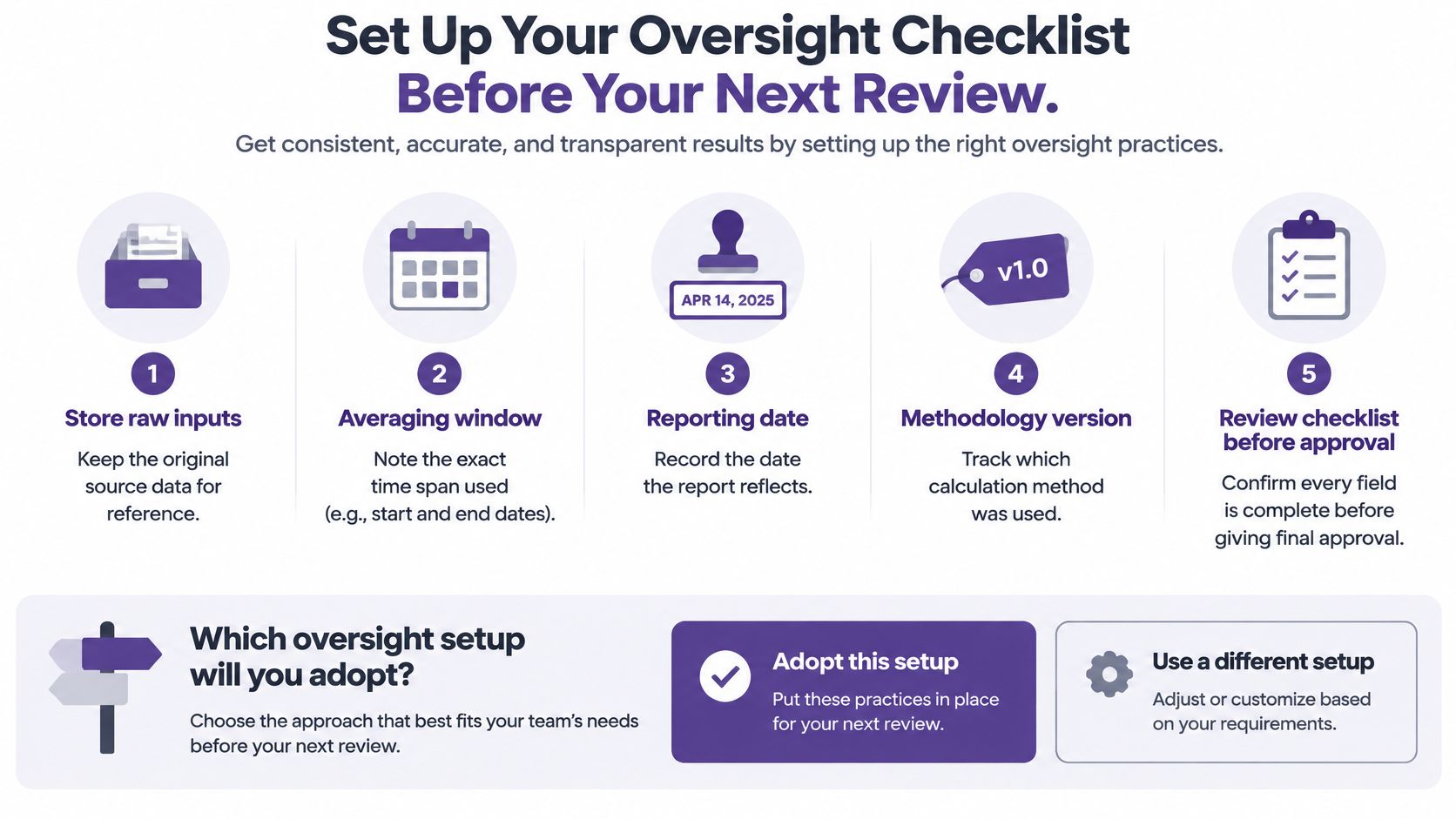
Store the reporting date separately from the date the screening system retrieved the filing. A newly retrieved document may still describe an older financial position.
Retain the raw financial values, calculation settings and effective methodology version alongside the verdict. If a classification changes, the reviewer should be able to identify whether the cause was a new filing, a price movement, a corrected input or a rule update.
Set a documented review buffer near each threshold rather than waiting for a breach. Borderline holdings deserve closer attention, but they shouldn't receive invented exceptions merely because selling them would be inconvenient.
Verdicts When ETF Holdings Are Incomplete
An ETF's name doesn't establish what it currently holds. Even a published holdings file may be delayed, incomplete or unsuitable for applying a constituent-level investment rule.
In a 2025 UK-based industry survey, 88% of ETF investors considered holdings transparency important when selecting a fund, according to the Investment Association's retail ETF report. For a portfolio manager, the operational question is more specific: how much of the fund can be assessed?
Coverage means the share of fund weight with a usable constituent verdict. It isn't the share of ticker symbols successfully matched, because a missing large position matters more than a missing tiny one.
Separate a breach from missing evidence
In our screening process, each ETF constituent receives the same stock screening, weighted by its share of the fund, and the assessment is recomputed nightly. Our policy distinguishes insufficient evidence from an observable failure.
How to act on each ETF verdict outcome
| Outcome | When it applies | What the manager does |
|---|---|---|
| Confirmed breach | Visible non-compliant weight already exceeds the applicable limit | Act under the breach policy and record the contributing constituents |
| Clean result | Coverage is at or above our 95% floor and the applicable tests pass | Record coverage, methodology and holdings timestamp |
| Indeterminate | Coverage is below our 95% floor with no breach already visible | Don't treat missing weight as zero; obtain fuller holdings |
| Not rated | Fund is leveraged, inverse or long-short under our method | Assess underlying exposures separately; don't rely on a fund verdict |
The coverage floor is our publication policy, not a universal industry guarantee. We decline to publish an ETF verdict below that floor unless the visible holdings already establish a breach, and we don't publish one for the excluded fund structures.
Our explanation of how much of an ETF can be screened gives context for interpreting these outcomes.
Missing holdings are unknown exposure, not evidence of zero exposure.
Timestamp each snapshot and keep its coverage beside the result. Reassess when the constituent file changes, and make sure the application doesn't keep displaying an older verdict as though it describes the latest holdings.
An indeterminate result needs a request for fuller or fresher holdings. A structurally unrated fund needs a different assessment approach. A confirmed breach requires a response even if better disclosure might reveal further problems.
Choosing a Screening Standard and Governing It
Different apps can faithfully apply different published standards and reach opposite conclusions about the same company. That isn't automatically a calculation error.
AAOIFI, Dow Jones Islamic Market, FTSE Shariah, MSCI Islamic and S&P Shariah don't represent interchangeable labels. Their treatment of financial inputs, denominators and eligibility conditions needs to be visible to the manager.
A 2026 systematic review covering 79 Scopus-indexed studies from 2008–2025, available through IBA's research repository, reports that market-capitalization-based screens generally admit a smaller investment universe, while asset-based screens can provide greater stability across crises. These findings describe trade-offs, not a guarantee that a particular screen will improve a client's returns.
Disclose the rule behind the answer
A useful verdict record shows the denominator, lookback period, debt and liquidity inputs, prohibited-revenue treatment and effective date. Without those fields, a disagreement between systems becomes difficult to investigate.
Our headline fund assessment is a portfolio-weight test derived from AAOIFI. Dow Jones, FTSE, MSCI and S&P apply their own per-company screens with their own thresholds. Keep that distinction explicit when presenting methodology comparisons.
Adopt a governance policy that identifies:
- The primary standard: Specify which methodology controls investment eligibility.
- Alternative views: Explain which comparisons users can see and what they mean.
- Borderline treatment: Define escalation and approval rules before a contested case arises.
- Change records: Preserve the previous status, new status, cause, effective date and reviewer.
Automate the workflow without hiding the policy
When selecting infrastructure, Loopfour's guidance on how to choose a finance automation vendor is a useful prompt to evaluate the workflow around the calculation, not just whether software returns an answer.
Ask whether reviewers can reconstruct a decision after inputs change. Check how corrections, unavailable fields and methodology updates reach downstream systems.
The manager remains responsible for the chosen policy. Automation should make that responsibility easier to exercise, not obscure who approved an exception or which rule governed a trade.
Set Up Your Oversight Checklist Before Your Next Review
Choose an oversight setup that makes incomplete evidence visible before approval. A polished dashboard isn't enough if the team can't reproduce the decisions behind it.
Use the checklist below as a record-completeness prompt.
Make every approval traceable
- Preserve calculation evidence: Keep original financial inputs, observation windows, reporting dates and methodology versions.
- Configure allocation controls: Record tolerance bands and identify correlated or expensive-to-trade positions that need deliberate treatment.
- Define incomplete-data actions: Set a coverage floor and specify when to suspend a conclusion, request holdings or escalate.
- Assign review triggers: Include threshold proximity, constituent changes and eligibility changes, with a named owner for each alert.
- Separate mandatory actions: Put hard compliance exceptions ahead of discretionary drift adjustments in the approval queue.
Evaluate compliance monitoring software against those tasks rather than the number of dashboard features. Confirm that the underlying records include constituents, financial inputs and timestamps for each assessment.
Our API uses the same JSON response shape for a single founder's halal portfolio app and a multi-desk bank's Shariah trading product. The operating controls still need to match each team's responsibilities and approval process.
Run this checklist against your current holdings this week. Note the first item you can't tick, identify its owner and turn that gap into your next data request.
Akinda provides a REST API for Shariah screening of stocks and ETFs, including supporting financial inputs and holdings-based fund assessments. Visit Akinda to explore how those records can support your portfolio review, exception handling and client reporting workflows.