
Two halal screening apps flag the same stock. One returns HALAL. The other returns NOT HALAL. Both cite recognised standards, both name a Shariah adviser, and neither has made an arithmetic mistake. Which one got it wrong?
Usually neither. The assumption underneath the question, that Shariah screening is one fixed list applied to a company's numbers, is the thing that breaks first. Screening is a short series of tests, and each test hides a decision: which denominator to divide by, which window to average over, whether a borderline company gets a maybe instead of a no. Move one of those decisions and the verdict moves with it.
The stakes are bigger than a single holding. The Islamic Financial Services Board's 2024 stability report put global Islamic financial services assets at USD 3.38 trillion in 2023 across banking, sukuk, takaful and funds, a total that measures the whole industry rather than the value of listed Shariah-compliant stocks. Screeners sit between that universe and an order ticket, and their job is to turn an annual report into a verdict you can check rather than trust.
Table of Contents
- The Four Tests a Stock Must Pass
- What Shariah-Compliant Investing Means
- Business Activities That Disqualify a Company
- Working Through a Debt Ratio With Real Numbers
- Why Two Screeners Disagree About the Same Stock
- Screening Funds and Cleaning Up Dividends
- Confirm a Verdict Before You Invest
The Four Tests a Stock Must Pass
A stock doesn't get screened by accumulating points. It runs a gauntlet, and one failure ends the run. Here's the sequence in the order a screening engine applies it, so you can check a holding in about a minute.
| Test | What it measures | Threshold | When it runs |
|---|---|---|---|
| Business activity | Whether revenue comes from a prohibited sector such as conventional banking, insurance, alcohol, tobacco or gambling | Excluded outright if the business is in a prohibited sector | First, decisive on its own |
| Non-permissible income | Share of total revenue from non-permissible activities | Below 5% of total revenue | Second, after the activity screen |
| Interest-bearing debt | Interest-bearing debt divided by 12-quarter average market capitalisation | Below 30% | Ratio test |
| Cash and short-term investments | Cash plus short-term investments divided by 12-quarter average market capitalisation | Below 30% | Ratio test |
| Preferred shares and fixed-income instruments | Type of instrument, not the company's business | Excluded whatever the company does | Checked by instrument |
The top row does most of the work, and it's the row readers skip. A company that earns its money from conventional lending, insurance underwriting, brewing, tobacco or gambling is out before anyone opens its balance sheet. Its finances can be immaculate. Immaculate doesn't matter, because the screen asks what the business is before it asks how the business is financed.
The middle rows test the accounts, and both of them use the same denominator: the average of twelve quarter-end market capitalisations. Debt signed off at 26% of that average is inside the limit. Cash sitting at 35% is not, even when the company earns nothing from interest. The bottom row is about what you hold rather than what you own, which is why a preferred share in a perfectly permissible company still fails.
One failure is enough. A company that clears three tests and fails the fourth isn't 75% compliant. It's outside the screen, and the verdict is NOT HALAL.
One caution before you apply these figures. The 30% and 5% limits are common across several published frameworks, not a single universal rule. Each standard sets its own thresholds, its own denominator and its own treatment of doubtful cases, so confirm the numbers against the standard you follow before treating a verdict as settled.
What Shariah-Compliant Investing Means
A stock is Shari ah compliant when two things are true at once: the company's business is permissible under Islamic law, and its accounts clear a set of published financial ratios. Both conditions have to hold.
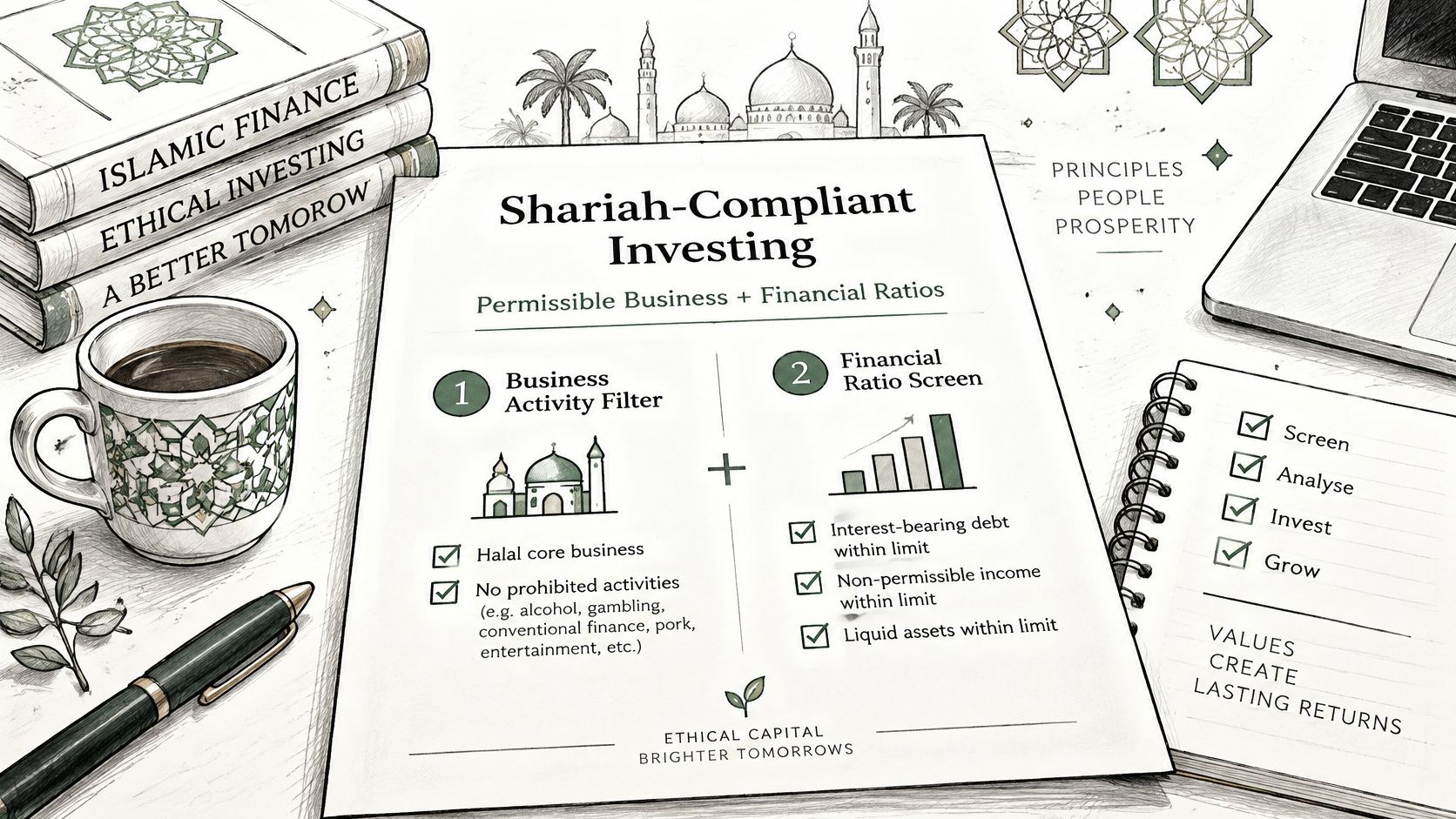
The screen works like a two-stage sieve. The top mesh catches the business itself, and a company whose core activity is prohibited never reaches the lower mesh, no matter how clean its books look. The lower mesh catches the balance sheet, which is where debt-heavy or cash-heavy companies drop out even though their products are fine. Most confusion about halal investing comes from running the meshes in the wrong order or assuming the second one can rescue a company that failed the first.
The question has grown well beyond a niche. The IFSB's industry stability report put global Islamic financial services assets at USD 3.38 trillion in 2023, and the same reporting series has since recorded USD 3.88 trillion in 2024, up 14.9% from the previous year. Islamic banking assets rose 17.05% and takaful 16.9%, while sukuk issuance reached USD 230.4 billion, a 25.6% increase, according to Fintech News reporting the IFSB figures. More institutions, more listed instruments, more investors asking for a verdict they can verify instead of a badge they have to trust.
Sukuk and takaful sit outside equity screening, and purifying a dividend is a separate step that comes after a holding passes. What stays constant is the pair of questions worth carrying through everything below.
What does the company do, and what do its numbers say? Answer those in that order and you'll rarely be surprised by a screener's output.
If you'd rather see the sequence walked through before working an example, this short video covers the same two-stage logic.
Business Activities That Disqualify a Company
Start with the sectors, because the activity screen is where most real portfolios lose names. Scan your holdings against these groups and the rest of the work gets much shorter.
- Banking and finance: conventional and regional banks, mortgage lenders, asset managers, stock and securities exchanges, derivatives dealers and clearing houses. The common thread is interest as a business model rather than an accident.
- Insurance: general and life insurers, plus healthcare plans, since the contract structure carries the same objections.
- Tobacco and alcohol: tobacco growers and manufacturers, brewers, distillers and vintners, including conglomerates that own drinks divisions.
- Gambling: casinos, betting operators and the machinery behind them.
- Pork and non-halal meat: producers, processors and the distributors whose revenue depends on them.
Two details decide most of the cases readers write in about. The first is that preferred shares are excluded by instrument, so a company that passes every business and ratio test still has a fail attached to its preferred stock. The instrument gets screened, not just the issuer. The second is that the screen follows what the company does, not how tidy its balance sheet is. A conventional bank with a low debt ratio and almost no interest income from outside sources is still a conventional bank. You can read the wider history of how these exclusion lists get drawn in this explainer on sin stocks.
Mixed revenue is where judgement starts
Say a diversified group earns 6% of revenue from brewing. That crosses the 5% non-permissible income line, so the company fails the income test whatever else it does. A different group earning 3% from the same activity passes that test, but it still has to clear the debt and cash ratios, and its dividend will need purifying on the way out.
The practical move is to open the annual report, find the segment breakdown, and mark every revenue line that comes from an excluded sector before you look at any ratio. Most reports hand you the split in a table. Marking first stops you from anchoring on a debt ratio you've already seen and deciding the business is fine.
Working Through a Debt Ratio With Real Numbers
Round figures make the logic visible, so take a hypothetical company and run both ratio tests by hand. This is the calculation that decides most borderline verdicts, and doing it once yourself removes the mystery from every screener output you'll see afterwards.
Say the company's last twelve quarter-end market capitalisations average USD 20 billion. On the latest balance sheet, interest-bearing debt breaks down as USD 800 million of short-term borrowings, USD 400 million of current portion of long-term debt, and USD 4 billion of long-term debt. That totals USD 5.2 billion, which is 26% of the average. Inside the 30% line, so the debt test passes.
Now the second test. Cash on hand is USD 5.5 billion and short-term investments are USD 1.5 billion, giving USD 7 billion, which is 35% of the same average. That fails. The company is not compliant, and no amount of good news about its debt ratio changes that.
| Ratio | Input | Calculation | Result |
|---|---|---|---|
| Interest-bearing debt | USD 5.2 billion | 5.2 ÷ 20 | 26%, pass |
| Cash and short-term investments | USD 7 billion | 7 ÷ 20 | 35%, fail |
The formula in one line: ratio equals the input divided by the twelve-quarter average market capitalisation. Same denominator for both tests, different numerator. That's why a company can clear one and stumble on the other.
Where each input comes from
Interest-bearing debt is the sum of short-term borrowings, the current portion of long-term debt and long-term debt, all taken from the balance sheet. Cash and short-term investments are separate line items on the same statement. Neither figure is an estimate you get to shape.
The denominator is where readers go wrong. It's the average of the last twelve quarter-end market capitalisations, not today's share price and not this week's market value. Pull the twelve quarter-end figures, add them, divide by twelve, then use that number for both ratios.
A price spike in one quarter doesn't move the ratio for one quarter. It sits in the denominator for a full three years.
Run the same company against a USD 16 billion average instead and the debt ratio becomes 32.5%, a fail. Nothing about the borrowing changed. Only the averaging window did. That single mechanic explains a large share of the disagreements between screening providers, and it's why the window matters as much as the threshold.
One more input to flag before you compute anything: standards differ on whether operating lease obligations count as debt. That choice shifts the numerator and can push a company over the line. The next section takes that and the other divergence points apart.
Before you draw a conclusion on your own holding, compute both ratios yourself, write down each input with its balance sheet line, note the twelve quarter-end market caps you averaged, and record the date of the filing you used. A verdict without those four things attached isn't evidence yet.
Why Two Screeners Disagree About the Same Stock
Two apps, one ticker, opposite answers. The instinct is to blame a data bug, but the split usually traces back to four decisions each standard makes for itself. Learn those four and you can explain most disagreements in about two minutes.
| Difference | What standards choose | Why a verdict can flip |
|---|---|---|
| Denominator | Average market capitalisation or total assets | A volatile share price can cross the 30% line on one denominator and stay under it on the other |
| Averaging window | Trailing twelve-quarter average or trailing twelve-month average | A year of sharp price moves produces very different ratios |
| Middle state | Pass or fail only, or a doubtful category | Borderline companies become NOT HALAL in one tool and DOUBTFUL in another |
| Lease and revenue classification | Whether operating lease obligations count as debt and how mixed revenue is split | Shifts the debt ratio or the non-permissible income share |
Each standard works like a ruler with its own markings: same company, different measurement. Take a company whose debt sits at 29% of a twelve-quarter average market capitalisation but 31% of total assets. Same balance sheet, same day, two verdicts. Now give that company a revenue line worth 5.4% of turnover that one rulebook counts as permissible and another counts as prohibited. The verdicts diverge for two independent reasons, and neither provider made an error.
Published frameworks commonly settle near 30% for interest-bearing debt or deposits and 5% for non-permissible revenue (Lunate's Shariah methodology brochure), yet each applies its own formula and data window. Dow Jones Islamic Market, FTSE Shariah, MSCI Islamic and S&P Shariah each publish their own rulebook, and none of those four uses a doubtful category, so a borderline company passes or fails outright while a screen that allows DOUBTFUL lands somewhere between. You can see how those frameworks compare in this breakdown of AAOIFI, IFSB and S&P Shariah standards.
The habit of checking inputs before trusting a score generalises beyond equities. Crypto traders weighing two token scanners apply the same discipline when comparing meme coin analysis tools: what does each tool measure, and against which baseline?
Disagreement between standards is rarely evidence of sloppy screening. It usually reflects legitimate scholarly and accounting judgement, and a transparent comparison serves you better than the promise of one universal formula.
Once you can name which of the four choices caused the split, you can pick the standard you meant to follow.
Screening Funds and Cleaning Up Dividends
A fund's name establishes nothing. Its holdings do. Screen the constituents one by one, weight each verdict by the share of fund value it represents, and the fund's non-compliant weight is the total of the failing names. That number, not the label on the factsheet, is what tells you whether the product fits.
Funds also get screened under several rulebooks at once, and the same fund can carry different verdicts depending on which standard is applied. Two providers can both be right and still disagree, which is why the fund question is never "is this halal" but "halal under which set of rules".
Purification in one worked sum
When a compliant holding pays a dividend, a small slice of that payment can trace back to non-permissible income. The common practice is to give that slice away rather than keep it. Take a USD 1,000 dividend from a holding whose non-permissible income share is 2%. Multiply the two and USD 20 goes to charity, with the remaining USD 980 yours to keep.
For a fund, the non-compliant weight is the figure used in the same calculation, so a fund carrying 3% non-compliant weight produces a 3% donation on each distribution. Purification doesn't make an otherwise prohibited investment permissible. It cleans the portion of income you received, nothing more.
Coverage tells you how much was actually checked
Fund screening depends on identifying holdings. When a portfolio's constituents can't be fully mapped, part of the fund goes unexamined and the verdict rests only on the portion that was seen. A fund with 60% coverage and no visible breach is a very different proposition from one with 98% coverage and the same result.
Ask three questions of any fund before relying on a verdict. Which rulebook governs the screen? How recent is the holdings data? And what share of the fund's weight was screened? The full mechanics of holdings-based fund analysis are set out in this guide to Shariah-compliant funds.
Confirm a Verdict Before You Invest
Checking a verdict is a procedure, not an opinion. Run it in this order and you'll have the numbers in hand when a screen result surprises you.
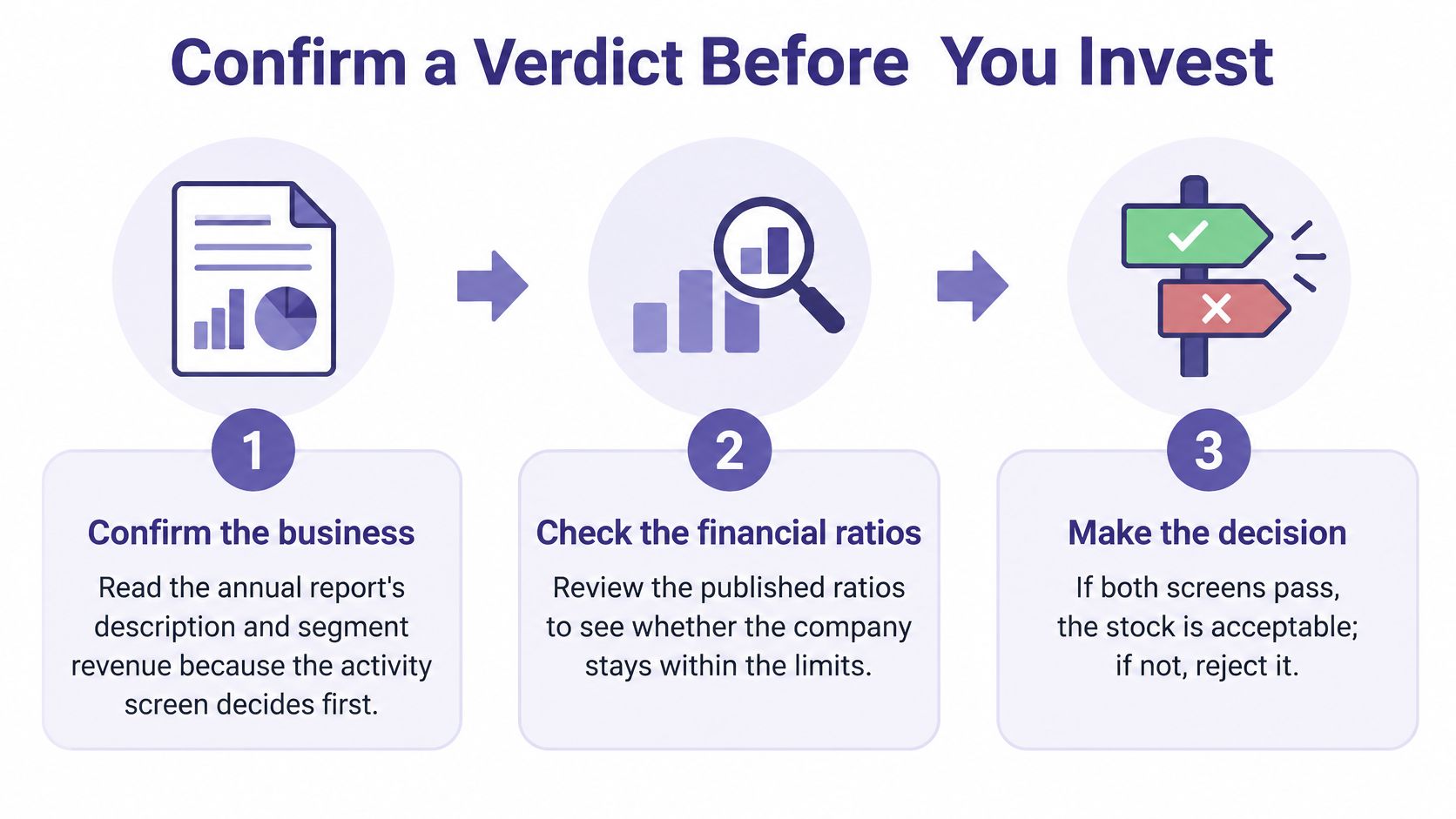
- Confirm the business from the annual report's description and segment revenue, because the activity screen decides the outcome before any ratio is calculated.
- Check the non-permissible income share against the 5% line, since a passing ratio on a prohibited revenue stream is still a fail.
- Pull the debt and cash lines from the balance sheet, so you're dividing reported figures rather than estimates.
- Find twelve quarter-end market capitalisations and average them, because the denominator has to be stable across both ratio tests.
- Calculate debt and cash ratios and compare each against 30%, the two tests that catch most borderline companies.
- Repeat under a second published standard, since a split verdict is information rather than an error.
- Record the filing date, the inputs and the verdict, so the assessment can be reproduced when the next annual report lands.
Those seven steps produce one of three outcomes, which is simpler than many people expect. A company that clears every test is HALAL under the standard applied. One that fails any single test is NOT HALAL. A borderline case or a missing input leaves the holding DOUBTFUL, and doubtful means research, not approval. For a fund, run the same procedure across the holdings and check the screened weight before you rely on the answer.
Whichever platform you trade through, screening and brokerage are separate decisions, and this guide to the best stock trading apps covers the account side while the tests above cover the security. Our endpoint returns every verdict against a documented Shariah rule and the exact figures that decided it, so the reasoning travels with the label rather than sitting somewhere behind it.
Treat a DOUBTFUL result as a prompt to keep reading the filing, never as a soft pass. The gap between doubtful and permitted is where most avoidable mistakes happen.
Act on a verdict only when you hold three things together: the inputs, the rulebook that produced them, and the filing date they came from. A verdict without all three is a screenshot, and screenshots don't survive the next quarterly report.
Akinda gives developers and research teams a Shariah compliance API that returns the verdict, the ratio behind it and the AI-extracted filing figures in one JSON response, aligned to AAOIFI Shari'ah Standard No. 21 as its primary methodology and comparable across four further rulebooks. If you're building a halal investment app or checking a portfolio by hand, you can pull a stock or fund verdict and inspect the exact numbers that produced it. Start for free at Akinda and screen your first ticker today.