
The most common advice about choosing a halal investment platform is to find a familiar name, check that it screens investments, and compare fees. That skips the question that matters most: how did the platform reach its verdict? A halal label isn't a substitute for the financial inputs and screening rules behind it.
Two services can disagree about the same stock without either making a calculation error. Different methodologies use different debt limits, denominators, and treatments of income, as explained in Akinda's guide to AAOIFI screening standards. A share-price change can also affect a market-capitalization-based calculation even when the company hasn't borrowed more.
Compare each service through the same lenses:
- Screening transparency. Can you identify the methodology, reporting period, financial inputs, and reason for a rejection?
- Investment access. Does it execute trades, manage portfolios, or provide research?
- Total cost. Separate subscriptions, management charges, underlying fund expenses, trading costs, and purification donations.
- Practical fit. Match the service to your country, account type, investment style, or integration requirements.
Regulatory permission and Shariah screening are separate checks. For developers considering digital assets alongside securities, the licensing roadmap for digital asset firms provides a separate regulatory reference, not evidence that an investment is halal.
The options below serve different jobs. Their order isn't a popularity ranking, and country-specific terms shouldn't be treated as globally available.
Table of Contents
- 1. Wahed
- 2. Musaffa
- 3. Manzil
- 4. Zoya
- 5. Muslim Xchange
- 6. Islamicly
- 7. Tabadulat
- 8. Hejaz Investa
- 9. Finispia
- 10. Akinda
- How the 10 halal investment platforms compare on model, fit and published pricing
- Choosing a Halal Investment Platform That Fits Your Portfolio
1. Wahed
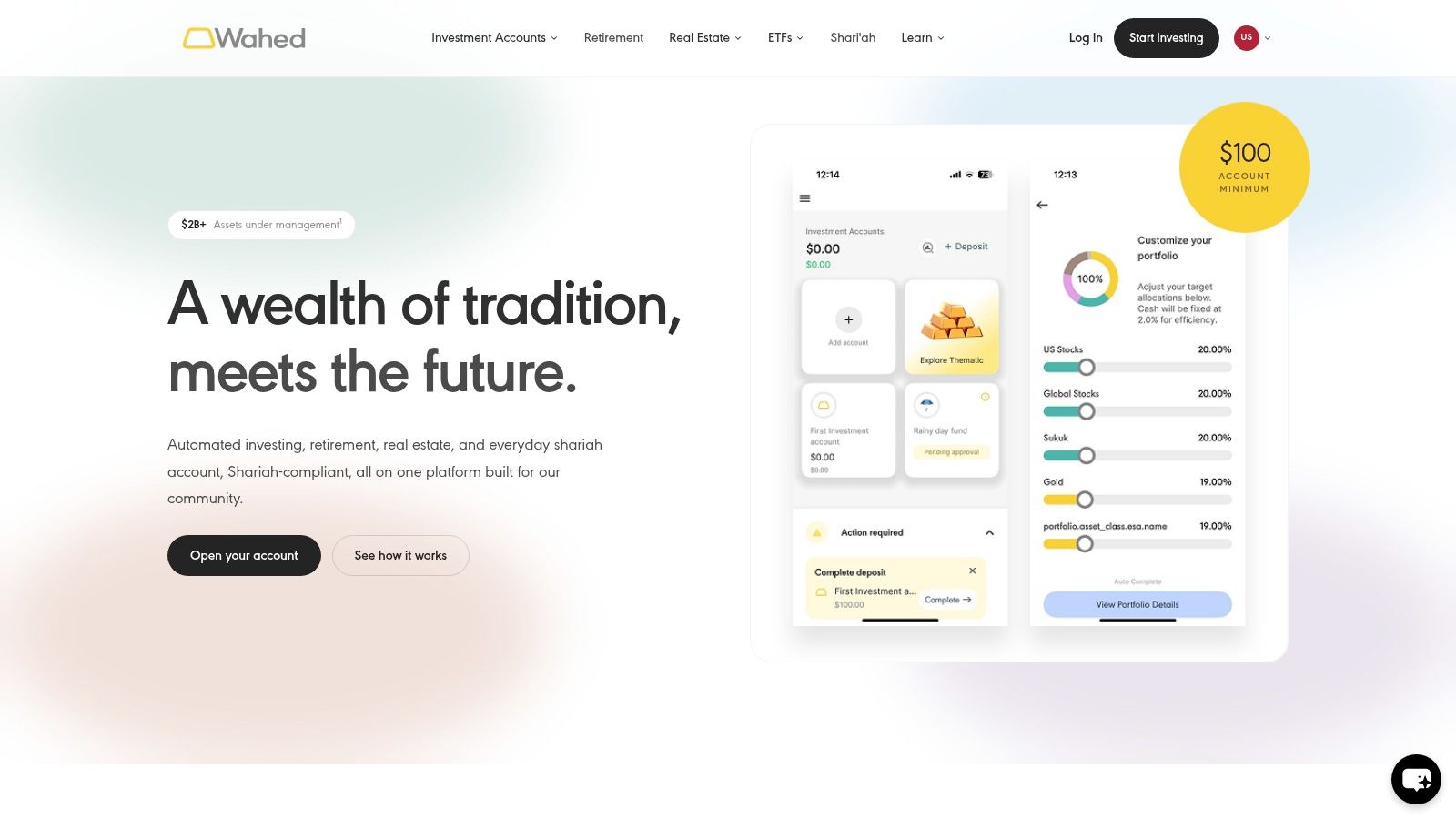
Wahed is primarily a managed-investing choice, not a stock-picking workspace. You select an appropriate risk profile, then delegate investment selection and rebalancing rather than approving every holding yourself.
Its portfolios can include equities, sukuk, gold, and cash, depending on the jurisdiction and product. Retirement, property-related offerings, and UK Stocks and Shares ISA access shouldn't be assumed available through every local account.
What you're paying to delegate
The important screening question is how Wahed governs the portfolio over time. Review its published investment approach, Shariah oversight, underlying holdings, and purification arrangements rather than expecting the same workflow as a security-level research terminal.
Management charges are only part of the cost. Wahed's US pricing structure combines an asset-based charge with a fixed annual component for smaller accounts; underlying investment expenses also deserve attention. A fixed component matters particularly when you're starting with a modest balance.
Its zakat and purification tools can reduce administrative work, but establish whether the service calculates an amount, facilitates a donation, or handles it automatically. Those aren't interchangeable services.
For product teams, this Islamic robo-advisor guide helps distinguish portfolio management from screening infrastructure.
Who this fits: An eligible investor who wants ongoing allocation and rebalancing without selecting individual securities. Look elsewhere if you need direct control over holdings or downloadable, methodology-level screening inputs for your own application.
2. Musaffa
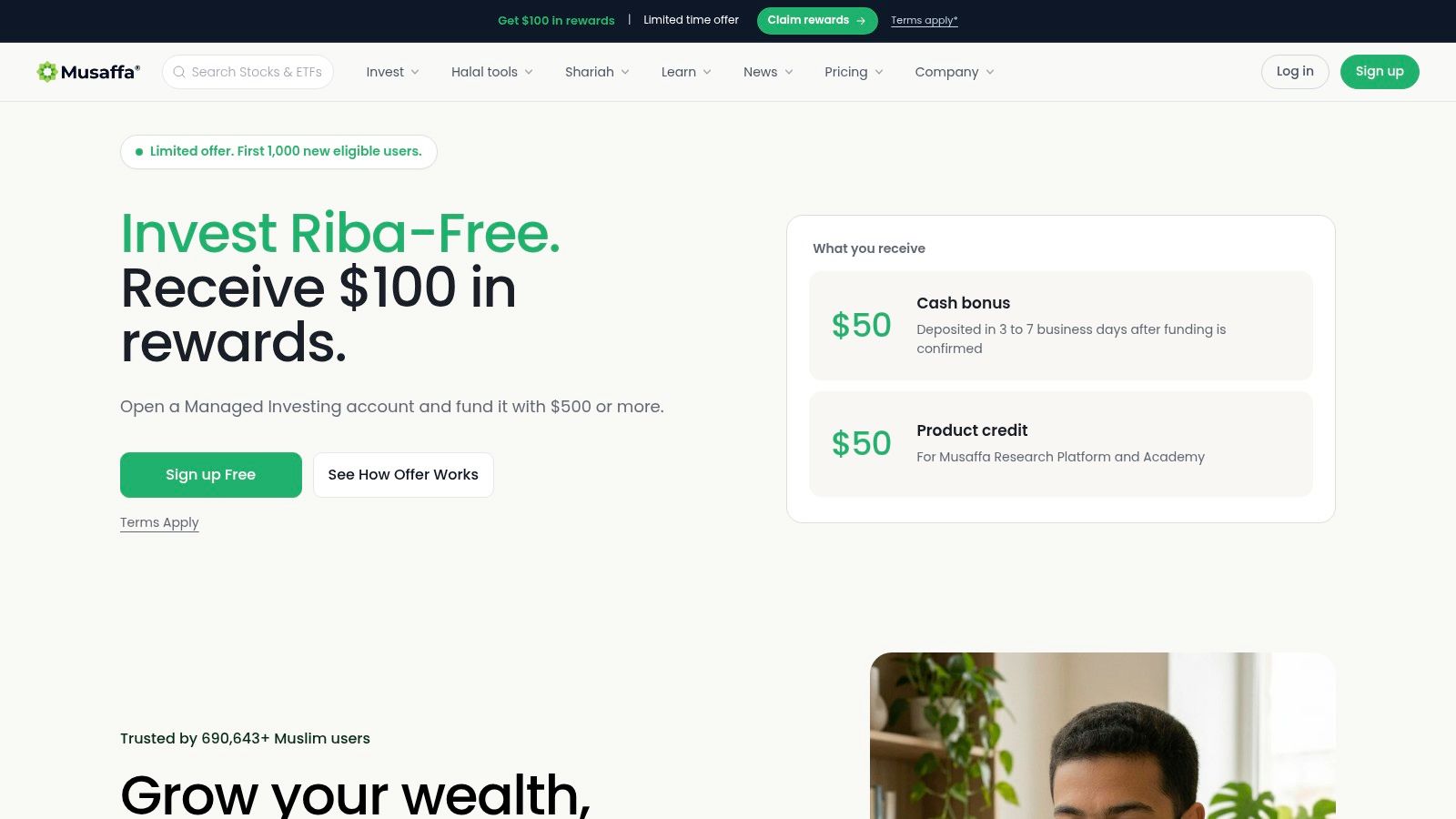
With Musaffa, distinguish research access, self-directed investing, and managed portfolios before comparing plans. They solve different problems and don't necessarily share the same pricing or eligibility rules.
The research tools combine screening reports, portfolio tracking, purification calculations, and compliance alerts. Self-directed investment access focuses on US-listed stocks and ETFs, while managed investing delegates portfolio decisions under separate terms.
- Methodology and inputs. Use the detailed compliance report to inspect why an investment passes or fails. Don't assume another provider will reach the same conclusion.
- Investment access. Confirm that your residence qualifies for the investing service, not merely the research subscription.
- Fees. Separate the self-directed subscription from managed-investing charges and any underlying fund expenses. Check whether research features remain available if you change investing plans.
Practical rule: Test the report on a company with mixed revenue before subscribing. A clean pass badge tells you less than an explanation of a difficult classification.
Musaffa's combination of research and execution can reduce the need to move between apps. The trade-off is that users must understand which entity handles execution and which service provides the screening or advice.
Purification calculations are useful, but review the income period and holdings information behind the result.
Who this fits: A US-market-focused investor who wants research and an investing route together. Look elsewhere if your strategy requires broad local-exchange execution or a commercial screening feed for an embedded product.
3. Manzil
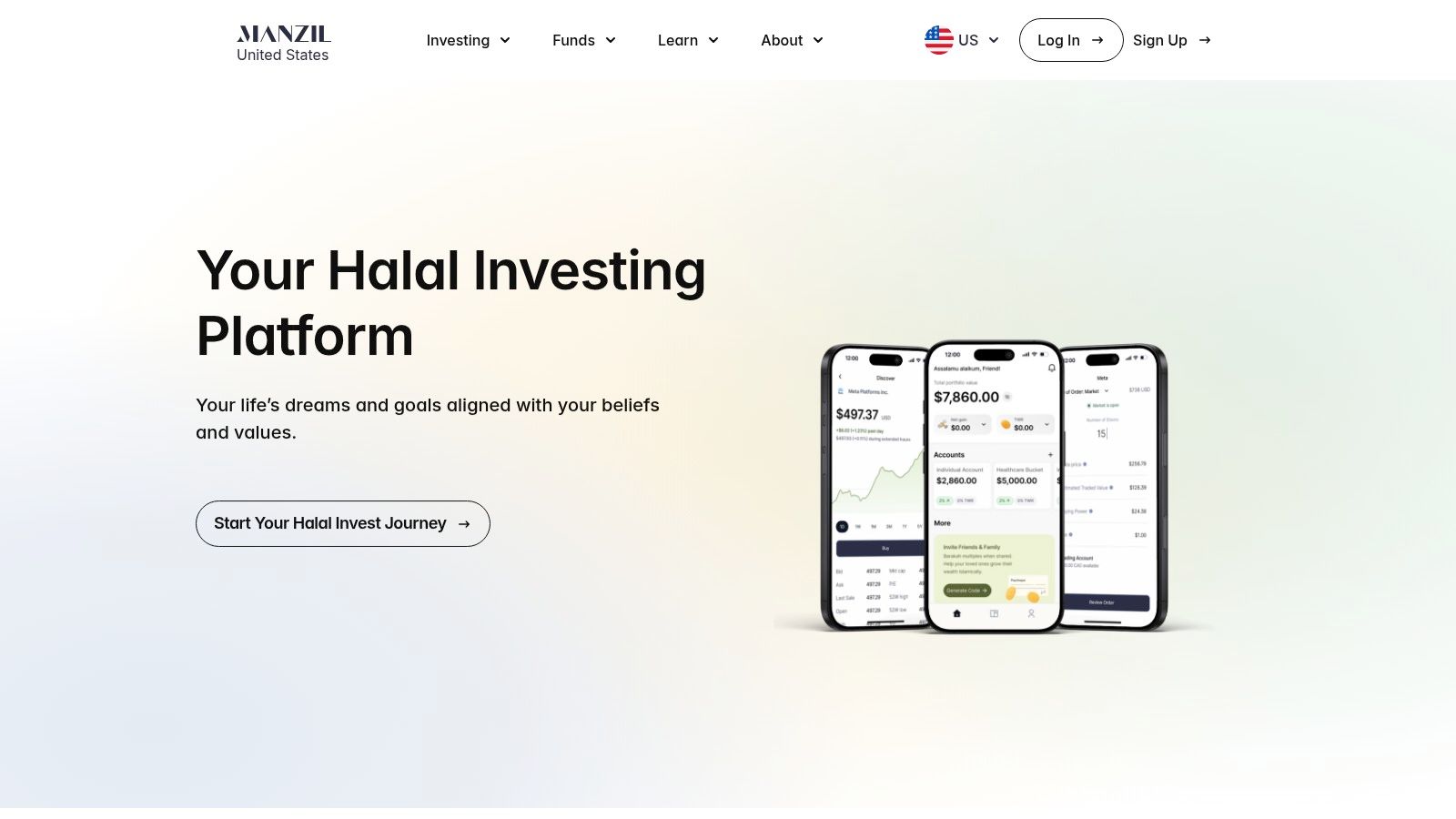
A Canadian household saving through registered accounts and a US investor buying individual shares aren't choosing the same Manzil product. Geography changes the offering, not just the currency shown on screen.
In the US, Manzil Trading provides self-directed screened stock investing, including fractional shares. Canadian managed portfolios are offered through Corex, with account options including TFSA, RRSP, and RESP.
Separate the country-specific decisions
Manzil describes its US screening as AAOIFI-based. For a meaningful comparison, inspect the supporting explanation and update process rather than treating a real-time status display as proof that every underlying financial figure is newly published.
The US pricing structure includes a fixed annual charge plus an asset-based fee, alongside a minimum account requirement. Canadian managed investing has its own arrangements, so don't carry US pricing assumptions into a Canadian comparison.
For Canadian investors, account suitability can outweigh interface preferences. This guide to halal investing in Canada provides context for evaluating the local route.
Also identify who performs each job: investment management, custody, account administration, and Shariah oversight. Review purification responsibilities separately from management charges, particularly where multiple firms participate.
Who this fits: A Canadian investor prioritizing registered-account access, or an eligible US investor seeking screened self-directed trading. Look elsewhere if you want an identical cross-border product or expect Canadian managed portfolios to offer individual-stock control.
4. Zoya
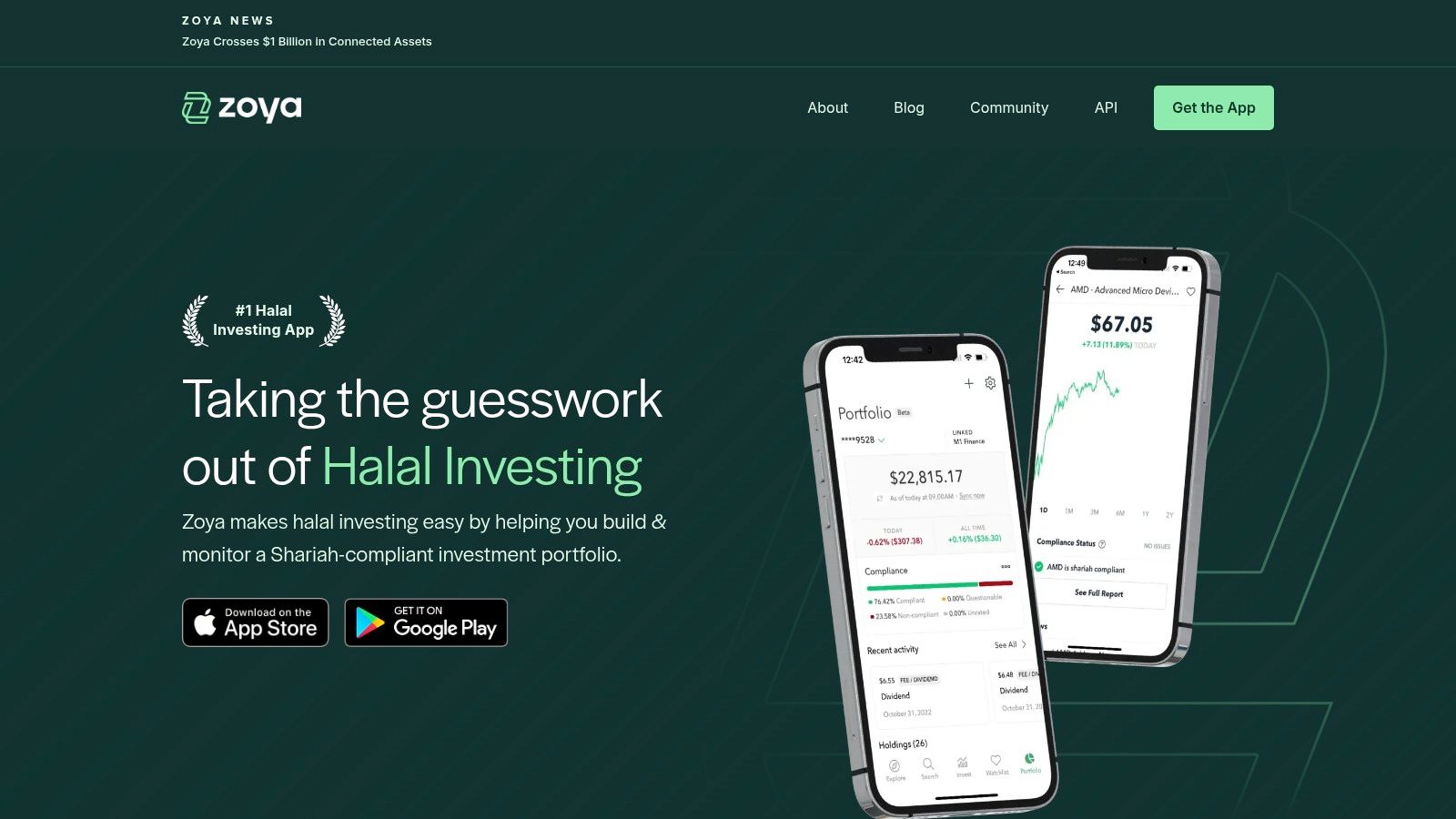
Keep your broker, add a screening layer is the clearest way to understand Zoya. It's a research and portfolio tool, not a brokerage or a discretionary portfolio manager.
Zoya supports stock and fund screening, portfolio tracking, purification and zakat tools, and connections with supported brokers. Custom baskets appeal to investors who want to assemble their own portfolio rather than accept a managed allocation.
- Screening transparency. Read the compliance explanation and methodology documentation. A classification isn't personalized investment advice.
- Actual investing. Execution depends on a separate supported brokerage relationship, even when the workflow starts inside the app.
- Full cost. Compare the free account with paid Pro features, then add brokerage charges, currency conversion, and fund expenses where applicable.
Its main advantage is separation: you don't have to move your assets to add a halal research workflow. Its weakness is the same separation, because broker connectivity, available securities, and synchronization determine how complete your portfolio view becomes.
Before relying on purification totals, reconcile imported positions and distributions against your brokerage statement. The broader question of whether stocks are halal requires business-activity screening as well as financial analysis.
Who this fits: A self-directed investor satisfied with an existing supported broker. Look elsewhere if you want someone to choose, execute, rebalance, and supervise the entire portfolio.
5. Muslim Xchange
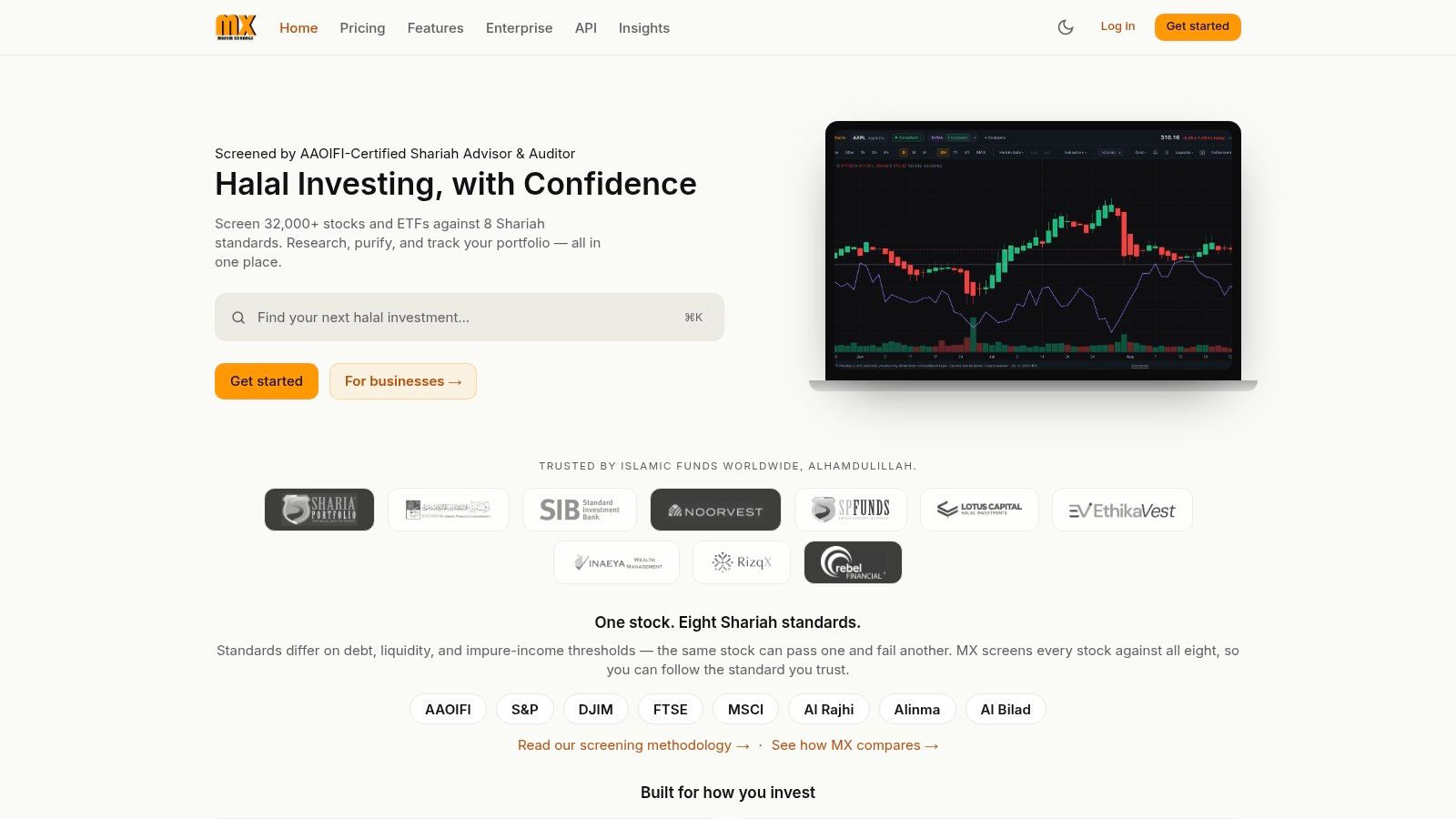
Muslim Xchange is particularly relevant when methodology comparison is part of the work, rather than an occasional source of confusion. Its screening options include AAOIFI and named index-provider and regional frameworks.
That breadth can help a research desk explain conflicting verdicts. It can also overwhelm an individual investor who hasn't decided which scholarly methodology to follow.
Compare explanations, not just classifications
A useful comparison should show more than different colored labels. Inspect whether the service exposes the numerator, denominator, reporting period, and relevant revenue treatment for the securities you follow.
For individuals, Muslim Xchange offers portfolio, purification, zakat, and research tools. For businesses, its offering extends to an API, Excel add-in, white-label screening, and Shariah advisory.
Don't equate research coverage with trading access. Establish how orders would be executed and where assets would be held, rather than assuming a portfolio screen is a brokerage account.
Pricing needs a use-case-specific review. Individual subscriptions and business licensing aren't interchangeable; for commercial use, clarify display rights, redistribution, request allowances, and whether advisory work is separately charged.
Purification tools also need a clear calculation basis, particularly when a portfolio contains funds rather than directly held shares.
Who this fits: A research analyst comparing methodologies or a financial business evaluating embedded screening. Look elsewhere if you only need a straightforward managed account and won't use the additional research capabilities.
6. Islamicly
Islamicly brings stock screening, compliance explanations, portfolio monitoring, purification tools, and broker connections into one service. For international investors, the practical test is whether it supports the exchanges, share classes, and brokers they use.
Broker linking does not establish who executes trades, holds your assets, or manages your investments. Check those roles separately, then review the screening methodology, the reasons given for non-compliance, and how the service reports changes in a security's status.
Subscription cost versus operating effort
Islamicly offers app and desktop subscriptions, with pricing varying by market and plan. Compare renewal terms with any promotional annual offer before estimating the ongoing cost.
Add broker commissions, foreign-exchange charges, and fund expenses to the subscription in your comparison. Purification is a separate cost, even when the app helps calculate it.
Investors who hold digital assets elsewhere may find a general crypto tax software comparison useful for tax recordkeeping. That workflow does not establish Shariah compliance or replace securities reporting.
Who this fits: An international, self-directed investor whose holdings and broker are supported. Look elsewhere if you need execution across every market or discretionary portfolio management.
7. Tabadulat
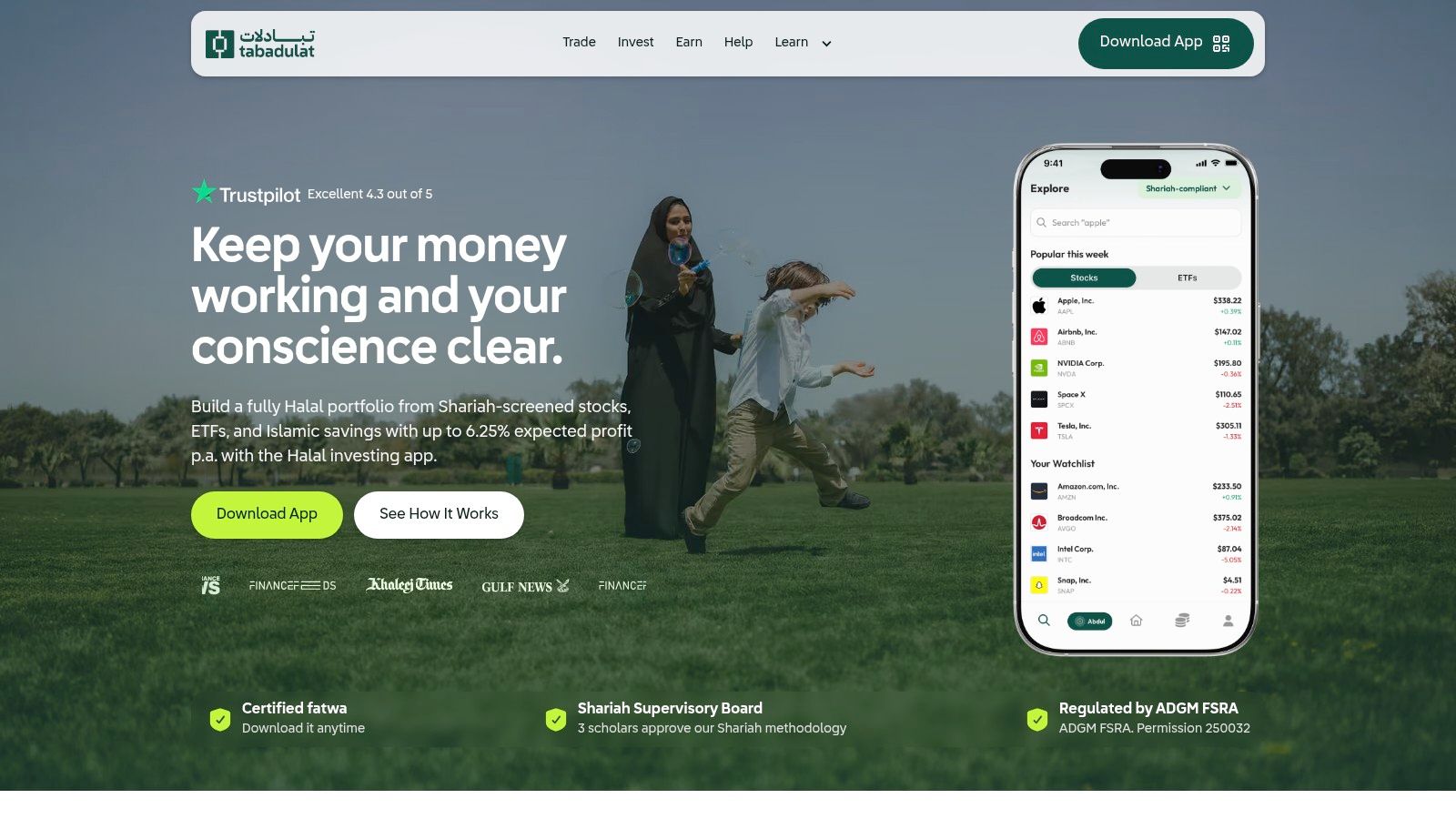
Tabadulat puts screened stock and ETF trading inside the same service. That makes it a different proposition from buying a screening subscription and connecting it to an existing brokerage.
The platform describes its screening as AAOIFI-based, with Shariah Supervisory Board oversight and a published fatwa. It also publishes its regulatory status under Abu Dhabi Global Market's FSRA.
- Methodology. Read the screening policy alongside the governance documentation. Board oversight doesn't eliminate the need to understand how borderline securities are handled.
- Investments. The core proposition is self-directed trading in screened stocks and ETFs, with a Murabaha savings feature also advertised.
- Costs. Free screening doesn't mean every investment activity is free. Review dealing charges, currency conversion, transfers, and product-specific terms.
Its FAQ says users can browse and screen without making a deposit. That's useful for evaluating coverage before funding, although geographic eligibility still needs to be established first.
Self-directed remains self-directed. An eligible investment isn't necessarily suitable for your risk tolerance, and an integrated app doesn't automatically supply portfolio construction or ongoing investment advice.
For funds, inspect the underlying holdings assessment rather than relying on a compliant-sounding name.
Who this fits: An eligible investor who wants screening and trading together and is comfortable making investment decisions. Look elsewhere if you need a managed allocation or a screening framework different from the platform's chosen approach.
8. Hejaz Investa
Australian investors who would otherwise buy and rebalance several funds themselves may prefer Hejaz Investa. It packages Hejaz ETFs and cash into a professionally managed multi-asset portfolio.
Published allocations include equities, sukuk, and a high-income allocation. Account structures include individual, joint, children's, trust, company, and self-managed superannuation fund arrangements, subject to the applicable requirements.
Convenience with an in-house fund structure
The central trade-off is delegated allocation versus manager concentration. You avoid manually coordinating separate fund purchases, but the portfolio uses Hejaz's own ETFs rather than an open selection of unrelated managers.
Review screening at the underlying fund level, including Shariah governance, holdings, and purification treatment. A managed wrapper doesn't remove the need to understand what each fund owns.
Hejaz publishes a recommended minimum and management-fee information. Compare the portfolio management charge with underlying fund expenses and any other applicable account or transaction costs; don't assume the headline charge captures everything.
Lower balances may not receive exposure to every model security. That matters if you're choosing the product specifically for its advertised asset mix.
The investor portal and fee calculator help with administration, but they don't provide individual-security control.
Who this fits: An eligible Australian investor who wants managed multi-asset exposure and accepts the in-house ETF structure. Look elsewhere if you want international account access, direct stock selection, or independent selection across competing fund managers.
9. Finispia
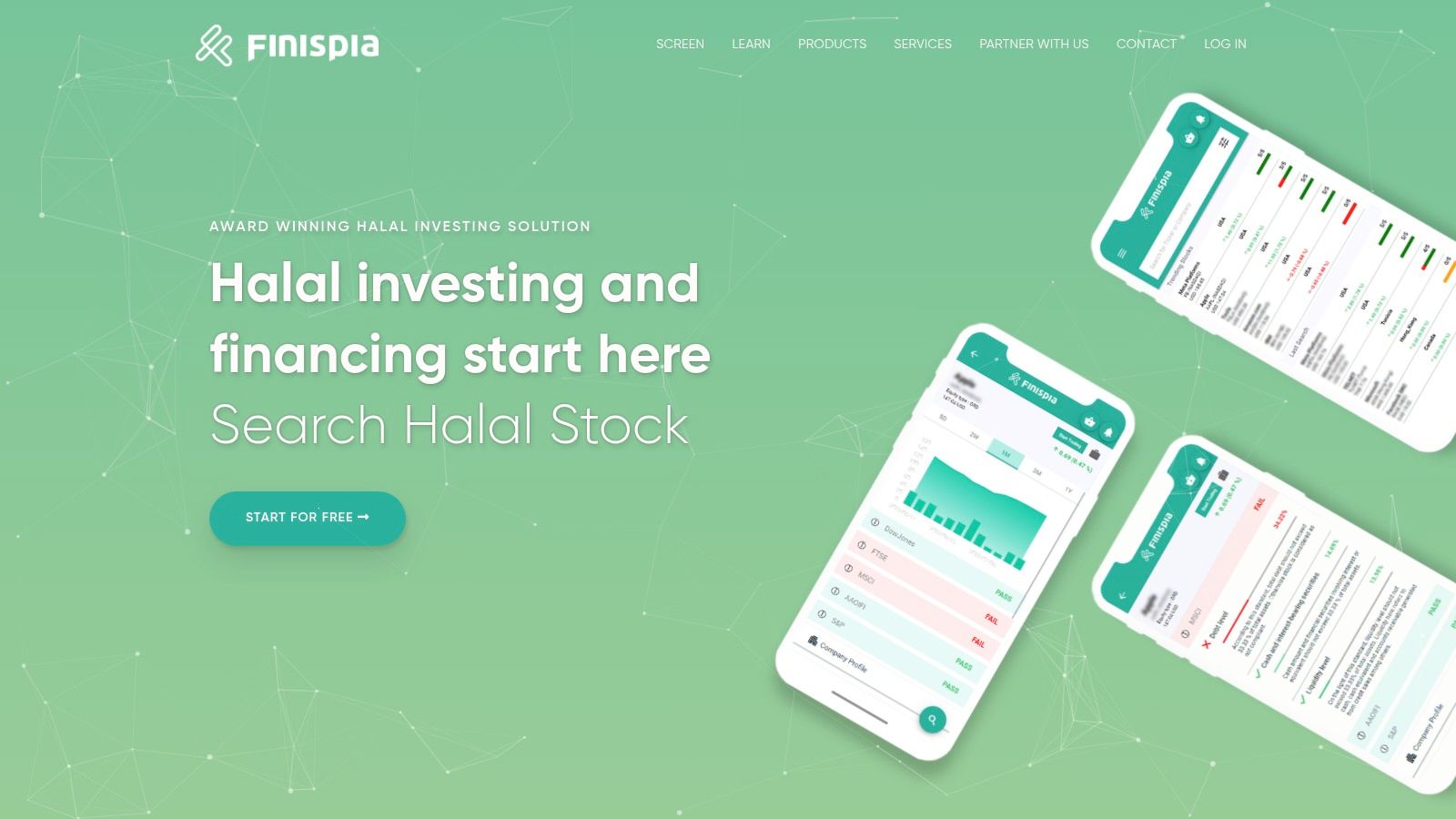
Finispia is a research starting point, not a place to deposit money for managed investing. It advertises basic stock searches and broader coverage spanning securities and investment categories beyond ordinary shares.
Its methodology options are described as inspired by AAOIFI and named index frameworks. That wording matters: inspired by a standard isn't an endorsement from its publisher, nor does it establish identical implementation.
For a useful evaluation, examine a detailed report rather than stopping at a free search result. Determine whether you can see the actual ratios, financial period, revenue exclusions, and explanation of the outcome.
- Investment access. You'll still need a broker or another investment provider to execute transactions.
- Fee structure. Basic screening is advertised as free, while detailed reports and ratios may require paid access.
- Developer relevance. An embeddable search bar can support discovery, but shouldn't be assumed to provide the licensing or functionality of a commercial data API.
Broad advertised coverage also needs a practical test. Search for the exact listings and asset types your workflow requires, then inspect the depth and freshness of the available report.
A screening result alone doesn't settle purification obligations or supply the income records needed for a calculation.
Who this fits: An investor conducting initial research across markets and asset categories. Look elsewhere if you need trade execution, delegated management, or a production integration with explicitly defined data rights.
10. Akinda
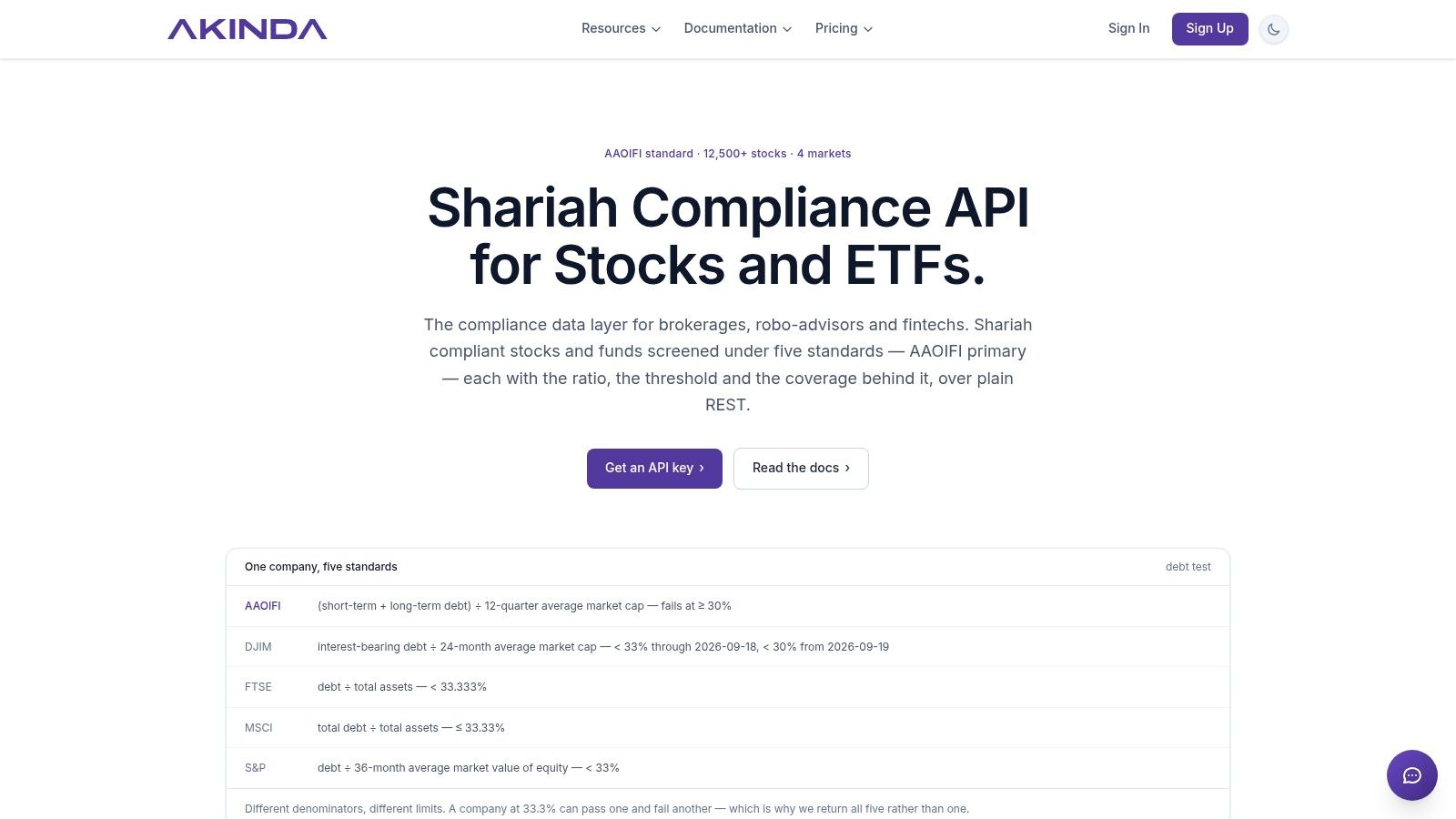
Akinda's developer platform serves a different buyer: the team building the halal investment application. We provide Shariah-compliance data through a REST API, not brokerage accounts, trade execution, or discretionary investment management.
Our primary methodology is AAOIFI, with parallel methodology outputs for comparison. Full reports expose financial ratios and extracted financial inputs, allowing a developer or analyst to explain a verdict rather than display an unsupported badge.
Evaluate the evidence returned
For fund screening, we assess constituent holdings and their weights rather than relying on the fund's name. Coverage information matters because an incomplete holdings assessment shouldn't be presented as complete assurance.
Our integration resources include documentation, request tools, code examples, and an MCP server. Eligible business integrations can use verdict-change feeds and webhooks rather than depend entirely on manual checks.
The cost category is data licensing. Free research access and commercial subscriptions serve different purposes; endpoint availability, market coverage, and request allowances depend on the plan. Brokerage infrastructure and investment-management costs remain separate.
Purification-related fund exposure is an input to a calculation, not a promise that donations are automatically processed. Builders still need a policy for investor records, income periods, and user-facing explanations.
Who this fits: A fintech developer, broker, robo-advisor, research desk, or academic team needing screening inputs inside its own workflow. Look elsewhere if you want to open an account and buy investments.
How the 10 halal investment platforms compare on model, fit and published pricing
The main difference is what each service leaves you responsible for: choosing investments, managing a portfolio, executing trades, or integrating screening data. Published fees cover different things, so compare the service cost with any separate brokerage, fund, purification, or management costs.
| Item | Service model | Best for | Published pricing | Market focus |
|---|---|---|---|---|
| Wahed | Managed halal portfolios | Hands-off, diversified investing | US: 0.49% yearly plus $60/year below $100,000; 0.49% yearly above | Multiple markets; products vary by country |
| Musaffa | Self-directed screening and investing, plus managed portfolios | Investors seeking compliance research and portfolio tools | Self-directed from $5/month under $24,000; managed pricing separate | Primarily US-listed stocks and ETFs; availability varies |
| Manzil | US self-directed trading; Canadian managed portfolios | Investors seeking market-specific halal investing options | US Core: $48/year plus 0.4% of assets; $100 minimum | United States and Canada |
| Zoya | Screening and portfolio research tool; no brokerage | Self-directed investors who need screening and tracking | Free account; Pro: $14.99/month or $119.99/year in the US | US pricing; broker and feature availability may vary |
| Muslim Xchange | Screening, research, and portfolio tools for individuals and businesses | Comparing Shariah standards or integrating screening into financial products | Pricing not stated | Individual and business users; coverage spans many stocks and ETFs |
| Islamicly | Screening, portfolio tracking, and broker linking | International investors seeking screening and compliance explanations | Pricing not stated | Multiple markets; confirm local coverage and broker support |
| Tabadulat | Self-directed trading with integrated screening | Investors who want trading and screening in one app | Pricing not stated | Supported markets; check eligibility |
| Hejaz Investa | Professionally managed multi-asset portfolio | Australian investors seeking hands-off investing | Growth option: 0.50% management fee; A$5,000 recommended minimum | Australia |
| Finispia | Screening and research tool; no brokerage or portfolio management | Investors researching assets across markets and methodologies | Free stock searches; detailed reports may require paid access | More than 90 exchanges |
| Akinda | Shariah-compliance data API for developers and businesses | Fintech apps, robo-advisors, banks, brokers, research desks, and academic teams integrating screening data | Limited free tier; personal research and commercial plans; enterprise terms are contract-specific | Stocks and ETFs across the United States, United Kingdom, Canada, and Uzbekistan; fund screening based on underlying holdings |
Choosing a Halal Investment Platform That Fits Your Portfolio
Match the service to your role before comparing features. A screening app, managed portfolio, trading platform, and data API can all support halal investing, but they leave different responsibilities with you.
For self-directed investors, begin with eligible trading access and the screening methodology you intend to follow. Then compare the combined cost of research subscriptions, brokerage, currency conversion, and underlying funds. A cheaper screener isn't a saving if it leaves you manually reconciling unsupported holdings every month.
For managed-portfolio investors, focus on allocation, holdings control, rebalancing, and total expenses. Establish who monitors compliance changes and what happens when a holding no longer qualifies. Purification calculations, donation handling, and zakat support should be understood separately.
Test the workflow before committing
Use an ordinary stock, a borderline company, and a fund with mixed holdings to evaluate the service. Inspect the explanation, reporting period, missing-data treatment, and notification process rather than comparing only the final classifications.
A missing assessment isn't a failed screen, and it isn't permission to invest. Keep uncertainty visible.
Companies that have never undergone a Shariah audit deserve particular attention. Our policy is to mark such a company UNQUALIFIED, with no audit date, and make no claim about its permissibility in either direction. Don't let an interface turn unavailable evidence into an apparently confident conclusion.
For developers and research teams, preserve the methodology version, input dates, and supporting figures alongside the verdict. Test how your application handles missing values, conflicting standards, stale data, and incomplete fund holdings. A production integration needs understandable failure states as much as successful responses.
For portfolio operators, decide what triggers review rather than automatically selling on every alert. Consider compliance policy, trading costs, tax consequences, and the time needed for qualified review. The operational principles behind exchange features that matter for journaling are useful for documenting decisions, although trade records don't establish Shariah compliance.
Finally, verify current pricing, residency eligibility, account structures, and service terms directly with each provider before funding or signing a contract. Choose the platform that makes your responsibilities clear, including what it screens, what it manages, what it charges, and what it leaves unresolved.
Akinda provides REST API screening for stocks and ETFs, with supporting financial inputs and methodology comparisons for halal investment applications. Visit Akinda to explore the documentation and test how compliance reports fit your portfolio or product workflow.