
If a fund is labelled halal, does that tell you whether it belongs in your TFSA, whether its holdings still pass screening, or why another app gives it a different verdict? It doesn't. Halal investing in Canada requires separate decisions about religious screening, portfolio construction and account choice.
Start with the underlying business and financial statements. Then examine the investment product, its ongoing compliance process and the costs of holding it in a particular account. Keeping those decisions separate helps you avoid buying a permissible investment in an unsuitable portfolio, or choosing a low-fee fund that costs more after currency conversion and withholding taxes.
Table of Contents
- What Makes an Investment Halal in Canada
- Why Halal Screening Verdicts Sometimes Disagree
- Halal Investment Options Available to Canadians
- Verify a Halal Stock or Fund Before You Buy
- Where to Hold Halal Investments Across TFSA, RRSP and Taxable Accounts
- Keeping a Halal Portfolio Compliant Over Time
What Makes an Investment Halal in Canada
An investment is halal when its underlying business is permissible under Shariah and its financial accounts pass the published screening rules you're following. Business activity comes first. A conventional bank doesn't become permissible because it has little debt.
An equity screen excludes businesses primarily involved in conventional financial services, alcohol, gambling, tobacco, pork, weapons or adult entertainment. Financial screening then examines whether an otherwise permissible company has excessive interest-bearing exposure or incidental prohibited income.
Apply the business screen before the financial tests
The following table summarises the business exclusions and the commonly specified financial limits associated with AAOIFI Shari'ah Standard 21, including debt and interest-bearing investment ratios below 30% of market capitalisation and impermissible income below 5% of total income.
AAOIFI Standard 21 screening tests
| Test | Threshold | What It Measures |
|---|---|---|
| Business activity | Zero tolerance for excluded primary business activities | Whether the core business involves conventional finance, alcohol, gambling, tobacco, pork, weapons or adult entertainment |
| Interest-bearing debt | Below 30% of market capitalisation | Interest-bearing borrowings only |
| Interest-bearing deposits and securities | Below 30% of market capitalisation | Interest-bearing deposits and securities, not all cash indiscriminately |
| Impermissible income | Below 5% of total income | Prohibited income, including segments inside otherwise permissible businesses |
The distinction between a prohibited primary business and incidental prohibited income matters. The income allowance isn't permission to invest in a company whose main activity fails the business screen.
The denominator also needs a precise definition. In our AAOIFI implementation, we compare debt with a twelve-quarter average market capitalisation. Don't assume another screen uses the same observation window merely because it displays a market-cap-based ratio.
Read the accounting inputs, not just the verdict
Interest-bearing debt isn't the same as total liabilities. A screen that substitutes total liabilities can sweep trade payables, provisions and lease-related amounts into the calculation without explaining their treatment.
Revenue needs similar care. Say a retailer sells mostly permissible goods but also earns income from a prohibited product category. The reviewer needs the relevant revenue breakdown, not just the retailer's industry classification.
Practical rule: A useful verdict shows what was measured, which financial period supplied the figures and how the denominator was calculated.
For any stock, retain the calculation date, filing period, source line items and actual numerator and denominator. If the disclosures don't separate interest income or prohibited revenue clearly, record that uncertainty instead of treating a missing figure as zero.
Why Halal Screening Verdicts Sometimes Disagree
One app says a stock is halal; another says avoid it. That disagreement doesn't automatically mean either app made an arithmetic mistake. They may be applying different rules to different financial snapshots.
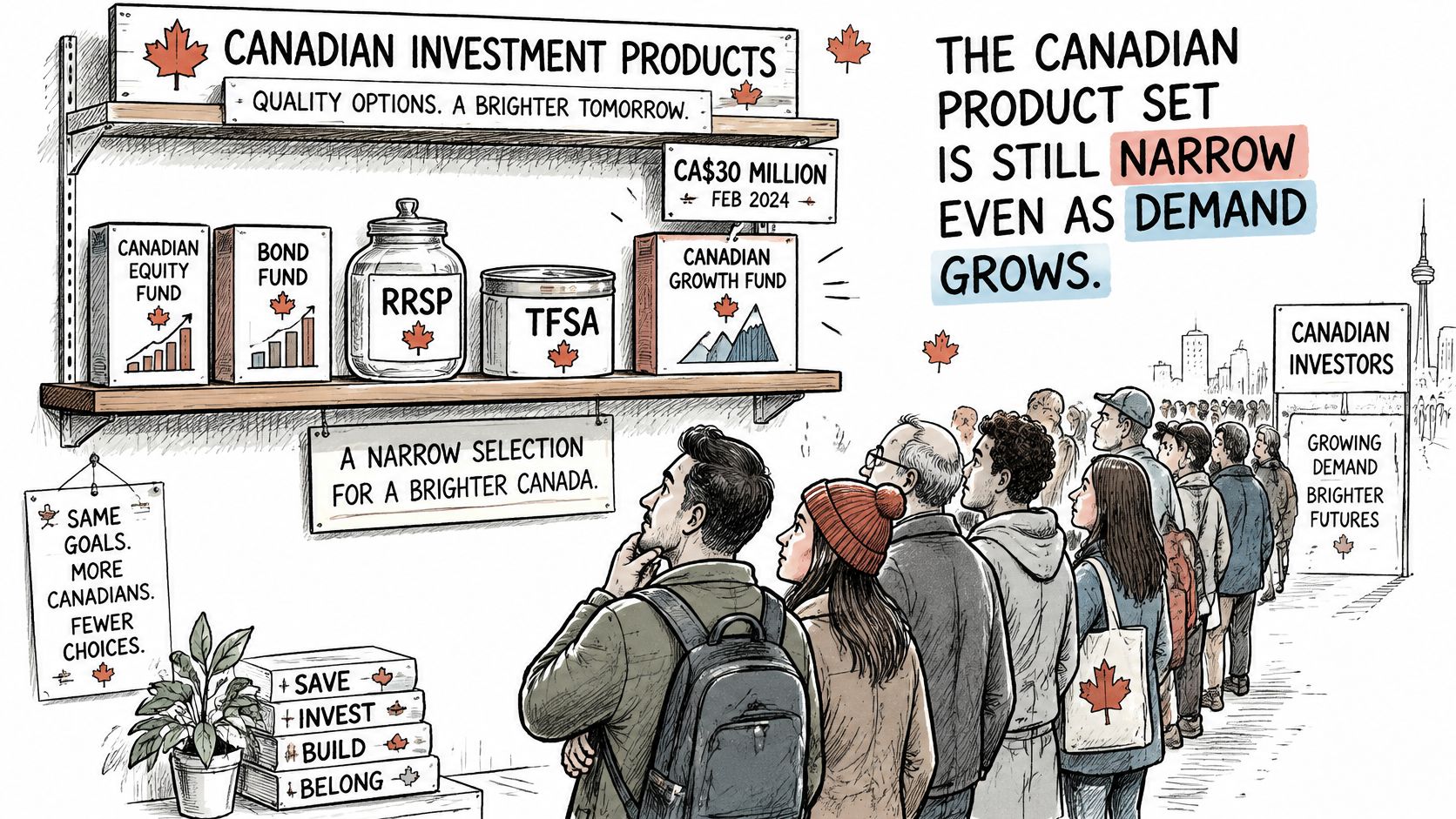
Limited product choice can make those conflicting verdicts particularly frustrating for Canadian investors.
Separate rule differences from data differences
Compare these elements before deciding which result to trust:
- Methodology: A market-capitalisation denominator and a total-assets denominator answer different financial questions.
- Measurement window: A current valuation and a trailing average can produce different ratios from the same borrowing figure.
- Financial inputs: Different filing periods, debt classifications or revenue estimates can change the result even under the same named standard.
Consider a company whose share price falls sharply while its borrowing remains unchanged. A screen using current market value may change its assessment sooner than one using an average. Neither calculation is useful without its denominator definition and valuation date.
For a fuller diagnostic approach, use our guide to why halal apps disagree about the same stock.
A video can provide another way to approach the screening discussion.
Keep the disagreement visible
Don't average conflicting verdicts into a compromise. Keep parallel results, record the reason for the difference and follow the methodology consistent with your qualified scholar's guidance.
At Akinda, we follow AAOIFI, the Accounting and Auditing Organization for Islamic Financial Institutions, standards for Shariah compliance screening. That identifies our methodological starting point, but a meaningful comparison still requires matching the inputs and calculation dates.
A doubtful assessment should also remain distinct from missing information. Uncertainty about how to classify disclosed income isn't the same problem as having no usable financial disclosure.
Halal Investment Options Available to Canadians
Canada's halal investment menu remains narrower than the conventional market. IFN Investor described options as limited, including gold mutual funds, the Wealthsimple Shariah ETF, the Mackenzie Halal Fund and vetted individual stocks.
Canadian availability has nevertheless expanded beyond individual stock selection. Reporting on the market's development identifies Shariah-aligned offerings from Manulife and Sun Life, alongside the S&P/TSX 60 Shariah Index as a Canadian equity reference universe, in the Winnipeg Free Press.
The practical choice is between different forms of exposure, not different halal labels.

Compare what each option adds
Canadian halal investment options compared
| Option | Canadian Examples | Diversification Trade-off | Main Consideration |
|---|---|---|---|
| Shariah-screened ETF | Wealthsimple Shariah ETF | Exposure is limited to its screened investment universe | Confirm methodology and holdings |
| Halal mutual fund | Mackenzie Halal Fund | The manager determines the portfolio within its mandate | Check fees and holdings overlap |
| Index segregated fund | Sun Life BlackRock ACWI Islamic Equity Index fund | Global equity exposure rather than a Canadian-only allocation | Confirm account and plan eligibility |
| Gold fund | Gold mutual funds | Commodity exposure rather than operating businesses | Not a substitute for an equity allocation |
| Individual screened stocks | Stocks from the S&P/TSX 60 Shariah Index universe | You must construct and rebalance the portfolio | Each holding needs its own review |
More funds don't necessarily mean more diversification. A global ETF and a mutual fund might both hold many of the same large companies. Adding both can increase fees or complexity without materially changing your exposure.
Choose by portfolio role
A global equity fund may suit an investor seeking broad geographic exposure, but inspect its regional and sector weights. A Canadian-listed product isn't necessarily invested mainly in Canada.
Gold provides a different type of exposure, yet it doesn't represent ownership in a diversified collection of productive businesses. Individual stocks offer control over exclusions, but you take responsibility for position sizing, liquidity and rebalancing.
For fund-specific questions, consult our complete guide to halal ETFs. For broader thinking about investment horizons, Futurecaps Stocks on long-term investing offers an India-focused perspective, not Canadian tax guidance or Shariah certification.
Before adding another fund, compare its largest positions, Canadian allocation and sector weights with what you already own. For an indexed product, inspect tracking differences; for exchange-traded holdings, consider trading liquidity and bid-ask spreads. Buy a new exposure, not merely another product name.
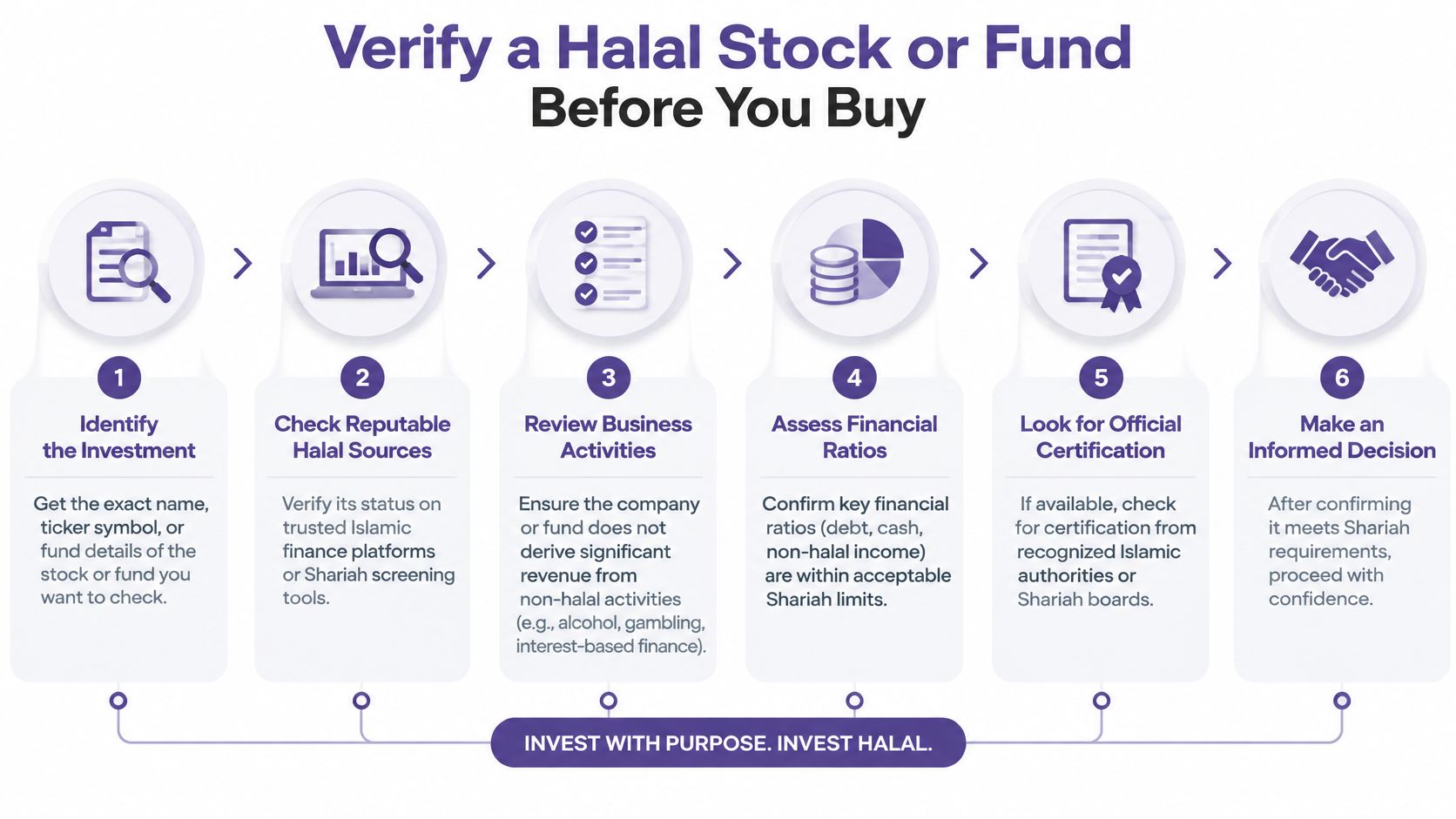
Verify a Halal Stock or Fund Before You Buy
Don't buy until you can identify the assessment, its methodology and its date. A familiar issuer or Islamic-sounding name doesn't replace an examination of the underlying investments.
The process differs for a stock and a fund because a fund's assessment depends on its constituents. The HalalWallet screening methodology describes holdings-based assessment, weighted exposure and the need to distinguish incomplete coverage from a completed screening result.
Use this sequence to organise your pre-purchase checks.
Inspect a fund from the holdings upward
Obtain the holdings file. Use the issuer's published constituent list and retain its effective date. A marketing factsheet may not contain enough detail to reproduce a screening assessment.
Check screening coverage. Identify which holdings were assessed and which remain unresolved. Partial coverage cannot support a clean conclusion unless an identified breach already establishes failure.
Calculate weighted exposure. Combine constituent assessments with their portfolio weights. Don't count companies equally when their allocations differ substantially.
Resolve security identities. Match foreign holdings by security identifier, exchange and share class. Similar ticker symbols aren't sufficient, and financial figures must use consistent currencies.
Preserve methodology differences. Compare an alternative such as Dow Jones Islamic Market, FTSE Shariah, MSCI Islamic or S&P Shariah. Record each result separately rather than blending them.
Retain purification inputs. Keep the weighted impermissible-income information separately from the overall fund verdict. A failing holding's portfolio weight isn't automatically the amount an investor must donate.
Check a stock against its actual filings
For an individual company, work from the business description into the financial calculations. Verify that the screen uses the correct issuer, filing period and debt classification, then inspect the revenue sources supporting its conclusion.
Our guide to checking whether a company is Shariah-compliant provides a practical reference for that review.
At Akinda, our /compliance endpoint provides a one-line halal verdict for a stock, while our Full Compliance Report includes underlying ratios and extracted financial figures. Our live Shariah verdicts cover the United States, United Kingdom, Canada and Uzbekistan.
Save the evidence behind the purchase decision, not just a screenshot of the final label.
Keep the source document, assessment date and unresolved questions together. Take questions about religious interpretation and purification to a qualified scholar; take account placement and tax consequences to a Canadian tax professional.
Where to Hold Halal Investments Across TFSA, RRSP and Taxable Accounts
The same halal investment can produce different outcomes depending on its account. Product access can change too: Sun Life's fund update announced that its BlackRock ACWI Islamic Equity Index segregated fund would become available in non-registered and TFSA plans on December 4, 2025, after previously being limited to registered non-taxable plans.
Account eligibility and Shariah compliance are separate tests. An account's tax advantages don't establish that its holdings are permissible, and a halal assessment doesn't establish that a product is available through your plan.
Match the investment structure to the account
Withholding and account treatment for halal ETFs
| Account | US Dividend Withholding | Eligibility | Key Consideration |
|---|---|---|---|
| TFSA | US-listed Islamic ETF distributions can face withholding that isn't recoverable | Confirm the product is offered through the account | Canadian tax sheltering doesn't eliminate foreign withholding |
| RRSP | Treaty treatment generally applies to qualifying directly held US-listed investments | Confirm the security and account qualify | Don't assume a Canadian-listed wrapper receives identical treatment |
| Non-registered (taxable) | Ask whether a foreign tax credit is available for the particular distribution | Confirm brokerage or plan access | Retain distribution and foreign-tax records |
| Employer plan | Establish treatment from the plan's account and investment structure | Limited to the employer's offered investment menu | Check for a Shariah-aligned segregated fund |
For a TFSA, consider foreign withholding alongside accessibility and your savings goal. For an RRSP, investigate whether treaty treatment applies to the exact security you intend to hold, rather than assuming every fund containing American shares receives the same outcome.
A taxable account adds recordkeeping questions about distributions, gains and foreign taxes. An employer plan adds another constraint: you can select only from the investments the plan offers.
Compare total cost, not just the management fee
When comparing Canadian-dollar-listed and US-listed products, request an account-specific cost comparison covering:
- Currency conversion: Include the brokerage's conversion spread and repeated conversion of distributions.
- Fund structure: Establish where withholding arises and whether the account can receive relief.
- Reporting obligations: Ask whether foreign-property reporting applies to the proposed holdings.
- Distributions and purification: Keep tax reporting separate from your scholar's calculation of impermissible income.
The lowest-fee halal ETF isn't necessarily the lowest-cost investment after withholding taxes, currency spreads and account-specific taxation.
A trading currency also doesn't tell you the portfolio's underlying currency exposure. Before placing an order, confirm the legal fund structure, account eligibility and applicable tax treatment with a Canadian tax professional. This is educational guidance, not a personalised tax recommendation.
Keeping a Halal Portfolio Compliant Over Time
A screening verdict describes an assessment at a particular time. Buying a compliant holding doesn't remove the need to review later financial statements, corporate changes and portfolio decisions.
Build a review routine you can maintain. An elaborate spreadsheet that nobody updates is less useful than a short register with clear dates, evidence and responsibility for follow-up.
Use scheduled and event-driven reviews
A practical routine combines a fixed review calendar with checks triggered by relevant events:
- New financial statements: Refresh the financial inputs when the issuer publishes annual or interim accounts. Record which filing replaced the previous one.
- Significant valuation changes: Review holdings whose financial ratios may be sensitive to changes in market value.
- Fund updates: Obtain revised holdings after rebalances or index changes and retain the previous assessment for comparison.
- Corporate events: Examine acquisitions, disposals, refinancing and changes in business activities instead of waiting for a routine review date.
Don't treat an alert as an automatic instruction to sell. Establish whether it reflects a confirmed methodological failure, stale information or an unresolved classification, then follow your scholar's guidance on the appropriate response.
Keep an actionable compliance register
Your portfolio record should distinguish compliant, non-compliant, uncertain and unassessed holdings. A company that hasn't been assessed isn't automatically prohibited, but it also hasn't earned a positive compliance conclusion.
Missing information deserves a follow-up task, not an invented zero. For each unresolved holding, name the missing document or classification and record who will investigate it.
Purification also needs its own record. Retain the relevant income information, your ownership records and the calculation method approved by your qualified scholar. Don't assume the fund manager has completed purification on your behalf without clear documentation.
Annual portfolio checklist
- Assessment record: Each holding has a verdict date, methodology and supporting source.
- Open issues: Missing disclosures and unresolved classifications have documented follow-up actions.
- Income handling: Purification calculations and any manager-provided guidance are retained.
- Portfolio fit: Concentration, account placement and investment objectives still match your circumstances.
Keep this checklist beside your holdings statement. That turns compliance from a label you checked at purchase into a process you can explain and maintain.
Akinda provides Shariah screening for stocks and ETFs, with supporting financial inputs and holdings-based fund assessments. Visit Akinda to explore how dated verdicts and transparent screening data can support your Canadian investment research or investment application.