
Two screening apps can look at the same ticker on the same morning and return opposite answers. One calls the share acceptable. The other rejects it. A pass-or-fail list treats that clash as a glitch. It usually isn't. The two apps often applied different rulebooks to different figures.
A shariah compliant stock is a share that clears a named standard on a named set of filings. It isn't a permanent label glued to the company. The check has a front door, the core business, and financial tests behind it. Change the standard, the denominator, or the filing date, and the verdict can flip while the company has done nothing new.
The useful question isn't a bare "is this stock halal?" It's which standard was applied, which numbers went into the ratios, and which report those numbers came from. Once you can trace a verdict back to those inputs, a disagreement is something you can check.
Table of Contents
- Shariah Compliant Stock Tests at a Glance
- Business Activities That Disqualify a Stock
- How Debt, Cash and Income Ratios Are Calculated
- Why Screening Standards Reach Different Verdicts
- What Changes a Verdict After You Buy
- Purifying Income and Screening Funds
- Confirm a Stock's Status Before You Invest
Shariah Compliant Stock Tests at a Glance
| Test | What is measured | Limit to pass |
|---|---|---|
| Business activity | Core business in a prohibited sector | Excluded outright, no ratio test applied |
| Non-compliant income | Income from prohibited components | Below 5% of total income |
| Interest-bearing debt | Debt against twelve-quarter average market cap | Below 30% |
| Cash and short-term investments | Cash against twelve-quarter average market cap | Below 30% |
AAOIFI Shari'ah Standard No. 21 sets stock screening as a two-layer control. Impermissible business activities are excluded first, then financial tests follow. Under that standard, interest-bearing debt must not exceed 30% of the company's market capitalization, and income from prohibited components must not exceed 5% of total income. The Akinda screen follows that standard and uses a twelve-quarter average market capitalization as the debt denominator.
Why the activity screen comes first
The activity screen works like the front door of a building, and the ratio tests are the security checks behind it. Nothing reaches the numbers without clearing the door. A conventional bank with a spotless debt profile still fails, because the core business itself is the problem. The three financial tests only matter once that door is open.
A stock must pass all four tests. Failing one is enough to exclude it. A company can sit comfortably inside the income limit and the debt limit, then fail because cash and short-term investments are too large relative to market cap. The verdict is the strictest result, not an average of the four.
Why the denominator can move the answer
Market capitalization isn't the same idea as total assets. A falling share price can raise the debt-to-market-cap ratio with no change in nominal debt, and a company that passed can fail on the next check. The standard also expects the latest verified financial position, so the filing date matters as much as the figures themselves. A usable screen keeps the filing date, the valuation date, the numerator definition, and the denominator method, rather than storing only a yes or no.
Two providers can disagree on the same issuer because they use different averaging windows, debt inclusions, or revenue denominators. AAOIFI's 30% debt ceiling is also stricter than the thresholds several index methodologies apply, so a share that clears a looser rulebook can still fail under AAOIFI.
Take the four tests in order against the latest filing, and write down the date of the figures so the verdict can be re-checked later.
Business Activities That Disqualify a Stock
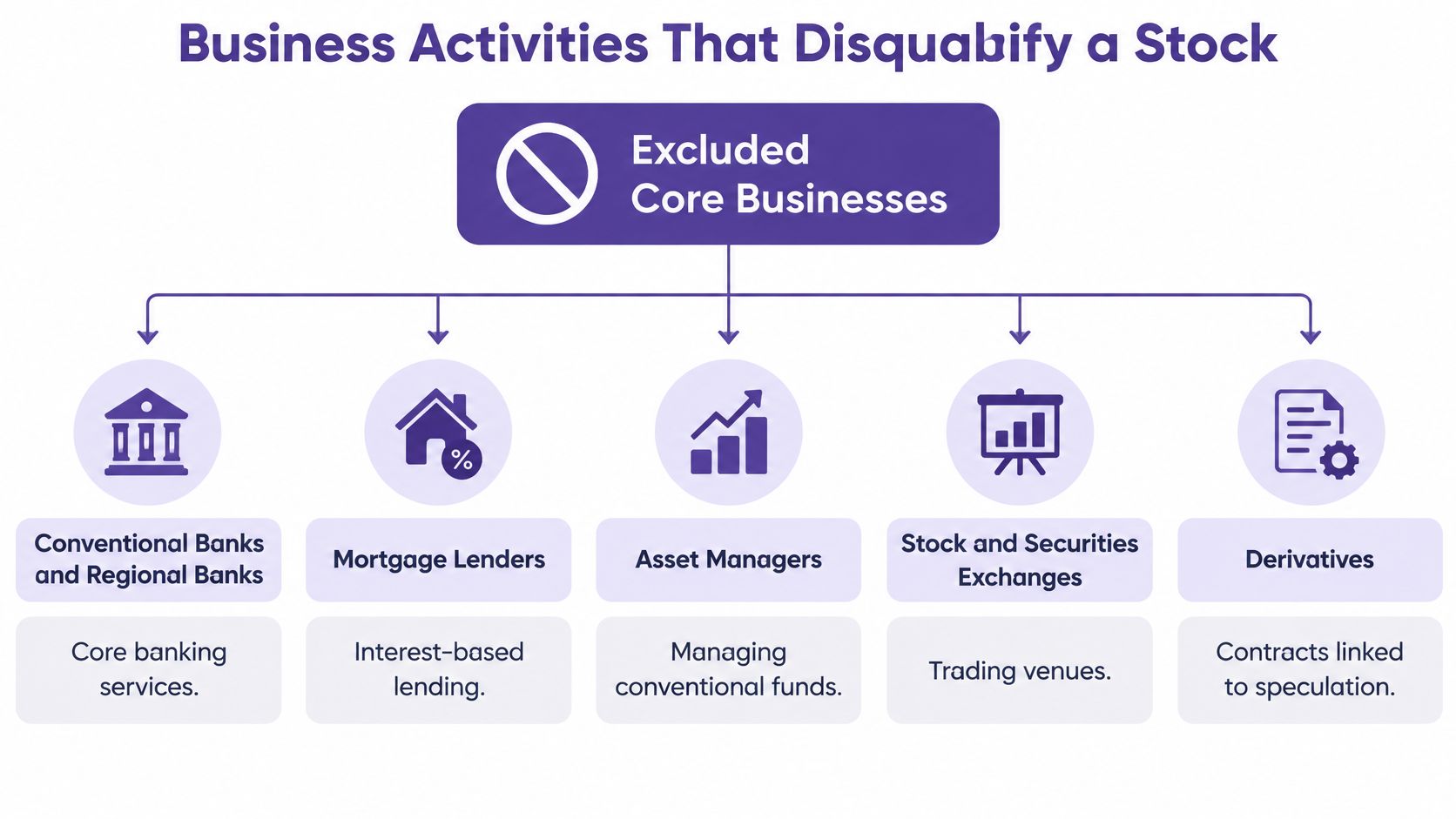
The activity test asks what the company is, not how its ratios look. If the core business sits in a prohibited sector, the share is out. No balance-sheet cleanup reverses that.
Finance built on interest
Conventional banks and regional banks fail because lending and deposit-taking on interest is the business, not a side line. Mortgage lenders fail for the same reason when interest-based home loans are the product. Asset managers that run conventional funds, stock and securities exchanges, and derivatives dealers and clearing houses are treated as market infrastructure for that system. The test doesn't award points for a strong capital ratio.
Insurance, and goods that are prohibited in themselves
Insurance companies, life insurers, and healthcare plans are excluded when the core contract is conventional insurance. Tobacco is out. So is alcohol, including brewers, distillers, and vintners. Gambling and casinos are out. Pork and non-halal meat businesses are out. A supermarket whose main trade is ordinary groceries is a different case from a company whose product is the prohibited good.
The instrument, not only the issuer
Preferred shares and fixed-income instruments are excluded by instrument type, whatever the issuer does. You can be looking at an acceptable operating company and still be buying the wrong security. Check the line on the order ticket, not only the company name. The same issuer can have a common share that reaches the ratio tests and a preferred share that never should.
A minor line is a different problem
Incidental revenue isn't the same as a core business. A retailer with a small alcohol aisle, or a hotel with a small bar, isn't automatically thrown out as if it were a brewery. That slice of income is normally handled by the income test, which asks whether prohibited components stay small relative to total income. The activity test removes the company only when the prohibited activity is what the company is for.
- Read the business description in the annual report and name the core activity in one sentence.
- Check the revenue segment breakdown for any prohibited line, and note whether it is the business or a side segment.
- Confirm the security you are buying isn't a preferred share or a fixed-income instrument.
If the core business is on the excluded list, stop. If only a minor segment shows up, move to the income test rather than writing the whole company off. A longer map of sectors investors often group as excluded sits in this guide to sin stocks.
How Debt, Cash and Income Ratios Are Calculated
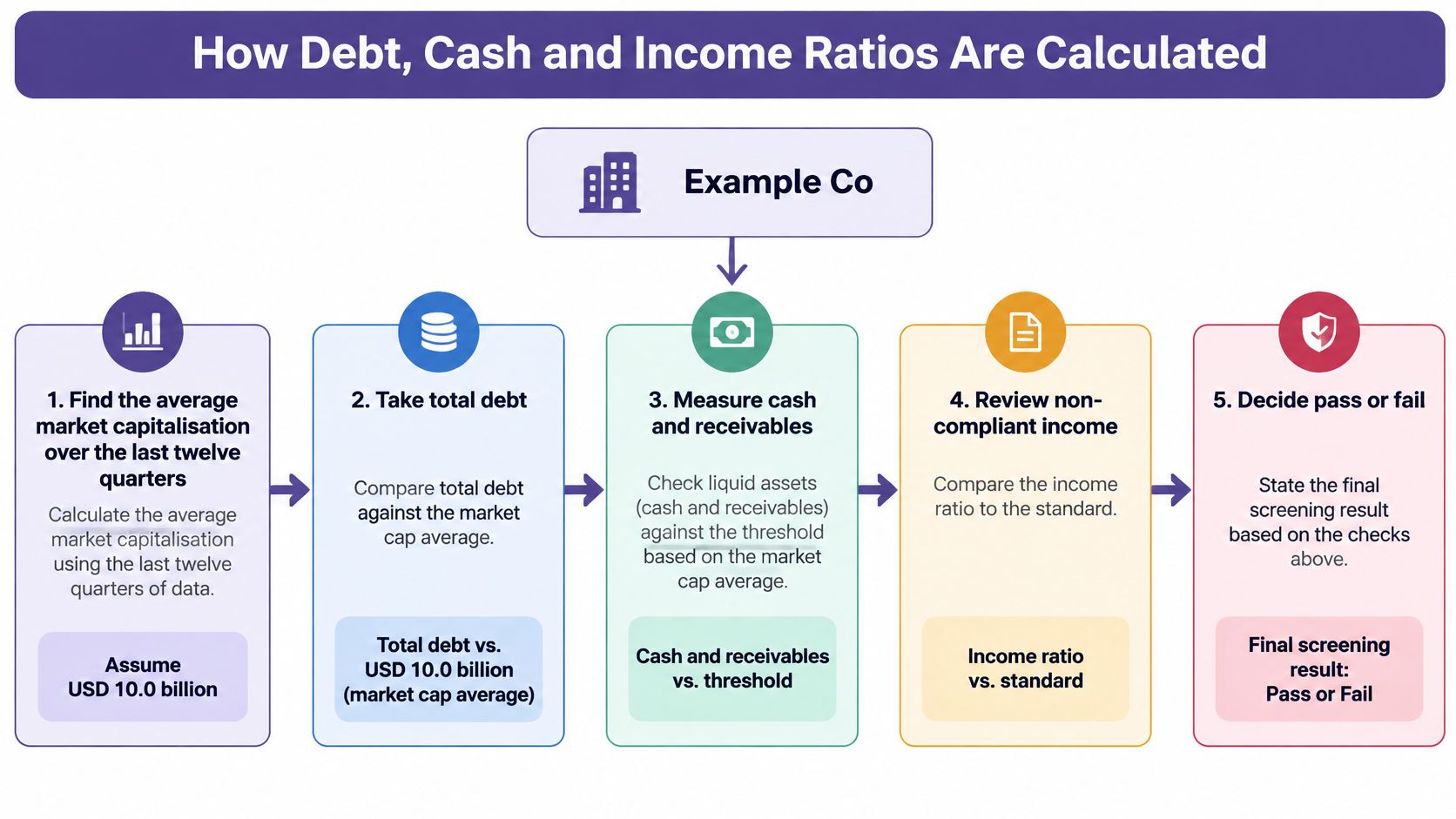
Ratios only mean something when you can see the arithmetic. Take a hypothetical issuer, Example Co, and assume every figure below. None of these numbers is a real filing.
Work the four results on one basis
- Find the average market capitalization over the last twelve quarters. For Example Co, assume USD 10.0 billion. That average is the denominator for the debt test and the cash test. A single day's price isn't the denominator.
- Take interest-bearing debt from the latest balance sheet. Assume USD 2.8 billion. Divide 2.8 by 10.0 and you get 28%. That sits inside the 30% line, so the debt test passes. Use interest-bearing debt, not every liability on the page.
- Take cash plus short-term investments. Assume USD 3.5 billion. Divide 3.5 by 10.0 and you get 35%. That misses the 30% line. The stock isn't compliant even though debt passed. This is the step where the verdict flips.
- Take income from prohibited components and divide by total income. Assume that share is 2.1%. It sits inside the 5% line, so the income test passes. It can't rescue the failed cash test.
| Test | Limit to pass | Result |
|---|---|---|
| Business activity | Excluded if core business is prohibited | Passes |
| Average market cap, twelve quarters | Denominator for ratios | Base figure |
| Interest-bearing debt | Below 30% | Passes |
| Cash plus short-term investments | Below 30% | Fails, so not compliant |
| Income from prohibited components | Below 5% | Passes |
What a price move does to the same debt
Say Example Co's share price falls 30% and the twelve-quarter average market cap falls with it, from 10.0 to 7.0, while debt stays at 2.8. The debt ratio becomes 2.8 divided by 7.0, or 40%. No new borrowing occurred. The ratio moved because the denominator shrank. That is why a screen should store the valuation window next to the result, not only the percentage.
The standard expects the latest verified financial position. Next to each result, record the filing date and the twelve quarters that built the average. A ratio without those two dates can't be reproduced. A stock is compliant only when all four results sit inside their limits on that same reporting basis.
Practical rule: If debt passes and cash fails, the share fails. Don't average the two ratios into a softer middle number.
Why Screening Standards Reach Different Verdicts
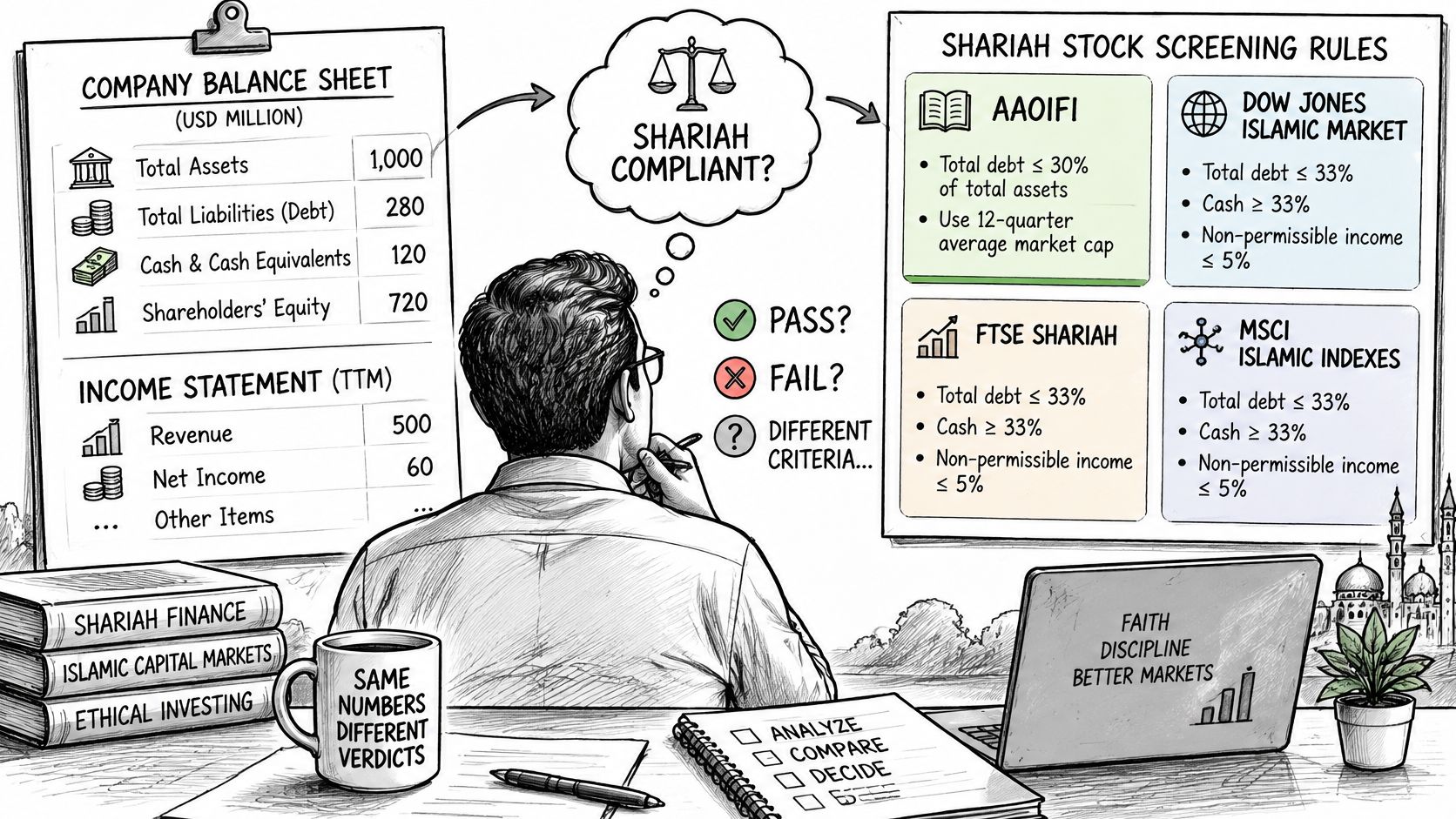
Two apps can show opposite verdicts for the same stock on the same day, and both can be right. Each rulebook works like a different measuring tape: same company, different marks. AAOIFI sets a 30% debt ceiling against a twelve-quarter average market capitalization, while the Dow Jones Islamic Market, FTSE Shariah, MSCI Islamic, and S&P Shariah indices each apply their own denominators, thresholds, and business exclusions. Other rulebooks and national criteria set debt ceilings that differ from AAOIFI's 30%, so shariah compliant stock status is not one global label. A company can sit comfortably inside one standard and breach another.
| Choice | AAOIFI approach | Alternative seen elsewhere | Effect on verdict |
|---|---|---|---|
| Debt threshold | 30% of average market cap | Higher ceilings in some other rulebooks and national criteria | The same company can pass one rulebook and fail another |
| Denominator | Average market cap over twelve quarters | Total assets in some frameworks | Share price swings change the result only under market cap |
| Averaging window | Twelve-quarter average | Shorter window or a single date | A volatile year can move the ratio sharply |
| Business exclusions | Prohibited core activities screened out first | Each index keeps its own exclusion list | A borderline revenue line can be ignored by one rulebook and flagged by another |
A real rulebook clash
The LSEG Islamic Investment Review 2025 describes eligibility as depending on business activities, capital structure, and financial practices, and notes that index providers and asset managers keep refining their frameworks. AAOIFI adoption remains uneven across jurisdictions, which is why disagreement between providers is a feature of the industry rather than proof of a data error.
Lease treatment shows how small the gap can be. Some frameworks count lease liabilities inside interest-bearing debt; others exclude them. One balance sheet then produces two different debt ratios, and only one of them fails the test. Denominators widen the gap further. When debt is measured against total assets, a crash in the share price leaves the ratio untouched. Under a market cap denominator, the same crash can push the company over the line.
Each of the four index rulebooks has its own denominator, thresholds, and business exclusions, which is why a stock can be acceptable on one and rejected on another. Apps that hide the rulebook will keep surprising you. The pattern behind why halal apps disagree about the same stock is usually this split, not a broken feed.
A methodology clash is also a different problem from a bad file. Stale filings, restated accounts, a sharp move inside the averaging window, or a real change in business mix can all move a verdict under one unchanged rulebook. Separate those causes before you blame the standard.
Before trusting any verdict, ask three things. Which standard was applied? Which denominator and averaging window produced the ratio? Which filing supplied the figures? A verdict that answers all three can be checked line by line. Akinda's reports take that approach, exposing the filing inputs behind each classification instead of returning a bare pass or fail.
What Changes a Verdict After You Buy
A compliant verdict is a snapshot. It has to be re-tested. Four triggers do most of the damage to a label you already hold.
Share price movement. Because the denominator is the twelve-quarter average market cap, a sustained fall raises the debt and cash ratios even when the company hasn't borrowed more or piled up more cash. The effect builds as lower prices enter the window. It doesn't all arrive on the day of the drop.
New filings. Each quarterly or annual report can change debt, cash, and income. Reviewing on each filing date is a practical default. Waiting for a year-end summary leaves three quarters unchecked.
Business mix. A new prohibited revenue line can grow past the income threshold over several reports. A segment that was a footnote can become the reason the share fails.
Restated accounts. Corrected earlier figures can overturn the old verdict even though nothing in the current business has changed. The cause is the correction, not a new strategy.
Say a company passes in March with debt at 27% of market cap. Over two quarters the share price falls 18%, and the average used in the ratio falls in line with that. The same debt is now about 33% of market cap, because 27 divided by 0.82 is roughly 33. The verdict flips without any new borrowing. A 25% fall in that average would have lifted the ratio to about 36%, since 27 divided by 0.75 is 36.
At each review, write down the filing date, the valuation window, and all four results. Then ask one question. Did the business change, did the figures change, or did the denominator change?
Purifying Income and Screening Funds
When a company earns a small share of income from prohibited components, investors commonly set aside that share of the dividend. The amount comes from the company's measured figure, not from a generic fixed percentage you apply to every holding.
Say the dividend is USD 800 and the measured non-compliant income share is 1.5%. Multiply 800 by 0.015 and you get USD 12 to set aside. If next year's filing shows 0.8%, the amount to set aside falls with it. If the filing shows the income test has been breached, purification of a dividend isn't the remedy. The share itself has left the screen. A worked method for that arithmetic is in this note on how to calculate purification.
A fund name isn't a verdict
A fund's name, domicile, or marketing label doesn't establish compliance. The verdict is a weighted calculation across holdings. For each constituent, the issuer test is applied, and any impermissible exposure is aggregated by portfolio weight. A small number of non-compliant holdings can matter a lot when their weights are large. One 8% position that fails can outweigh a long list of tiny clean holdings.
You need constituent identifiers, weights, effective dates, and issuer-level verdicts. Stale holdings after a rebalance, a corporate action, or an index substitution distort the weighted result. Missing issuer matches should stay an uncertainty. Don't read a blank as compliant.
Compare the fund's non-compliant weight with the limit in the screen you use. Pull the holdings list and check the largest non-compliant weights first. Learning how to read fund fact sheets makes that holdings table easier to trust, because fact sheets show weights and dates that a fund's marketing name never will.
Any purification figure for a fund should use the measured non-compliant income or the measured holding weight as an explicit input. A flat percentage copied from another fund isn't a calculation.
Confirm a Stock's Status Before You Invest
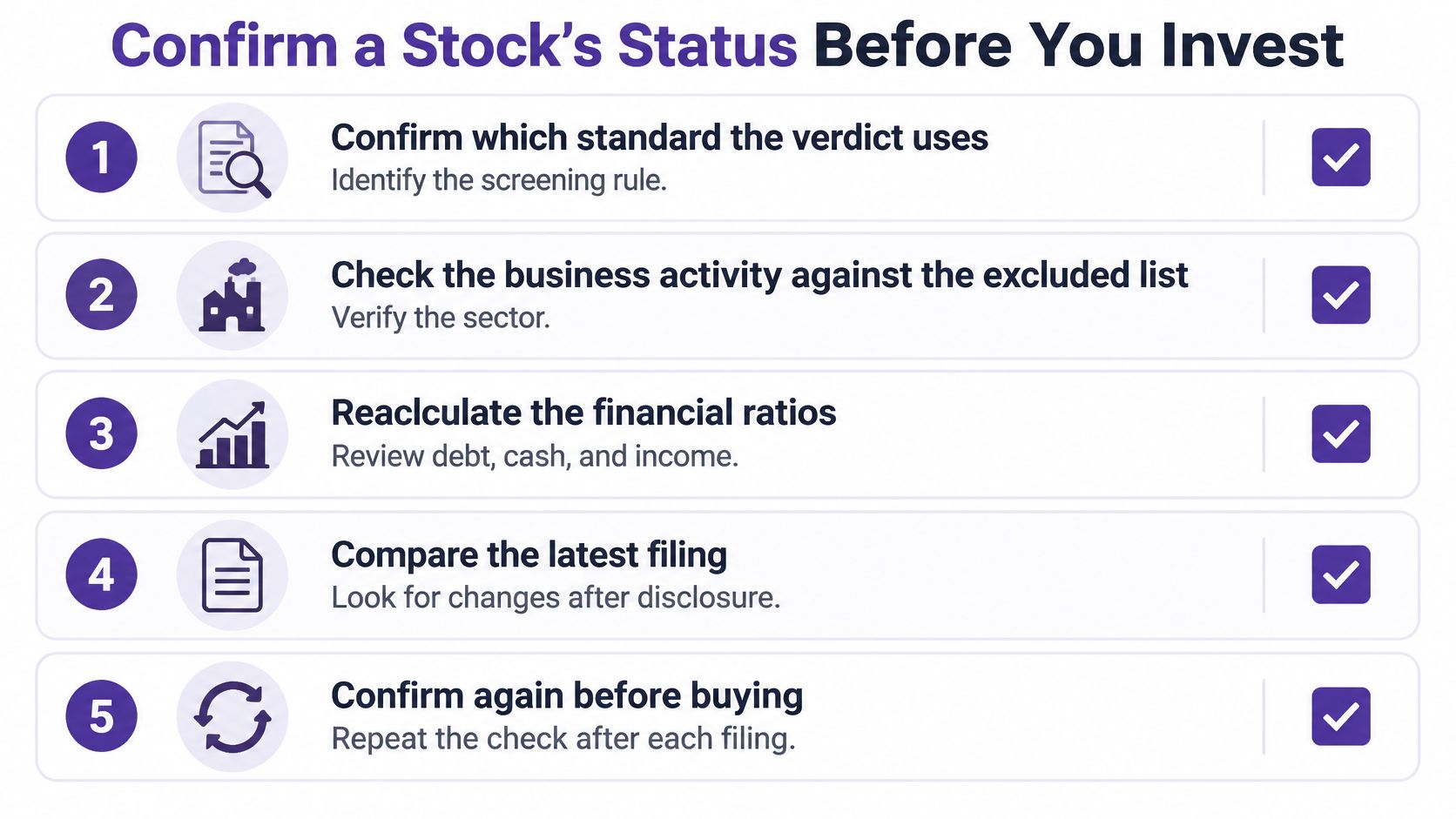
Run this before you buy, and again after each filing.
- Confirm the standard. Name the rulebook behind the verdict. If you can't name it, you don't have a verdict yet.
- Check the business. Match the core activity to the excluded list, and confirm you aren't buying a preferred share or a bond.
- Recalculate the ratios. Recompute debt, cash, and income from the latest filing, and record that filing's date.
- Confirm the window. Check that the market-cap average really covers twelve quarters, and note the start and end dates.
- Repeat on a trigger. Run the check again after every new filing or large share-price move, not only when you first buy.
Our Shariah Compliance Status endpoint takes a ticker and returns an AAOIFI-aligned halal or non-halal status. Live verdicts currently cover the United States, United Kingdom, Canada, and Uzbekistan. A status line is still only as current as the filing behind it.
Screening reduces some issuer-specific risk and doesn't make a portfolio low-risk. Research on Indonesian Islamic equities finds that screening can mitigate issuer-specific risk yet doesn't fully protect portfolios from global systemic risks such as monetary-policy uncertainty, geopolitical pressure, and capital outflows, as described in this study of Indonesian Islamic equities. A screen is one layer of risk governance. It isn't a substitute for diversification or for watching those wider forces. It also says nothing about whether a share is a good investment.
Pick one holding and run the five steps on it this week. Start with the company's latest annual report and the market-cap figures for the last twelve quarters.
Akinda's Shariah Compliance API screens stocks and ETFs under five methodologies, with AAOIFI as the primary one, and returns the ratios and filing inputs behind each verdict rather than a bare label. If you're building a halal portfolio app, a broker screen, or a research desk that has to explain why two rulebooks disagree, start with the documented rules and the numbers that decided them. Visit Akinda to see the endpoints and try a ticker.