
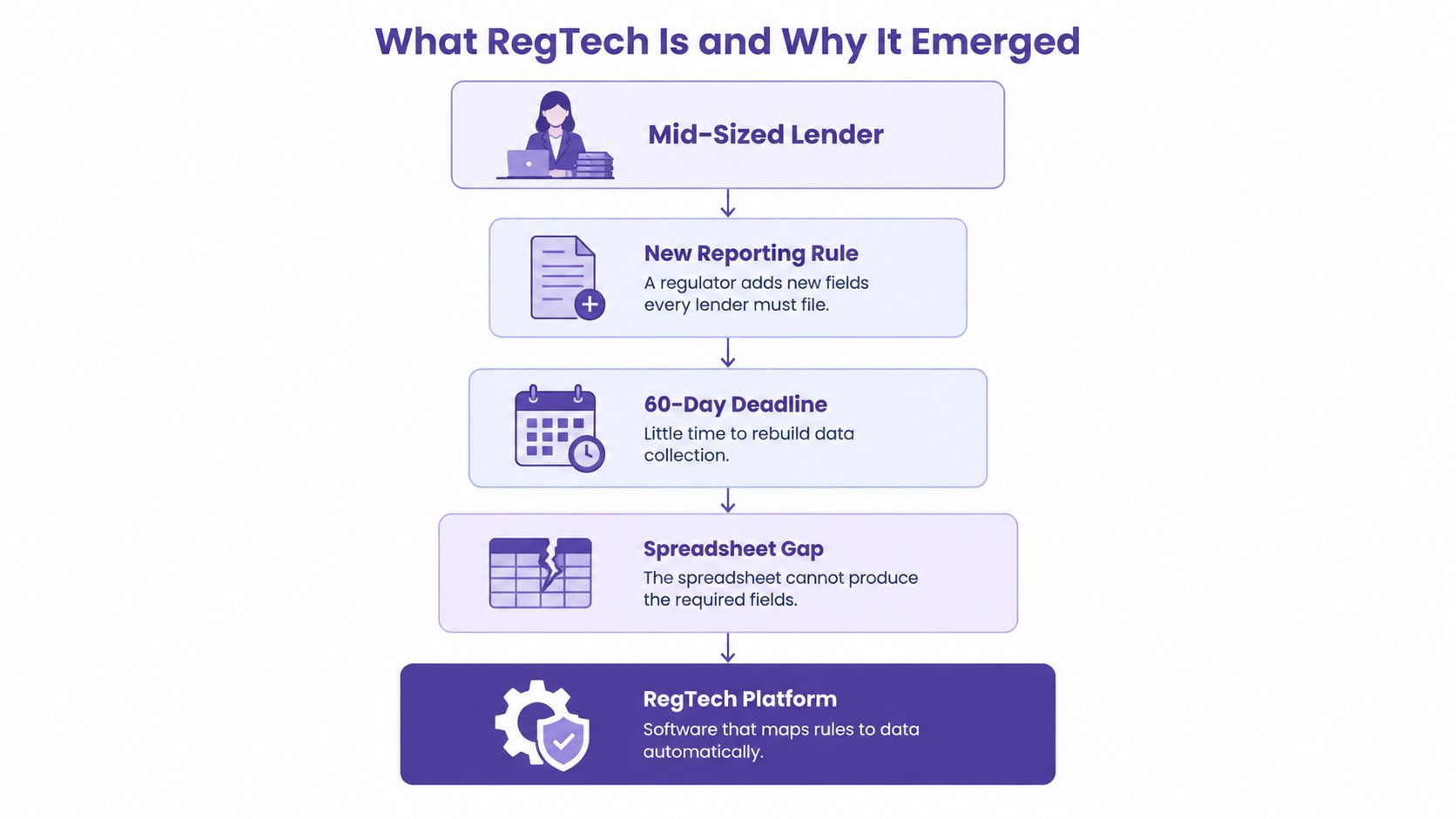
Say you're the compliance officer at a mid-sized lender. A new reporting rule arrives with a hypothetical sixty-day deadline, but your spreadsheet can't produce the required fields. Before you can submit anything, someone must interpret the rule, locate the missing data, check the calculations and preserve evidence of what was filed.
That's the problem regulatory technology is meant to address. The useful question isn't whether software can finish the work faster. It's whether you can trust the answer, explain how it was reached and recognise when the available information isn't enough.
Table of Contents
- What Regulatory Technology Is and Why It Emerged
- How Rules Become Machine-Readable Data
- How APIs, Automation and Data Analysis Fit Together
- A Worked Example From Rule to Verdict
- Where Regulatory Technology Falls Short
- Confirm Fit Before You Adopt a RegTech Tool
What Regulatory Technology Is and Why It Emerged
Regulatory technology, or RegTech, is software and data methods that help firms meet regulatory obligations faster, more consistently and with a record of what was checked. At the lender, that could mean linking reporting instructions to accounting fields, validating the figures and producing a filing with an auditable calculation history.
Think of a building inspector working from a printed construction code. The inspector must translate each paragraph into something observable, such as whether a doorway meets the applicable requirements. A second inspector uses a checklist already mapped to those requirements, with spaces for measurements and photographs.
RegTech resembles the second approach. It doesn't remove the need to understand the code, but it makes repeated checks easier to perform and document.
The lender's reporting problem illustrates why that translation matters.
Core RegTech functions at a glance
RegTech supports banking, securities, insurance, payments and financial-crime controls. Regulators also use related tools, known as supervisory technology, or suptech, to examine information submitted by firms.
| Function | What it automates | Typical users |
|---|---|---|
| Regulatory reporting | Turning ledger data into standard filings, often with XBRL tags | Banks, listed companies |
| Transaction monitoring | Flagging unusual payments against risk rules and thresholds | Banks, payment firms |
| Identity verification | Checking identity documents and sanctions lists during onboarding | Brokers, fintechs, lenders |
| Surveillance | Scanning trades and communications for signs of misconduct | Broker-dealers, asset managers |
| Risk analytics | Scoring exposures and running stress scenarios on portfolios | Banks, insurers |
| Regulatory change management | Mapping new rules to internal controls and owners | Compliance teams |
| Supervisory technology (suptech) | Regulators' tools for collecting and analysing firm data | Central banks, supervisors |
These functions produce different kinds of outputs. A transaction alert is a reason to investigate, not proof of wrongdoing. An identity match may require someone to distinguish between people with similar names, while a reporting validator checks whether a submission follows defined requirements.
That distinction prevents a common misunderstanding: a successful software check isn't automatically a legal conclusion.
Why the field developed
An academic review of RegTech's development identifies the 2007–2008 financial crisis and the subsequent digitalisation of financial markets as principal drivers of its expansion. Before the crisis, large institutions mainly used information systems for internal risk monitoring and compliance support; broader reporting, capital, conduct and supervisory obligations then increased the pressure to automate.
One important reporting tool was XBRL. It attaches identifying tags to financial figures so receiving systems can recognise what a number represents, rather than treating it as an isolated spreadsheet cell. Consistent labels make information easier to exchange and interpret across institutions and supervisors.
Published market forecasts differ considerably because analysts draw different boundaries around the sector, as the Grand View Research market overview illustrates. A market estimate is therefore less useful for evaluating a particular tool than understanding the workflow it supports.
The practical test is straightforward: does the tool turn an obligation into a checkable process that leaves evidence? Function matters more than branding, and artificial intelligence isn't a prerequisite.
How Rules Become Machine-Readable Data
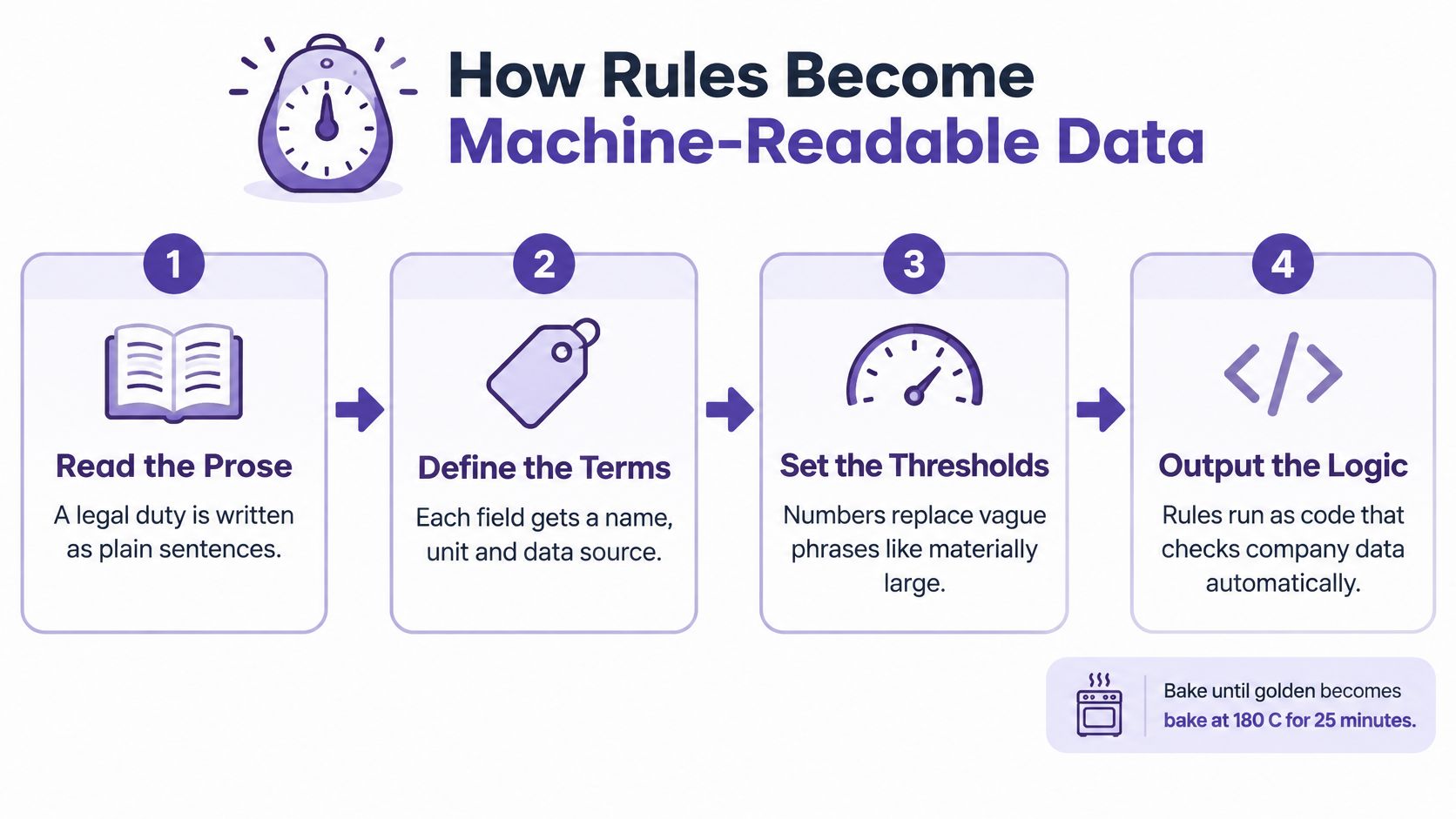
A recipe might tell you to bake until golden. A kitchen timer can't interpret that instruction without more precise directions, and a thermometer needs a defined temperature to check.
Legal obligations pose a similar translation problem. Software needs to know which entities a requirement covers, what information to examine and how to evaluate it. Machine-readable regulation expresses those elements as structured fields, categories and, where appropriate, executable rules.
The translation follows a sequence, but legal interpretation remains part of the work.
From a sentence to a test
Suppose a hypothetical rule requires an eligible lender to report a liquidity ratio against a specified minimum. Before writing the calculation, the implementation team must establish:
- Applicability: Which lenders, activities and reporting periods fall within scope?
- Inputs: Which assets and liabilities belong in the calculation, and where will those values come from?
- Logic: What formula, units, rounding convention and comparison does the requirement specify?
- Timing: When does the obligation take effect, and which version applies to the reporting period?
- Evidence: Which provision supports the interpretation, and who approved it?
A collection of agreed labels, such as institution type, reporting obligation and effective date, forms a taxonomy. These labels help teams connect legal text to internal policies, controls and data fields without relying on document titles alone.
FINRA's machine-readable rulebook notice describes an API exposing regulatory content with taxonomy terms applied to 40 FINRA rules. This lets firms retrieve tagged obligations programmatically, rather than finding every relevant passage through manual searches.
Practical rule: Structured regulatory text should make the original obligation easier to inspect, not hide it behind a software-generated conclusion.
Preserve meaning as well as structure
Each obligation needs a stable identifier, source provision, jurisdiction, effective date, applicability conditions, required inputs, calculation logic and version history. That connection between a structured instruction and its legal meaning is semantic traceability.
Stable identifiers also let developers request a particular rule version reliably. The human-readable source must remain available because a technically valid implementation can still reflect an incorrect legal interpretation.
For an investment-screening example, the guide to screening methodology and data fields shows the kinds of inputs a methodology needs before it can become a repeatable check.
This video provides another way to approach the topic.
When an obligation changes, linked metadata helps compliance staff identify affected controls, reports and owners. They can assess the change directly instead of waiting for someone to rediscover the connection during a periodic document review.
How APIs, Automation and Data Analysis Fit Together
APIs move information, automation repeats checks, data analysis measures patterns and thresholds, and human reviewers decide edge cases. These are separate responsibilities, even when a vendor packages them in the same application.
An API is a defined way for systems to exchange information. It can deliver a filing, a rule or a screening result, but delivery alone doesn't establish that the information is complete or correct.
Technical layers in a RegTech system
| Layer | Role | Example in practice | Failure to watch |
|---|---|---|---|
| APIs | Deliver rules, filing data and verdicts in a standard format | A screening endpoint returns a verdict with its ratios and source fields | Breaking changes to endpoints or fields without notice |
| Automation | Run fixed checks on every record on a schedule or trigger | Nightly recalculation of fund verdicts from holdings | Wrong rules repeated across every record at scale |
| Data analysis | Measure ratios, patterns and thresholds | Comparing interest-bearing debt with 30% of a 12-quarter average market capitalisation in our screening process | Results change with the denominator and averaging window |
| Human review | Approve edge cases, rule changes and held batches | Reviewing an unusually large batch of verdict changes before release | Delays if every routine item reaches a person |
Consider a filing that arrives through an API. An automated workflow checks whether the document belongs to the correct company and reporting period, extracts the required fields and sends valid records for calculation. Analysis then measures the relevant ratios and compares them with the chosen limits.
A reviewer handles exceptions, such as an unexpected change in reported debt or a document whose tables were extracted incorrectly. Sending every clean record to a person would undermine the benefit of automation; sending none of the exceptions would remove an important control.
Our screening endpoint quickstart provides a concrete integration example for developers connecting these layers.
Separate calculation speed from information freshness
At Akinda, we update financial ratios quarterly from each company's regulatory filings. Running a calculation more frequently doesn't make the underlying financial statement more recent.
A useful output should distinguish the source reporting period, document publication date, ingestion time and calculation time. Otherwise, a freshly generated response can look like fresh financial information when it's only a new calculation using older inputs.
A fast response tells you how quickly the system answered. It doesn't tell you how recently the company reported the facts.
Automation also repeats mistakes efficiently. If a team configures the wrong comparison operator or selects the wrong denominator, a scheduled job can apply that error throughout the dataset without producing a technical failure.
Before deployment, test normal cases, boundary cases, missing inputs and known exceptions. Each layer should record what it received and what it changed, so an investigator can reconstruct which input, instruction and calculation produced the output.
A Worked Example From Rule to Verdict
Suppose you're building a halal investment application and need to assess a company under a Shariah screening methodology. This illustrates a RegTech-style workflow, although investment-screening criteria shouldn't be confused with statutory obligations that apply universally.
The company's name or industry label isn't sufficient. The system needs financial evidence, an explicit methodology and a defined way to handle gaps.
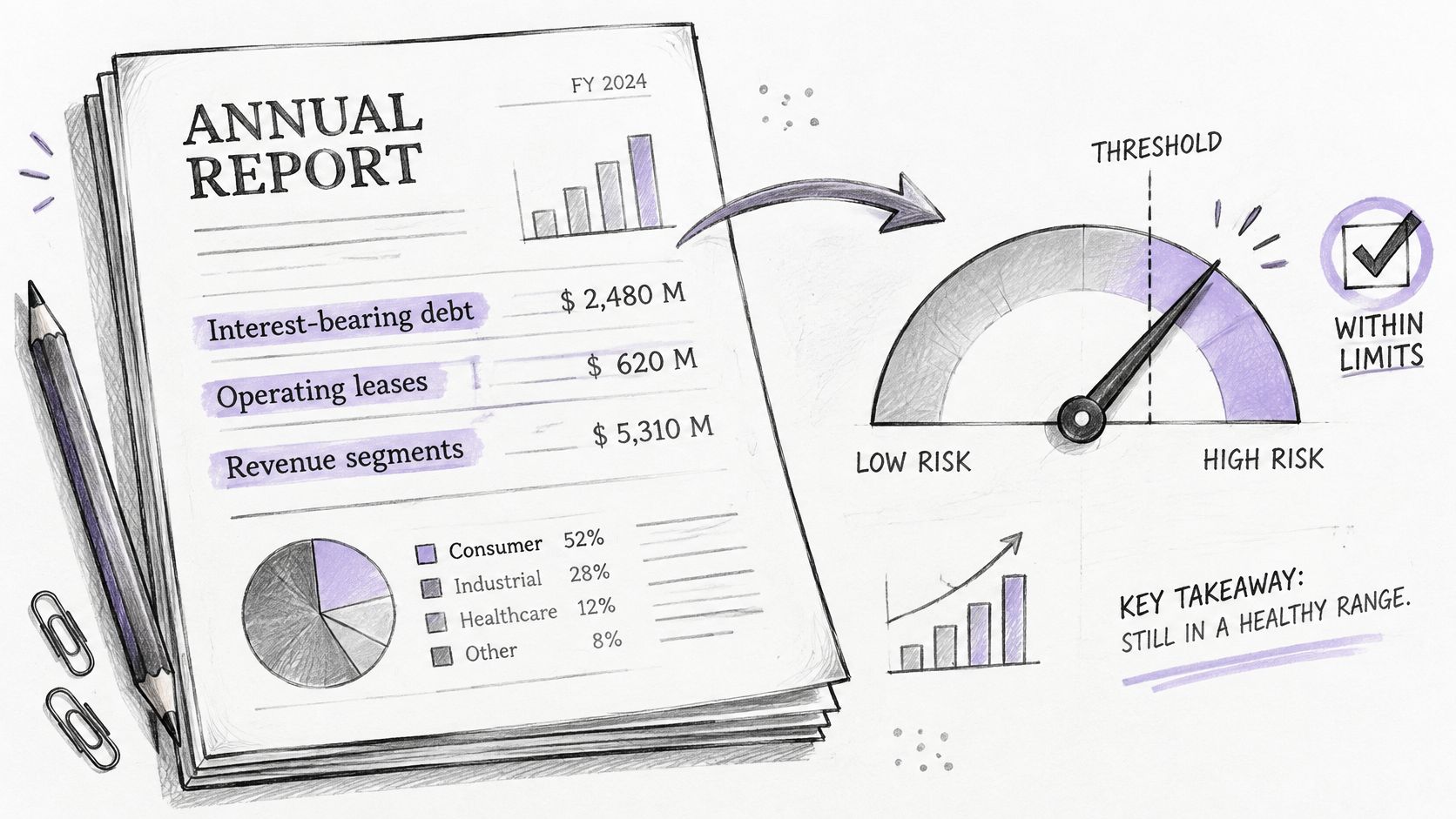
An annual report provides the starting material, not a ready-made verdict.
Follow the evidence through the calculation
Retrieve the filing and extract the inputs. The workflow identifies interest-bearing debt, operating leases and revenue segments that may be prohibited. We source US tickers from SEC EDGAR 10-K and 10-Q filings, UK tickers from Companies House annual accounts, and Canadian tickers from SEC 40-F filings plus company investor relations reports.
Load the selected methodology. In our AAOIFI-based debt screening, interest-bearing debt is compared with a 30% threshold against a 12-quarter average market capitalisation. The same company can also be assessed under another methodology, preserving that framework's own denominator, thresholds, comparators and business exclusions.
Calculate and retain the supporting figures. Store the numerator, denominator, reporting period and methodology version alongside the result. If the frameworks produce different outcomes, a reviewer should be able to identify the methodological difference rather than assume that one calculation malfunctioned.
Stop when a required field is absent. Return null, meaning no computed value is available, rather than substituting an estimated zero. Mark the affected verdict as unavailable, because the system lacks evidence to decide whether the company passes or fails.
The last step changes the application's behaviour. Instead of displaying a reassuring status, it should explain which field is missing and keep the case separate from confirmed compliant and non-compliant results.
Extend the process without losing the detail
For ETFs, we screen each constituent using the stock-screening process, weight it by its share of the fund and recompute the assessment every night. The fund calculation therefore depends on the quality of both the constituent assessments and the holdings information.
A polished fund label can't replace that underlying work. Reviewers need to understand which holdings contributed to the result, rather than accepting the fund's name as evidence.
These tools also operate on the supervisory side: in Central Banking's 2024 survey, 8 of 15 surveyed central banks and supervisory authorities, or 53%, reported using regtech or suptech, while one respondent was implementing it. That's a finding about the surveyed authorities, not a measure of adoption by every regulator.
Where Regulatory Technology Falls Short
More automation doesn't necessarily produce better compliance. In PwC's 2025 Global Compliance Survey, 63% of respondents struggled with the complexity and disaggregated nature of organisational data, while 56% cited data reliability and quality as challenges.
Those problems arise before a model or rules engine reaches a conclusion. If a filing omits a required disclosure, or separate systems identify the same company differently, faster processing won't repair the evidence.
Common RegTech failure modes and safeguards
| Failure mode | What it looks like | Safeguard |
|---|---|---|
| Incomplete source data | A required filing field is missing | Return null instead of an estimated zero |
| Thin coverage | Only part of a fund's weight can be checked | Withhold the verdict below the coverage threshold |
| Stale rules | A verdict uses an outdated threshold | Record the rule version and effective date |
| Conflicting standards | Frameworks return opposing verdicts | Show methodology-specific results side by side |
| Over-automation | A batch error reaches users unchecked | Hold unusually large batches for review |
| Late data | Ratios lag behind the latest filing | State the update cadence in every output |
Missing evidence and evidence of a breach require different responses. A missing field should prompt a data-quality investigation. A confirmed breach should enter the appropriate compliance or investment-review workflow.
Coverage requires similar care. We decline to publish an ETF verdict when we can see less than 95% of its weight and the visible portion hasn't already breached the limit. We also decline to publish verdicts for leveraged, inverse or long-short funds.
The exception matters: an already visible breach needn't become invisible merely because some holdings remain unassessed. But a seemingly acceptable visible portion doesn't justify assuming that unseen holdings are acceptable too.
Design for uncertainty, not just alerts
When an unusually large number of stocks change at once, we hold the batch for review before sending it. Held events are delivered once released, allowing a reviewer to investigate whether the changes reflect genuine developments or a processing problem.
Our screening data is automated, depends on third-party and company-reported inputs, isn't real-time and may be incomplete or incorrect. Applications should communicate those limitations where users make decisions, not hide them in an integration document.
An honest unavailable result is better than an unsupported pass.
A false positive incorrectly flags a problem; a false negative misses one. An unrated outcome means the system hasn't established an answer, and it should remain distinguishable from both.
Teams should measure those outcomes separately. Otherwise, pressure to reduce unrated cases can encourage guessed values that make a dashboard look more complete while weakening its reliability.
Confirm Fit Before You Adopt a RegTech Tool
Treat adoption as an evidence test, not a feature comparison. A regulatory-change management industry report published through AAP found that 98% of surveyed institutions automated at least part of regulatory-change management, making automation alone an unhelpful differentiator.
Use these checks to evaluate whether a tool fits your actual decisions:
Run your own cases. Select records from your portfolio or case file and compare the results with a manual assessment. Include awkward cases, not just straightforward ones.
Test missing inputs. Remove a required value and inspect the response. An unavailable result should remain visibly different from a completed assessment.
Inspect a verdict's evidence. Require the source document, extracted inputs, methodology version and calculation date. A status label alone isn't enough for investigation.
Replay a rule change. Check whether historical results retain their original basis, corrections remain traceable and affected users receive notifications. Test publication dates separately from effective dates.
Match scope to your use case. Our Shariah Compliance API screens stocks and ETFs under five Shariah methodologies, with AAOIFI primary, across four markets. Confirm that the applicable methodologies, instruments and market access fit the intended application.
Exercise the release controls. Trigger an abnormal batch in a test environment and verify the review process, including what users receive after approval.
Together, these checks establish decision lineage: the record needed to reconstruct a past verdict after documents, interpretations or thresholds change. The build-versus-buy screening guide can help frame the associated implementation responsibilities.
If a tool can't reconstruct a historical decision or state its coverage and update cadence in writing, reject it regardless of its feature list. Make that pass-or-fail requirement part of your acceptance criteria before committing engineering time.
Akinda offers a REST API for Shariah screening of stocks and ETFs, connecting screening results with the financial information needed to examine them. Visit Akinda to explore the integration resources and assess whether the service fits your application's methodology, coverage and evidence requirements.
Enhanced by the Outrank app