How to attract Muslim customers to your fintech or investing app (2026)
Muslim investors are one of the largest underserved audiences in consumer finance — and reaching them is a product problem, not a marketing one. Here's what they actually want, how to make Shariah compliance credible, and how to power it with an AAOIFI-based API instead of building the screening engine yourself.
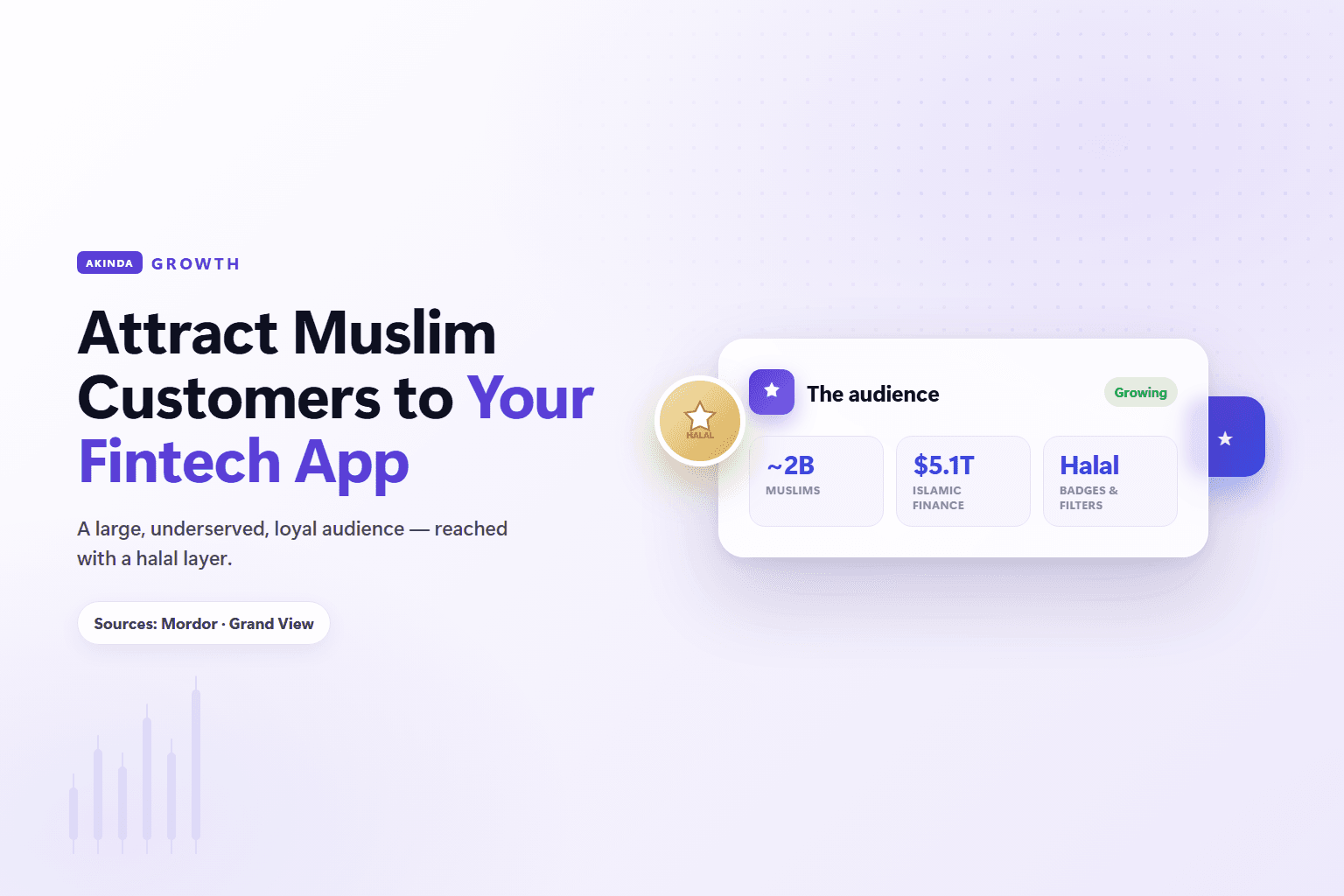
Muslim investors are one of the largest underserved audiences in consumer finance, and reaching them isn't really a marketing problem — it's a product one. You don't attract Muslim customers with a crescent-moon logo and an ad campaign; you attract them by genuinely respecting the values that shape how they invest, and by making that respect visible and credible. This guide covers what Muslim customers actually want from a fintech or investing app, how to build and signal real Shariah compliance, and how to earn the trust that turns them into long-term users.
Quick answer
By the numbers (2026)
The audience is large and the market is growing quickly. The figures below are the widely-cited industry estimates that frame the opportunity:
- Addressable population: roughly 2 billion Muslims worldwide today, a figure Pew Research Center projects will reach about 2.8 billion by 2050.
- Islamic finance assets: about $5.1 trillion in 2026, projected to reach roughly $8.46 trillion by 2031 (a compound annual growth rate near 10.7%), according to Mordor Intelligence.
- Islamic fintech: around $250 billion in 2026 and growing fast, per Grand View Research.
For a deeper look at why fintechs are moving into this space, see our write-up on the halal investing market opportunity.
What Muslim customers actually want
Start from the investor's reality. For an observant Muslim, faith isn't a lifestyle filter applied after the financial decision — it shapes the decision itself. Interest (riba) is prohibited regardless of how the proceeds are used, and whole sectors — conventional banking, alcohol, gambling — are off-limits. That means a standard investing app, which happily lets users buy an index full of conventional banks and insurers, simply doesn't work for them out of the box.
What Muslim customers want, then, is straightforward: the ability to invest in line with their faith without doing all the compliance work themselves, and the confidence that your app's halal claims are real. They want to know a stock's status before they buy it, to trust that the screening is sound, and to handle obligations like purification correctly. Meet those needs credibly and you're not just another app — you're the one they can actually use.
Make Shariah compliance visible and credible
Compliance that users can't see doesn't attract anyone. The apps that win Muslim customers surface compliance at every relevant moment and back it with credibility signals:
- A clear verdict at the point of decision. A HALAL / NOT HALAL badge on every ticker and a status check before a trade, so users never have to guess. Akinda returns this in a single
halal_statusfield — HALAL, NOT HALAL, or DOUBTFUL — plus a “no data” marker (ERROR_DATA/INCOMPLETE_DATA) when a company hasn't reported enough to screen. - Transparent reasoning. Show the business-activity result and the financial ratios behind a verdict, so an informed user can see why a stock is or isn't compliant.
- A recognised standard. Screen against AAOIFI-based rules and say so — vague “ethically screened” language doesn't build trust with a knowledgeable audience. Akinda's screen follows AAOIFI Shari'ah Standard No. 21.
- Scholar governance. A named Shariah advisor and a published methodology tell users the verdicts are accountable, not marketing.
The Akinda API is built around exactly these signals: a documented, AAOIFI-based screening methodology overseen by Dr. Muhammad Nazir Khan, who holds a PhD in Islamic Economics and Finance and an AAOIFI Shari'ah Auditing Certification. You can audit every rule on the methodology page, or point users to the live playground to see the same screening in action.
Build genuinely compliant products
Credibility comes from substance, and Muslim users — especially the community's influential power users — will quickly spot a superficial “halal” wrapper on a non-compliant product. To attract and keep them, the compliance has to be real end to end:
- Screen the whole universe. Let users filter to only compliant securities, and make sure your default lists and search respect that. Akinda covers US tickers broadly, with UK (London,
.L) and Canadian (Toronto,.TO) listings available on higher tiers. - Gate the risky moments. Warn or block a NOT HALAL buy rather than letting a user accidentally violate their own values.
- Support purification. Give users the figure they need to cleanse the impermissible portion of dividends — a detail that signals you understand the practice, not just the label. Akinda computes this through the
akinda_calculate_purificationtool on its MCP server (paid plans), not as a field baked into a REST report. - Keep it current. Re-screen holdings as company finances change, so a verdict a user relied on last quarter is still accurate this quarter.
Products built this way market themselves inside the community, because trust travels by word of mouth among Muslim investors far more than through paid acquisition. For a concrete pattern, our guide on adding Shariah compliance to your app walks through badges, pre-trade gates, and monitoring.
Speak the language: localization and community
Muslim investors are not a monolith — they span dozens of countries and languages, and many are underserved specifically because mainstream apps are English-only and culturally generic. Attracting them often means meeting them in their language and context: a multilingual interface, content that explains halal investing in familiar terms, and a presence in the communities where these investors actually gather.
A structured data layer makes this easier than it sounds. Because Akinda returns compliance as machine-readable fields — halal_status, the AAOIFI ratios, company revenue segments — rather than pre-rendered English prose, you localize the presentation in your own UI without waiting on the provider to translate anything. Pairing credible, language-agnostic compliance data with localized education and community presence is far more effective than a translated landing page bolted onto a generic product.
Leverage the ethical and ESG overlap
Attracting Muslim customers doesn't mean narrowing your audience — it can widen it. Shariah screening excludes many of the same sectors that ethical and ESG investors avoid — alcohol, gambling, and conventional interest-based finance — so a genuinely compliant product also appeals to values-driven non-Muslim users. And the old objection that faith-based screening costs you returns doesn't hold up: broad Shariah-compliant indices have historically tracked their conventional benchmarks closely over full market cycles.
Framing your halal features as part of a broader values-based offering, rather than a walled-off niche, lets the same investment in compliance serve two growing audiences at once. If users ask about the mechanics, link them to our explainer on AAOIFI vs IFSB vs S&P Shariah screening.
How to power it with the Akinda API
Turning all of this into product is fastest with an API. The Akinda API gives you the compliance layer — verdicts and the ratios behind them — through a few REST endpoints, so your team can spend its time on experience, community, and growth rather than on building Islamic-finance infrastructure. The base URL is https://b2b-api.akinda.io/api/v1, and the ticker is a path parameter:
GET /compliance/<ticker>— a fast HALAL / NOT HALAL / DOUBTFUL verdict. Available on the free Basic tier (200 calls/day).GET /basic-report/<ticker>— the verdict plus the three core AAOIFI ratios (debt_ratio_perc,liquidity_ratio_perc,non_compliant_revenue_perc). Personal Standard and up.GET /full-report/<ticker>— the full screen with AI-extracted SEC figures and their dollar counterparts. Personal Ultimate and up; the Akinda ranking pillars (ranking, profitability, and so on) are a Business Ultimate / Enterprise add-on.
Authentication is an Akinda API key, sent either as a query parameter — ?apikey=YOUR_KEY — or as an X-API-Key: YOUR_KEY header. There is no bearer-token or OAuth flow for the REST API. A single call is all it takes to power a halal badge:
cURL
curl "https://b2b-api.akinda.io/api/v1/compliance/AAPL" \
  -H "X-API-Key: YOUR_KEY"
JSON
{
  "ticker": "AAPL",
  "company_name": "Apple Inc.",
  "halal_status": "HALAL"
}
Current verdict: Halal
AAPL) returns halal_status: HALAL from the compliance endpoint. Want the ratios behind it? The full breakdown is in is Apple halal?From there, the rollout is a standard integration path:
- Generate an API key from the dashboard and prototype on the free Basic tier — the
/complianceendpoint only, at 200 calls/day, which is enough to evaluate and wire up but not to run production traffic. - Add halal badges and a pre-trade check using
/compliance/<ticker>. - Build detail views from
/basic-report(the three AAOIFI ratios) or/full-report(AI-extracted SEC figures with dollar counterparts) on the paid tiers. - Offer purification via the
akinda_calculate_purificationMCP tool, so users get an actionable cleanse figure for their dividend income. - Re-screen quarterly so verdicts stay accurate, caching results between runs to control request volume.
- Move to a paid or business plan before you ship — review the pricing page to pick a tier.
Because the same data is exposed as an MCP (Model Context Protocol) server, you can also let an AI assistant screen tickers and compute purification mid-conversation. Connect Akinda to Claude with Sign in with Google at https://b2b-api.akinda.io/mcp (paid plans only) — full walkthrough in Connect Akinda to Claude. Building a robo-advisor or brokerage instead of a self-directed app? See Shariah screening for robo-advisors and brokerages.
Frequently asked questions
How do I attract Muslim customers to my investing app?
Make Shariah compliance real, visible, and credible. Screen securities against a recognised standard, show a clear HALAL / NOT HALAL verdict at the point of decision, support purification, and back it with a transparent, scholar-governed methodology. Then meet users in their language and community. Substance plus visibility beats any marketing campaign with this audience, because trust spreads by word of mouth.
Is it enough to just add a “halal” label?
No, and it can backfire. Knowledgeable Muslim investors will quickly notice if a “halal” product still lets them buy a NOT HALAL security or offers no purification. Credibility comes from genuine, end-to-end compliance — screening, gating, purification, and a published methodology — not from labelling alone.
Do I need my own Shariah scholars to attract Muslim users?
You need credible scholar governance behind the compliance, but you don't have to hire a board from scratch. Using an API whose methodology is published and overseen by a qualified scholar lets you offer accountable compliance while your own advisors review and rely on it. Given how scarce scholars with both classical Shariah training and modern finance expertise are, this is how most teams do it.
Will focusing on Muslim customers limit my market?
Not necessarily — it can expand it. Because Shariah screens overlap with ethical and ESG exclusions, a compliant product also appeals to values-driven non-Muslim investors. Framed as a values-based offering, halal features serve two growing audiences at once.
How long does it take to add credible compliance?
With an API, weeks rather than months. The hard parts — screening logic, financial data, and scholar governance — already exist, so you integrate the endpoints, design the UX around the verdicts, and set up quarterly re-screening. Building the same capability in-house would take far longer and require scarce specialist talent.
Informational, not a fatwa
Verify it yourself via the Akinda API
Fire a live /full-report/<ticker> call from the playground using your own API key — see the compliance ratios, AAOIFI screen verdict, and source-breakdown fields the methodology produces.
Related reading