
A stock screener can give you a shortlist in seconds. The harder question is whether you can trust it. A tool with hundreds of filters may still leave you guessing when its financial data was updated, why a company vanished from the results, or how it calculated a debt ratio.
The test is simple: can you explain why a security passed? Developers need reproducible inputs and usable outputs. Research desks need consistent definitions. Shariah-focused teams also need to know which rulebook produced the verdict.
That distinction matters. Comparisons published in the Journal of Islamic Finance show that Shariah screening providers differ on permitted activities, ratios, denominators, and thresholds. A conventional low-debt filter can't stand in for a methodology-specific assessment.
Practical rule: Pick the tool that helps you verify a decision, not the one with the longest filter menu.
These 10 tools tackle different jobs, from chart-led discovery and fundamental research to brokerage workflows and explainable compliance screening. Free access may be enough to find candidates, but not to export results, confirm data freshness, or power an application.
Start with what you need to decide. Then check market coverage, timestamps, calculation definitions, and integration rights before trusting the shortlist.
Table of Contents
- 1. Akinda
- 2. TradingView
- 3. Finviz
- 4. Stock Rover
- 5. Koyfin
- 6. Yahoo Finance
- 7. Stock Analysis
- 8. ChartMill
- 9. TIKR
- 10. Fidelity Stock Screener
- Stock screener tools at a glance
- Choosing a Stock Screener You Can Defend
1. Akinda
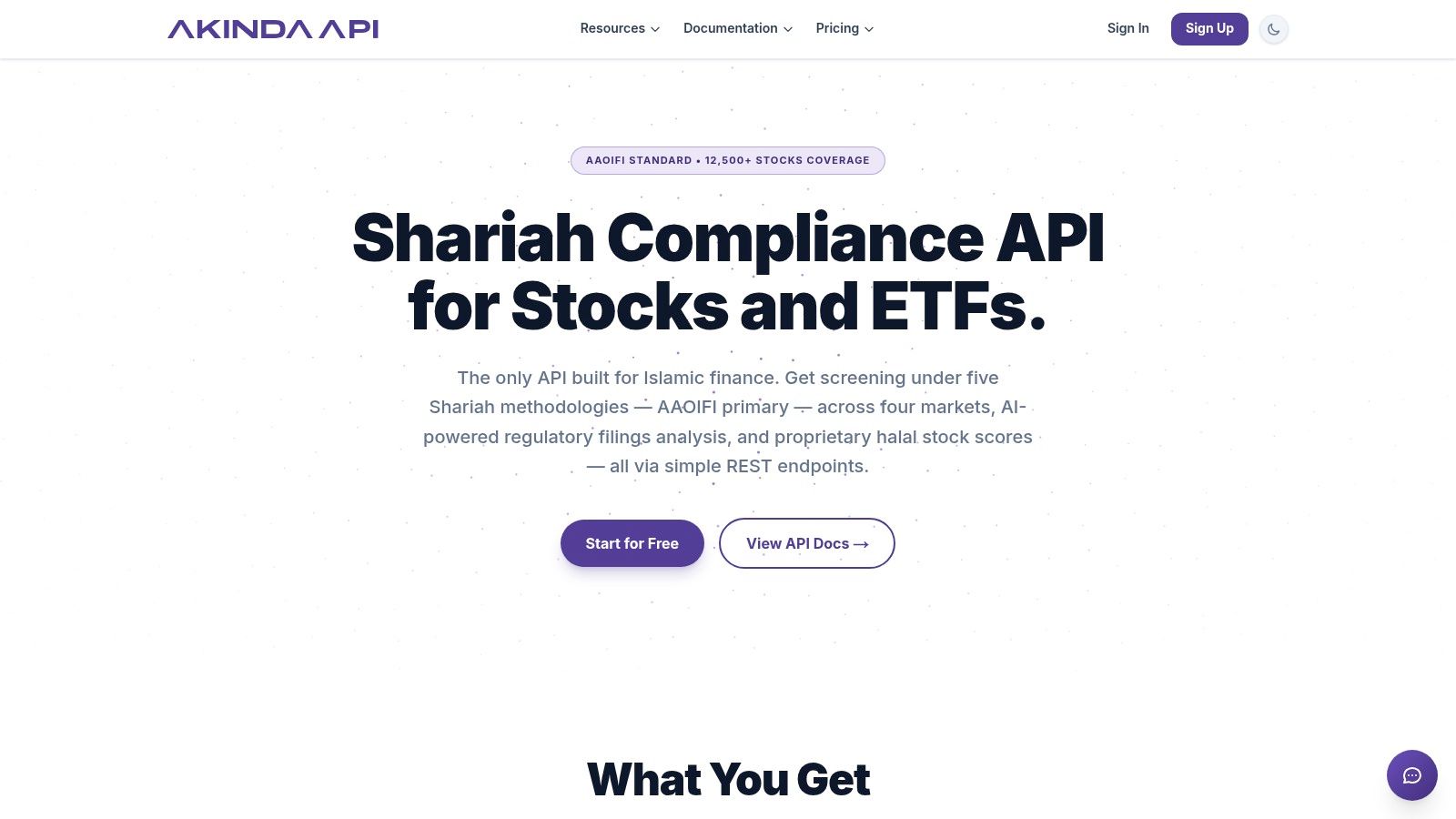
Best for fintech teams that need explainable Shariah screening inside an application. Akinda is an API-first service rather than primarily a charting workspace. We return compliance verdicts, debt and liquidity ratios, non-compliant revenue shares, and reports containing the financial inputs behind those results.
Our primary methodology is AAOIFI Shari'ah Standard No. 21. Parallel outputs cover five methodologies, preserving each rulebook's denominators, thresholds, comparators, and business exclusions. That matters when your research team needs to explain a disagreement rather than hide it behind a single label.
What you can verify
Our filing analysis extracts items such as interest-bearing debt, operating leases, and prohibited revenue sources. Reports let developers connect a headline classification to its supporting financial figures instead of maintaining a verdict-only database.
- Stock coverage: We cover more than 12,500 stocks across the United States, United Kingdom, Canada, and Uzbekistan, with downloadable market lists.
- Fund assessment: We screen constituent holdings and weight their results by portfolio share. Fund verdicts are recomputed nightly, and coverage accompanies the assessment.
- Integration: REST endpoints, documentation, an interactive viewer, and code examples support implementation. Eligible plans add an MCP server, change feeds, and webhooks.
The main trade-off is filing-based analysis, not real-time market data. Automated results depend on company-reported and third-party inputs, which may be incomplete or incorrect. Nightly fund recalculation doesn't mean every constituent has newly published financial statements.
A limited free tier supports evaluation, while advanced capabilities depend on the plan. Test endpoint access and country-level ticker coverage before designing your production workflow. Our screening is informational and doesn't replace a qualified scholar's judgment.
2. TradingView
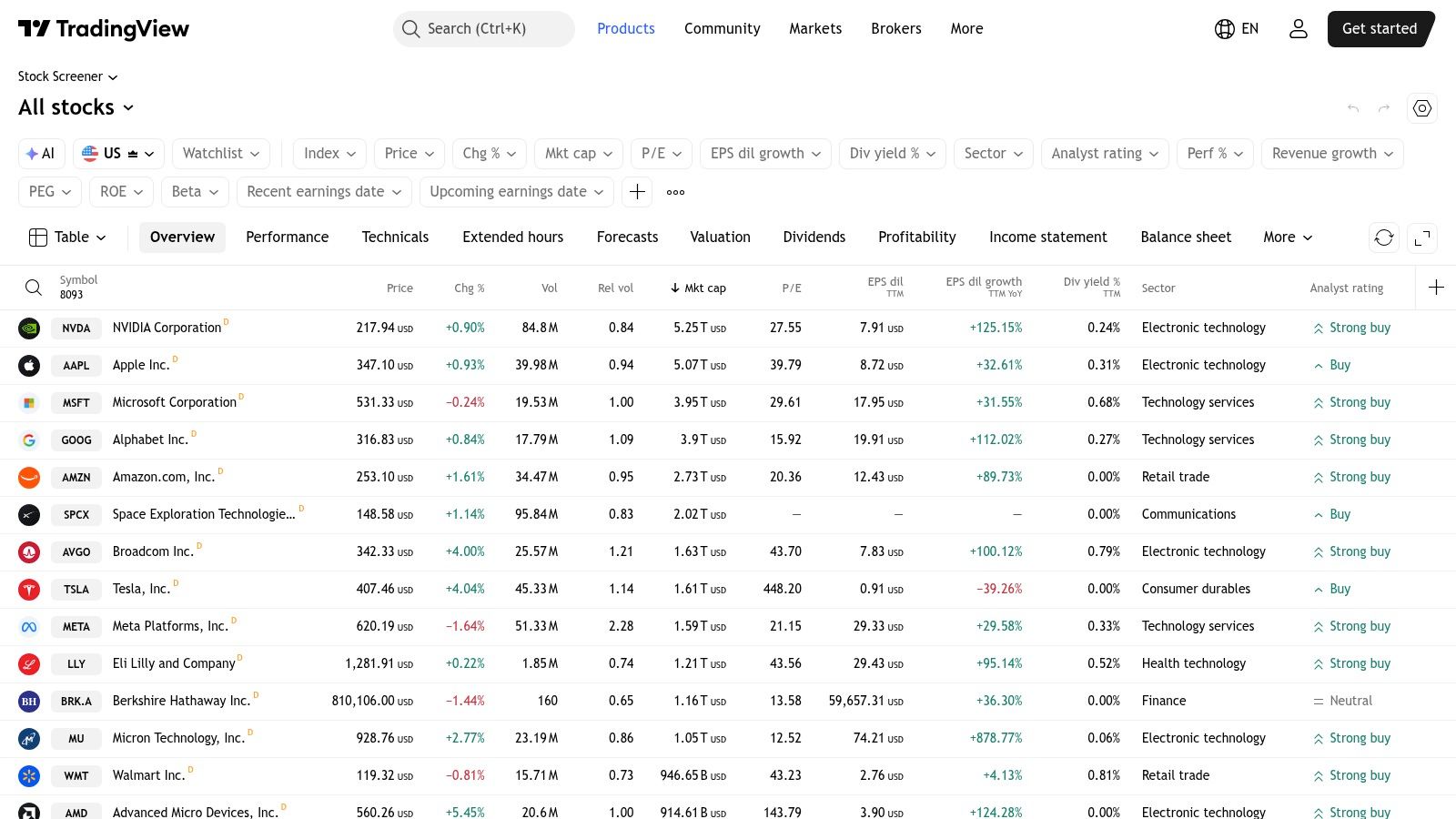
Choose TradingView's stock screener when the next step after filtering is opening a chart. Its combination of fundamental fields, technical indicators, configurable columns, and regional selection suits analysts who want to inspect price behavior without rebuilding their shortlist elsewhere.
Say you're screening profitable companies with improving price performance. Display profitability, valuation, volume, and performance together, then inspect charts for the candidates that survive. That's a more disciplined workflow than selecting an attractive chart first and searching for supporting fundamentals afterward.
Where the workflow stops
Chart integration is the advantage. Compliance interpretation isn't included. TradingView doesn't provide a dedicated Islamic finance methodology or Shariah rulings, so a technical or low-debt filter remains an investment-research condition.
- Useful features: Saved screens, configurable result views, and export options help maintain a repeatable discovery process.
- Access limits: Some functionality and market data require paid access or separate exchange subscriptions.
- Verification priority: Inspect the exchange, quote status, reporting period, and metric definition before relying on a result.
For application builders, distinguish a screen you can operate manually from a data workflow you can legally and technically integrate. A CSV export isn't automatically a production data service.
The guide to building a halal stock screener explains the additional compliance layer. Keep that layer separate from chart-based ranking so users can distinguish investment attractiveness from eligibility.
3. Finviz
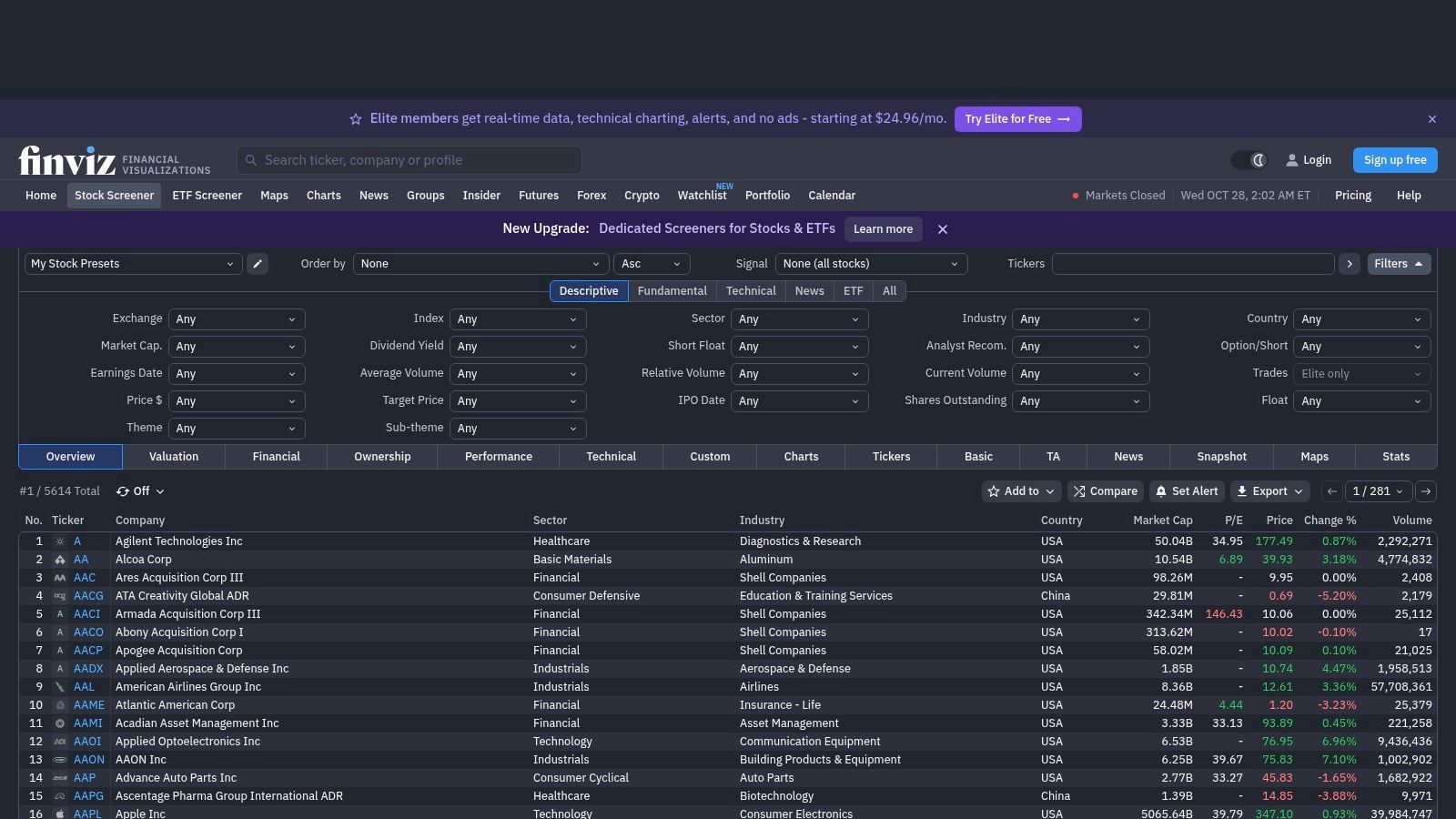
Finviz is a practical choice for fast U.S. market discovery. Its descriptive, fundamental, and technical filters make common screens straightforward, while chart views and market maps help you inspect the resulting group visually.
The important limit is the universe. Coverage concentrates on Nasdaq, NYSE, and AMEX, so don't treat an empty result as evidence that no suitable company exists internationally. It may mean the company isn't in the searchable market universe.
A useful routine is to start with sector, size, profitability, and liquidity, then add technical conditions. This keeps the economic question visible instead of producing a shortlist defined mostly by chart patterns.
A visually clean shortlist can still contain stale quotes or financial fields measured over different periods.
Free versus paid access changes the workflow. Free quotes are delayed, while Elite adds real-time quotes and capabilities such as alerts, exports, and expanded charting. Verify the data status relevant to your screen rather than assuming every displayed field updates together.
Finviz works well as a discovery tool, but its conventional financial filters don't establish Shariah compliance. Debt fields alone won't resolve prohibited business activity, revenue classification, or methodology-specific denominators.
If free access is your starting point, compare the distinctions in free halal stock-screening apps. Separate the cost of finding candidates from the work needed to verify their eligibility.
4. Stock Rover
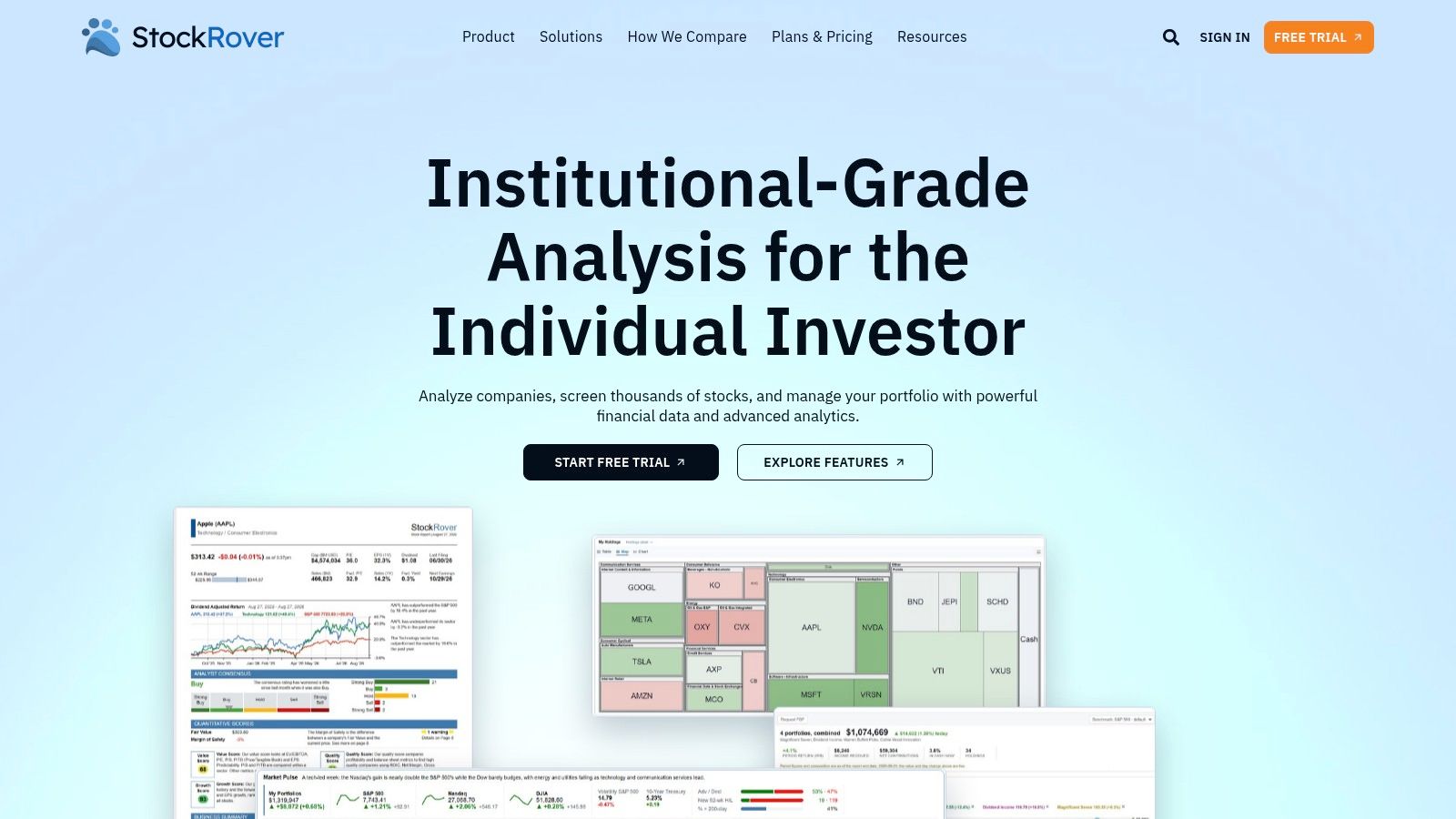
Stock Rover fits fundamental research that continues after the initial screen. Its browser-based platform combines company metrics, stock and fund research, portfolio tools, and alerts. It's a stronger fit for evaluating business quality and portfolio exposure than for watching a rapidly changing intraday setup.
The decision advantage comes from connecting screening with further analysis. A dividend candidate deserves more than a high-yield filter: inspect earnings, cash generation, debt levels, and the history behind the current payout. A ranked result is a starting order for investigation, not a conclusion.
Depth depends on the subscription
Stock Rover offers custom screens, with equation-based and ranked screening available on eligible plans. Historical financial and price-data access also varies by tier, so test your actual query before subscribing.
- Strength: Fundamental and income-oriented research can stay connected to portfolio analysis.
- Boundary: Coverage focuses on North America rather than a fully global investment universe.
- Usability trade-off: The information-dense interface is better suited to a large screen than quick mobile checks.
For a research desk, custom equations are useful only when everyone agrees on their definitions. Document whether a ratio uses annual or trailing figures, how negative values behave, and what happens when an input is missing.
Stock Rover isn't a dedicated Shariah screening product. Use its financial analysis to investigate candidates, but don't interpret a custom debt filter as a complete compliance methodology.
5. Koyfin
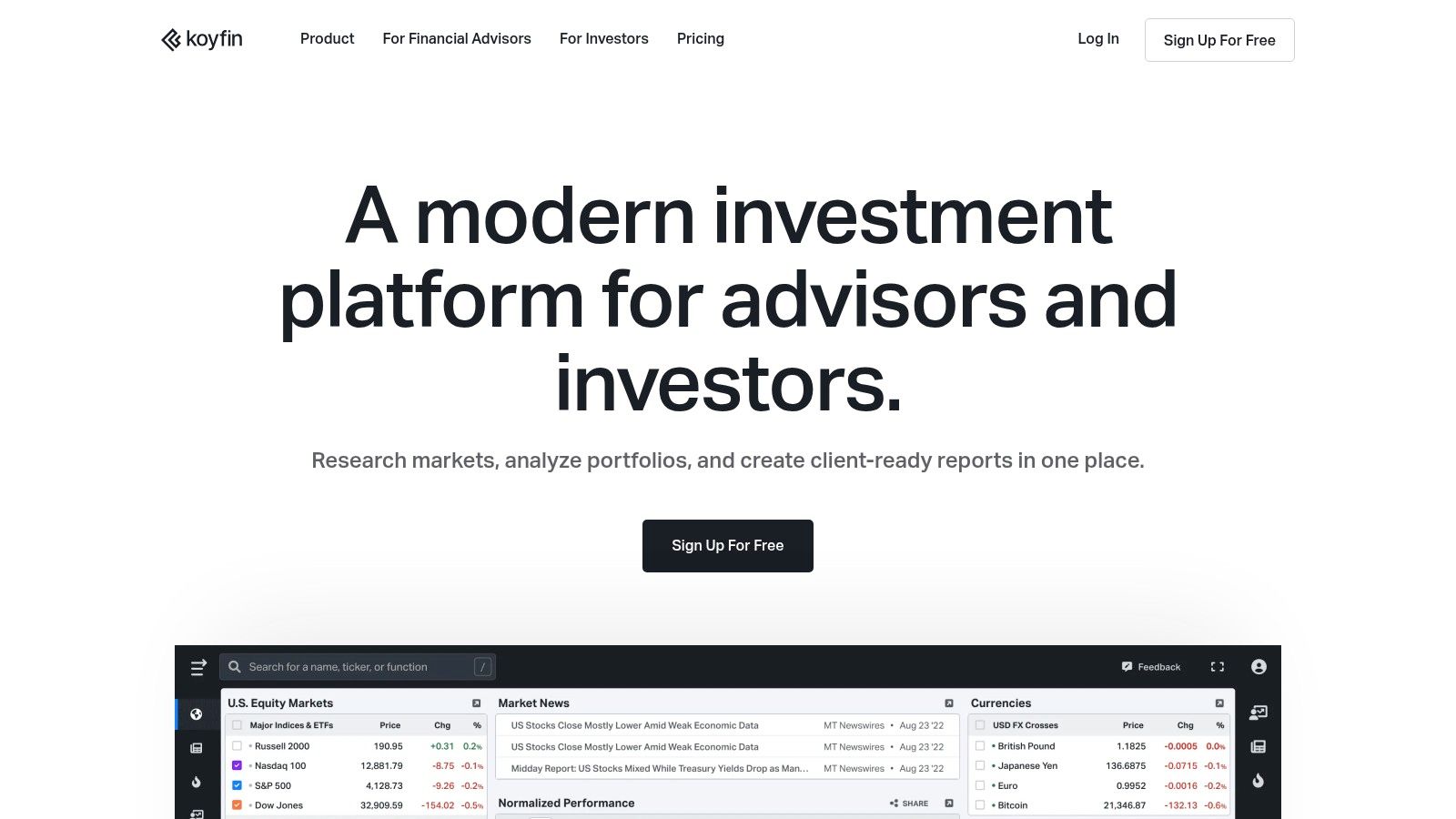
A global shortlist needs context. Koyfin combines stock and ETF screening with company snapshots, analyst estimates, charts, dashboards, and portfolio tools, making it useful when you need to compare candidates beyond a basic results grid.
Its practical advantage is continuity between discovery and investigation. An analyst can shortlist companies, examine expectations, and compare market conditions within the same research workspace. That suits teams evaluating international peers rather than isolated domestic tickers.
Compare businesses on compatible terms
Cross-market screening needs care even when the interface looks consistent. Before comparing valuation or growth, inspect reporting currencies, fiscal periods, and whether the field represents reported results or analyst expectations.
- Best use: Global company comparison supported by broader market context.
- Main trade-off: Advanced datasets and workflows depend on paid access.
- Compliance limit: Screening results are research inputs, not Shariah assessments.
A free tier offers an entry point, but evaluate it using your intended workflow. Finding a company isn't the same as having enough history, estimates, or saved-screen capacity to maintain a research process.
Koyfin can be excessive if all you need is an occasional basic filter. It makes more sense when analysts will use the surrounding dashboards and company analysis. For developers, assess data delivery and licensing separately from the quality of the browser interface.
6. Yahoo Finance
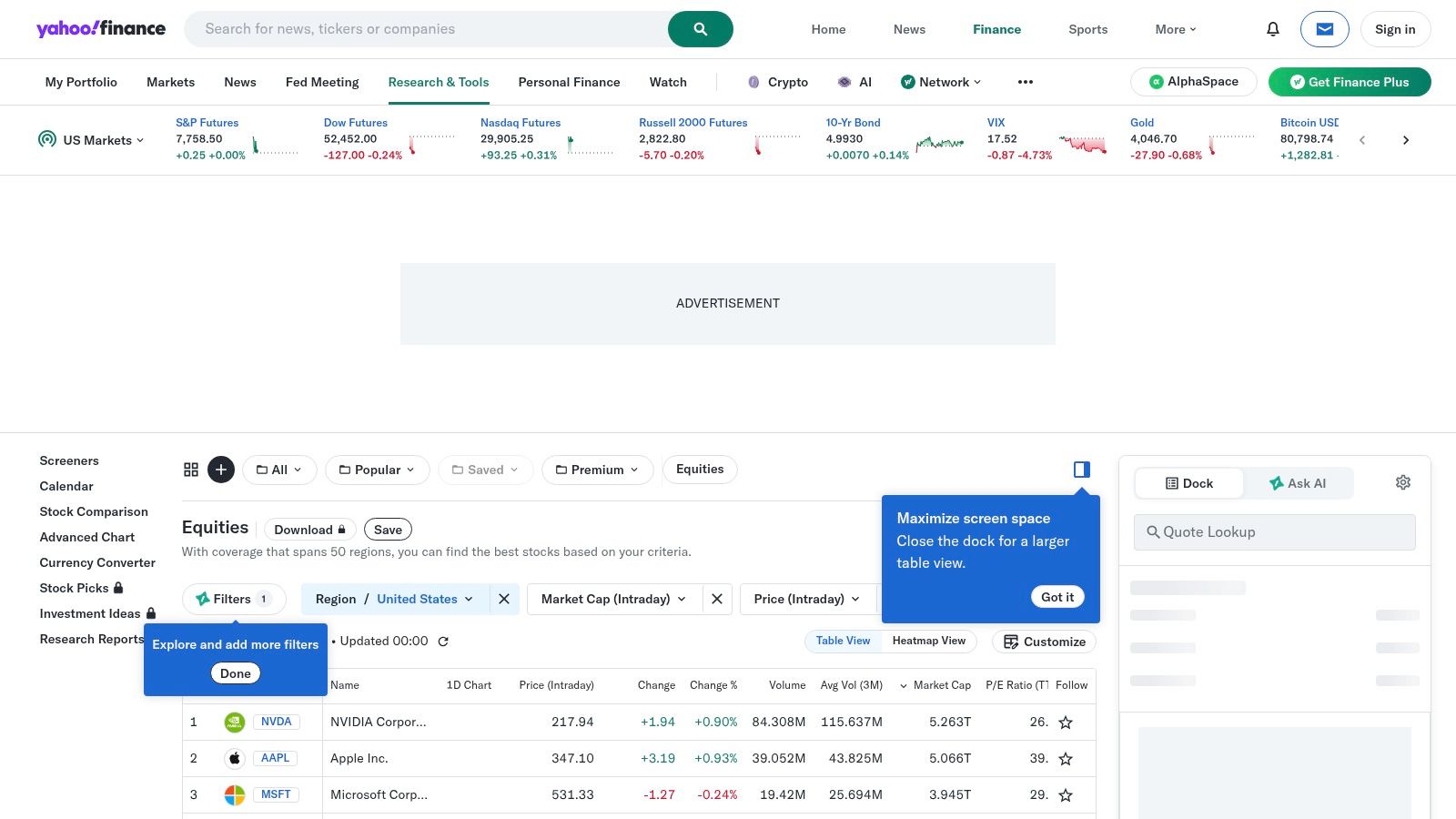
For an accessible starting point, Yahoo Finance's equity screener covers familiar fields such as price, volume, market capitalization, valuation, sector, and industry. Presets reduce setup work, while custom filtering lets you turn a broad category into a more deliberate shortlist.
Yahoo Finance advertises equity-screening coverage across more than 50 regions, according to its plan comparison page. That breadth makes it useful for exploratory research, but it doesn't establish that every market has identical field availability or data freshness.
Treat preset names as navigation, not methodology. A growth-oriented label doesn't explain which growth measure was selected, which period it covers, or how companies with missing values are handled. Open the criteria and adjust them to your actual research question.
- Convenient: Results connect to company quotes, financial information, and news.
- Accessible: Basic discovery is free, and signed-in users can save custom screens.
- Limited: Advanced data and functionality can depend on the plan or region.
For a prototype, Yahoo Finance can help an analyst define useful fields and examine candidate companies. Don't confuse that convenience with permission to build a commercial backend around the website.
It also doesn't replace a Shariah rulebook. Use it to discover or investigate securities, then perform a separate assessment using explicit business-activity and financial criteria.
7. Stock Analysis
Choose Stock Analysis when you want a straightforward route from screening to company financials. Its stock screener sits alongside financial histories, forecasts, charts, comparison tools, and fund research. That arrangement suits analysts who want to interrogate a result rather than stop at the ticker list.
Suppose a company passes a profitability screen but appears unusually cheap. Open its financial statements and check whether the apparent bargain reflects deteriorating revenue, unusual income, or a mismatch between trailing results and expectations. The useful feature isn't another filter; it's access to the information needed to challenge the result.
Inspect the field, not just the value
Financial, valuation, dividend, analyst, and performance filters can answer different questions. Mixing them without checking their periods can produce a screen that looks precise but combines incompatible observations.
- Research advantage: Accessible company-level pages help explain why a candidate passed.
- Coverage advantage: Global stock and fund research offers an alternative to U.S.-focused tools.
- Plan limitation: Saving screens and broader data access can require paid plans.
Pay particular attention to price freshness. Values on screening or market-mover pages may differ from streaming quotes, so don't use a convenient research display as an execution reference without verification.
Stock Analysis isn't a Shariah screening product. Its financial statements can support an investigation, but ordinary valuation and balance-sheet fields don't provide a standardized compliance verdict.
8. ChartMill
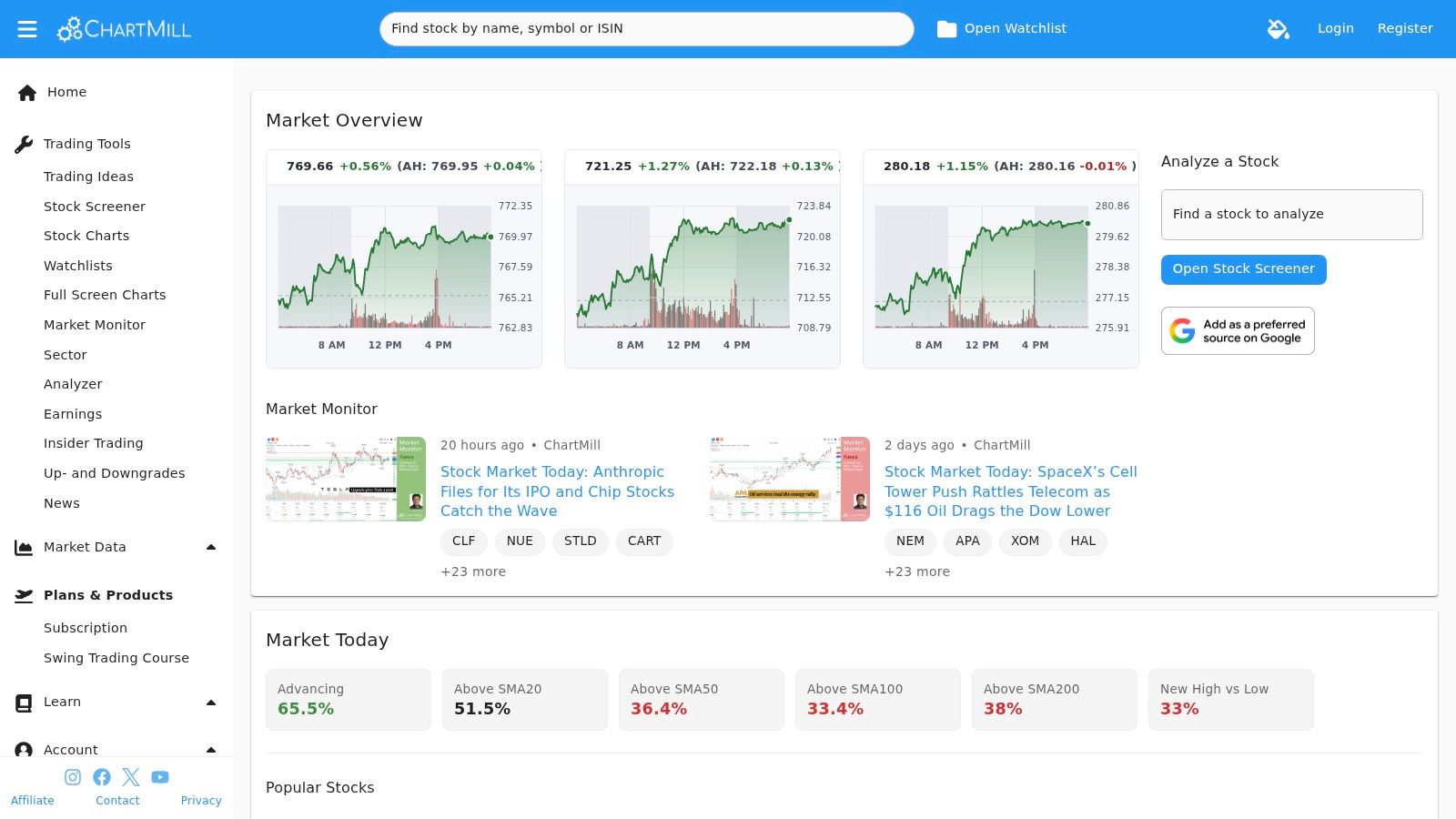
ChartMill is oriented toward trading setups and candidate shortlists. It combines technical and fundamental filters with preset ideas, company analysis, ratings, watchlists, and alerts. That's useful when your question is which securities deserve chart review, rather than which businesses meet a detailed investment mandate.
Start with a preset to understand its logic, then inspect the conditions individually. A pattern-related screen may identify a plausible setup while saying little about valuation, liquidity suitability, or compliance. Add those constraints deliberately instead of assuming the preset includes them.
Research discipline: Keep the reason a stock is eligible separate from the reason you want to trade it.
Market data remains delayed even for subscribers. Paid tool access therefore shouldn't be mistaken for a live execution feed. Check whether the delay is acceptable for your decision horizon before paying for unlimited use.
Ratings need interpretation
Company reports and ratings can help prioritize review, but they shouldn't replace your own definitions. When a rating changes, investigate the underlying price or financial input rather than treating the new score as an instruction.
ChartMill's web-based workflow fits analysts who organize and follow candidates over time. Occasional users should weigh the subscription against how often they'll use alerts and saved workflows.
For halal portfolios, use technical setups only after eligibility has been established. A strong setup doesn't resolve business exclusions or financial-ratio requirements.
9. TIKR
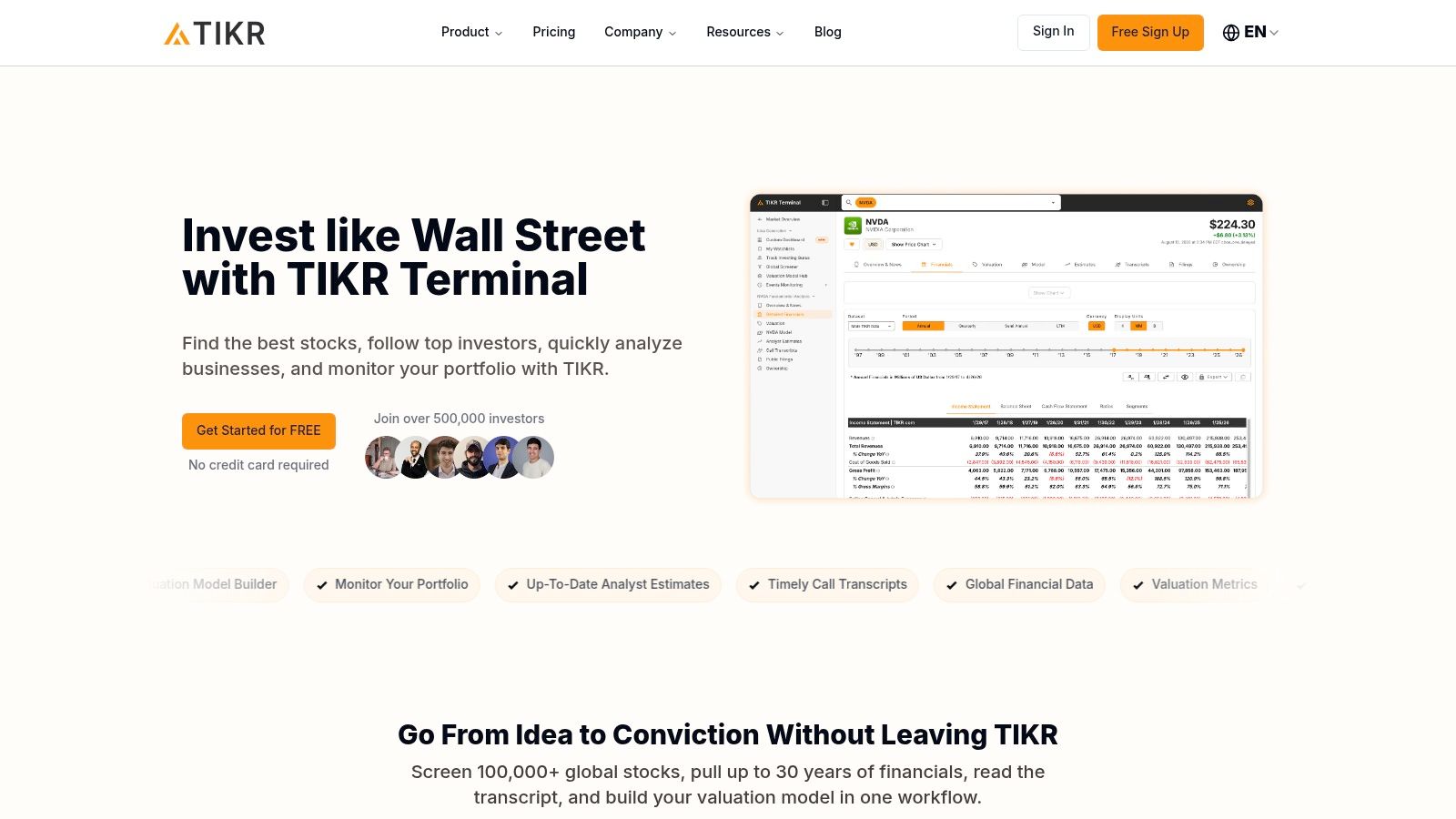
TIKR makes sense when screening is the entrance to detailed company research. Financial histories, analyst estimates, filings, earnings transcripts, and fund-holdings information help an analyst investigate the companies that survive an initial filter.
Its global orientation is particularly relevant to teams comparing international businesses. The access boundary matters, though: the free tier is U.S.-focused, while paid plans provide broader geographic coverage and deeper research.
Use documents to challenge the shortlist
A screen might identify improving margins or unusually low valuation. Filings and transcripts help you examine whether those figures reflect a durable operating change, a temporary benefit, or management expectations that still need testing.
- Strong fit: Fundamental analysts who need supporting documents after discovery.
- Subscription constraint: Geographic coverage, research depth, and saved-screen allowances vary by tier.
- Methodology gap: TIKR doesn't provide standardized Shariah verdicts.
For comparative research, verify company identity and listing details before joining exported results to another dataset. A ticker alone is a weak matching key when companies have multiple listings or share classes.
TIKR is less compelling if you only need a quick basic filter and won't use the documents or financial histories. For an application team, it can support analyst review, but a research subscription shouldn't be assumed to include redistribution rights or a production screening feed.
10. Fidelity Stock Screener
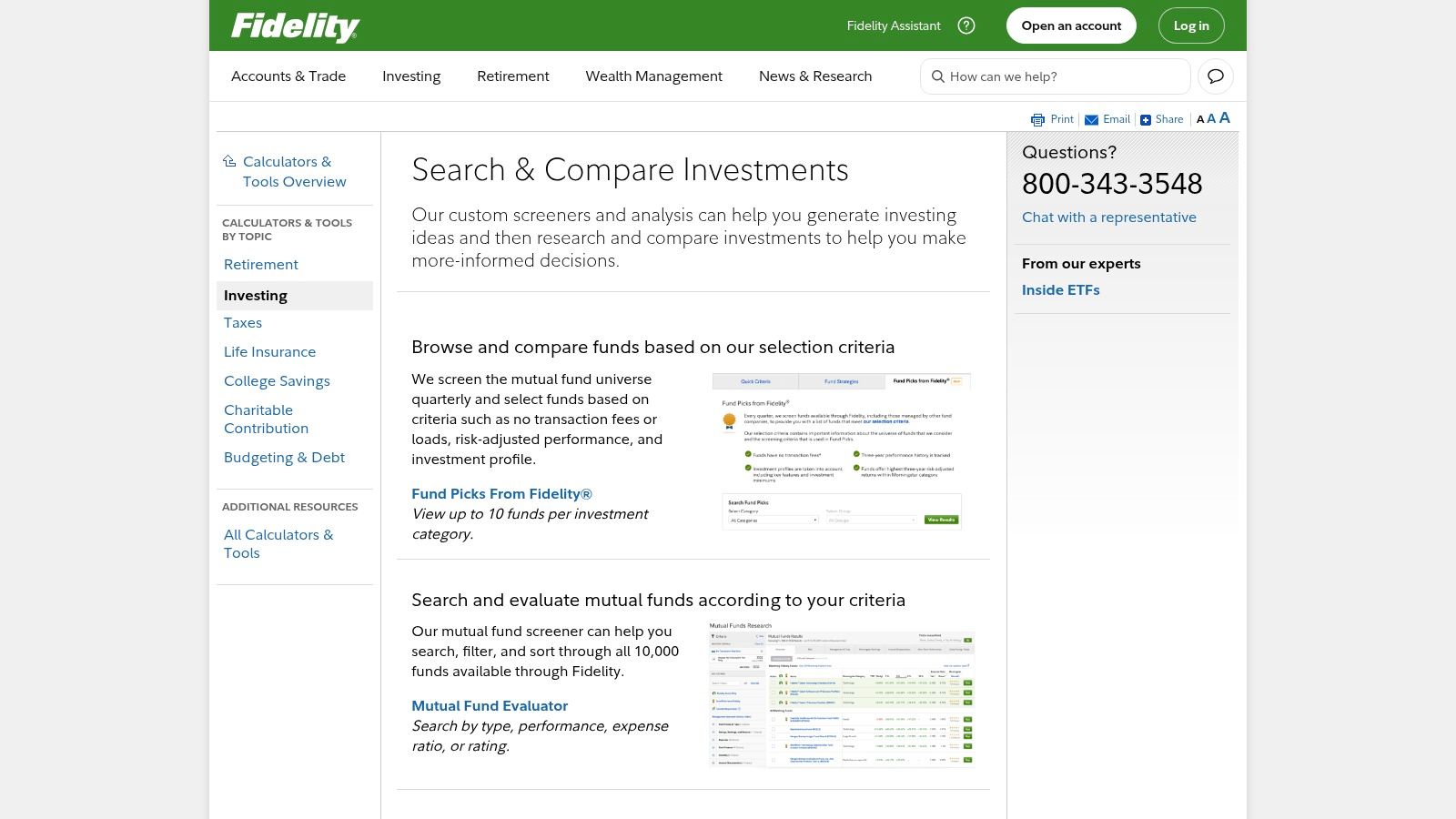
Fidelity's strongest case is convenience for existing customers. Its investment search and comparison tools connect screening with the brokerage's broader stock and investment research environment. Preset and custom criteria let users move from discovery into further investigation without starting in a separate research workspace.
This is a different proposition from a standalone global platform. If your analysts already work within Fidelity, consolidating research may matter more than adding another specialist interface. If you're building a customer-facing screening application, brokerage convenience doesn't answer your integration requirements.
- Useful capability: Sector and analyst-related criteria support conventional stock discovery.
- Access consideration: Sign-in or account access may be needed for some features.
- Verification issue: Third-party data and research require attention to attribution, definitions, and timestamps.
Don't assume that data shown together was produced under a shared methodology. Check the provider and measurement period for analyst-related fields before combining them with financial ratios.
Funds require a different investigation
Stock screening and ETF research shouldn't be treated as interchangeable. A fund's name and stated objective don't establish the current eligibility of its constituents.
For a holdings-level review process, the halal ETF guide explains the questions to resolve. Keep fund selection, constituent assessment, and portfolio suitability as separate decisions, even when a brokerage presents them in one interface.
Stock screener tools at a glance
| Item | Coverage focus | Free access | Shariah screening |
|---|---|---|---|
| Akinda | Stocks and ETFs; coverage figures vary across materials | Limited free tier | Yes; AAOIFI-based, with comparisons across five methodologies |
| TradingView | Global stocks; fundamental and technical filters, charting | Free access; some features and data may be paid | No dedicated Shariah screening |
| Finviz | Primarily U.S. stocks; fundamental and technical filters | Free screener | No dedicated Shariah screening |
| Stock Rover | North American stocks, ETFs, and mutual funds; detailed fundamentals | Free plan and trial options | No dedicated Shariah screening |
| Koyfin | Global stocks and ETFs; market research and analysis | Free tier | No dedicated Shariah screening |
| Yahoo Finance | Stocks and ETFs across multiple regions; custom and preset screens | Free screener | No dedicated Shariah screening |
| Stock Analysis | Global stocks and funds; financials, forecasts, and screening | Free tier | Not a Shariah screening product |
| ChartMill | Technical and fundamental screening, with emphasis on trading setups | No free tier stated | No dedicated Shariah screening |
| TIKR | Global stocks and company research; free tier is U.S.-focused | Free plan | No standardized Shariah verdicts |
| Fidelity Stock Screener | Public stocks with preset and custom criteria | Basic access has no separate screener subscription stated | No dedicated Shariah screening |
Choosing a Stock Screener You Can Defend
Start with the question your screen has to answer. Are you finding investment ideas, checking a shortlist against a specific rulebook, or feeding an application? Those jobs require different evidence, and buying a broader research platform won't automatically solve all of them.
For chart-led discovery, TradingView, Finviz, and ChartMill offer useful routes from filters to visual review. For fundamental investigation, Stock Rover, Koyfin, Stock Analysis, and TIKR connect candidates with deeper company information. Yahoo Finance and Fidelity provide accessible starting points, particularly when their surrounding research environment already fits your workflow.
Test candidates using securities you already understand. Include a straightforward company, a borderline case, a company with incomplete reporting, and a fund whose holdings require investigation. Compare not only which securities appear, but also which disappear and whether the platform explains why.
Verify the result before adopting the workflow
A defensible screen needs more than a saved filter name. Record the universe, criteria, measurement periods, and data status so another analyst can understand the result without reconstructing your intentions.
- Coverage: Confirm the listing, share class, venue, and security type you need.
- Freshness: Separate quote timestamps from financial-statement dates and holdings dates.
- Definitions: Inspect ratio denominators, reporting periods, and missing-value treatment.
- Delivery: Test exports or integration access using the workflow you'll operate.
- Compliance: Preserve the selected rulebook and the inputs supporting the verdict.
Point-in-time records matter when you evaluate a strategy historically. The capital-markets paper using Edgar downloads and Bloomberg attention data describes investors using public signals to decide where to acquire more information. Treat screening in that spirit: it directs investigation rather than completing it.
For Shariah-specific decisions, demand an explicit methodology and distinguish a genuine pass from insufficient information. For funds, inspect constituent weights and the proportion covered by usable assessments. No prohibited exposure found is a different conclusion from no prohibited exposure existing.
Developers should also test changed inputs, unavailable fields, and revised classifications. A prototype that handles only clean results won't adequately explain borderline cases to users.
I'd choose the smallest toolset that supports a traceable decision. Keep discovery, eligibility, and portfolio construction distinct, then connect them with documented inputs. The best stock screener is the one whose results your team can explain, reproduce, and challenge.
Akinda provides Shariah stock and ETF screening through a REST API, with methodology-specific verdicts and supporting financial inputs. Visit Akinda to test your shortlist, inspect holdings-level fund assessments, and evaluate how explainable screening fits your application.