
Your lending app needs to confirm a customer's income, inspect their account history and pay out an approved loan. You don't operate a bank, and you don't want to build banking infrastructure. You need a dependable connection to organisations that already provide those capabilities, plus enough evidence to explain what happened when a customer questions the result.
Table of Contents
- What a Fintech API Is and Why It Matters
- The Main Fintech API Types and What Each Exposes
- Common Use Cases Built on Fintech APIs
- Integration Patterns and the Request Flow
- How to Test Authorization and Abuse Resistance
- How to Score Coverage and Data Quality
- Designing for Explainability and Audit
- Choose and Test a Fintech API Before You Commit
What a Fintech API Is and Why It Matters
A fintech API is a controlled interface that lets software request financial data or actions from a bank, payment processor or specialist provider. Think of it as a service counter for software: the application submits a defined request, presents its credentials and receives a structured answer.
For the lending app, those requests might retrieve account transactions, obtain an identity-check result and initiate a payout. Different providers may handle each operation. Access to their APIs doesn't itself grant permission to lend, hold deposits or perform another regulated activity.
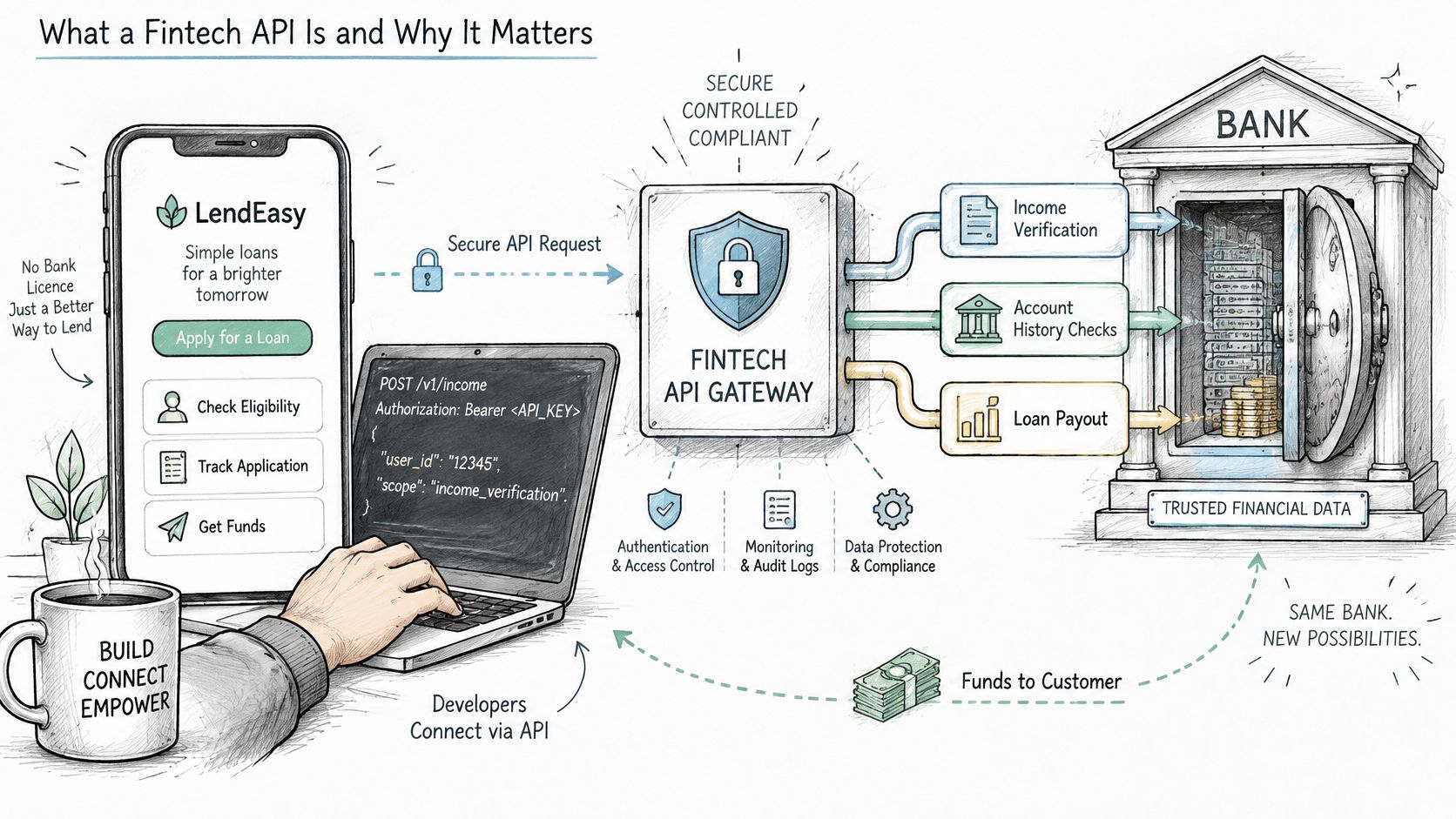
What happens during a request
Many financial APIs use REST-style endpoints, which are addresses for particular resources or operations. Your backend sends an HTTPS request, and the provider commonly returns JSON, a structured format containing named fields and values.
An account response might contain a currency, an available balance and a timestamp. A payment response might contain a payment identifier and a pending status. That distinction matters: successfully submitting a payment request doesn't necessarily mean the recipient has received the money.
An API key commonly identifies your application or account. An OAuth token can represent delegated access, such as permission to read a customer's transactions. Neither should be interpreted as unlimited authority: customer consent, contractual entitlements and server-side permissions still constrain the request.
Practical rule: Read an API response as an assertion with conditions, not as an unquestionable fact.
Why financial interfaces need closer scrutiny
The mechanics resemble an ordinary web API, but the consequences differ. An incorrect weather response might spoil a picnic. An incorrect financial response could produce a rejected payment, expose personal information or influence a credit decision.
Open banking is one important subset of this infrastructure, not a synonym for every fintech API. Juniper Research estimated global open-banking API call volume at 137 billion in 2025 and forecast 722 billion calls in 2029. That forecast describes open banking specifically, not all financial integrations.
For a developer, the useful questions are more concrete than market size. What does the interface expose? Who authorises access? How fresh and complete is the answer? Can you reconstruct the evidence behind a decision after the provider updates its records?
A reliable integration answers those questions before a successful demonstration becomes a production dependency.
The Main Fintech API Types and What Each Exposes
Start with the data you need and the action your product must take, rather than a vendor's category label. The same provider may sell several API families under one contract.
Fintech API types, what they expose and typical use
| API type | What it exposes | Typical use |
|---|---|---|
| Payment initiation | Payment orders and their status from a bank account | Checkout, bill pay, payouts |
| Account information | Balances, transactions and account details, with customer consent | Budgeting apps, cash-flow underwriting |
| Identity and KYC | Document checks, identity matching and sanctions screening | Customer onboarding |
| Card issuing | Virtual and physical card creation and spend controls | Expense tools, card programmes |
| Lending and credit data | Credit bureau scores, income verification and loan offers | Loan origination, buy-now-pay-later |
| Market and reference data | Prices, company filings and financial ratios | Investment research, portfolio tools |
| Currency and transfers | FX quotes and cross-border payouts | Marketplaces, remittance services |
Read by regulatory family, then by bundle
The family helps determine the applicable rules. As Open Banking Limited's account of PSD2 explains, the revised Payment Services Directive took effect in the UK on 13 January 2018, establishing secure access for authorised third parties. Market-data storage and redistribution, by contrast, require careful attention to licence terms.
A product bundle isn't a single dependency. A budgeting tool might combine transaction access, categorisation and card issuing. Map those components separately so you know what breaks when an endpoint disappears or a contract ends.
Identity checks also aren't a complete fraud strategy. MANDATE's resource on browser verification for fraud prevention offers a complementary way to think about the browser presenting a request, distinct from verifying the person's documents.
Common Use Cases Built on Fintech APIs
A consumer sees a spending chart, a loan approval or a portfolio adjustment. Behind that screen, developers coordinate permissions, data retrieval and actions across separate systems.
Open Banking Limited recorded more than 2 billion open-banking API calls in one month and 15 million active users in the United Kingdom in July 2025. These connections already support consumer-scale activity, but each product needs its own failure-handling design.
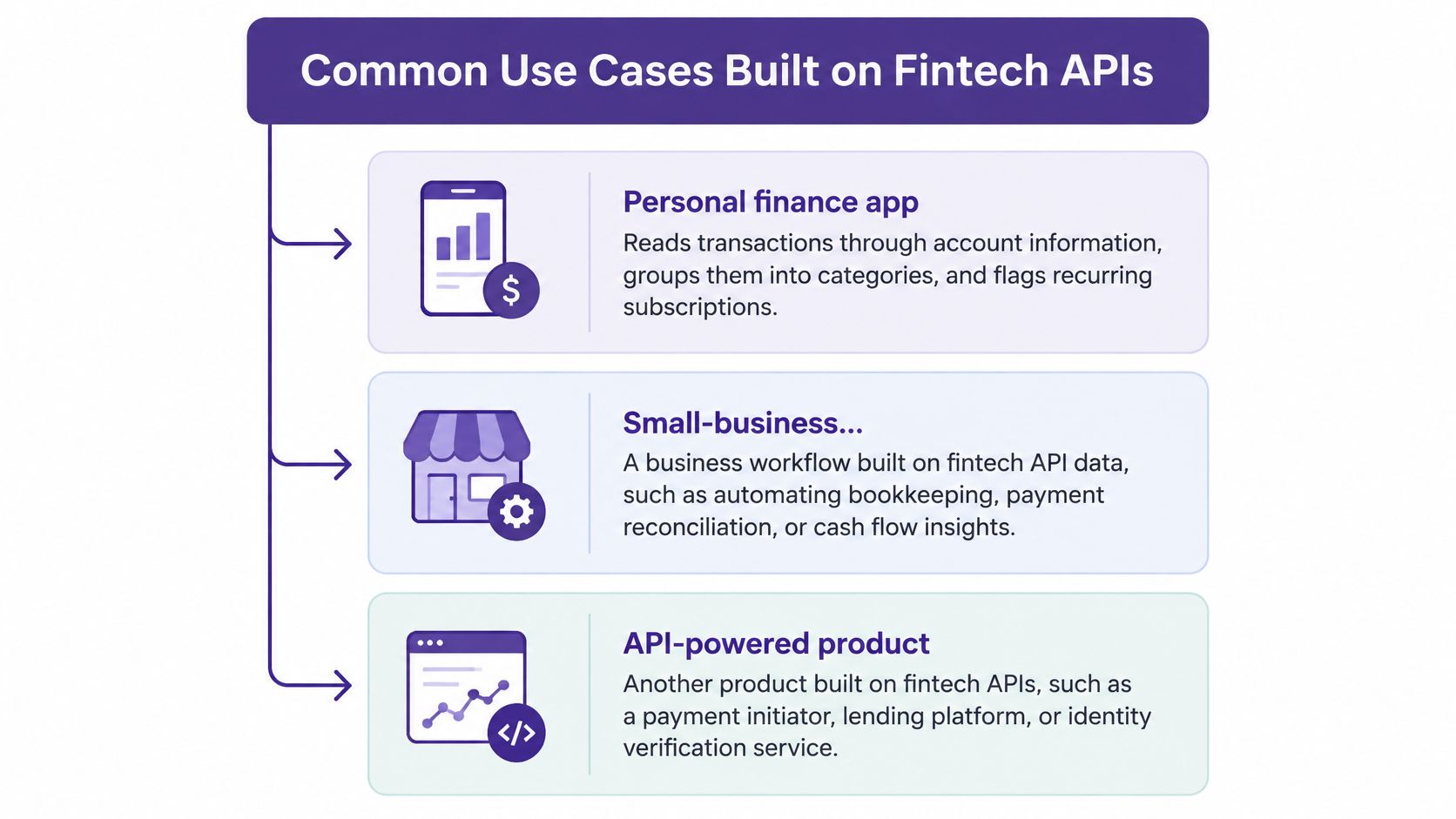
A personal finance app
A customer connects their bank account and permits transaction access. The app retrieves transactions, groups purchases into categories and identifies patterns that could represent recurring subscriptions.
The difficult part isn't drawing the chart. Pending transactions may later settle with different details, merchant descriptions may be ambiguous, and customers may correct categories. Keep the bank's original transaction separate from the app's interpretation, and make a suggested subscription distinguishable from a confirmed recurring commitment.
If the connection expires, retain a clearly dated historical view rather than presenting the old balance as current. A reconnection prompt should explain what stopped updating.
A small-business lender
Say a business applies for working capital. The lender verifies the business's identity, obtains consent to inspect a recent transaction window, calculates cash flow and submits an approved payout.
Each stage needs a different recovery path. An inconclusive identity match belongs in a review queue, while incomplete account history may require additional evidence. A payout with an uncertain outcome needs status reconciliation before anyone submits it again.
Keep the underwriting inputs attached to the application. Otherwise, a later refresh can replace the evidence used to approve or decline it, making the original decision difficult to explain.
A robo-advisor
A robo-advisor retrieves portfolio holdings and market reference data, calculates target allocations and proposes trades. Execution belongs to a brokerage connection, while payment initiation can fund or withdraw from the account; moving money and placing trades aren't interchangeable operations.
For that execution boundary, a brokerage API integration needs its own treatment of order acceptance, fills and account restrictions. A submitted rebalance isn't complete merely because the funding request succeeded.
Before building any of these products, map the workflow explicitly:
- Required evidence: Identify the inputs needed to make the decision.
- Responsible service: Assign each read, calculation and action to its API family.
- Failure outcome: Decide whether to pause, request evidence, retry safely or send the case for review.
- Customer message: Explain what is known, what is pending and what the customer can do next.
The key design choice is where the workflow may safely stop. Don't let a missing input become an invisible assumption.
Integration Patterns and the Request Flow
Choose a connection pattern according to the control you need to retain. This diagram separates the connection choice from the request lifecycle.
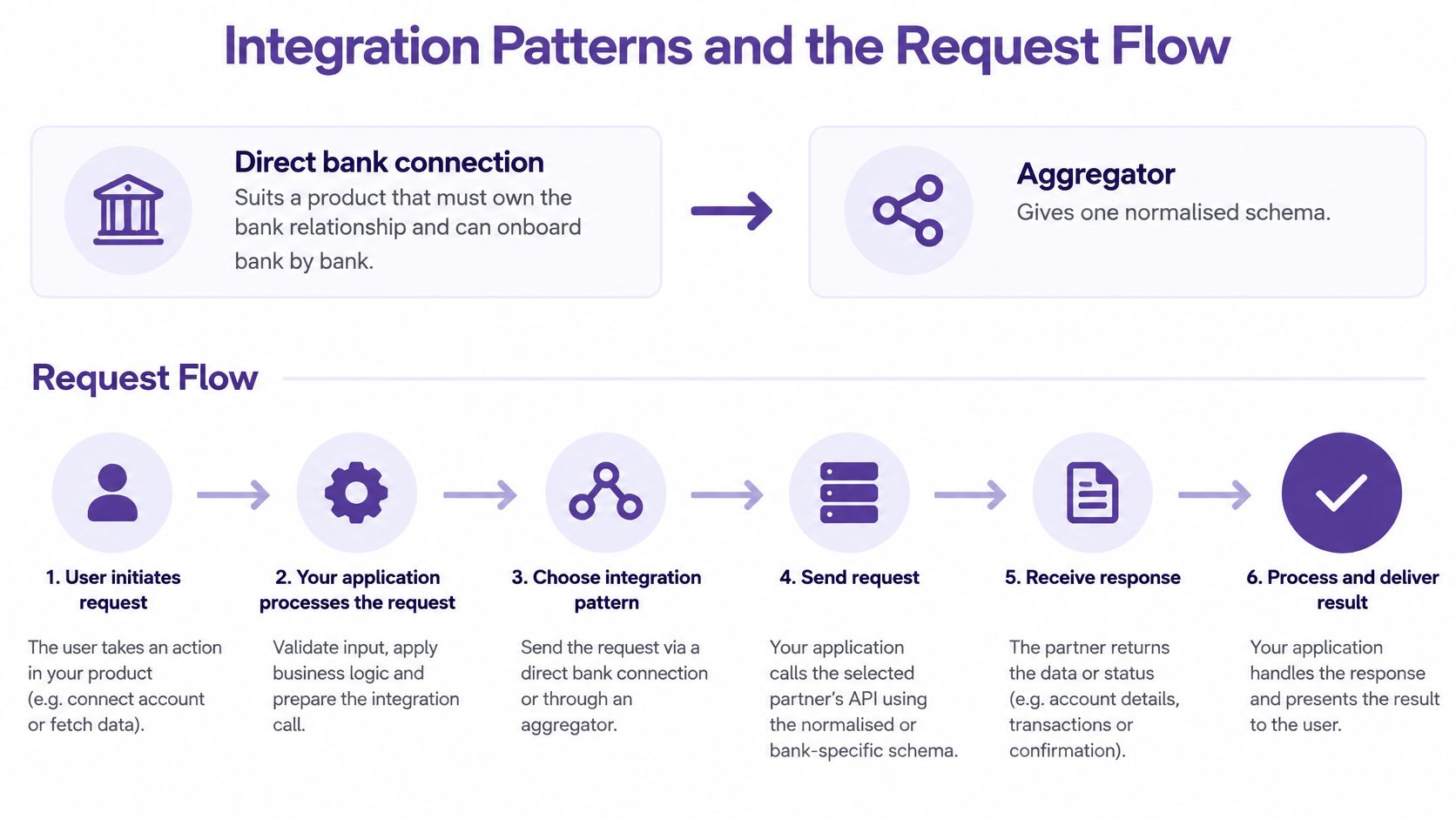
Fintech API integration patterns compared
| Pattern | Who holds the customer | Data you receive | Main trade-off |
|---|---|---|---|
| Direct bank connection | The bank | Account and payment data under open banking rules | Bank-by-bank coverage and onboarding effort |
| Aggregator | The aggregator | One normalised schema across many banks | Extra intermediary and added cost |
| Embedded finance platform | The platform | Accounts, cards and payments through one API | Limited visibility into the underlying bank |
| Data vendor | The vendor | Market, company and reference data | Licence terms and update lag differ by vendor |
The relationship column identifies the connection's principal provider, not an exclusive legal relationship with the end user. Check the contracts for responsibility and data-controller roles.
Build a defensive request lifecycle
OWASP's guidance on unsafe consumption of APIs flags unencrypted connections, unvalidated upstream data, missing resource limits and absent timeouts.
- Provision credentials. Our requests use a single API key, supplied as an
apikeyquery parameter or anX-API-Keyheader. - Prefer the header. Query strings can expose credentials through URL logging.
- Set transport limits. Use TLS, connection deadlines, read deadlines and payload caps.
- Validate responses. Enforce your schema and quarantine incompatible payloads.
- Preserve evidence. Retain permitted raw and normalised records with timestamps under an appropriate retention policy.
- Reconcile changes. Deduplicate webhook events and compare them with authoritative records.
- Bound retries. Apply backoff and jitter, and retry writes only when their semantics make that safe.
MCA Pay's discussion of keeping Texas funder records in sync provides a concrete reconciliation context.
For a visual companion to the request lifecycle, use the following video.
How to Test Authorization and Abuse Resistance
A valid credential isn't proof that a request is allowed. A customer might be correctly authenticated yet still be able to retrieve someone else's report by changing an identifier.
OWASP ranks Broken Object Level Authorization as API1:2023, describing the risk created when endpoints accept object identifiers without checking access to the requested object. Authentication identifies the caller; authorisation must evaluate the particular account, holding, report or action.
Run these tests only in an authorised test environment, using fixtures you control. Agree on load limits with the provider before testing abuse resistance.
Test cross-customer and nested access
Start with separate test customers. Create an account and report for each, then attempt to retrieve one customer's resources using the other customer's credentials. Repeat the exercise for updates, downloads and deletion operations where those exist.
Every prohibited operation must be denied without returning protected fields. Some systems deliberately hide whether an object exists, so the acceptance criterion should focus on denial and absence of disclosure rather than a particular error message.
Then change the parent-child relationship. Request a holding through an account it doesn't belong to, or a report through another tenant's portfolio. The server should validate the entire relationship, not merely check that each identifier exists.
Include list, search and export endpoints. A protected detail endpoint doesn't help if a bulk download exposes the same records.
Test valid actions used in harmful ways
Repeat an otherwise valid operation at an abnormal rate. For a transfer, verify that an idempotency key prevents duplicate execution when the same logical request is retried. Also confirm that a caller can't bypass transaction limits by supplying fresh keys.
For report downloads, test extraction controls rather than assuming payment-style idempotency is appropriate. Rate limits, tenant entitlements and detection of unusual access patterns should constrain automated harvesting.
The Imperva API Threat Report found that 44% of advanced bot activity targeted APIs in its 2025 threat data. That finding supports testing legitimate-looking automation, not just malformed requests.
- Sensitive fields: Request information outside the token's consent or entitlement and confirm it isn't returned.
- Replay protection: Resend captured webhook events and confirm the receiver rejects or safely deduplicates them.
- Audit events: Check that sensitive operations record subject, object, action, tenant and policy result.
- Credential recovery: Verify that rotation procedures include revocation and application cutover.
DevArmor's guide to testing defenses against common API attacks can complement these business-logic scenarios with broader REST API checks.
A successful security test proves that the server refuses a plausible request the caller isn't entitled to make.
Our API key authenticates requests as its owner, should remain server-side and can be rotated from the dashboard if exposed. Don't embed it in a mobile application or browser bundle.
Record the test identity, object identifier, sanitised request, response code and expected outcome. Use a credential fingerprint or fixture name instead of writing live tokens into tickets or test reports.
How to Score Coverage and Data Quality
Coverage is a gate, not a ranking. A provider either supports the institutions, markets and instruments your users need, or leaves a gap your product must handle.
Build a representative evaluation set from permitted accounts or identifiers, including awkward cases such as renamed companies, thinly documented instruments and different account types. Compare the results with an independent source and investigate disagreements rather than automatically treating either provider as correct.
Coverage and data-quality criteria for a fintech API
| Criterion | What to check | Red flag |
|---|---|---|
| Market coverage | Named list of countries, account types and institutions | Only a vague claim of global coverage |
| Endpoint breadth | Read, write and webhook operations your flow needs | Read-only endpoints for a payments use case |
| Freshness | Update frequency and a last-updated timestamp on each response | No timestamp on responses |
| Null versus zero | Whether unknown values return null or a number | Unknown values shown as 0 |
| Provenance | Source document, date and extraction method for each figure | No source reference for any value |
| Versioning | Version header and the notice period before a breaking change | Breaking changes without notice |
| Uptime and latency | Published status history and response-time figures | Uptime claims with no history behind them |
Missing isn't the same as measured zero
Suppose a screening response has no usable figure for prohibited revenue. Returning zero tells downstream software that the provider measured the value and found none. Returning null says the value wasn't computed or isn't available.
Those are different inputs to a decision. Your client should preserve that distinction through database storage, calculations and the interface. A default expression that replaces null with zero can undo the provider's careful handling.
Define a policy for incomplete records: request review, display an unavailable state or withhold a verdict. Don't let a missing denominator produce an apparently favourable ratio.
A stock screener API evaluation also requires separating screening evidence from market prices. Our API does not include real-time stock prices; a product that needs executable or current pricing requires an appropriate market-data source.
Measure freshness against actual events
Retrieve your evaluation set repeatedly over a defined trial period. Compare source dates, retrieval timestamps and changed fields, then inspect records whose underlying filings or transactions changed during that period.
An unchanged record isn't automatically stale. The source itself may be unchanged, so test the delay between a known source event and its first appearance in your integration. Keep source publication time, provider update time and your retrieval time distinct.
Acceptance criterion: A freshness claim is useful only when you can connect it to the source event your product depends on.
Test payload size and latency under representative concurrency, pagination and report depth. A fast summary endpoint doesn't establish that a full-report export will meet your needs.
Before signing, obtain the update schedule, uptime history and breaking-change policy in writing. Record unresolved coverage gaps as product limitations, not engineering tasks you assume the provider will eventually fix.
Designing for Explainability and Audit
A screening result should travel with its reasoning, like a receipt that records what was assessed and how the total was calculated. A model-assisted classification is more than a value extracted from a filing: it reflects a chosen methodology, extracted inputs and applied rules. Retain enough of that chain for another person to review the decision.
The Government Accountability Office's report on AI in financial services discusses reliability and explainability concerns, including how opaque models can hinder independent review and auditability. A confident-looking score does not resolve those concerns.
Keep the decision record together
Store each result with the evidence needed to interpret it:
- Methodology identity: Record the rule set, model version and applicable methodology version.
- Calculation basis: Keep the inputs, units, currency and denominator.
- Evidence snapshot: Preserve source references, filing dates and extraction provenance.
- Limitations: Record population coverage, uncertainty and any human-review status.
For Shariah screening, show which methodology produced the classification. The same company can receive different assessments under different rule sets. Akinda's API presents results under five methodologies, with AAOIFI as the primary one, so a decision record should identify the methodology selected rather than imply that one verdict applies universally.
If methodology version pinning is unavailable, define how a change triggers reassessment, user notification and migration. Treat regulatory reporting as an engineering requirement, not a year-end documentation task. Akinda's overview of regulatory technology and its role in financial services provides related context.
Prove that reconstruction works
Choose a saved decision and rebuild its inputs from the stored record without calling the provider again. Reproduce the arithmetic where possible, and distinguish calculations that can be repeated from model inferences that require separate validation.
If reconstruction fails, the result is a lower-trust input until the record contains adequate evidence. Keep the inputs, source references and methodology together so reviewers can see not only the verdict, but how it was reached.
Choose and Test a Fintech API Before You Commit
Choose the provider that passes your acceptance gates, not the one with the most endpoints. Use this selection sequence to turn a promising trial into a documented decision.
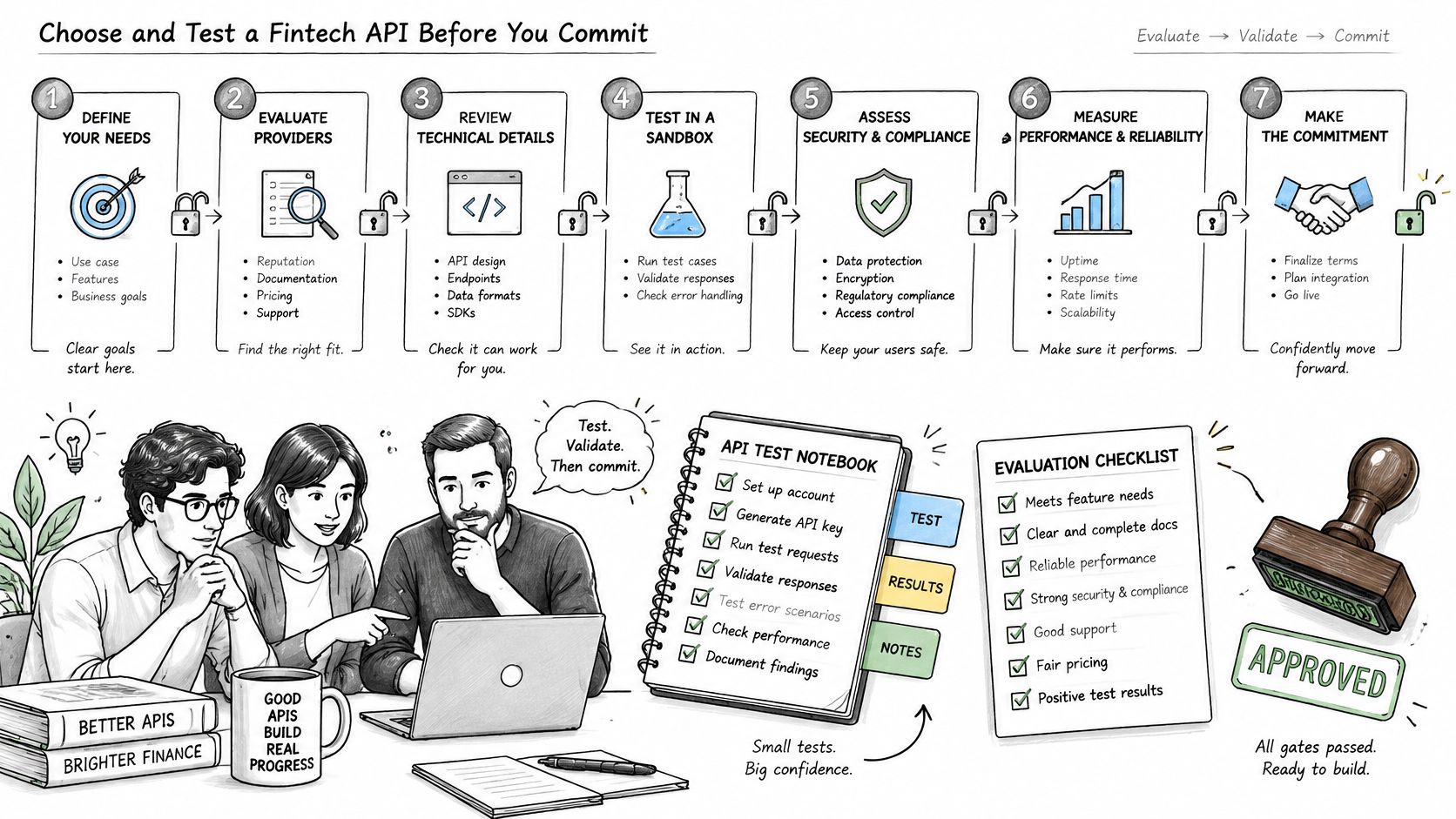
- Name the deliverable. Identify the response field your product needs. Pass when its meaning and allowed states are unambiguous.
- Check functional fit. Match required reads, writes and notifications to documented operations. Reject missing essentials.
- Assign responsibilities. Choose the connection pattern and document who handles consent, support, reconciliation and incidents.
- Capture a staging baseline. Run representative requests and retain timestamped responses. Pass when results can be compared across later runs.
- Require isolation. Complete cross-customer, nested-resource and abuse tests. Any unauthorised disclosure stops the evaluation.
- Approve evidence quality. Check coverage, missing-value behaviour and provenance against independent references. Document exceptions with an owner.
- Pilot reversibly. Release to a limited user group with monitoring and a feature switch that can disable the integration without a deployment.
Match scale without relaxing the gates
Our integration approach uses the same JSON shape for a single founder's halal portfolio app and a multi-desk bank's Shariah trading product. That consistency doesn't replace workload-specific testing, operating procedures or contractual review.
Request written operational commitments before signing, and make unresolved issues explicit acceptance decisions. The final question is simple: Can I explain every value my product shows a user and trace it to its source?
Akinda offers Shariah stock and ETF screening through an API, with reports and methodology data that help developers build traceable investment decisions. Visit Akinda to explore the documentation and test representative screening responses against your product's coverage, evidence and integration requirements.