
Most guides treat the S&P 500 Shariah as a finished halal list. Buy the screened index, they say, and every name inside it is safe under every rulebook. That advice breaks the first time two serious screens disagree on the same ticker.
A company can clear one published standard and miss another on identical filings. The gap is usually the arithmetic, not a mistake by either provider. Debt sits in the numerator. Some average of market value sits in the denominator. Move the share price, and the ratio moves even when the balance sheet does not.
If you ship a halal portfolio, a robo-advisor, or a research dashboard, a binary badge hides that math. What follows walks the two gates, the thresholds that get tested, and a worked ratio that shows how a price move alone can flip a verdict.
Table of Contents
- How the S&P 500 Shariah Screen Works
- Thresholds Across the Major Shariah Methodologies
- Why the Same Company Gets Different Verdicts
- How Price Moves Flip a Verdict Over Time
- Constituent Counts Change Over Time
- Choose a Methodology Before You Trust a Label
- How to Screen an S&P 500 Company Yourself
How the S&P 500 Shariah Screen Works
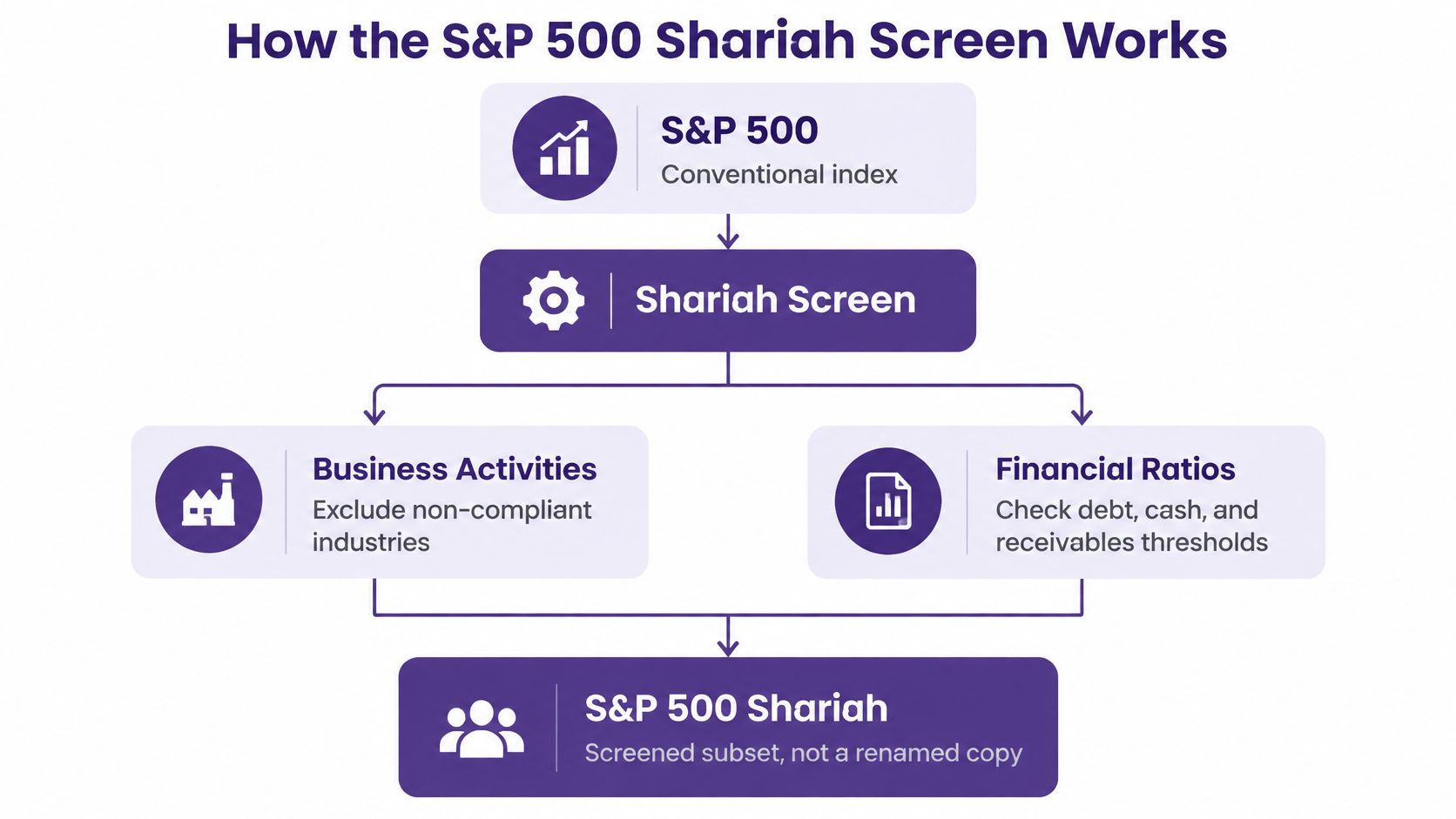
The S&P 500 Shariah is a screened subset of the conventional S&P 500, not a renamed copy. Eligibility depends on business activities and on financial ratios, so the investable universe can differ materially from the parent benchmark. The index was launched on December 19, 2006. In a comparison cited by S&P Dow Jones Indices, Shariah screening retained 266 of the 503 companies in the S&P 500, only slightly more than half at that measurement date. The parent benchmark represents approximately 500 leading U.S.-listed companies and about 80% of U.S. equity-market capitalization.
Two gates in order
Think of airport security. The activity gate comes first, and it is decisive on its own. A company is excluded when its primary activity is alcohol, gambling, tobacco, pork-related products, or conventional financial services, whatever the balance sheet looks like. No debt ratio rescues a conventional bank. Only companies that clear that gate reach the accounting tests.
Stage two applies accounting filters to debt, cash and interest-bearing securities, and revenue from prohibited activities. A company must pass every test. Failing one is enough. A permissible core business with a heavy interest-bearing debt load still drops out. So does a clean balance sheet paired with too much prohibited revenue.
The same two-gate logic shows up in other long-running Islamic benchmarks, including the Dow Jones Islamic Market construction. Faith-based rules do not relabel a national large-cap market. They rebuild the exposure.
- Activity first: Stop if the core business is prohibited.
- Each ratio next: Test debt, cash and interest-bearing securities, then prohibited revenue.
- Record the failure: Write down which test failed, not only a pass or fail flag.
Thresholds Across the Major Shariah Methodologies
| Methodology | Debt line | Denominator to check before the percentage |
|---|---|---|
| AAOIFI Shari'ah Standard No. 21 | below 30% | 12-quarter average market capitalisation |
| S&P Shariah | below 33% | average market value of equity |
| Dow Jones Islamic Market | index-specific cap | that rulebook's denominator and averaging window |
| FTSE Shariah | index-specific cap | that rulebook's denominator and averaging window |
| MSCI Islamic | index-specific cap | that rulebook's denominator and averaging window |
Read the AAOIFI row as a hard line. Interest-bearing debt below 30% of the 12-quarter average market capitalisation passes. A ratio of 31% fails, however close the company sits to the line. There is no rounding courtesy and no “almost halal” bucket in the standard itself.
The S&P Shariah row uses a different yardstick. It measures debt, and certain interest-bearing assets, against an average market value of equity, with the debt ratio line at below 33%. A company at 31% of that average can pass this row and fail the AAOIFI row on the same filings. Closeness is not compliance.
The three index rows are not blank spaces to be filled with the AAOIFI or S&P number. Dow Jones Islamic Market, FTSE Shariah and MSCI Islamic each set their own cap inside their own rulebook, and the four index rulebooks each have their own denominator, thresholds and business exclusions. That is why a single percentage copied across methodologies misleads.
How to read any row
- Find the denominator first. Market capitalisation and market value of equity are not interchangeable labels.
- Then find the averaging window. A short window and a long window do not smooth the same shocks.
- Only then read the threshold. A 30% cap and a 33% cap answer different questions.
A methodology name without its denominator, window, and threshold tells you almost nothing.
Why the Same Company Gets Different Verdicts
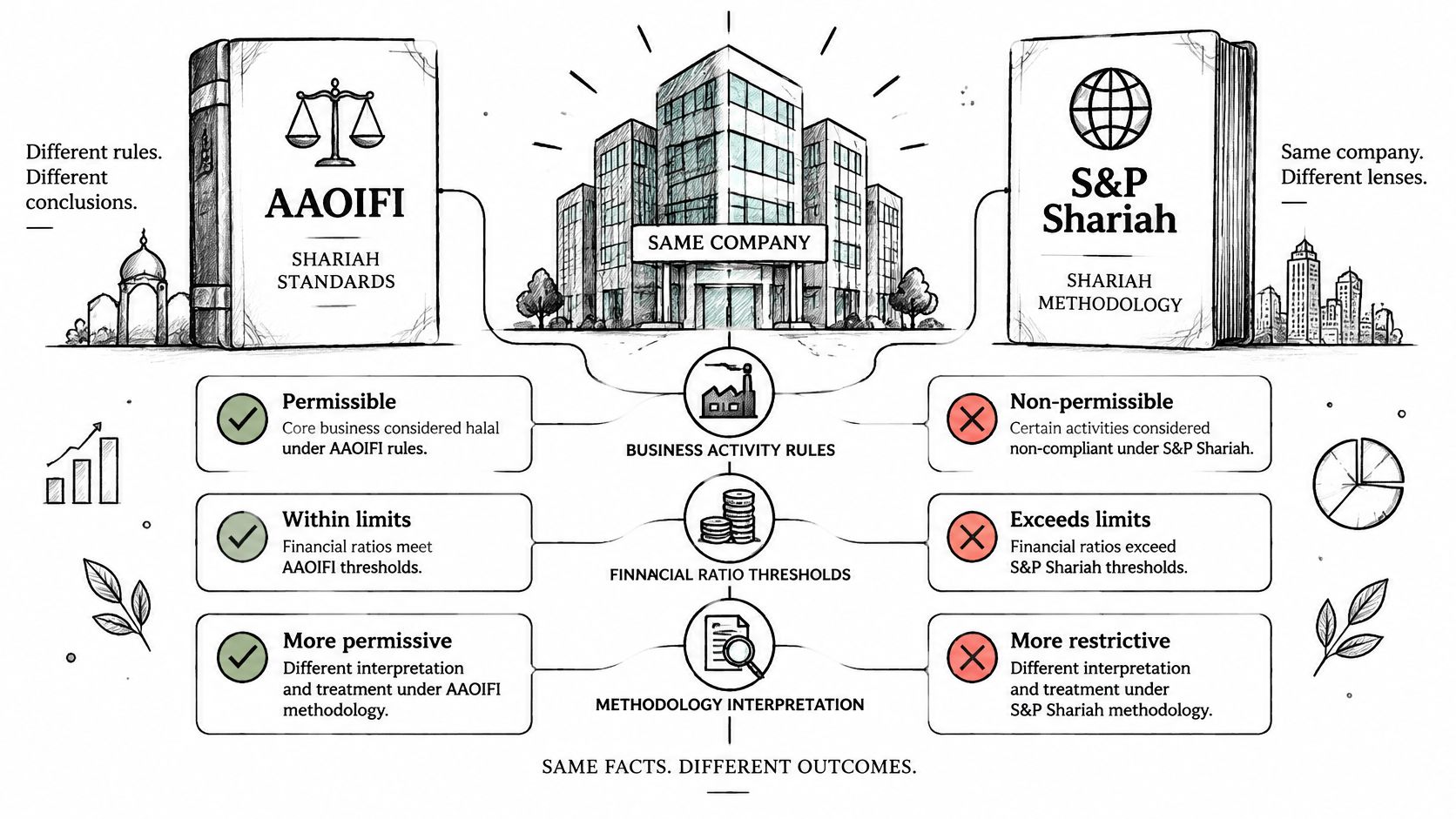
One halal label is not universal. Disagreement between rulebooks is expected. It is not, by itself, evidence that either side misread the filing. The S&P Shariah Indices methodology uses debt and certain interest-bearing assets relative to an average market value of equity, and its methodology materials describe a 36-month average for key financial tests. Compliance is assessed monthly, so classification can change as statements and market capitalization move.
Three causes, not one data error
The denominator comes first. AAOIFI-aligned screening tests interest-bearing debt against a market-capitalisation average. S&P tests debt and interest-bearing assets against average market value of equity. A volatile share price can put the same issuer on opposite sides of a 30% line and a 33% line.
The window is the second cause, and it is easy to misread. AAOIFI's 12-quarter average and S&P's 36-month average both span three years, so window length is not what splits them. What is averaged, and the cap applied to that average, is what splits them.
Cash, securities, and revenue rules are the third cause. Frameworks do not treat interest-bearing assets or prohibited revenue the same way. A stock can fail because market value falls even though debt has not increased, since the ratio rises mechanically.
A verdict is only as comparable as the rulebook behind it.
Say Company A shows a debt ratio of 31% of average market value on one set of filings. It fails an AAOIFI test capped below 30%. It passes an S&P test capped below 33%. Neither app "got the filing wrong." They applied different numerators' companions and different caps. When two apps disagree, compare the denominator first, then the window, then the threshold.
A static halal or non-halal list hides that path. For a screening API or a research desk, the useful display is parallel outputs, the numerator, the denominator, and a flag when the ratio sits near the line.
How Price Moves Flip a Verdict Over Time
S&P Shariah screening uses market-value-based accounting denominators, so equity prices feed the ratio directly. The financial tests compare total debt, cash and interest-bearing securities with an average market value of equity, and the debt line sits below 33%. Reported debt can stay flat while the verdict changes.
Read the last row of this hypothetical first. Debt is in USD millions. The ratio is debt divided by average market value. The last row is the clean split: one issuer, one filing, two answers.
| Scenario | AAOIFI (below 30%) | S&P (below 33%) |
|---|---|---|
| Base. Debt 8,700. Average market value 30,000. Ratio 8,700 / 30,000 = 29.0% | Pass | Pass |
| Share price down 20%. Debt still 8,700. Average falls to 24,000. Ratio 8,700 / 24,000 = 36.3% | Fail | Fail |
| Debt up 10% to 9,570. Average still 30,000. Ratio 9,570 / 30,000 = 31.9% | Fail | Pass |
What each row is doing
In the base case, 8,700 divided by 30,000 is 0.290. Both caps clear.
Price is the moving part. A 20% drop does not touch the debt stock, but it shrinks the average from 30,000 to 24,000, so 8,700 / 24,000 = 0.3625, or 36.3%. Both caps fail. A rising price does the opposite: it fattens the denominator and can pull a failing name back under the line without any repayment.
The third row is the divergence. Debt rises by 870, from 8,700 to 9,570, while the average stays 30,000. Then 9,570 / 30,000 = 0.319, or 31.9%. That fails a cap below 30% and passes a cap below 33%. The balance-sheet change is modest; the rulebooks still disagree.
Between review snapshots, a name can change classification before the product mix changes at all. Point-in-time copies also break when the statement date, the price window and the review date are not the same day. Keep the methodology version, observation date, denominator and raw inputs on every row; teams maintaining an audit-ready verdict-change history cannot reproduce a flip from a binary flag alone.
Store the date: A verdict without its observation date cannot be rerun.
Constituent Counts Change Over Time
The S&P 500 Shariah list changes as screening results, market capitalizations and corporate actions change. A count is only valid for the review that produced it. For the date that matters to a portfolio or an audit, use the index's published constituent list for that same date rather than an older snapshot.
The count can move even when the parent S&P 500 looks stable. A company can leave after debt, cash, interest-bearing assets or prohibited revenue exposure crosses a threshold. It can also lose index weight before it loses eligibility, because the index is float-adjusted market-capitalization weighted. Passing the screen does not give every survivor equal influence. Larger companies with more publicly tradable value pull the benchmark harder, so two portfolios holding the same names can still diverge if one equal-weights and the other follows float.
Weight and the review cycle
A compliance breach and an index membership change are related, not identical. The screen can fail on the numbers, while the constituent list changes when the index applies its update. That timing gap is why a saved list can be right for one observation date and wrong for the next.
- Date-stamp every snapshot. A constituent file is a picture of one review, not standing membership.
- Rebuild the list each cycle. Activities and ratios can both move before the next update.
Those count changes are the portfolio-level result of the same denominator moves that flip a single issuer. Sector mix shifts with them. Conventional banks and insurers are screened out at the activity stage, so a Shariah version usually carries less financial exposure than the conventional benchmark even when its headline count looks close. Other industries can still drop at the ratio stage when balance sheets move. Compare sector weights only after fixing the review date, the denominator rule and the constituent list.
Choose a Methodology Before You Trust a Label
Pick the rulebook before you print the word halal. If your users, regulator, or client expect a named standard, apply that standard and put its name on every verdict. If you serve several audiences, show parallel outputs so a reader can see where the rulebooks split. If you must defend a verdict, keep the raw figures, the denominator, the methodology version, and the observation date with the result. On our API, every halal verdict maps back to a documented Shariah rule and the exact numbers that decided it.
- Name one primary standard on every label. AAOIFI Shari'ah Standard No. 21 and S&P Shariah are not synonyms. Say which one the product uses.
- Retest the borderline cases side by side. Run Company A, the 31.9% debt-increase case, and the 36.3% price-drop case under each standard you claim to support.
- Log every split before you publish. If two verdicts differ, the note should say whether the denominator, the window, or the threshold caused it. Do not ship the label until that sentence exists.
A published verdict is defensible only when the reader can see which rule produced it. Anything less is a badge, and badges do not survive a second methodology.
How to Screen an S&P 500 Company Yourself
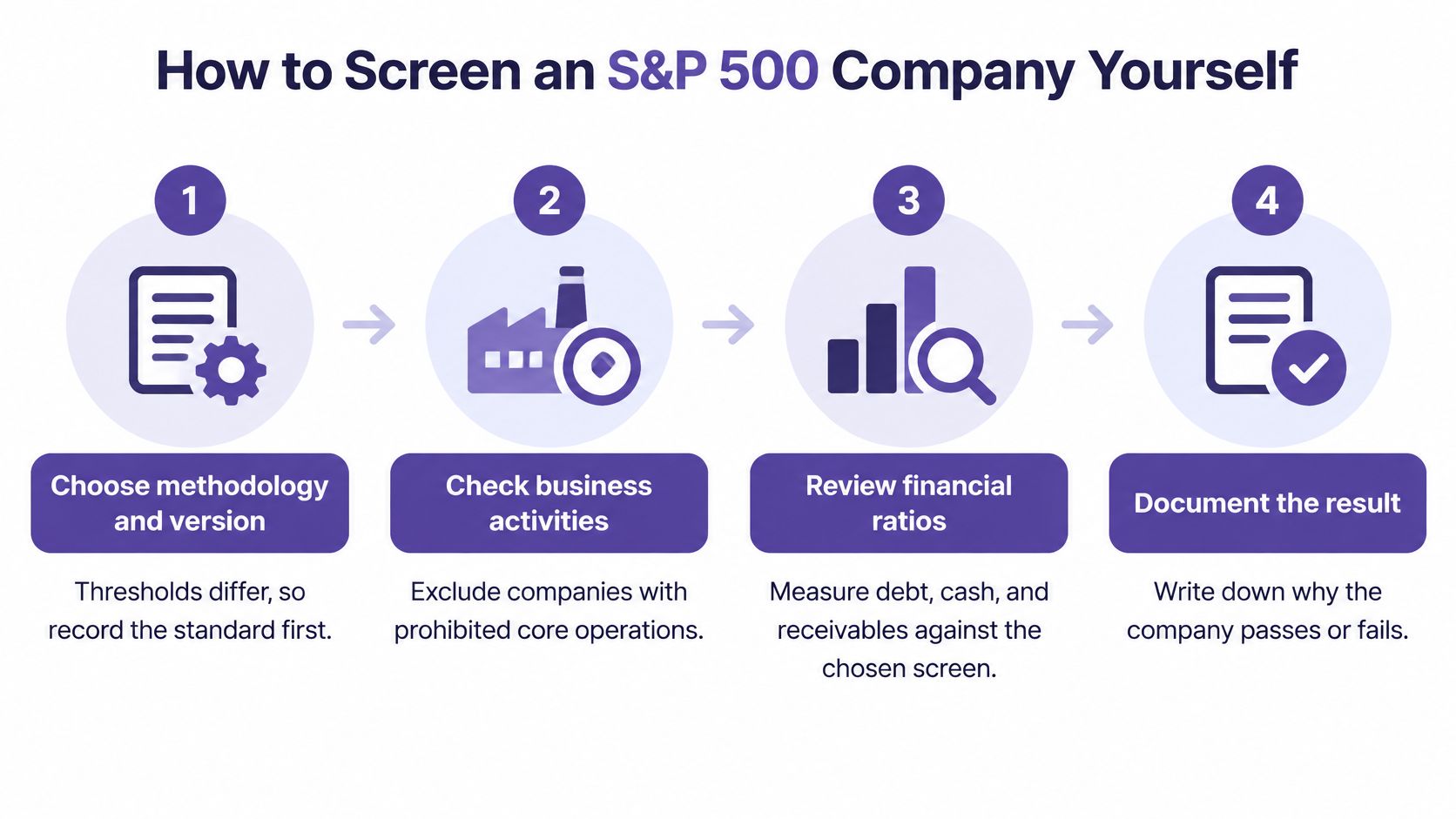
You can reproduce a verdict with filings and a price history. The order matters more than the spreadsheet. For a fuller walkthrough of a single-name check, see how to check if a company is Shariah compliant.
- Choose and record the methodology and version. Write "AAOIFI Shari'ah Standard No. 21" or "S&P Shariah" on the sheet before any ratio. Thresholds differ, so a number without a rulebook is not a verdict.
- Run the activity screen on segment revenue. If a core business is prohibited, stop. No debt ratio repairs alcohol, gambling, tobacco, pork, or conventional financial services as a primary activity.
- Collect interest-bearing debt from the latest annual filing. Use that methodology's debt definition, including the items it adds, such as certain leases, and the items it leaves out.
- Build the market-value history for that methodology's window. Average only the observations the rulebook names. Do not substitute today's price for a multi-period average.
- Divide. Debt, then cash and interest-bearing securities, each divided by the denominator that methodology specifies. Quote the ratio to one decimal so a 29.6 and a 30.4 cannot be confused.
- Measure non-compliant revenue against the revenue limit in that same rulebook. A small prohibited slice can still fail the issuer after the balance sheet has passed.
- Flag anything within two percentage points of a cap. Note which input moved, debt, cash, revenue mix, or the share price inside the average. That is your borderline file.
- Store inputs, observation date, methodology version, and verdict. Rerun at each new filing and at each index rebalance. A saved flag from last quarter is not evidence about this quarter.
Holding an S&P 500 ETF does not replicate the Shariah benchmark. As the S&P 500 Shariah index description makes clear, the screened index is a float-adjusted subset whose names and weights follow the rules. Unless you screen constituents and rebalance weights the same way, the ETF is a different portfolio.
Akinda screens stocks and ETFs under AAOIFI Shari'ah Standard No. 21 and returns parallel verdicts for Dow Jones Islamic Market, FTSE Shariah, MSCI Islamic, and S&P Shariah, including the ratios behind each call. If you are building a halal portfolio app, a broker product, or a research screen, that is the difference between a badge and an auditable rule. See how the endpoints work at Akinda.