Is Bitcoin halal? A 2026 breakdown of crypto and Shariah compliance
The scholarly debate on Bitcoin and crypto is real, but not unresolved. Here's the 2026 picture, the AAOIFI position, and how we treat it on the API.
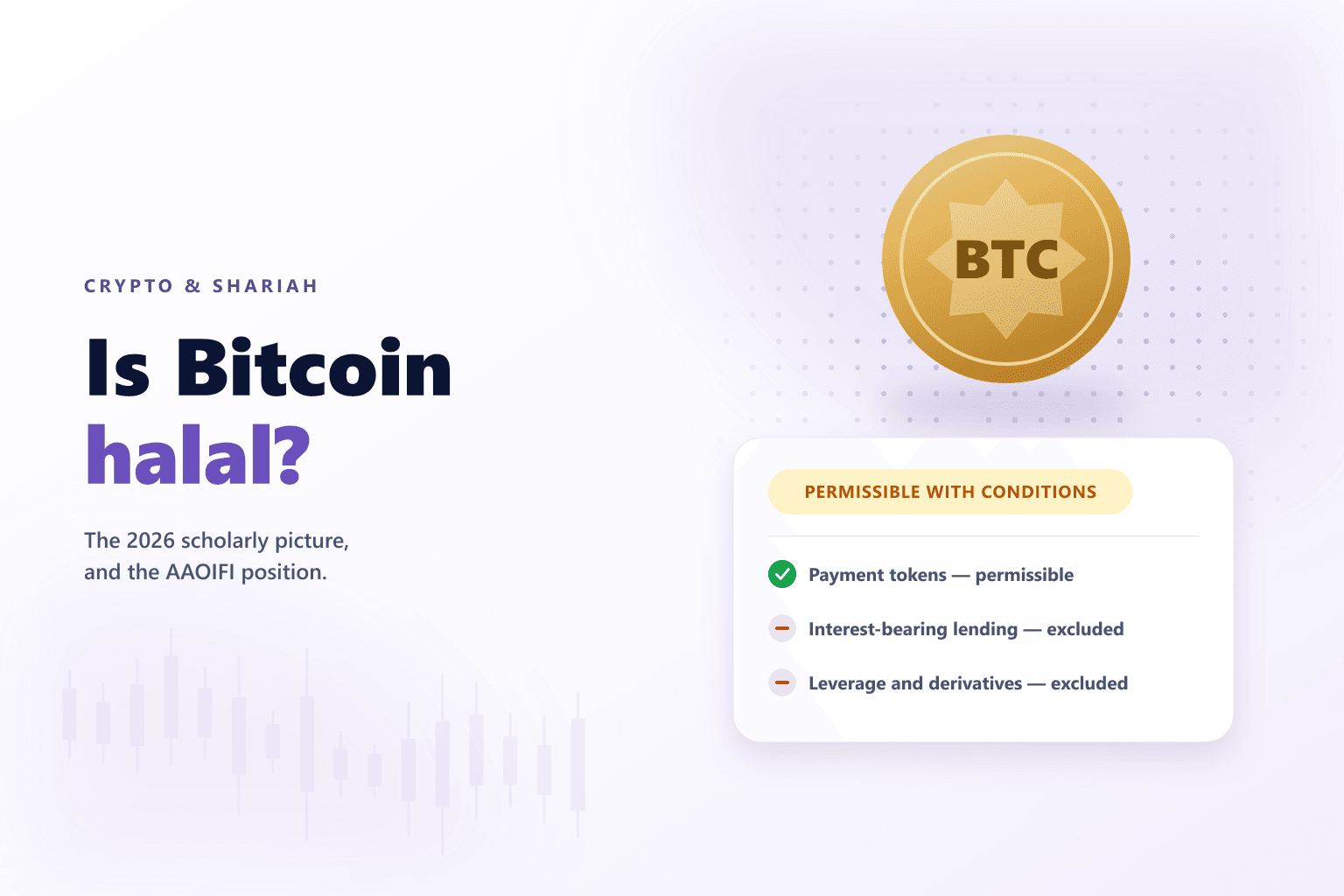
Is Bitcoin halal? It's the most-searched halal-investing question of the last five years, and the short answer in 2026 is: the scholarly debate is real, the rulings are published, and the practical position most major Shariah boards have arrived at is “permissible with conditions ” — not the categorical haram some early opinions suggested.
Where the scholarly debate sits
The debate hinges on three classical-fiqh questions: is Bitcoin maal (recognised property)? Does it carry mithliyya (fungibility) and a stable enough thaman (medium-of-exchange quality)? And is its use free of riba, gharar (excessive uncertainty), and maysir (gambling)?
By 2026 the dominant published view from scholars working in AAOIFI-adjacent frameworks — Mufti Faraz Adam's work, Mufti Taqi Usmani's published opinions, and the collective fatwas of bodies like the Shariyah Review Bureau — converges on Bitcoin being a recognised form of property and a permissible medium of exchange in itself, with derivatives, futures, and leveraged trading remaining problematic.
The AAOIFI position
AAOIFI has not issued a single “crypto” standard as of 2026. The closest formal touchpoint is Shari'ah Standard 21 (Financial Papers), which deals with how to treat digital instruments, and the ongoing AAOIFI working-group consultations on digital assets. The functional rule that emerges:
- Spot ownership of major cryptocurrencies (Bitcoin, Ethereum) — permissible, subject to the same general rules that govern fiat currency exchange (immediate delivery, equivalent counter-value, no riba).
- Margin trading and leveraged crypto — not permissible (riba on the borrowed leverage).
- Futures and perpetual contracts — not permissible (gharar + non-delivery).
- Staking and yield products — case-by-case, depending on whether the yield is genuine network participation or disguised interest.
How the Akinda API treats crypto today
The current API surface (/compliance, /basic-report, /full-report) screens publicly-traded equities — meaning the AAOIFI methodology described on our methodology page is applied to listed stocks, not directly to spot crypto. However, companies whose business model is operating crypto exposure (mining operators, exchange equities, custody platforms) ARE in scope and get screened like any other equity.
So while you won't get a halal verdict for the BTC token itself from /full-report/BTC (that endpoint isn't served), you can ask the API about /full-report/COIN (Coinbase), /full-report/MARA (Marathon Digital), or /full-report/MSTR (Strategy) and get the AAOIFI-screened picture for that equity exposure.
Practical takeaway
Verify it yourself via the Akinda API
Fire a live /full-report/<ticker> call from the playground using your own API key — see the compliance ratios, AAOIFI screen verdict, and source-breakdown fields the methodology produces.
Related reading